To write about Abraham today would appear to be a peculiar, if not absurd, undertaking. How can an ancient figure, enveloped in the fog of mystery and (in the opinion of today s cynical man) myth, fascinate the imagination and vision of modern scholars and preachers? They confront innumerable problems of enormous magnitude and force, and face situations which captivate their fantasy with both greatness and perplexing tragedy. Why should they investigate and probe a person who emerges from the unknown historic twilight, whose contours and features are blurred and almost imperceptible to the onlooker, while there is a world full of marvels, light, and charm that wink at and tantalize us? Why watch a bubble riding on the crest of a wave disappearing at the distant horizon, while a mighty tide rolls on toward us and breaks at our feet Excerpt from Abraham s Journey.
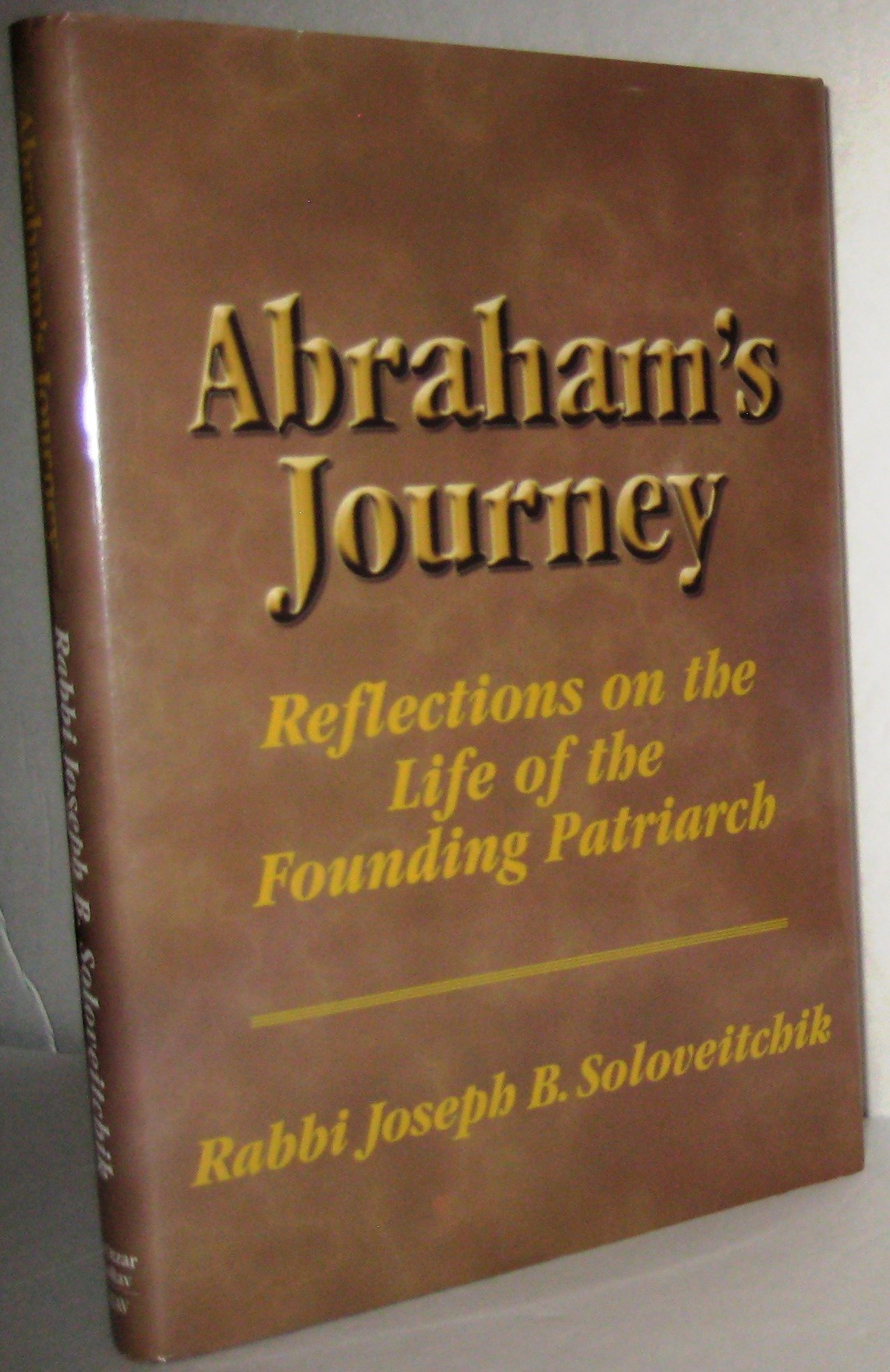
Abraham's Journey: Reflections on the Life of the Founding Patriarch focuses on the life of Avraham Avinu, founding patriarch of the Jewish People. Abraham was not only the first Jew, but also a historical prototype, his experiences and actions foreshadowing critical patterns in the history of his people. In addition, Abraham serves as a spiritual and ethical model to his descendants. He is a teacher, a paragon of kindness, a lonely iconoclast, a master of sacrifice, and a knight of faith. Through careful exegesis of verses, illuminating analyses of character, and insightful readings of classical commentators, the essays in this book seek both the eternal and the contemporary messages of the Abraham story.
Abraham s Journey is the ninth volume in MeOtzar HoRav: Selected Writings of Rabbi Joseph B. Soloveitchik.
Abraham's Journey
Reflections on the Life of the Founding PatriarchBy Joseph B. SoloveitchikKTAV Publishing House, Inc.
Copyright © 2008 Toras Horav Foundation
All right reserved.ISBN: 978-1-60280-004-5Contents
Preface...................................................................ixIntroduction..............................................................xiAbraham as Personality and Paradigm.......................................1From Adam to Abraham: The Fall and Rise of Monotheism.....................19Go Forth from Your Land...................................................49A Wandering Aramean.......................................................73Abraham the Teacher.......................................................90Partnerships Fulfilled and Frayed.........................................113The War Between the Kings.................................................126An Eternal Covenant.......................................................136The Visit.................................................................159From Generation to Generation.............................................184Index of Topics and Names.................................................205Index of Biblical and Rabbinic Sources....................................218
Chapter One
Abraham as Personality and Paradigm
Experiencing History
To write about Abraham today would appear to be a peculiar, if not absurd, undertaking. How can an ancient figure, enveloped in the fog of mystery and (in the opinion of today's cynical man) myth, fascinate the imagination and vision of modern scholars or preachers? They confront innumerable problems of enormous magnitude and force, and face situations which captivate their fantasy with both greatness and perplexing tragedy. Why should they investigate and probe a person who emerges from the unknown historic twilight, whose contours and features are blurred and almost imperceptible to the onlooker, while there is a world full of marvels, light, and charm that wink at and tantalize us? Why watch a bubble riding on the crest of a wave disappearing at the distant horizon, while a mighty tide rolls on toward us and breaks at our feet?
The historian will say that Abraham cannot be considered an archaeological reality, since, measured by the conventional standards of historical evidence, we cannot assert as a certainty that such a person lived and acted in the way the Bible describes. Many a Bible critic, Jew or gentile, casts serious doubt upon the authenticity of the narrative about this strange and unique man. No inscriptions or other pieces of documentary evidence have been discovered that mention even once the name of the patriarch. Perhaps Abraham is nothing but a myth, a legend, a vision of a tribe or a clan that assigned to its progenitor the role of God's fellow-companion and recorded out of this fantasy the dialogues and arguments, tribulations and joyous moments, of that imaginary figure.
As a matter of fact, this sort of skepticism regarding the biblico-historical accounts has, of late, lost much of its vigor and arrogance. Recent excavations and discoveries have confirmed many biblical accounts-not only in their general outlines but, more important, in their minute details, such as names of geographic places, travel routes, and cultic forms. Historians have begun to look upon the Bible as a book replete with historically true records. Excavations in the Negev have unearthed a rich civilization reminiscent of the biblical narratives concerning the economic and cultural surroundings in which Abraham lived and worked. In a word, the fury of the historian-the passionate seeker of truth-against the "Abraham myth" has abated. One will think twice nowadays before denying the existence of such a person.
To us, this problem is almost irrelevant. We need no evidence of the historical existence of our patriarch, just as there is no necessity for clear-cut logical evidence concerning the reality of God. The immediacy and aboriginal impact of our God-experience, cutting through all levels of existence and forming the very essence of our ontic awareness, does not require any other form of evidence and is not subject to logico-deductive or inductive verification. The latter is dependent upon a postulate-premise, whereas the God-experience is prior to cognitive activities of every kind, including the act of postulation. We may deal in a similar manner with the historical "proofs" of the existence of Abraham. As the architect and founder of our nation, Abraham left such an indelible imprint upon our unfolding historic destiny that he has been integrated into our historical consciousness; he is so singular a motif of our historical emergence that the whole paradoxical, complex experience of our charisma would be impossible if we denied the reality of the Abraham-personality. The narrative about his life is almost, to use a Kantian term, an apodictic truth, a constitutive category that activates our great historical experience and lends it meaning and worth. If we were to deny the truth of the Abraham story, our historic march would be a fathomless mystery, an insensate, cruel, absurd occurrence that prosecutes no goal and moves on toward nothingness, running down to its own doom. The great figure of our patriarch is indispensable because it suggests a meaning and an end that are within the grasp of historical realization. The axiological character of our historical process can be determined only in relation to the figure of Abraham. If Abraham were a myth, a legend, a beautiful but fantastic vision, then we would be faced with a tragic hoax and the ridicule of the centuries and millennia.
The old problem pertaining to the truthfulness of our categorical schemata was solved by Kant by means of the following idea. If our primary media and logical framework of cognition were a mere chimera, a figment of our vivid imagination with no relation to an objective order, then reality would remain an insoluble enigma, an inaccessible realm where no mind may dare to probe and explore. Since the whole cognitive gesture is dependent upon the categorical approach, its legitimacy is eo ipso ascertained. The same method is applicable to historical categories. Abraham is the prime historical idea, the basic category that introduces purposefulness and destiny-filled tenseness in our historical experience. Without it, we would forfeit the reasonableness or meta-rationality with which it is endowed.
We experience our historical occurrence in a very peculiar manner. Historical time, in contrast to physical time, is not a mere form enveloping the cosmic process, but rather the historical event itself. It is inseparable from the happening, from the very acting and realizing. What occurs is a time event; what addresses itself to us is a time personality; what emerges is a living time. Hence, to experience a historical figure one must feel the heartbeat of time.
The Jewish historical community has a strange time awareness, one that is often baffling to strangers. Let me illustrate this with an episode that occurred during the Second World War. I received a letter from a Jewish physician in New York in which he enclosed a clipping from an Anglo-Jewish journal published somewhere in Great Britain. The physician, a good friend of mine, implored me in his letter to read the enclosed article and prepare an answer to the writer's attack on traditional Judaism. The author of the...