
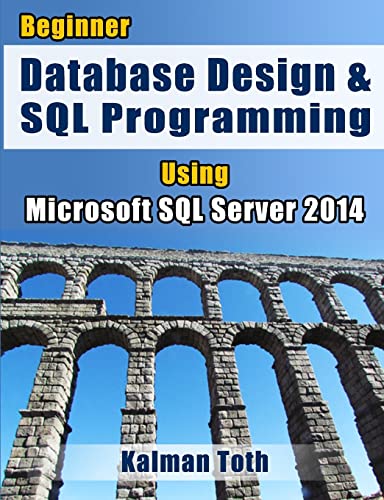
Beginner Database Design & SQL Programming Using Microsoft SQL Server 2014
Kalman Toth
ISBN 10: 1499321732 ISBN 13: 9781499321739
Verlag: Createspace Independent Publishing Platform, 2014
Neu
Paperback / softback
Verkäufer
THE SAINT BOOKSTORE, Southport, Vereinigtes Königreich
Verkäuferbewertung 5 von 5 Sternen

AbeBooks-Verkäufer seit 14. Juni 2006
Dieser Artikel ist nicht mehr verfügbar.
Beschreibung
Beschreibung:
This item is printed on demand. New copy - Usually dispatched within 5-9 working days. Bestandsnummer des Verkäufers C9781499321739
Inhaltsangabe:
LIVE THE AMERICAN DREAM!
Earn from $100,000 to $200,000 as a database expert. Learn Microsoft Database Design & SQL Server 2014 Programming! SQL Server 2014 follows just in 2 years after SQL Server 2012 with very exciting new features. One on the top: in-memory OLTP tables for superior performance. With abundant computer memory, why keep tables on a slow disk? Developers across the world face database issues daily. While immersed in procedural languages with loops, RDBMS forces them to think in terms of sets without loops. It takes to transition. It takes training. It takes experience. Developers are exposed also to Excel worksheets, or spreadsheets, as they were called in the not so distant past. So, if you know worksheets, how hard can databases be? After all, worksheets look pretty much like database tables, don’t they? The big difference is the connections among well-designed tables. A database is a set of connected tables, which represent entities in the real world. A database can be 100 connected tables or 3000. The connection is very simple: row A in table Alpha has affiliated data with row B in table Beta. However, even with 200 tables and 300 connections (FOREIGN KEY references), it takes a good amount of time to become familiar to the point of having an acceptable working knowledge."The Cemetery of Computer Languages" is expanding. You can see tombstones like PL/1, Forth, Ada, Pascal, LISP, RPG, APL, SNOBOL, JOVIAL, Algol – the list goes on. For some, the future is in question: PowerBuilder, ColdFusion, FORTRAN, and COBOL. On the other hand, SQL is running strong after 3 decades of glorious existence. What is the difference? The basic difference is that SQL can handle large datasets in a consistent manner based on mathematical foundations. You can throw together a computer language easily: assignment statements, looping, if-then conditional, 300 library functions, and voila! Here is the new language: Mars/1, named after the red planet to be fashionable with NASA's new Mars robot. However, can Mars/1 JOIN a table of 1 million rows with a table of 10 million rows in a second? The success of SQL language is so compelling that other technologies are tagged onto it like XML/XQuery, which deals with semi-structured information objects. In SQL you are thinking at a high level. In C# or Java, you are dealing with details – lots of them. That is a major difference. Why is so much of the book dedicated to database design? Why not plunge into SQL coding and eventually the developer will get a hang of the design? Because high-level thinking requires thinking at the database design level. A farmer has six mules. H how do we model it in the database? We design the Farmer and FarmAnimal tables and then connect them with FarmerID FOREIGN KEY in FarmAnimal referencing the FarmerID PRIMARY KEY in the Farmer table. What is the big deal about it? It looks so simple. In fact, how about just calling the tables Table1 and Table2 to be more generic. Ouch! Meaningful naming is the very basis of good database design. Relational database design is truly simple for simple well-understood models. The challenge starts in modeling complex objects such as financial derivative instruments, airplane passenger scheduling, or a social network website. When you need to add 5 new tables to a 1000 table database and hook them in (define FOREIGN KEY references) correctly, it is a huge challenge. To begin with, some of the five new tables may already be redundant, but you don't know that until you understand what the 1000 tables are really storing. Frequently, learning the application area is the biggest challenge for a developer when starting a new job.Live Life Smart, Active, Agile, Brilliant, Healthy & Happy!
Über die Autorin bzw. den Autor: KALMAN TOTH, M.A. PHYSICS COLUMBIA UNIVERSITY & M.PHIL. IN COMPUTING SCIENCE COLUMBIA UNIVERSITY, IS AN SQL DATABASE DESIGN AND BUSINESS INTELLIGENCE SPECIALIST. HIS PROFESSIONAL RESEARCH INTEREST IS ARTIFICIAL INTELLIGENCE. HE IS CONVINCED THAT MACHINE INTELLIGENCE WILL NOT ONLY REPLACE HUMAN INTELLIGENCE BUT SURPASS IT MILLION TIMES IN THE NEAR FUTURE. HIS HOBBY IS FLYING GLIDERS, VINTAGE FIGHTER & BOMBER PLANES. CONTACT: kalmantoth@gmail.com .
„Über diesen Titel“ kann sich auf eine andere Ausgabe dieses Titels beziehen.
Bibliografische Details
Titel: Beginner Database Design & SQL Programming ...
Verlag: Createspace Independent Publishing Platform
Erscheinungsdatum: 2014
Einband: Paperback / softback
Zustand: New
Beste Suchergebnisse bei AbeBooks

Foto des Verkäufers
Beginner Database Design & SQL Programming Using Microsoft SQL Server 2014
Verlag:
CreateSpace Independent Publishing Platform, 2014
ISBN 10: 1499321732
ISBN 13: 9781499321739
Neu
Softcover
Anbieter: GreatBookPrices, Columbia, MD, USA
Verkäuferbewertung 5 von 5 Sternen
Zustand: New. Bestandsnummer des Verkäufers 21474060-n
Neu kaufen
EUR 27,51
EUR 2,32 Versand
Versand innerhalb von USA
Versand innerhalb von USA
Anzahl: Mehr als 20 verfügbar
Foto des Verkäufers
Beginner Database Design & SQL Programming Using Microsoft SQL Server 2014
Verlag:
CreateSpace Independent Publishing Platform, 2014
ISBN 10: 1499321732
ISBN 13: 9781499321739
Gebraucht
Softcover
Anbieter: GreatBookPrices, Columbia, MD, USA
Verkäuferbewertung 5 von 5 Sternen
Zustand: As New. Unread book in perfect condition. Bestandsnummer des Verkäufers 21474060
Gebraucht kaufen
EUR 29,36
EUR 2,32 Versand
Versand innerhalb von USA
Versand innerhalb von USA
Anzahl: Mehr als 20 verfügbar
Beispielbild für diese ISBN
Beginner Database Design & SQL Programming Using Microsoft SQL Server 2014
Verlag:
CreateSpace Independent Publishing Platform, 2014
ISBN 10: 1499321732
ISBN 13: 9781499321739
Neu
Softcover
Anbieter: California Books, Miami, FL, USA
Verkäuferbewertung 4 von 5 Sternen

Zustand: New. Print on Demand. Bestandsnummer des Verkäufers I-9781499321739
Neu kaufen
EUR 29,92
Versand gratis
Versand innerhalb von USA
Versand innerhalb von USA
Anzahl: Mehr als 20 verfügbar
Foto des Verkäufers
Beginner Database Design & SQL Programming Using Microsoft SQL Server 2014
Verlag:
CreateSpace Independent Publishing Platform, 2014
ISBN 10: 1499321732
ISBN 13: 9781499321739
Gebraucht
Softcover
Anbieter: GreatBookPricesUK, Woodford Green, Vereinigtes Königreich
Verkäuferbewertung 5 von 5 Sternen
Zustand: As New. Unread book in perfect condition. Bestandsnummer des Verkäufers 21474060
Gebraucht kaufen
EUR 39,08
EUR 17,41 Versand
Versand von Vereinigtes Königreich nach USA
Versand von Vereinigtes Königreich nach USA
Anzahl: Mehr als 20 verfügbar
Beispielbild für diese ISBN
Beginner Database Design & SQL Programming Using Microsoft SQL Server 2014
Verlag:
CreateSpace Independent Publishing Platform, 2014
ISBN 10: 1499321732
ISBN 13: 9781499321739
Gebraucht
Softcover
Anbieter: Phatpocket Limited, Waltham Abbey, HERTS, Vereinigtes Königreich
Verkäuferbewertung 5 von 5 Sternen
Zustand: Good. Your purchase helps support Sri Lankan Children's Charity 'The Rainbow Centre'. Ex-library, so some stamps and wear, but in good overall condition. Our donations to The Rainbow Centre have helped provide an education and a safe haven to hundreds of children who live in appalling conditions. Bestandsnummer des Verkäufers Z1-G-028-01601
Gebraucht kaufen
EUR 43,18
EUR 12,35 Versand
Versand von Vereinigtes Königreich nach USA
Versand von Vereinigtes Königreich nach USA
Anzahl: 1 verfügbar
Beispielbild für diese ISBN
Beginner Database Design & SQL Programming Using Microsoft SQL Server 2014
Verlag:
CreateSpace Independent Publishing Platform, 2014
ISBN 10: 1499321732
ISBN 13: 9781499321739
Neu
Softcover
Anbieter: GreatBookPricesUK, Woodford Green, Vereinigtes Königreich
Verkäuferbewertung 5 von 5 Sternen
Zustand: New. Bestandsnummer des Verkäufers 21474060-n
Neu kaufen
EUR 45,41
EUR 17,41 Versand
Versand von Vereinigtes Königreich nach USA
Versand von Vereinigtes Königreich nach USA
Anzahl: Mehr als 20 verfügbar
Beispielbild für diese ISBN
Beginner Database Design & SQL Programming Using Microsoft SQL Server 2014 (Paperback)
Verlag:
Createspace Independent Publishing Platform, 2014
ISBN 10: 1499321732
ISBN 13: 9781499321739
Neu
Paperback
Anbieter: CitiRetail, Stevenage, Vereinigtes Königreich
Verkäuferbewertung 5 von 5 Sternen
Paperback. Zustand: new. Paperback. LIVE THE AMERICAN DREAM! Earn from $100,000 to $200,000 as a database expert. Learn Microsoft Database Design & SQL Server 2014 Programming! SQL Server 2014 follows just in 2 years after SQL Server 2012 with very exciting new features. One on the top: in-memory OLTP tables for superior performance. With abundant computer memory, why keep tables on a slow disk? Developers across the world face database issues daily. While immersed in procedural languages with loops, RDBMS forces them to think in terms of sets without loops. It takes to transition. It takes training. It takes experience. Developers are exposed also to Excel worksheets, or spreadsheets, as they were called in the not so distant past. So, if you know worksheets, how hard can databases be? After all, worksheets look pretty much like database tables, don't they? The big difference is the connections among well-designed tables. A database is a set of connected tables, which represent entities in the real world. A database can be 100 connected tables or 3000. The connection is very simple: row A in table Alpha has affiliated data with row B in table Beta. However, even with 200 tables and 300 connections (FOREIGN KEY references), it takes a good amount of time to become familiar to the point of having an acceptable working knowledge."The Cemetery of Computer Languages" is expanding. You can see tombstones like PL/1, Forth, Ada, Pascal, LISP, RPG, APL, SNOBOL, JOVIAL, Algol - the list goes on. For some, the future is in question: PowerBuilder, ColdFusion, FORTRAN, and COBOL. On the other hand, SQL is running strong after 3 decades of glorious existence. What is the difference? The basic difference is that SQL can handle large datasets in a consistent manner based on mathematical foundations. You can throw together a computer language easily: assignment statements, looping, if-then conditional, 300 library functions, and voila! Here is the new language: Mars/1, named after the red planet to be fashionable with NASA's new Mars robot. However, can Mars/1 JOIN a table of 1 million rows with a table of 10 million rows in a second? The success of SQL language is so compelling that other technologies are tagged onto it like XML/XQuery, which deals with semi-structured information objects. In SQL you are thinking at a high level. In C# or Java, you are dealing with details - lots of them. That is a major difference. Why is so much of the book dedicated to database design? Why not plunge into SQL coding and eventually the developer will get a hang of the design? Because high-level thinking requires thinking at the database design level. A farmer has six mules. H how do we model it in the database? We design the Farmer and FarmAnimal tables and then connect them with FarmerID FOREIGN KEY in FarmAnimal referencing the FarmerID PRIMARY KEY in the Farmer table. What is the big deal about it? It looks so simple. In fact, how about just calling the tables Table1 and Table2 to be more generic. Ouch! Meaningful naming is the very basis of good database design. Relational database design is truly simple for simple well-understood models. The challenge starts in modeling complex objects such as financial derivative instruments, airplane passenger scheduling, or a social network website. When you need to add 5 new tables to a 1000 table database and hook them in (define FOREIGN KEY references) correctly, it is a huge challenge. To begin with, some of the five new tables may already be redundant, but you don't know that until you understand what the 1000 tables are really storing. Frequently, learning the application area is the biggest challenge for a developer when starting a new job. Live Life Smart, Active, Agile, Brilliant, Healthy & Happy! This item is printed on demand. Shipping may be from our UK warehouse or from our Australian or US warehouses, depending on stock availability. Bestandsnummer des Verkäufers 9781499321739
Neu kaufen
EUR 45,42
EUR 42,95 Versand
Versand von Vereinigtes Königreich nach USA
Versand von Vereinigtes Königreich nach USA
Anzahl: 1 verfügbar