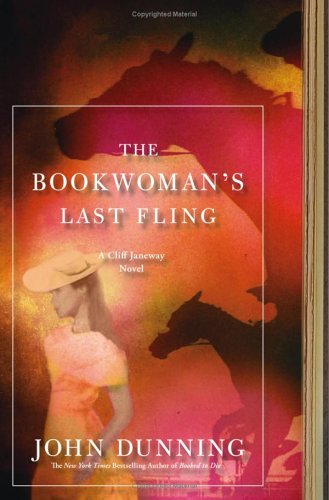
As a young man, New York Times bestselling author John Dunning earned his living for several years working behind the scenes on the racetrack circuit. Now he brings his memories of the horse world and his expertise in collectible books to this mesmerizing new Bookman novel rich with the lore of both books and horses. . . .
Denver bookman Cliff Janeway would have liked Candice Geiger. She loved books with a true bookwoman's passion. Her collection of first-edition children's books is the best that Janeway ever hopes to see. Sadly, Janeway and Candice Geiger will never meet. She died much too young. Now, twenty years later, her books remain a testament to an extraordinary woman's remarkable vision.
Janeway first learns about the juvenilia collection when Candice's elderly husband, H. R. Geiger, passes away and Janeway travels to their Idaho home to assess the collection. The estate can't be distributed until the books are valued, so there's pressure on Janeway to do the job quickly. But one look at the books tells Janeway something's wrong. Valuable titles are missing, replaced by cheap reprints. Other hugely valuable pieces remain. Why would a thief take one priceless book and leave an equally valuable volume on the shelf?
The answer may lie in Candice's story. The daughter of a wealthy industrialist, she married horse owner and trainer H. R. Geiger at a young age. They traveled the racetrack circuit with some success, as evidenced by winner's-circle photographs -- in which Candice is always a mysterious background figure dressed in white.
Two decades after Candice's strange death, Janeway finds himself deep in a book mystery that may turn out to be much more than a cataloging exercise. It may even involve murder. Candice's daughter, Sharon, may be one of the few people who can help Janeway discover the truth. Sharon has her own Idaho ranch where she takes in sick and injured horses. Janeway worries that her house contains something that could make her very vulnerable: half of her mother's fabulous book collection.
The trail of Candice's shadowy past leads Janeway to California's Golden Gate and Santa Anita racetracks, where he signs on as a racehorse hot walker. A novice at racetrack life, he tries to remain inconspicuous while listening to the chatter among the hands. He doesn't like what he hears. And when he goes to the house where Candice died to look for answers, he finds more than he bargained for.
With its rich mix of books and horses, The Bookwoman's Last Fling is a classic entry in John Dunning's acclaimed Bookman series of suspense novels, sure to bring this superbly talented author even more accolades.
As a young man, New York Times bestselling author John Dunning earned his living for several years working behind the scenes on the racetrack circuit. Now he brings his memories of the horse world and his expertise in collectible books to this mesmerizing new Bookman novel rich with the lore of both books and horses. . . .
Denver bookman Cliff Janeway would have liked Candice Geiger. She loved books with a true bookwoman's passion. Her collection of first-edition children's books is the best that Janeway ever hopes to see. Sadly, Janeway and Candice Geiger will never meet. She died much too young. Now, twenty years later, her books remain a testament to an extraordinary woman's remarkable vision.
Janeway first learns about the juvenilia collection when Candice's elderly husband, H. R. Geiger, passes away and Janeway travels to their Idaho home to assess the collection. The estate can't be distributed until the books are valued, so there's pressure on Janeway to do the job quickly. But one look at the books tells Janeway something's wrong. Valuable titles are missing, replaced by cheap reprints. Other hugely valuable pieces remain. Why would a thief take one priceless book and leave an equally valuable volume on the shelf?
The answer may lie in Candice's story. The daughter of a wealthy industrialist, she married horse owner and trainer H. R. Geiger at a young age. They traveled the racetrack circuit with some success, as evidenced by winner's-circle photographs -- in which Candice is always a mysterious background figure dressed in white.
Two decades after Candice's strange death, Janeway finds himself deep in a book mystery that may turn out to be much more than a cataloging exercise. It may even involve murder. Candice's daughter, Sharon, may be one of the few people who can help Janeway discover the truth. Sharon has her own Idaho ranch where she takes in sick and injured horses. Janeway worries that her house contains something that could make her very vulnerable: half of her mother's fabulous book collection.
The trail of Candice's shadowy past leads Janeway to California's Golden Gate and Santa Anita racetracks, where he signs on as a racehorse hot walker. A novice at racetrack life, he tries to remain inconspicuous while listening to the chatter among the hands. He doesn't like what he hears. And when he goes to the house where Candice died to look for answers, he finds more than he bargained for.
With its rich mix of books and horses, The Bookwoman's Last Fling is a classic entry in John Dunning's acclaimed Bookman series of suspense novels, sure to bring this superbly talented author even more accolades.
The Bookwoman's Last Fling
A Cliff Janeway NovelBy John DunningScribner
Copyright ©2006 John Dunning
All right reserved.ISBN: 0743289455Chapter 1
The morning was angry but I was cool. The rain rolled in from the west like a harbinger of some vast evil brewing but I had the man's money in my bank account, it was mine, he couldn't get it back unless I went nuts and decided to give it to him, and that made me cool. I had followed his orders almost to the letter, varying them just enough to satisfy my own persnickety nature. Long before the first faint light broke through the black clouds, I got up, dressed, got out of my motel room, and drove out toward the edge of town.
I found the all-night diner without a hitch; parked at the side and sat in my cold car with the motor idling. I was early. I had been told to come at five o'clock, no more or less, but I tend to ignore advice like that, especially when it comes with an attitude. I waited ten minutes and the appointed hour came and went. I could sense his presence off to my left beyond the parking lot: If I looked hard at that patch of darkness I could make out the vaguest shape of a car or truck, a vehicle of some kind in a small grove of trees. At five-oh-five by the clock in my car I got out and went inside. The waiter took my order, a slam-bang something with eggs and pancakes: enough cholesterol to power the whole state of Idaho. I consoled myself. I seldom eat like that anymore unless I am on the road, and apparently I am one of the lucky ones: I have great genes and my so-called good cholesterol readings are always sensational. No matter how much fat I eat, my system burns it. To my knowledge, no one in my family tree has ever died of a heart attack, which only means that I have a fine opportunity to be the first one.
The waiter tried to make the cook understand what I wanted through a serious language barrier. The cook looked illegal as hell: he spoke a kind of Spanglish through the window and the waiter struggled with that. I sat through two cups of coffee and no one came out of the lot beyond parking. My breakfast was surprisingly tasty and hot; I ate it slowly and looked up occasionally for some sign of life in the parking lot. When I looked at my watch again, it was five-thirty. The man was half an hour late.
I stretched out my legs and waited some more. If he didn't come at all it was truly his loss. I had five thousand of his American big ones and that usually guaranteed good faith. I could buy a fairly nice book with that. It was my rock-bottom minimum these days, the least it took for a stranger like him to get me off my dead ass in Denver and on the road to some distant locale. I got the money up front for just such contingencies as this one: a client with guff to match my own. That's one thing people had said about Harold Ray Geiger in all the newspaper accounts I had read of his life and death. He was abrupt, and so was the guy who had called me.
Geiger's man was also mysterious, enigmatic to a fault. He had sent me a cashier's check, so I still didn't know his full name. "My name is Willis," he had said on the phone. "I am Mr. Geiger's representative in Idaho." Normally I wouldn't touch a job like this: I certainly wouldn't leave home and make such a drive without knowing certain salient details. What had sold me on the case were the books. Geiger had died last month with a vast library of great first editions, the estate had a problem with them, and that was partly what I did now. I seldom did appraisal work: I found that boring and there were others who could do it faster and at least as well. There can be huge differences between honest appraisers and I tend to be too condition-conscious for people who, for reasons of their own, want their appraisals high. But I would help recover stolen books, I would try to unravel a delicate book mystery, I would do things, and not always for money, that got me out in the sunshine, away from my bookstore in Denver and into another man's world. It all depended on the man, and the voice on the phone seemed to belong to a five-grand kind of guy.
Six o'clock came and went. I rolled with it, prepared to sit here half the morning. The man deserved no less than that for five thousand dollars.
At some point I saw the truck move out of the shadows and bump its way into the parking lot. It was one of those big bastards with wheels half the size of Rhode Island. The sky was still quite dark and the rain drummed relentlessly on the roof of the truck. I could see his knuckles gripping the wheel -- nothing of his face yet, just that white-knuckle grip beyond the glass. I knew he had a clear look at me through the windshield, and at one point I smiled at him and tried to look pleasant. But I had a come-if-you-want-to, don't-if-you-don't attitude of my own. The ball was in his court.
Eventually he must have realized this, for I saw the unmistakable signs of life. A light went on in the truck and a man in a hat and dark glasses materialized. He climbed down and came inside.
"You Janeway?"
I recognized his voice from that cryptic phone call a week ago. I said, "Yep. And you would perhaps be representing the estate of Mr. Harold Ray Geiger?"
"I'm Willis. I was Mr. Geiger's right-hand man for more than thirty years."
He sat in the booth and sent up a signal for coffee. He didn't offer his hand and I didn't try to take it. There was another moment when I might have taken it by force, but then he had moved both hands into his lap and I figured groping around between his legs might cast us both in a bad light. From the kitchen the Mexican cook was watching us.
The mystery man sat sipping his coffee.
"Do you have a first name, Mr. Willis?"
"Yes, I have a first name." He said this with dripping sarcasm, a tone you use with a moron if you are that kind of guy. Already I didn't like him; we were off to a bad start.
"Should I try to guess it? You look like somebody named Clyde, or maybe Junior."
I said this in a spirit of lighthearted banter, I hoped, but he bristled. "My first name doesn't matter. I am the man who will either take you out to Mr. Geiger's ranch or leave you to wonder for the rest of your life what this might have been."
Now it was my turn to stifle a laugh.
"Are you making light of this?" I sensed a blink behind his dark shades. "Are you trying to annoy me?"
"Actually, Mr. Willis, I was starting to think it was the other way around."
"You've got a helluva nerve, coming out here with an attitude."
"I wasn't aware I had one."
"Keep it up and you can just climb right back in that car and get the hell out of here."
I stared at him for a long moment. I was suddenly glad I had been paid by cashier's check: his money was now firmly in my bank.
"I want it established right from the start," he said: "You are working for me. You will appraise Mr. Geiger's books and do it ASAP. If it turns out that books are missing and lost forever, I want you...