
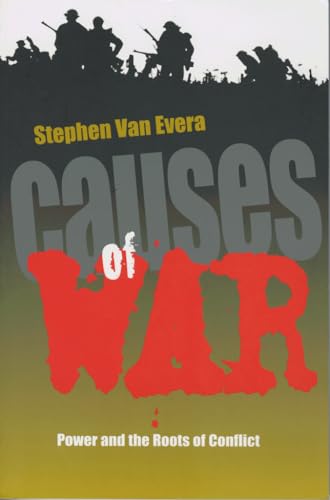
Causes of War : Power and the Roots of Conflict
Van Evera, Stephen
ISBN 10: 0801432014 ISBN 13: 9780801432019
Verlag: Cornell University Press, 1999
Gebraucht
Hardcover
Verkäufer
Better World Books, Mishawaka, IN, USA
Verkäuferbewertung 5 von 5 Sternen

AbeBooks-Verkäufer seit 3. August 2006
Dieser Artikel ist nicht mehr verfügbar.
Beschreibung
Beschreibung:
Former library copy. Pages intact with minimal writing/highlighting. The binding may be loose and creased. Dust jackets/supplements are not included. Includes library markings. Stock photo provided. Product includes identifying sticker. Better World Books: Buy Books. Do Good. Bestandsnummer des Verkäufers GRP35285708
Inhaltsangabe:
What causes war? How can military conflicts best be prevented? A prominent political scientist here addresses these questions, offering ideas that will be widely debated.
Stephen Van Evera frames five conditions that increase the risk of interstate war: false optimism about the likely outcome of a war, a first-strike advantage, fluctuation in the relative power of states, circumstances that allow nations to parlay one conquest into another, and circumstances that make conquest easy. According to Van Evera, all but one of these conditions—false optimism—rarely occur today, but policymakers often erroneously believe in their existence. He argues that these misperceptions are responsible for many modern wars, and explores both World Wars, the Korean War, and the 1967 Mideast War as test cases. Finally, he assesses the possibility of nuclear war by applying all five hypotheses to its potential onset.
Van Evera's book demonstrates that ideas from the Realist paradigm can offer strong explanations for international conflict and valuable prescriptions for its control.
What causes war? How can military conflicts best be prevented? In this book, Stephen Van Evera frames five conditions that increase the risk of interstate war: false optimism about the likely outcome of a war, a first-strike advantage, fluctuation in the relative power of states, circumstances that allow nations to parlay one conquest into another, and circumstances that make conquest easy.
According to Van Evera, all but one of these conditions—false optimism—rarely occur today, but policymakers often erroneously believe in their existence. He argues that these misperceptions are responsible for many modern wars, and explores both World Wars, the Korean War, and the 1967 Mideast War as test cases. Finally, he assesses the possibility of nuclear war by applying all five hypotheses to its potential onset. Van Evera's book demonstrates that ideas from the Realist paradigm can offer strong explanations for international conflict and valuable prescriptions for its control.
Über die Autorin bzw. den Autor:
Stephen Van Evera is Professor of Political Science at the Massachusetts Institute of Technology and Associate Director of the MIT Center for International Studies. His other works include Guide to Methods for Students of Political Science, also from Cornell.
„Über diesen Titel“ kann sich auf eine andere Ausgabe dieses Titels beziehen.
Bibliografische Details
Titel: Causes of War : Power and the Roots of ...
Verlag: Cornell University Press
Erscheinungsdatum: 1999
Einband: Hardcover
Zustand: Good