Click here to preview chapter 1.
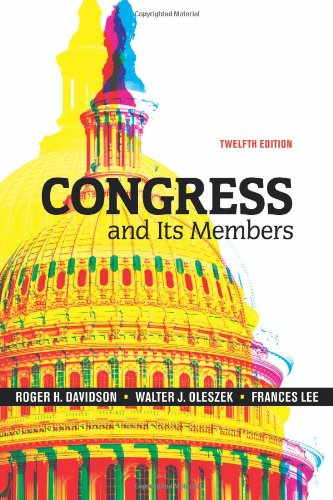
Davidson, Oleszek, and Lee’s focus on Congress as both a legislative institution and as a group of reelection-minded politicians has proven to be an extraordinarily effective and accessible way for thousands of students to understand the institution and the law-making process. A proven classic, the twelfth edition of Congress and Its Members features careful revising, new scholarship, and crucial updating.
From edition to edition, the updates you can always rely on feature coverage of:
- the 2008 elections
- the agenda of the new Congress
- White House–Capitol Hill relationships
- party and committee leadership changes
- judicial appointments
- campaign finance
- reapportionment
- the future of partisan polarization
- rules changes and procedural shifts
And revisions that explore the historic and significant changes since the last edition include:
- How will Congress deal with the economic crisis and financial meltdown, along with two foreign wars in Iraq and Afghanistan?
- How will Speaker Pelosi and Senate Majority Leader Reid—with consolidated majorities in the House and Senate—work with the Obama administration?
- How will Congress confront the “midnight regulations” of the Bush administration?
- What is the role of conference committees for reconciling bicameral disagreements?
- Do the 2008 congressional elections signify a partisan realignment, or simply a continuing trend?
- Do new developments in campaign funding, strategies, and techniques tell us something new, or do they mainly repeat past trends?
- Has Bush’s “imperial presidency” become a precedent for future inter-branch working arrangements? How effectively can Congress strive to regain its powers and prerogatives?
Roger H. Davidson was professor emeritus of government and politics at the University
of Maryland and served as visiting professor of political science at the University of
California, Santa Barbara. He was a senior fellow of the National Academy of Public
Administration. During the 1970s, he served on the staffs of reform efforts in both the
House (Bolling-Martin Committee) and the Senate (Stevenson-Brock Committee).
For the 2001–2002 academic year, he served as the John Marshall chair in political
science at the University of Debrecen, Hungary. His books include Remaking
Congress: Change and Stability in the 1990s, co-edited with James A. Thurber (1995),
and Understanding the Presidency, 7th ed., co-edited with James P. Pfiffner (2013).
Davidson was co-editor with Donald C. Bacon and Morton Keller of The Encyclopedia
of the United States Congress (1995).
Walter J. Oleszek is a senior specialist in the legislative process at the Congressional
Research Service. He has served as either a full-time professional staff aide or consultant
to many major House and Senate congressional reorganization efforts beginning
with the passage of the Legislative Reorganization Act of 1970. In 1993, he served as
policy director of the Joint Committee on the Organization of Congress. A former
adjunct faculty member at American University, Oleszek is a frequent lecturer to various
academic, governmental, and business groups. He is the author or co-author of several
books, including Congressional Procedures and the Policy Process, 11th ed. (2020),
and Congress Under Fire: Reform Politics and the Republican Majority, with C. Lawrence
Evans (1997).
Frances E. Lee is professor of politics and public affairs in the School of Public and
International Affairs and the Department of Politics at Princeton University. She has
been a research fellow at the Brookings Institution and an APSA congressional fellow.
Most recently, she is co-author of The Limits of Party: Congress and Lawmaking in a
Polarized Era (2020). She is also the author of Insecure Majorities: Congress and the
Perpetual Campaign (2016) and Beyond Ideology: Politics, Principles, and Partisanship
in the U.S. Senate (2009) and co-author, with Bruce I. Oppenheimer, of Sizing Up
the Senate: The Unequal Consequences of Equal Representation (1999). Her articles have
appeared in the American Political Science Review, Journal of Politics, Legislative Studies
Quarterly, and American Journal of Political Science, among others.