
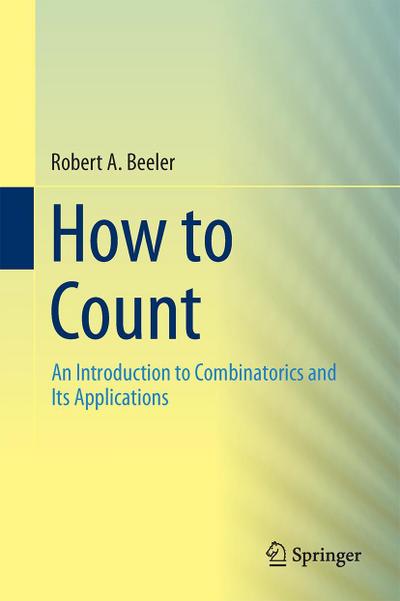

How to Count
Robert A. Beeler
ISBN 10: 331913843X ISBN 13: 9783319138435
Verlag: Springer, Springer Mär 2015, 2015
Neu
Buch
Verkäufer
Rheinberg-Buch Andreas Meier eK, Bergisch Gladbach, Deutschland
Verkäuferbewertung 5 von 5 Sternen

AbeBooks-Verkäufer seit 17. November 2008
Dieser Artikel ist nicht mehr verfügbar.
Beschreibung
Beschreibung:
Neuware -Providing a self-contained resource for upper undergraduate courses in combinatorics, this text emphasizes computation, problem solving, and proof technique. In particular, the book places special emphasis the Principle of Inclusion and Exclusion and the Multiplication Principle. To this end, exercise sets are included at the end of every section, ranging from simple computations (evaluate a formula for a given set of values) to more advanced proofs. The exercises are designed to test students' understanding of new material, while reinforcing a working mastery of the key concepts previously developed in the book. Intuitive descriptions for many abstract techniques are included. Students often struggle with certain topics, such as generating functions, and this intuitive approach to the problem is helpful in their understanding. When possible, the book introduces concepts using combinatorial methods (as opposed to induction or algebra) to prove identities. Students are also asked to prove identities using combinatorial methods as part of their exercises. These methods have several advantages over induction or algebra. 380 pp. Englisch. Bestandsnummer des Verkäufers 9783319138435
Inhaltsangabe:
Providing a self-contained resource for upper undergraduate courses in combinatorics, this text emphasizes computation, problem solving, and proof technique. In particular, the book places special emphasis the Principle of Inclusion and Exclusion and the Multiplication Principle. To this end, exercise sets are included at the end of every section, ranging from simple computations (evaluate a formula for a given set of values) to more advanced proofs. The exercises are designed to test students' understanding of new material, while reinforcing a working mastery of the key concepts previously developed in the book. Intuitive descriptions for many abstract techniques are included. Students often struggle with certain topics, such as generating functions, and this intuitive approach to the problem is helpful in their understanding. When possible, the book introduces concepts using combinatorial methods (as opposed to induction or algebra) to prove identities. Students are also asked to prove identities using combinatorial methods as part of their exercises. These methods have several advantages over induction or algebra.
Über die Autorin bzw. den Autor: Robert A. Beeler is an Associate Professor of Mathematics at East Tennessee State University. His research interests include enumerative combinatorics and graph theory; edge decompositions of graphs, graceful labelings on graphs, intersection/representation theory, and combinatorial designs; combinatorial games and games on graphs. He is a member of the Mathematics Association of America, the American Mathematical Society, and the Institute of Combinatorics and its Applications.
„Über diesen Titel“ kann sich auf eine andere Ausgabe dieses Titels beziehen.
Bibliografische Details
Titel: How to Count
Verlag: Springer, Springer Mär 2015
Erscheinungsdatum: 2015
Einband: Buch
Zustand: Neu