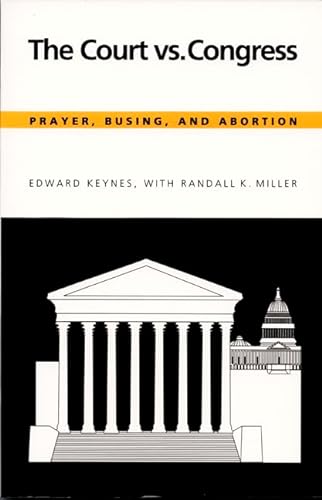
The Court vs. Congress: Prayer, Busing, and Abortion
Sprache: Englisch
Verlag: Duke University Press, 1989
- Softcover
- Neu

Anbieter: THE SAINT BOOKSTORE, Southport, Vereinigtes KönigreichTHE SAINT BOOKSTORE
AbeBooks-Verkäufer/-in seit 14. Juni 2006
Zustand: Neu
EUR 38,98
Anzahl: 1 verfügbar
In den WarenkorbArtikelbeschreibung vom Verkäufer
Bestandsnummer des Verkäufers B9780822309680
- Titel
- The Court vs. Congress: Prayer, Busing, and Abortion
- Autor
- Edward Keynes
- Verlag
- Duke University Press
- Veröffentlichungsjahr
- 1989
- Zustand
- New
- Einband
- Paperback / softback
- Sprache
- Englisch
- ISBN-10
- 0822309688
- ISBN-13
- 9780822309680
- Artikelgewicht
- 729 Gramm
Edward Keynes and Randall Miller argue that Congress lacks the constitutional power to legislate away the powers of the federal courts and to prevent individuals from seeking redress for presumed infringements of their constitutional rights in these areas. They demonstrate that neither the framers nor ratifiers of the Constitution intended the Congress to exercise plenary power over the appellate jurisdiction of the Supreme Court. Throughout its history the Court has never conceded unlimited powers to Congress; and until the late 1950s Congress had not attempted to gerrymander the Court's jurisdiction in response to specific decisions. But the authors contend this is just what the sponsors of recent legislative attacks on the Court intend, and they see such efforts as threatening the Court's independence and authority as defined in the separation of powers clauses of the Constitution.
„Inhaltsangabe“ gehört möglicherweise zu einer anderen Auflage dieses Titels.
Auszug. © Genehmigter Nachdruck. Alle Rechte vorbehalten.
The Court vs. Congress
Prayer, Busing, and Abortion
By Edward Keynes, Randall K. MillerDuke University Press
All rights reserved.
Contents
Acknowledgments,
Introduction,
1 Congress, the Courts, and Federal Jurisdiction: Theoretical Perspectives,
2 Jurisdiction and Judicial Review: The Framers' Perspective,
3 The Judicial Function, Jurisdiction, and Congressional Power: The Ratifiers' Intent,
4 Judicial Power, the Judicial Function, and Jurisdiction: The Formative Period (1789–1835),
5 Congressional Power Over the Supreme Court's Appellate Jurisdiction: From Roger Taney to Earl Warren,
6 Congressional Power Over the Court: A View from the Capitol,
7 Congress, the Court, and School Prayer,
8 School Desegregation and Court-Ordered Busing: Where There Is a Right, Is There a Remedy?,
9 The Undying Issue: Congress, the Court, and Abortion Rights,
Epilogue: Constitutional Democracy, Judicial Review, and Congressional Power Over the Federal Courts,
Notes,
Table of Cases Cited,
Index,
CHAPTER 1
Congress, the Courts, and Federal Jurisdiction: Theoretical Perspectives
* * *
Congressional Power To Limit Federal Jurisdiction
Since 1955 members of Congress have introduced numerous bills to curb the federal courts' jurisdiction over selected areas of judicial decision making. Piqued by the Supreme Court's decisions on state and federal loyalty-security programs, public school segregation, defendants' rights and the administration of criminal justice, congressional districting, state legislative reapportionment, school busing as a tool of desegregation, prayer in the nation's public schools, and state antiabortion laws, the Court's congressional opponents have attempted to limit federal-court jurisdiction in these areas. Although there are many differences among the hundreds of bills that have been introduced, essentially they all leave the future definition and protection of federal constitutional rights or interests to the solicitude of the states' courts.
Sometimes referred to as court curbing, jurisdiction stripping, or jurisdictional gerrymandering, proposed limitations on federal jurisdiction reflect substantial congressional and, perhaps, public dissatisfaction with the Warren and Burger courts' definition and protection of the individual's rights against state and federal interference. Jurisdictional limitations also have constitutional consequences that reach beyond dissatisfaction with particular judicial decisions. Attempts to curb federal jurisdiction raise serious questions about congressional authority over the federal courts, the legitimate scope of judicial review in a democracy, and the Supreme Court's role as an arbiter of congressional, presidential, and state power within an institutional framework of federalism and the separation of powers.
In their attempts to curb "extraconstitutional" judicial policy making, the Court's congressional foes have zeroed in on the Court's controversial decisions on school prayer, Engel v. Vitale (1961) and Abington v. Schempp (1963); school busing, Swann v. Charlotte-Mecklenburg (1971); and state antiabortion laws, Roe v. Wade (1973). At times intense, the struggle over prayer, busing, and abortion reflects the fact that once again the Supreme Court is at the center of the political storm. This struggle raises basic questions about congressional authority to limit the Supreme Court's appellate jurisdiction as well as the lower federal courts' jurisdiction. A seemingly dry and technical subject, the debate engenders passionate discourse over congressional power on questions such as the Framers' and Ratifiers' original understanding of the Court's relationship to Congress. It is a high stakes debate about the Supreme Court's future role as a constitutional policymaker in a society that is theoretically committed to political democracy (popular sovereignty, majority rule, and responsible and responsive government) as well as a debate about constitutional limitations on the exercise of governmental power vis-à-vis individuals and minorities.
This perennial but unresolved debate includes at least three major positions on the scope of congressional authority to regulate and limit federal jurisdiction. The conventional view is that under Article III of the Constitution, congressional power to regulate federal jurisdiction is plenary. A second argument, the mandatory view, often associated with Justice Joseph Story, is that Article III imposes an affirmative duty on Congress to vest the entire constitutional jurisdiction in some federal court. A third view of more recent parentage is that, while Article III may impose few or no restrictions on Congress, other constitutional limitations external to Article III do impose specific limits on the exercise of congressional power over federal jurisdiction.
According to the plenary view, the language of the exceptions and regulations clause (Article III, section 2) imposes no limit on congressional power to regulate and make exceptions to the Supreme Court's appellate jurisdiction. Similarly, under the ordain and establish clause (Article III, section 1), Congress has plenary power to create and abolish lower federal courts and to define and limit their jurisdiction. These two clauses are legitimate checks on judicial usurpation of congressional and state legislative authority. Therefore, Congress can leave the final determination of federal constitutional questions to the states' courts without recourse to the federal judiciary. There may be a right to judicial process, but there is no guarantee of a federal forum in which individuals can vindicate their constitutional claims. Furthermore, under the supremacy clause (Article VI, section 2), state courts have an obligation to enforce the individual's rights against infringements by the states and the national government.
As the mandatory view implies, Article III imposes a constitutional obligation on Congress to create federal courts and to vest the maximum constitutional jurisdiction in the federal judiciary. The exceptions and regulations clause merely grants Congress authority to distribute federal jurisdiction between the Supreme Court and inferior federal courts. It is neither a grant of power to restrict access to the federal courts nor a legitimate check on the exercise of judicial power. If the federal judiciary is to act as a coequal partner to Congress and the president, its jurisdiction must extend to the limits of Article III and must be coterminous with the legislative power of Congress. Otherwise, Congress and the president could shield themselves from constitutional scrutiny and emasculate the federal judiciary's power of judicial review. From the mandatory perspective, Article III simply confers on Congress housekeeping power to promote the efficiency and effectiveness of the federal judiciary.
In response to recent attempts to curb federal jurisdiction on a selective basis, some scholars argue that congressional power under Article III may be broad, but it is not unlimited. Taken in context, the language of Article III does not warrant a complete closure of the federal courts to litigants presenting constitutional claims. Indeed, various constitutional provisions, including the supremacy clause (Article VI, section 2), the habeas corpus clause (Article I, section 9, clause 2), and the due process clause of the Fifth...
„Über diesen Titel“ gehört möglicherweise zu einer anderen Auflage dieses Titels.
THE SAINT BOOKSTORE
Southport, Vereinigtes Königreich
AbeBooks-Verkäufer/-in seit 14. Juni 2006
Versandkosten von Vereinigtes Königreich nach USA
| Artikel | 7 bis 28 Werktage | 7 bis 28 Werktage |
|---|---|---|
| Erster Artikel | EUR 21,00 | EUR 23,32 |
Zahlungsarten
Shop-Beschreibung
Spezialisierung
GeneralUnternehmensdaten der Verkäuferin bzw. des Verkäufers
SB ONLINE LTD
50 Devonshire Road
Southport, Vereinigtes Königreich PR9 7BZ
Verkaufsbedingungen
Please order through the Abebooks checkout. We only take orders through Abebooks - We don't take direct orders by email or phone.
Refunds or Returns: A full refund of the purchase price will be given if returned within 30 days in undamaged condition.
As a seller on abebooks we adhere to the terms explained at http://www.abebooks.co.uk/docs/HelpCentral/buyerIndex.shtml - if you require further assistance please email us at orders@thesaintbookstore.co.uk
Widerrufsrecht
Wenn Sie Verbraucher sind, können Sie gemäß den folgenden Bestimmungen vom Vertrag zurücktreten. Verbraucher ist jede natürliche Person, die zu Zwecken handelt, die nicht ihrer kaufmännischen, gewerblichen, künstlerischen oder beruflichen Tätigkeit zugerechnet werden können.
Informationen zum Widerrufsrecht
Gesetzliches Widerrufsrecht
Sie haben das Recht, den Vertrag innerhalb von 14 Tagen ohne Angabe von Gründen zu widerrufen.
Die Widerrufsfrist beträgt 14 Tage ab dem Tag, an dem Sie oder ein von Ihnen benannter Dritter, der nicht der Transporteur ist, die letzte Ware oder den letzten Posten oder das letzte Exemplar in Besitz genommen hat.
Um das Widerrufsrecht auszuüben, füllen Sie auf unserer Website unter „Meine Einkäufe" in „Mein Nutzerkonto" eine eindeutige Erklärung elektronisch aus und senden Sie sie ab. Wir werden Ihnen unverzüglich eine Bestätigung über den Eingang eines solchen Widerrufs auf einem dauerhaften Datenträger (z. B. per E-Mail) übermitteln.
Um die Widerrufsfrist einzuhalten, reicht es aus, dass Sie Ihre Mitteilung über die Ausübung des Widerrufsrechts vor Ablauf der Widerrufsfrist absenden.
Auswirkungen des Widerrufs
Wenn Sie diesen Vertrag widerrufen, erstatten wir Ihnen alle Zahlungen, die wir von Ihnen erhalten haben, einschließlich der Lieferkosten (mit Ausnahme der zusätzlichen Kosten, die entstehen, wenn Sie eine andere Art der Lieferung als die von uns angebotene günstigste Standardlieferung gewählt haben).
Wir können einen Abzug von der Rückerstattung für den Wertverlust der gelieferten Waren vornehmen, wenn der Verlust auf eine unnötige Behandlung durch Sie zurückzuführen ist.
Wir werden die Rückerstattung unverzüglich und nicht später als 14 Tage nach dem Tag vornehmen, an dem wir über Ihre Entscheidung, diesen Vertrag zu widerrufen, informiert wurden.
Für die Rückerstattung verwenden wir dasselbe Zahlungsmittel, das Sie für die ursprüngliche Transaktion verwendet haben, es sei denn, Sie haben ausdrücklich etwas anderes vereinbart; in keinem Fall werden Ihnen aufgrund einer solchen Rückerstattung Gebühren berechnet.
Wir können die Rückzahlung verweigern, bis wir die Waren wieder zurückerhalten haben oder Sie den Nachweis erbracht haben, dass Sie die Waren zurückgesandt haben, je nachdem, was eher eintritt.
Sie müssen die Waren unverzüglich und in jedem Fall spätestens 14 Tage ab dem Tag, an dem Sie uns über den Widerruf dieses Vertrags unterrichten, an THE SAINT BOOKSTORE, Southport, United Kingdom, zurücksenden oder übergeben. Die Frist ist eingehalten, wenn Sie die Ware vor Ablauf der Frist von 14 Tagen zurücksenden. Sie müssen die direkten Kosten der Rücksendung der Waren tragen. Sie haften nur für einen etwaigen Wertverlust der Waren, der auf eine Behandlung zurückzuführen ist, die nicht zur Prüfung der Art, Eigenschaften und Funktionsweise der Waren erforderlich ist.
Ausnahmen vom Widerrufsrecht
Das Widerrufsrecht gilt nicht für:
- Die Lieferung von Zeitungen, Zeitschriften oder Magazinen mit Ausnahme von Abonnementverträgen; und
- Die Lieferung digitaler Inhalte, die nicht auf einem physischen Medium (z. B. auf einer CD oder DVD) geliefert werden, wenn Sie bei Ihrer Bestellung akzeptiert haben, dass wir mit der Lieferung beginnen können und dass Sie nach Beginn der Lieferung den Vertrag nicht mehr widerrufen können.
Versandbedingungen
Most orders usually ship within 1-3 business days, but some can take up to 7 days.