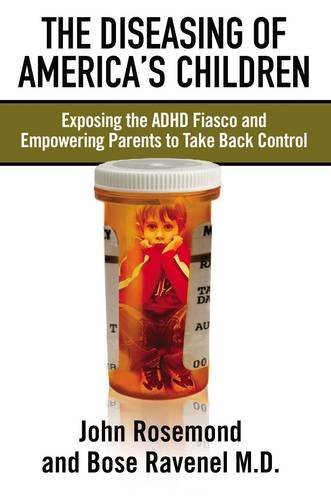
How parents, teachers, and even professionals are being deceived by the "ADHD Establishment" regarding ADHD and other childhood behavior disorders and the drugs used to treat them.
The issue of diagnosing children with behavioral diseases that do not conform to a scientific definition of disease, and then medicating them is a scandal ready to erupt. InThe Diseasing of America's Children, popular family psychologist, speaker, and best-selling author John Rosemond joins with pediatrician Dr. Bose Ravenel to uncover the fiction and fallacy behind attention-deficit/hyperactivity disorder (ADHD), oppositional defiant disorder (ODD), early-onset biopolar disorder (EOBD), and the drugs prescribed to treat them. Rosemond and Ravenel will:
- reveal the pseudo-science behind these diagnoses
- explain how parents, teachers, and even professionals are deceived
- expose the short- and long-term dangers behavioral drugs pose to children
- discuss how America's schools are unwittingly feeding the diagnostic beast
- reveal the simple, common sense truth behind these behavior problems
- and give parents a practical program for curing these problems without drugs or dependence on professionals
THE DISEASING OF AMERICA'S CHILDREN
Exposing the ADHD Fiasco and Empowering Parents to Take Back ControlBy John Rosemond Bose RavenelThomas Nelson
Copyright © 2008 John K. Rosemond and S. DuBose Ravenel
All right reserved.ISBN: 978-0-7852-2886-8Contents
Acknowledgments...................................................................................................ixRead This First!..................................................................................................xiIntroduction......................................................................................................xiiiPART 1 EXPOSING THE ADHD FIASCO1. Five Slippery Words............................................................................................32. Redefining Childhood...........................................................................................113. Biology in Wonderland..........................................................................................354. The Politics of Diagnosis......................................................................................675. The Politics and Perils of Pharmaceuticals.....................................................................77PART 2 MAKING SENSE6. A Simple Explanation...........................................................................................1057. Why Johnny Can't Sit Still, Pay Attention, Do What He's Told, and Learn to Read................................137PART 3 EMPOWERING PARENTS TO TAKE BACK CONTROL8. Nipping "ADHD" in the Bud......................................................................................1619. Nipping "ADHD" in Full Bloom...................................................................................189Notes.............................................................................................................213Index.............................................................................................................229Introduction to The Well-Behaved Child: Discipline That Really Works (available October 2009).....................239About the Authors.................................................................................................253
Chapter One
FIVE SLIPPERY WORDS It depends on what the meaning of the word "is" is. -President Bill Clinton
Discussions about attention-deficit/hyperactivity disorder (as well as oppositional defiant disorder and early onset bipolar disorder) can get complicated very quickly. The complications generally involve one or more of five slippery words: believe, real, work, have, and know.
As I was walking out of an auditorium in Lexington, Kentucky, where I had just spoken to some three hundred people, mostly parents, a woman approached me and said, "So I take it you don't believe in ADHD."
During the presentation, I had done my best to debunk some widely held falsehoods concerning ADHD, including that it is an inherited or gene-based condition. Because the diagnosis had become so ubiquitous, I realized that several parents in the audience would have questions.
"What does believing in ADHD require?" I asked her.
She looked at me with a slightly embarrassed smile. "Well, you know ... that it's real."
I could tell this was going to be a somewhat thorny conversation. Before I could answer her, we had to come to agreement concerning what the word real means with regard to this supposed disorder. Does it mean that ADHD has objective reality, that it is the behavioral result of physical anomalies that can be seen and measured? Some psychologists, physicians, and researchers believe that it does and is. They believe that ADHD can be seen in brain scans, detected by electroencephalography, that it exists in the form of structural abnormalities in the brain and/or imbalances in the brain's chemistry. The emphasis in the previous two sentences is meant to draw attention to the fact that in the field of ADHD, belief is all there is. Science, however, is not about belief. It is about objective, verifiable, replicable evidence, of which there is none where ADHD is concerned.
One of the characteristics of postmodernity-the curious times in which we twenty-first-century Americans live-is that if enough people think something is true, it takes on a consensual reality that is as powerful, and sometimes more so, than a fact that can be verified by objective means of detection or measurement. Furthermore, once something has acquired consensual reality, people-and even people who ought to know better, people with scientific credentials-will often deny that facts are facts.
The fact is that none of the claims that ADHD has a biological cause has been verified through scientific experiments that upon replication yield the same results. On that basis, therefore, ADHD is not real, not yet at least. Then again, one can ignore all the claims of genes, microscopic brain lesions, and chemical imbalances and limit the notion that ADHD is real to its phenomenology-to the undeniable fact that large and ever-increasing numbers of children display the defining behaviors (or "symptoms," as delineated in the most recent revision of the Diagnostic and Statistical Manual, the diagnostic guidebook for the mental health professions) to a significant degree. From that perspective, ADHD is very real indeed.
But is ADHD a "disorder"? Does its nomenclature accurately reflect that there is something amiss with the children in question, that for whatever reason-biological or otherwise-they can't "think straight," and thus their behavior is often chaotically disorganized? Or is attention-deficit/ hyperactivity disorder simply a more scientific-sounding way of referring to what, not so long ago, people simply called a spoiled brat? Is the term just one more example of how political correctness has corrupted language? This point of view has it that the ADHD child's behavior problems are indeed real but that there is nothing inherently wrong with the child. In many ways, the hurricane of controversy that swirls around the topic of ADHD is in fact an argument concerning whether or not it is real, and if so, in what sense of the term.
Since I didn't have enough time to help this woman understand these sorts of distinctions, I simply said, "I think ADHD is very real in the sense of the behavior problems that are being described. I just don't believe that the things many, if not most, diagnosing and treating professionals are saying about ADHD are factual."
"So you don't believe the medicines really work?" she asked.
Ah! The third of our slippery terms-work. This mother had likely been persuaded that if administration of a drug like Ritalin results in significant diminishment of symptoms for several hours, we have prima facie evidence that ADHD does indeed have biological reality (i.e., the drugs supposedly correct a fictitious biochemical imbalance).
I said, "The answer to that question depends on whether you are defining work in the short-term or the long-term sense."
"But why would the medicines work at all if ADHD wasn't real?" she astutely challenged.
"Has one of your children been diagnosed with ADHD?" I asked her, fairly certain of the answer.
"Our five-year-old son," she said. "My husband has been diagnosed with it as well, and we suspect that our second child may also have it, but it's too early to...