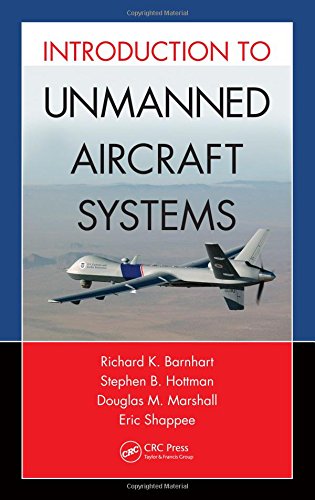
Introduction to Unmanned Aircraft Systems is the editors’ response to their unsuccessful search for suitable university-level textbooks on this subject. A collection of contributions from top experts, this book applies the depth of their expertise to identify and survey the fundamentals of unmanned aircraft system (UAS) operations. Written from a nonengineering civilian operational perspective, the book starts by detailing the history of UASs and then explores current technology and what is expected for the future.
Covering all facets of UAS elements and operation—including an examination of safety procedures and human factors—this material gives readers a truly complete and practical understanding of what it takes to safely operate UASs for a variety of missions in the National Airspace System.
Topics covered include:
- The U.S. aviation regulatory system
- Certificate of authorization process
- UAS for geospatial data
- Automation and autonomy in UAS
- Sensors and payloads
With helpful end-of-chapter discussion questions, this resource is designed to give beginning university students and other new entrants to the field a comprehensive, easy-to-understand first overview of the field. The book’s broad scope also makes it useful as a foundation for professionals embarking on further study.
Richard K. Barnhart, Ph.D., is professor and head of the Aviation Department at Kansas State University (K-State; Salina) in addition to serving as the executive director of the Applied Aviation Research Center at K-State, which oversees the newly established Unmanned Aerial Systems program office. Dr. Barnhart is a member of the graduate faculty at K-State and holds a commercial pilot certificate with instrument, multiengine, seaplane, and glider ratings. He also is a certified flight instructor with instrument and multiengine ratings. Dr. Barnhart holds an airframe and power-plant certificate with inspection authorization. In addition, he holds an A.S. in aviation maintenance technology from Vincennes University (Indiana), a B.S. in aviation administration from Purdue University (West Lafayette, Indiana), an MBAA from Embry-Riddle Aeronautical University (Daytona Beach, Florida), and a Ph.D. in educational administration from Indiana State University (Terra Haute). Dr. Barnhart’s research agenda is focused in aviation psychology and human factors. His industry experience includes work as a research and development (R&D) inspector with Rolls-Royce Engine Company, and systems instructor for American Trans-Air airlines. Most recently, Dr. Barnhart was associate professor and acting department chair of the Aerospace Technology Department at Indiana State University, where he was responsible for teaching flight and upper-division administrative classes. Courses taught include Aviation Risk Analysis, Citation II Ground School, King Air 200 Flight, Air Navigation, Air Transportation, Instrument Ground School, and many others.
Stephen B. Hottman is the director of the Unmanned Aircraft System (UAS) Technical Analysis and Applications Center (TAAC) and associate dean for Research and Development and senior deputy director of the New Mexico State University (NMSU; Las Cruces) Physical Science Laboratory (PSL). The TAAC includes all of the UAS research, development, test, and evaluation (RDT&E) and operations that are taking place in the National Airspace System (NAS). The UAS TAAC is evolving into a center of influence for global UAS RDT&E and airspace integration and access. Hottman’s areas of responsibility include leadership for two separate departments. The 21st Century Aerospace Department includes all of the unmanned aircraft work performed since 1999; and missile, rocket, and telemetry support to the Missile Defense Agency, Space and Missile Defense Command, National Aeronautics and Space Administration (NASA), and other agencies. The Columbia Scientific Balloon Facility (Department) is a government-owned contractor-operated NASA carrier program providing all operations, R&D, and engineering support for near space activity (120–160K AGL) with several ton payloads operating for over a month at a time. Launch operations occur at numerous international sites utilizing balloons up to 60 M ft2.
Prior to NMSU, Hottman worked in the industry and focused primarily on optimizing the effectiveness of the human in manned weapon systems. His last industry position in 1998 was leading a human systems strategic business unit focused on human performance, chem/bio, and training that was the largest provider of such services to the Department of Defense (DoD), other federal agencies, and international sponsors. His career has included an eclectic variety of domains, including directed energy weapons development; chemical biological warfare vulnerability and countermeasures for ground and aircrew members; command, control, and communication; a variety of aviation programs; and training primarily in support of the war fighter.
Hottman is a Ph.D. candidate in psychology (engineering psychology) at New Mexico State University, has an M.S. in industrial engineering (human factors specialization), and a B.S. in psychology; both degrees are from Texas A&M University. He has more than 100 publications and presentations. He is a life member of the National Defense Industrial Association (NDIA); and the Aerospace Medical Association, a member of the Association for Unmanned Vehicle Systems International (AUVSI), Human Factors and Ergonomics Society, and a member of the Southwest Border Security Task Force.
Douglas M. Marshall, J.D., is division manager, UAS Regulations & Standards Development at the Physical Science Laboratory, New Mexico State University, where he is involved in UAS research and a variety of efforts concerned with the safe integration of unmanned aircraft systems into national and international airspace. He previously held the position of professor of aviation at the University of North Dakota, where he directed the aviation master’s program and taught courses in aviation law, airline labor law and policy, aviation economics, airline management, organizational behavior and management theory, and aviation regulations and policy. Marshall has been engaged full-time on UAS-related activities for more than 6 years, is the coeditor of two books on aviation topics, and is the author of numerous published articles on aviation law, regulations, and remotely piloted aircraft.
Marshall currently serves on the Radio Technical Commission for Aeronautics (RTCA) SC-203, American Society of Testing and Materials (ASTM) F-38, and Society of Automotive Engineers (SAE) G-10 committees, the Association for Unmanned Vehicle Systems International (AUVSI) Advocacy Committee, the Arctic Monitoring and Assessment Program’s UAS Expert Group, and The Arctic Research Interest Group. He previously served on the Federal Aviation Administration’s (FAA) Small UAS Aviation Rulemaking Committee, whose recommendations are under consideration by the FAA. He has also served on the Steering Committee, Civil Applications of Unmanned Aerial Systems Conference (Boulder, Colorado); the Department of Defense’s Joint Integrated Product Team for UAS; and several other committees dedicated to the development of UASs and has delivered presentations on international aviation regulations and airspace issues at conferences around the world.
In his previous career, Marshall practiced law for three decades, specializing in maritime and aviation litigation and employment law, representing several major airlines in labor- and employment-related matters, and was the general counsel and later president of a commuter airline. He holds a private pilot’s certificate with commercial and instrument ratings.
Marshall earned a bachelor of arts degree at the University of California, Santa Barbara, in 1969, and a juris doctor from the University of California’s Hastings College of the Law in 1972. He is an active member of the American Institute of Aeronautics and Astronautics (AIAA), where he is vice chair of the Legal Aspects of Aeronautics Technical Committee, as well as a member of the American Academy for the Advancement of Science, the Association for Unmanned Vehicle Systems International, and regularly serves on panels and delivers presentations on UAS-related topics.
Eric Shappee serves as an associate professor of aviation at Kansas State University at Salina in the professional pilot program. He teaches numerous aviation courses, which include: Introduction to Aviation, System Safety, Safety Management, and Introduction to Unmanned Aerial Systems. Shappee holds a commercial pilot certificate with instrument, multiengine, and glider ratings. He is also a certified flight instructor with gold seal. Shappee holds two associate degrees from Antelope Valley College (Palmdale, California), a bachelors in aeronautical science and a masters in aeronautical science and safety from Embry-Riddle Aeronautical University. Shappee’s main area of focus in aviation is safety. He has developed several risk assessment tools for K-State and other aviation organizations. Further, he was recently named as a member of the International Society of Air Safety Investigators, a membership earned through professional service and experience. Shappee has been active in the field of aviation since 1986, and teaching since 1995. During his career in aviation, Shappee has also spent time working with unmanned aerial systems including the Predator and Aerosonde.