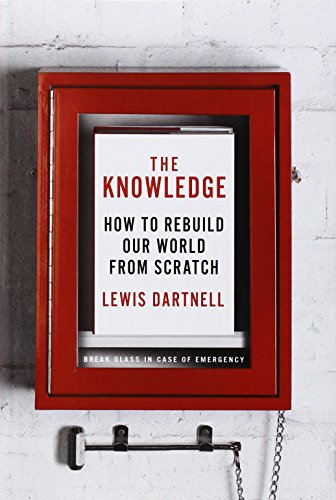
How would you go about rebuilding a technological society from scratch?If our technological society collapsed tomorrow, perhaps from a viral pandemic or catastrophic asteroid impact, what would be the one book you would want to press into the hands of the postapocalyptic survivors? What crucial knowledge would they need to survive in the immediate aftermath and to rebuild civilization as quickly as possible—a guide for rebooting the world?
Human knowledge is collective, distributed across the population. It has built on itself for centuries, becoming vast and increasingly specialized. Most of us are ignorant about the fundamental principles of the civilization that supports us, happily utilizing the latest—or even the most basic—technology without having the slightest idea of why it works or how it came to be. If you had to go back to absolute basics, like some sort of postcataclysmic Robinson Crusoe, would you know how to re-create an internal combustion engine, put together a microscope, get metals out of rock, accurately tell time, weave fibers into clothing, or even how to produce food for yourself?
Regarded as one of the brightest young scientists of his generation, Lewis Dartnell proposes that the key to preserving civilization in an apocalyptic scenario is to provide a quickstart guide, adapted to cataclysmic circumstances. The Knowledge describes many of the modern technologies we employ, but first it explains the fundamentals upon which they are built. Every piece of technology rests on an enormous support network of other technologies, all interlinked and mutually dependent. You can’t hope to build a radio, for example, without understanding how to acquire the raw materials it requires, as well as generate the electricity needed to run it. But Dartnell doesn’t just provide specific information for starting over; he also reveals the greatest invention of them all—the phenomenal knowledge-generating machine that is the scientific method itself. This would allow survivors to learn technological advances not explicitly explored in The Knowledge as well as things we have yet to discover.
The Knowledge is a brilliantly original guide to the fundamentals of science and how it built our modern world as well as a thought experiment about the very idea of scientific knowledge itself.
INTRODUCTION
THE WORLD AS WE KNOW IT HAS ENDED.
A particularly virulent strain of avian flu finally breached the species barrier and hopped successfully to human hosts, or was deliberately released in an act of bioterrorism. The contagion spread devastatingly quickly in the modern age of high-density cities and intercontinental air travel, and killed a large proportion of the global population before any effective immunization or even quarantine orders could be implemented.
Or tensions between India and Pakistan reached the breaking point and a border dispute escalated beyond all rational limits, culminating in the use of nuclear weapons. The warheads’ distinctive electromagnetic pulses were detected by defense surveillance in China and triggered a round of preemptive launches against the United States, which in turn spurred retaliatory strikes by America and its allies in Europe and Israel. Major cities worldwide were reduced to jagged plains of radioactive glass. The enormous volumes of dust and ash injected into the atmosphere reduced the amount of sunlight reaching the ground, causing a decades-long nuclear winter, the collapse of agriculture, and global famine.
Or the event was entirely beyond human control. A rocky asteroid, only around a mile across, slammed into the Earth and fatally changed atmospheric conditions. People within a few hundred kilometers of ground zero were dispatched in an instant by the blast wave of intense heat and pressure, and from that point on most of the rest of humanity was living on borrowed time. It didn’t really matter which nation was struck: the rock and dust hurled up high into the atmosphere—as well as the smoke produced by widespread fires ignited by the heat blast—dispersed on the winds to smother the entire planet. As in a nuclear winter, global temperatures dropped enough to cause worldwide crop failures and massive famine.
This is the stuff of so many novels and films featuring post-apocalyptic worlds. The immediate aftermath is often—as in Mad Max or Cormac McCarthy’s novel The Road—portrayed as barren and violent. Roving bands of scavengers hoard the remaining food and prey ruthlessly on those less well organized or armed. I suspect that, at least for a period after the initial shock of collapse, this might not be too far from the truth. I’m an optimist, though: I think morality and rationality would ultimately prevail, and settlement and rebuilding begin.
The world as we know it has ended. The crucial question is: now what?
Once the survivors have come to terms with their predicament—the collapse of the entire infrastructure that previously supported their lives—what can they do to rise from the ashes to ensure they thrive in the long term? What crucial knowledge would they need to recover as rapidly as possible?
This is a survivors’ guidebook. Not one just concerned with keeping people alive in the weeks after the Fall—plenty of handbooks have been written on survival skills—but one that teaches how to orchestrate the rebuilding of a technologically advanced civilization. If you suddenly found yourself without a working example, could you explain how to build an internal combustion engine, or a clock, or a microscope? Or, even more basic, how to successfully cultivate crops and make clothes? The apocalyptic scenarios I’m presenting here are also the starting point for a thought experiment: they are a vehicle for examining the fundamentals of science and technology, which, as knowledge becomes ever more specialized, feel very remote to most of us.
People living in developed nations have become disconnected from the everyday processes of civilization that support them. Individually, we are astoundingly ignorant of even the basics of the production of food, shelter, clothes, medicine, materials, or vital substances. Our survival skills have atrophied to the point that much of humanity would be incapable of sustaining itself if the life-support system of modern civilization failed, if food no longer magically appeared on store shelves, or clothes on hangers. Of course, there was a time when everyone was a survivalist, with a far more intimate connection to the land and methods of production, and to survive in a post-apocalyptic world you’d need to turn back the clock and relearn these core skills.*
What’s more, each piece of modern technology we take for granted requires an enormous support network of other technologies. There’s much more to making an iPhone than knowing the design and materials of each of its components. The device sits as the capstone on the very tip of a vast pyramid of enabling technologies: the mining and refining of the rare element indium for the touch screen, high-precision photolithographic manufacturing of microscopic circuitry in the computing processor chips, and the incredibly miniaturized components in the microphone, not to mention the network of cell phone towers and other infrastructure necessary to maintain telecommunications and the functioning of the phone. The first generation born after the Fall would find the internal mechanisms of a modern phone absolutely inscrutable, the pathways of its microchip circuits invisibly small to the human eye and their purpose utterly mysterious. The sci-fi author Arthur C. Clarke said in 1961 that any sufficiently advanced technology is indistinguishable from magic. In the aftermath of the Fall, the rub is that this miraculous technology would have belonged not to some star-faring alien species, but to people just a generation in our own past.
Even quotidian artifacts of our civilization that aren’t particularly high-tech still require a diversity of raw materials that must be mined or otherwise gathered, processed in specialized plants, and assembled in a manufacturing facility. And all of this in turn relies on electrical power stations and transport over great distances. This point is made very eloquently in Leonard E. Read’s 1958 essay written from the perspective of one of our most basic tools, “I, Pencil.” The astounding conclusion is that because the sourcing of raw materials and the methods of production are so dispersed, there is not a single person on the face of the Earth who knows how to make even this simplest of implements.
A potent demonstration of the gulf that now separates our individual capabilities and the production of even simple gizmos in our everyday life was offered by Thomas Thwaites when, in 2008, he attempted to make a toaster from scratch while studying for his MA at the Royal College of Art. He reverse-engineered a cheap toaster down to its barest essentials—iron frame, mica-mineral insulating sheets, nickel heating filaments, copper wires and plug, and plastic casing—and then sourced all the raw materials himself, digging them out of the ground in quarries and mines. He also looked up simpler, historical metallurgical techniques, referring to a sixteenth-century text to build a rudimentary iron-smelting furnace using a metal trash can, barbecue coals, and a leaf blower for bellows. The finished model is satisfyingly primitive but also grotesquely beautiful in its own right and neatly underscores the core of our problem.
Of course, even in one of the extreme doomsday scenarios, groups of survivors would not need to become self-sufficient immediately. If the great majority of the population succumbed to an aggressive virus, there would still be vast resources left behind. The supermarkets would remain stocked with plentiful food, and you could pick up a fine new set of designer clothes from the deserted department stores or liberate from the showroom the sports car you’ve always dreamed about. Find an abandoned mansion, and with a little foraging it...