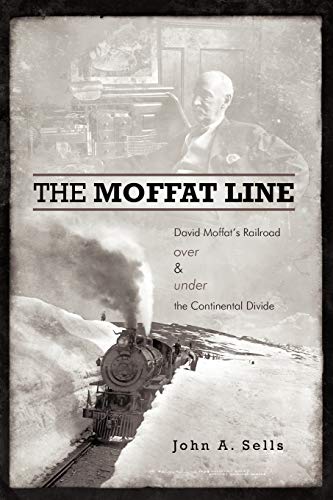
By the latter part of the nineteenth century, the railroad was king. Railroad lines crisscrossed the North American continent, allowing for the long-distance transportation of oil, coal, lumbar, gold, and other valuables. Despite high operating costs and fierce competition, the search for better and more profitable routes was constant. David Moffat, a banker and railroad executive, dreamed of a direct route across the Rocky Mountains, a route that would allow him to tap into Colorado's vast mineral wealth. There was, however, one major obstacle standing in his way-the 13,660-foot Continental Divide. The Moffat Line tells the story of David Moffat and the impossible dream that led to the 1927 completion of the Moffat Tunnel. The story is also about the men who drove the trains and built and operated the railroad under incredible weather and equipment challenges-day and night. Together, Moffat's vision and the exploits of the railroad workers combine to produce a fascinating chapter in the history of the American West.
THE MOFFAT LINE
David Moffat's Railroad over and under the Continental DivideBy John A. SellsiUniverse, Inc.
Copyright © 2011 John A. Sells
All right reserved.ISBN: 978-1-4620-2654-8Contents
Preface.............................................................................IXChapter 1: Moffat Background........................................................1Chapter 2: The Rio Grande Railroad..................................................11Chapter 3: Crossroads...............................................................20Chapter 4: Friend And Foe...........................................................22Chapter 5: Getting Started..........................................................35Chapter 6: The Rollins Pass Trail And John Quincy Adams Rollins.....................45Chapter 7: Dangerous Trial And Error................................................67Chapter 8: It Is Never Routine......................................................80Chapter 9: Gore Canyon..............................................................85Chapter 10: Day By Day..............................................................88Chapter 11: Near Disaster...........................................................91Chapter 12: Railroading.............................................................95Chapter 13: Moffat Legacy...........................................................103Chapter 14: Honorable Mention: Gandy Dancers........................................104Chapter 15: The Moffat Tunnel.......................................................112End Notes...........................................................................119Bibliography........................................................................123Index...............................................................................127
Chapter One
Moffat Background
This is a story about a man with a vision of a railroad going through a tunnel under the Continental Divide, but first David Moffat and his few loyal investors had to cross over the spine of the American continent. The Moffat family (spelled in a variety of ways) has two theories of origin. The simplest is directly to and from Scotland. The more detailed history finds the name progressing north from Italy, through France into Normandy, and then following William the Conqueror across the channel into England. From there, the thread leads to Scotland and, for some, over to Ireland. Today the representation is international.
The first Moffat to settle in the New World—Samuel and his wife Anne Gregg—sometime in the 1720s, located a spot on the upper Hudson River near present-day Newburgh, New York. Samuel and Anne had twelve children and all lived to at least adulthood, which was unusual for the time. Moreover, the Moffat progeny reportedly supported the Revolution during a divisive period and thereafter played a progressive part in business and local politics. The early genealogy is set down in limited form in the McLaughlin book and in manuscript detail. It is more than need be repeated here. Basically, the Moffat family—as it rapidly grew—was from all accounts a close-knit and productive group for over two hundred years, and there still remains a scattered linkage about the world. The centers of the American roots are Blooming Grove and Washingtonville, New York. The Washingtonville name was in deference to George Washington. The two towns and a museum and library exist today as one within the other. To the east is Newburgh, with State Road 208 serving as the artery, as it did in the early days as a rural road.
Patriarchs
David Halliday Moffat Sr., one of the twelve children born to Samuel and Anne Gregg, lived from March 1780 until October 1863. Some of the historical background suggests that he could barely support his large family of eight children. Besides farming, he owned a feed mill, which was twice destroyed by fire. Later, he reportedly was into premium butter production with another Moffat, and they marketed to New York City. As an aside, the oldest operating winery in the country, according to Moffat Library manuscripts, can be traced back to 1839 and John Jacques, a Moffat relation.
David H. Moffat Jr., one of eight children, was born July 23, 1839, and his childhood was spent among a growing Moffat family in Washingtonville. At the early age of eleven, he may have left home for New York City to work as a messenger for the New York Exchange Bank (now Irving Exchange bank). By age sixteen, he reportedly was an assistant to the bank teller. Although the real extent of his duties is not clear, it was not that uncommon for young people at the time to bear some significant responsibilities.
Samuel Moffat, the eldest child of David Moffat Jr., probably recalling the desperate times of his parents and his seven siblings, experienced the first call of the Western Frontier and moved to Des Moines, Iowa, in 1851 to take a bank cashier position. The community was founded in 1845 in a rich agricultural region. Samuel was soon writing letters encouraging any Moffat to pick up and relocate some 1,200 miles west to join him. Most seem to have passed on the invitation. However, his parents—along with his younger brother David Moffat Jr.—made the decision to go West, traveling in the comfort of the New York and Erie Railroad.
With Samuel's referral and David's New York Exchange Bank experience, the transition probably went well enough. Employees with money management skills on the frontier were in short supply. While at the New York Exchange Bank, David Moffat Jr. had become a close friend of Benjamin F. Allen. Aside from Samuel, it may have been the influence of Allen that sealed Moffat's decision to go along with his family to Des Moines. While there, he worked at the A. J. Stevens Bank.
On His Own
Benjamin Allen had bigger plans, however, and he soon moved 135 miles west to Omaha where he planned to establish a "financial center." Moffat soon followed Allen to Omaha and a job as cashier for the Bank of Nebraska. However, even with the tight family bonding, the raw frontier of Omaha was a world away from Des Moines and David Jr. left alone. Unknown to Moffat, he was at the right spot at the right time. In the later years, family members reportedly may have joined Moffat in Denver.
During his Omaha experience, Moffat found time away from banking to buy and sell real estate. His efforts paid off, because by 1859, at age twenty and with escalating land values, he was a paper millionaire. Despite the heady experience, he was still a minor and William Byers, who became a mentor and a lifelong friend, had to complete the paperwork until he left for Denver to begin his newspaper career as publisher of The Rocky Mountain News.
Moffat enjoyed Omaha and its frontier people. His charisma, initiative, and character brought him in contact with the right people. The earlier role models of a flock of aunts, uncles, cousins, parents, siblings, and grandparents had left their mark. He was soon in the social swirl and, although Omaha was a tiny town where it was easy enough to get shot, people living there or passing through had a better view of the Western potential. During his three years in Omaha, Moffat became close friends with George Kassler. Kassler would move on to Denver and an influential business career in water development. As mentioned, he also held a friendship with William Byers. Byers eventually left Omaha for Denver in April 1859 and endured six...