Inhaltsangabe
"Learn how to live and you'll know how to die; learn how to die, and you'll know how to live."
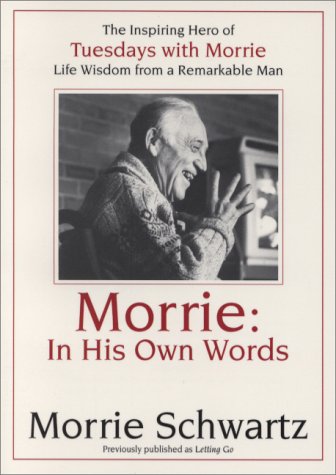
In these remarkable pages are the profound, life-affirming words of Morrie Schwartz as he faced his own imminent death.
In 1994, at the age of seventy-seven, Schwartz learned he had ALS, commonly known as Lou Gehrig's disease. Undaunted, the former professor embraced his illness, choosing to live passionately and calmly until the end. He also embarked on his greatest teaching adventure: sharing his evolving knowledge of living while dying.
With warmth, wisdom, and humor, Morrie reveals how to:
-- live fully in the moment
-- tap into the powers of the mind to transcend physical limitations
-- grieve for your losses
-- reach out to family and friends
-- develop an inner space for meditation and spiritual connection.
It's never too late to become the kind of person you'd like to be. Morrie shows the way in his magnificent legacy of love, forgiveness, transcendence, and redemption, a guide to living fully to the end of your days.
Morrie's willingness to talk about his illness made him an inspiration. In 1995 Nightline ran three interviews in which Ted Koppel spoke to Morrie about life, death and the disease that was afflicting his body.
In Morrie: In His Own Words, Morrie combined inspiring lessons with practical advice to help those who have chronic or terminal sickness and to help those close to them maintain healthy emotions and loving relationships. As life-affirming as it is life-releasing, Morrie: In His Own Words will have a profound effect on generations of readers.
Auszug. © Genehmigter Nachdruck. Alle Rechte vorbehalten.
INTRODUCTION
Paul Solman
His name: Morris Schwartz. "But call me Morrie," he insisted, even to Ted Koppel, who obliged on three Nightline specials in 1995, half-hour interviews which helped make this wise old man a national icon.
Morrie's reason for appearing on network television was as straightforward as the man himself: At age seventy-eight, more fully alive than ever, Morrie was dying -- of a degenerative disease known as amyotrophic lateral sclerosis (ALS), or Lou Gehrig's disease. And though actually a rather humble guy, Morrie realized he could use the media for one final accomplishment in an achievement-filled life: to flush death out of the closet, to help people talk openly about illness, decay, and the end we all share.
"Learn how to live," Morrie wrote, "and you'll know how to die; learn how to die, and you'll know how to live." Morrie's message was not only for the sick and those close to them, but for the healthy as well. His was a way of looking at the world, a point of view he expressed on Nightline, in the Boston Globe, and on radio and television nationwide.
And people responded, powerfully. Morrie struck a nerve. Hundreds of viewers, listeners, and readers wrote to him -- for advice, for comfort, but most of all to thank him for giving a voice to issues they have been struggling with in silence.
After all, here was a man with a disease that destroys, without exception, the ability of nerves to signal muscles. The muscles stop working and atrophy, in Morrie's case starting with the legs. Then you die.
But Morrie's response to the death sentence was to create a sort of living memorial service. A joyous one. He watched Marx Brothers movies, steeped himself in all the humor he could find. He let friends know he wanted them to visit. And he began writing the aphorisms which form the core of this book.
The book is, in a sense, Morrie's last will and testament -- of how to live passionately and calmly, right to the end. As he lost muscle function he handwrote the aphorisms ever more slowly and unsteadily, but with surer and surer conviction. He thought at first they could stand on their own without elaboration. But he came to realize that most readers need help putting them into practice. The aphorisms are written in a sort of how-to shorthand: They're mantras that, by themselves, can seem as formidable as they are profound.
"Grieve and mourn for yourself not once or twice, but again and again," Morrie writes.
But how? We're not all Morries. Most of us don't know why we should grieve and mourn, don't know how.
And so Morrie began to dictate the biographical commentaries that accompany the aphorisms -- trying to help teach readers how he'd arrived at the aphorisms, how he meant for people to understand them, and most of all, how to help readers apply the aphorisms and internalize them.
The taping took place over the course of several months and sometimes the effort was enormous. By the end, struggling to cough to bring up phlegm, Morrie could only watch as the microphone slipped off his chest and wait for it to be propped back up. But the more we taped, the more apparent it became that not only were the aphorisms workable, they were part of something much larger. Morrie had a consistent worldview, one that had been evolving for most of his life and that he was only now articulating as a whole. To paraphrase it may sound hokey to some, reassuringly familiar to others. But regardless, to Morrie, life was a process of opening oneself lovingly--to other people, to the world, ultimately, to something larger than ourselves. To the last instant, Morrie was full of wonder and joy. The way he lived his final year was this great teacher's final lesson.
The aphorisms flow from his worldview; the worldview, in turn, from Morrie's biography. And so it helps to know something about him before taking on the text.
A short, freckle-faced redhead, born in Chicago of Russian Jewish immigrants and brought up in the New York ghetto, Morrie "dressed like a schlepper, with half-pants that came to my knees," as he described himself in one of his last interviews. He was, he remembered, "always kind of cheerful, but sad inside." That's because his mother died when he was eight, forcing her son to withdraw into himself.
"I had become aware of vulnerability," he said, "that something precious could be snatched away at any moment."
Growing up motherless sensitized Morrie to loss and his need for other people. A nurturing stepmother who adored both Morrie and his younger brother instilled a compassion for others, combined with a passion for learning.
Morrie made it to New York's tuition-free City College. Turned down for military service in World War II because of a punctured eardrum, he decided to apply to graduate school. He was torn between sociology and psychology.
"I'd always been interested in psychology," Morrie said. "What tipped the scales was that psychology involved working with rats." He wound up studying sociology at the University of Chicago.
Reading the likes of Carl Rogers, Harry Stack Sullivan, and Martin Buber, Morrie responded to their philosophy: open yourself up to what you're really feeling. The emphasis wasn't solely on the individual, as psychology would have it, or strictly on society, as the word "sociology" suggests. Instead, Morrie was drawn to the connection between the two: an emerging field known as social psychology.
With Morrie's first job came his first epiphany, because in order to work on a research project at a mental hospital, he had to undergo psychoanalysis.
"I started to understand the full impact of my mother's death...and mourn my loss," he said in his last interview. Morrie described therapy as "cathartic"; it was his first experience with seeing himself at a distance, becoming a witness to himself. As the aphorisms make clear, this became a key technique for coping with his death.
In collaboration with Alfred H. Stanton, Morrie began working on a ward in a nontraditional psychoanalytic mental hospital, watching the troubled and tormented, observing the staff and their relationships with patients. What struck him was the huge influence the attitudes of those around them had on the patients. Morrie was there to observe and talk with everyone--even those patients crouching alone in the corners. He related to them civilly, humbly. He opened his heart as best he could. Gradually, he got them to respond. The importance of opening oneself to others, no matter who they are, and the impact of community on the individual became clear to him.
The book that resulted from the research, "The Mental Hospital" by Stanton and Schwartz, became a classic of social psychology, influencing an entire generation of practitioners. Not long after the book's publication, Morrie was offered a faculty position at Brandeis. For almost four decades, to a year before his death, he continued to be a participant-observer. His undergraduate course on "group process" was an annual laboratory in learning to be nonjudgmental, to see yourself as a part of a community and open yourself to it. In short, Morrie spent the rest of his life practicing what he had begun to preach.
He had help. To his wife and two sons, he attributed his ability to suppress his ego, to understand that others can be even more important to you than you yourself are.
To "Greenhouse," a low-fee psychotherapy organization and community he formed with friends and colleagues in the '60s, he ascribed his ability to mourn loss, starting with his mother and ending with himself.
To his colleagues in the then-radical...
„Über diesen Titel“ kann sich auf eine andere Ausgabe dieses Titels beziehen.