
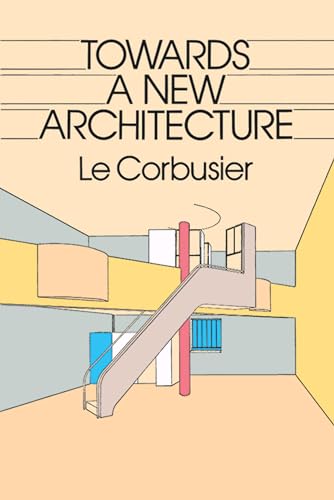
Towards a New Architecture
Le Corbusier, (Introduction) Frederick Etchells
ISBN 10: 0486250237 ISBN 13: 9780486250236
Verlag: Dover Publications, Inc., 1986
Neu
Paperback
Verkäufer
Strand Book Store, ABAA, New York, NY, USA
Verkäuferbewertung 4 von 5 Sternen

Heritage Bookseller
AbeBooks-Mitglied seit 1996
Dieser Artikel ist nicht mehr verfügbar.
Beschreibung
Beschreibung:
Bestandsnummer des Verkäufers 2413443
Inhaltsangabe:
For the Swiss-born architect and city planner Le Corbusier (Charles-Édouard Jeanneret, 1887–1965), architecture constituted a noble art, an exalted calling in which the architect combined plastic invention, intellectual speculation, and higher mathematics to go beyond mere utilitarian needs, beyond "style," to achieve a pure creation of the spirit which established "emotional relationships by means of raw materials."
The first major exposition of his ideas appeared in Vers une Architecture (1923), a compilation of articles originally written by Le Corbusier for his own avant-garde magazine, L'Esprit Nouveau. The present volume is an unabridged English translation of the 13th French edition of that historic manifesto, in which Le Corbusier expounded his technical and aesthetic theories, views on industry, economics, relation of form to function, the "mass-production spirit," and much else. A principal prophet of the "modern" movement in architecture, and a near-legendary figure of the "International School," he designed some of the twentieth century's most memorable buildings: Chapel at Ronchamp; Swiss dormitory at the Cité Universitaire, Paris; Unité d'Habitation, Marseilles; and many more.
Le Corbusier brought great passion and intelligence to these essays, which present his ideas in a concise, pithy style, studded with epigrammatic, often provocative, observations: "American engineers overwhelm with their calculations our expiring architecture." "Architecture is stifled by custom. It is the only profession in which progress is not considered necessary." "A cathedral is not very beautiful . . ." and "Rome is the damnation of the half-educated. To send architectural students to Rome is to cripple them for life."
Profusely illustrated with over 200 line drawings and photographs of his own works and other structures he considered important, Towards a New Architecture
is indispensable reading for architects, city planners, and cultural historians?but will intrigue anyone fascinated by the wide-ranging ideas, unvarnished opinions, and innovative theories of one of this century's master builders.
Auszug. © Genehmigter Nachdruck. Alle Rechte vorbehalten.:
Towards a New Architecture
By LE CORBUSIERDover Publications, Inc.
Copyright © 1986 Dover Publications, Inc.
All rights reserved.
ISBN: 978-0-486-25023-6All rights reserved.
Contents
INTRODUCTION,
ARGUMENT,
THE ENGINEER'S ÆSTHETIC AND ARCHITECTURE,
THREE REMINDERS TO ARCHITECTS:,
I. MASS,
II. SURFACE,
III. PLAN,
REGULATING LINES,
EYES WHICH DO NOT SEE:,
I. LINERS,
II. AIRPLANES,
III. AUTOMOBILES,
ARCHITECTURE:,
I. THE LESSON OF ROME,
II. THE ILLUSION OF PLANS,
III. PURE CREATION OF THE MIND,
MASS-PRODUCTION HOUSES,
ARCHITECTURE OR REVOLUTION,
CHAPTER 1
ARGUMENT
THE ENGINEER'S ÆSTHETIC AND ARCHITECTURE
THE Engineer's Æsthetic, and Architecture, are two things that march together and follow one from the other: the one being now at its full height, the other in an unhappy state of retrogression.
The Engineer, inspired by the law of Economy and governed by mathematical calculation, puts us in accord with universal law. He achieves harmony.
The Architect, by his arrangement of forms, realizes an order which is a pure creation of his spirit; by forms and shapes he affects our senses to an acute degree and provokes plastic emotions; by the relationships which he creates he wakes profound echoes in us, he gives us the measure of an order which we feel to be in accordance with that of our world, he determines the various movements of our heart and of our understanding; it is then that we experience the sense of beauty
THREE REMINDERS TO ARCHITECTS
MASS
Our eyes are constructed to enable us to see forms in light.
Primary forms are beautiful forms because they can be clearly appreciated.
Architects to-day no longer achieve these simple forms.
Working by calculation, engineers employ geometrical forms, satisfying our eyes by their geometry and our understanding by their mathematics; their work is on the direct line of good art.
SURFACE
A mass is enveloped in its surface, a surface which is divided up according to the directing and generating lines of the mass; and this gives the mass its individuality.
Architects to-day are afraid of the geometrical constituents of surfaces.
The great problems of modern construction must have a geometrical solution.
Forced to work in accordance with the strict needs of exactly determined conditions, engineers make use of generating and accusing lines in relation to forms. They create limpid and moving plastic facts.
PLAN
The Plan is the generator.
Without a plan, you have lack of order, and wilfulness.
The Plan holds in itself the essence of sensation.
The great problems of to-morrow, dictated by collective necessities, put the question of "plan" in a new form.
Modern life demands, and is waiting for, a new kind of plan, both for the house and for the city
REGULATING LINES
An inevitable element of Architecture.
The necessity for order. The regulating line is a guarantee against wilfulness. It brings satisfaction to the understanding.
The regulating line is a means to an end; it is not a recipe. Its choice and the modalities of expression given to it are an integral part of architectural creation.
EYES WHICH DO NOT SEE
LINERS
A great epoch has begun.
There exists a new spirit.
There exists a mass of work conceived in the new spirit; it is to be met with particularly in industrial production.
Architecture is stifled by custom.
The "styles" are a lie.
Style is a unity of principle animating all the work of an epoch, the result of a state of mind which has its own special character.
Our own epoch is determining, day by day, its own style.
Our eyes, unhappily, are unable yet to discern it.
AIRPLANES
The airplane is the product of close selection.
The lesson of the airplane lies in the logic which governed the statement of the problem and its realization.
The problem of the house has not yet been stated.
Nevertheless there do exist standards for the dwelling house.
Machinery contains in itself the factor of economy, which makes for selection.
The house is a machine for living in.
AUTOMOBILES
We must aim at the fixing of standards in order to face the problem of perfection.
The Parthenon is a product of selection applied to a standard.
Architecture operates in accordance with standards.
Standards are a matter of logic, analysis and minute study; they are based on a problem which has been well "stated." A standard is definitely established by experiment.
ARCHITECTURE
THE LESSON OF ROME
The business of Architecture is to establish emotional relationships by means of raw materials.
Architecture goes beyond utilitarian needs.
Architecture is a plastic thing.
The spirit of order, a unity of intention.
The sense of relationships; architecture deals with quantities.
Passion can create drama out of inert stone.
THE ILLUSION OF PLANS
The Plan proceeds from within to without; the exterior is the result of an interior.
The elements of architecture are light and shade, walls and space.
Arrangement is the gradation of aims, the classification of intentions.
Man looks at the creation of architecture with his eyes, which are 5 feet 6 inches from the ground. One can only deal with aims which the eye can appreciate, and intentions which take into account architectural elements. If there come into play intentions which do not speak the language of architecture, you arrive at the illusion of plans, you transgress the rules of the Plan through an error in conception, or through a leaning towards empty show.
PURE CREATION OF THE MIND
Contour and profile are the touchstone of the architect.
Here he reveals himself as artist or mere engineer.
Contour is free of all constraint.
There is here no longer any question of custom, nor of tradition, nor of construction nor of adaptation to utilitarian needs.
Contour and profile are a pure creation of the mind; they call for the plastic artist
MASS-PRODUCTION HOUSES
A great epoch has begun.
There exists a new spirit.
Industry, overwhelming us like a flood which rolls on towards its destined ends, has furnished us with new tools adapted to this new epoch, animated by the new spirit.
Economic law inevitably governs our acts and our thoughts.
The problem of the house is a problem of the epoch. The equilibrium of society to-day depends upon it. Architecture has for its first duty, in this period of renewal, that of bringing about a revision of values, a revision of the constituent elements of the house.
Mass-production is based on analysis and experiment.
Industry on the grand scale must occupy itself with building and establish the elements of the house on a mass-production basis.
We must create the mass-production spirit.
The spirit of constructing mass-production houses.
The spirit of living in mass-production houses.
The spirit of conceiving mass-production houses.
If we eliminate from our hearts and minds all dead concepts in regard to the house, and look at the question from a critical and objective point of view, we shall arrive at the "House-Machine," the mass-production house, healthy (and morally so too) and beautiful in the same way that the working tools and instruments which...
„Über diesen Titel“ kann sich auf eine andere Ausgabe dieses Titels beziehen.
Bibliografische Details
Titel: Towards a New Architecture
Verlag: Dover Publications, Inc.
Erscheinungsdatum: 1986
Einband: Paperback
Zustand: New