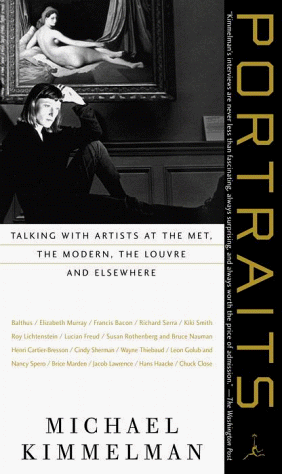
Inhaltsangabe
The chief art critic for "The New York Times" gives a painter's-, sculptor's-, and photographer's-eye view of art as he explores museums with some of today's most important artists. Photos throughout.
Auszug. © Genehmigter Nachdruck. Alle Rechte vorbehalten.
I was born in this century, but I belong much more to the nineteenth-century," says Balthasar Klossowski, known to the world as the painter Balthus. As it happens, Balthus was born on February 29, 1908, a quirk of fate, he likes to joke, that makes him twenty-two. The poet Rainer Maria Rilke once told him that being born on leap day was like slipping through a crack in time; it gave Balthus access, Rilke said, to a "kingdom independent of all the changes we undergo." For years he has contrived to live in that kingdom, in life as in his archaizing art, divorced from his time in a realm of his own devising.
Balthus has been described as a realist painter, but he is a realist of a singular and imaginary sort. His portraits and figure studies, painstakingly and thickly painted, have a calculated naïveté and a predilection for precisely drawn yet somehow mysterious imagery, full of oddities of scale and gesture. His landscapes are dreamy, almost fairy-tale scenes bathed in a granular light, images of time in abeyance. There's a geometry and flatness to the art that can be described as modernist, but in every way Balthus has tried to put distance between himself and the principal goings-on in art of the twentieth century.
I have come on a spring day in 1996 to visit him in his sprawling eighteenth-century chalet in Rossiniere, a tiny Swiss mountain village, between Montreux and Gstaad. He and his wife, Setsuko Ideta, also a painter, have lived here for more than twenty years. They tell me that they came once when it was an hôtel garni, found it to be for sale and bought it.
The steep rising hills and, on this day, the soft spring colors can bring to mind some of Balthus's gauzy landscapes from a time before he moved here, as if this were a fulfillment of a vision he had had years ago. Before Rossiniere, Balthus lived in grand and often conspicuously remote houses in France and Italy. During the 1950s he painted the view from his dilapidated château de Chassy in the mountainous region of the Morval in central France. Those pictures come to mind here, where Balthus enjoys a kind of isolation.
Almost proudly he makes a point of the fact that he has never been to the United States, not even for his own retrospectives over the years at the Museum of Modern Art and the Metropolitan Museum in New York. Balthus has agreed to meet for a few hours. Today he is dressed in a seaweed-green Japanese abbot's robe, short black boots over bright red socks, a gold chain around his neck. Thick glasses perch on his nose. His gray hair is brushed straight back. You can see that he was handsome when he was younger. Though he speaks slowly, in a gravelly voice, he has lost none of his mischievousness or preening finesse. A chain-smoker, he keeps a lighted cigarette bouncing in the corner of his mouth when he talks. "You don't smoke?" he asks me at one point, then, with a dismissive arch of his eyebrows, answers himself: "No, of course not. You're an American." Setsuko, an alert, piquant woman in her early fifties, wears a blue kimono with red sash, her lips bright red, her face white. Filipino servants flutter about the room. I feel vaguely that I have stumbled into a Sax Rohmer novel.
Knowing his famous reluctance to say much about himself, I have brought along a book of paintings from the Louvre to talk about because many of the works that have influenced him, the ones he has echoed most often in his art, come from the Louvre. He went there countless times as a young man teaching himself to paint.
"The Louvre was the most instructive place for me," he says, "and chiefly because I looked at Poussin." At seventeen, Balthus copied Poussin's Echo and Narcissus there, and later he adapted the figure of the reclining Narcissus in several paintings, as he has adapted other figures from other Poussins, like the sleeping Rinaldo from Rinaldo and Armida in Thérèse Dreaming, a languid image, mildly erotic, of a child rapturously dozing.
"I taught myself to paint, and I went to the Louvre to find how the great painters did it. There I understood that if you do not have the means of telling something, you have nothing. Poussin came out of a time when art was a craft. To make an art like the art of the seventeenth century, when Poussin was alive, is impossible today because artists no longer know how it's done."
Balthus has got on to a favorite subject, the decline of civilization. "You know, the human being was quite different in Poussin's period," he says, a theory he has put forward before. "And the human being has completely changed, especially since the war. Before the war there was another kind of humanity, but I'm convinced that something has happened to mankind, something terrible, that Mr. Hitler let something diabolic into the atmosphere. There's no longer any culture, if you've noticed."
Balthus is scythelike, a wraith. These days he needs help to cross a room. He hears with difficulty, and his eyes are too weak to allow him to draw. Setsuko says she assists him in his studio, calling herself his "studio boy."
Just how much assistance she has given him lately is a matter of some art-world gossip. Always slow to finish a painting, he has exhibited only one new painting in the last few years, though he says he paints every day. A friend, the writer Claude Roy, once likened him to a cat: "brilliant, but in that very brilliance, reserved, skittishly secret, courteously open yet hermetically closed." And it is true, Balthus is evasive, and one can get the impression that his remarks-everything about his extravagant persona, in fact-are a little fantastical and to be taken with a grain of salt.
For instance, years ago, to the bafflement of friends, he let it be known that he was of noble birth and that his rightful name was the Count de Rola, and moreover he declared, despite his German, Russian and Polish ancestry, a family connection between himself and Byron (in whose onetime home, the Villa Diodati, near Geneva, Balthus happened to live for a time). "We come from a very bloody clan," Balthus claims, and I think I detect fleeting amusement on Setsuko's part. Other people have not been so amused by his reluctance to acknowledge his Jewish ancestry, which includes a maternal grandmother and a grandfather who was a cantor in Breslau, nor by the lengths to which he has sometimes gone to attack those who have pointed out his heritage.
Until lately, Balthus had a horror of interviewers and photographers, which is not to say he wasn't sociable. It is, of...
„Über diesen Titel“ kann sich auf eine andere Ausgabe dieses Titels beziehen.