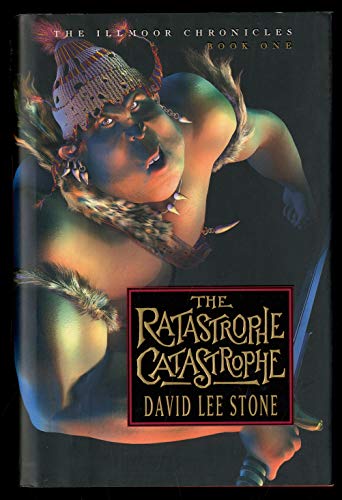
Diek Wustapha is a normal shepherd boy-until a dark, evil magic instills him with the power to charm man and beast with his magic flute. When the ancient town of Illmoor is plagued by an infestation of giant rats, Diek offers to lead the rodents to their doom. But when the dim-witted Duke of Illmoor refuses to reward him, Diek seeks revenge by kidnapping the town's children. Just when it seems the children are gone for good, a team of misfit mercenaries-Groan, a buck-toothed Giant, Gordo, a wise-cracking dwarf, and Tambor, a has-been sorcerer-set out on a bumbling journey to stop Diek, and save the children. But will they be too late?
The Illmoor Chronicles
The Ratastrophe CatastropheBy David Lee StoneHyperion Books
Copyright © 2004 David Lee Stone
All right reserved.ISBN: 9780786851287Chapter One
WHOOSH ...
Diek Wustapha dropped his flute. The leather-bound book that had been resting on his lap tumbled to the floor and lay open, its pages flapping in the breeze.
"What is it, lad?"
The boy turned and looked up at his father, his smile was apprehensive. "I thought I heard something, Dad."
"That'll be the cattle cart," said his father, quietly grateful that his son had stopped playing; Diek's musical ability suggested possible employment in the torture trade.
Mr. Wustapha looked out over a broad expanse of west-country farmland, his brow creased. A few cows in the field opposite had wandered over to the gate and were mooching idly about.
"No, it was more like a feeling than a sound. I thought I felt something."
"Well, that'll be your dinner," his father continued, reflecting on years of terror at the dinner table. Mrs. Wustapha was one of a long line of cooks on her mother's side of the family. He hoped fervently she would be the last. "You know something, boy, when I first met your ma, she used to make puddings the like of which would turn your stomach inside out for days on end."
"Yes, Dad. So you've told me. Repeatedly."
"Fair enough. You're reading again, I see?"
Diek nodded, sliding his flute under a rock with the heel of his boot. He snatched up the book. "It's called Ancient Royal Fables."
"Good lad," said his father, patting the boy affectionately on the shoulder. "Have you got to the bit where Huud the Wise tells Prince Kellogg to go round up the sheep?"
"No, Dad."
Diek looked up. His father was waiting patiently, a grin spreading across his broad face.
"I'll go and round the sheep up now, Dad," he said, with a knowing smile.
Diek got to his feet and set off toward the north field. His father watched him go.
Diek wasn't a bad lad, he thought, at least, not in the conventional sense. He just dawdled from time to time, lacked direction. Perhaps he should take his brother's advice and send Diek to Legrash for the summer, let him experience a bit of the real world. What harm could it do?
He stroked his chin thoughtfully, wondering exactly how much trouble a young boy could get into in a town like Legrash. A boy like Diek. Probably best not to speculate. He whistled a merry tune and headed off to see how his son was getting on with the sheep.
The magic sank into Diek's mind like a stone plunging down a deep well. There it lay low, biding its time with patience born of millennia lingering in deep caverns, lurking in dormant hollows.
When the magic decided to surface, it did so with such reptilian guile that no human eye could detect the change. Diek Wustapha, however, was cursed with the ownership of a barrowbird with particularly keen sight.
The barrowbird is a curious creature indeed. One of the High Art's darker throwbacks, it was rumored to have once been an ordinary scrawny relative of the forest hornbill. Legend holds that on the few occasions throughout history when the gods decided to visit Illmoor, they did so by inhabiting the minds of barrowbirds. On one such occasion, it is said that one particularly spiteful god decided to leave something behind: the curse known as Vocalis Truthilium, commonly translated as "I speak as I find."
And the barrowbird did just that. In fact, it gave a new and terrible meaning to the phrase. No personal comment was beyond it. Despised as a species, its put-downs included such harsh observations as "You'll never get a girlfriend unless you actually cut that ear off," and the oft heard "If I had a figure like yours, love, I'd stay indoors for the duration."
Now Diek's own barrowbird was treating him to a baleful stare. "There's somethin' amiss with your right eyeball," it chirped. "'S glowin' like an ember, ain't it?"
"Is it?"
Diek blinked and raised a hand to his head. He'd been propped against one corner of the pigpen all morning, watching the truffle hogs misbehaving. "Maybe I'm coming down with something," he said, beginning to wander off around the side of the pen. "I do feel a bit odd."
He reached for his flute and brought the instrument to his lips, but was interrupted before he was able to muster a tune.
"Could be fouleye," the barrowbird squawked. "You hear of a lot of folk dyin' from that."
"Dying? It's fatal?"
"Right as mustard. You ask anyone: 'How's your daughter, Milly?' 'Fouleye took her.' 'How's your aunty Ethel?' 'Down with fouleye.' One minute you can be runnin' around in a field, the next you're a goner. That's usually the females, mind. I never heard of a male taken with it yet."
"Okay, okay. It's probably not that, then."
Diek produced a single, shrill note from the flute, then stowed it away in his tunic. He didn't feel much like playing today; his heart really wasn't in it.
He sighed and closed his eyes tight, then tentatively opened them again. "Has it gone?" he asked.
"Has it, heck!" said the barrowbird. "Now they're both alight! Well, stone me. You're not standin' on a lightnin' rod or somethin', are ya?"
Diek took a step back, then looked around. "I'm not standing on anything," he said. "Besides, you noticed it when I was over there."
The barrowbird put its head on one side. "Then, if I were you, I'd go and see the apothecary or, come to that, the village witch."
"I need to do my chores. Besides, why would I want to see a witch?"
"Well, first there's the eye thing, and then maybe you could find out why you're suddenly such a magnet for the pigs."
"Huh?"
Turning about on his heels, Diek noticed for the first time that all twelve of his father's hogs had followed him along the length of the pen and were now squatting in a group just beyond the fence. Curious. Usually, they ignored him completely, unless he had scraps. "Th-that's odd."
"Odd ain't the word, boy. 'F y'ask me, you're up the creek without a shovel."
"I think that's supposed to be a 'paddle,' and I feel fine, thank you. Now, I'm going to see to the milking ... alone."
The barrowbird hopped onto a nearby tree branch, and watched Diek skulk toward the milking shed. "Somethin' amiss," it muttered. "Somethin' amiss, right enough"
The milk was curdled. Rather, it hadn't been curdled when Diek had first picked up the bucket, but it was definitely curdled now.
Diek tipped the bucket, shaking his head as a series of fat, creamy blobs plopped onto the bench below. Odd. He took a step back, turned on his heels and stopped dead. All the cows were staring at him, their tails swishing in the shadows of the milking shed. There was definitely something wrong; they usually took no notice of him whatsoever.
Maybe it was time to see an apothecary....
Diek's visit to the apothecary wasn't entirely successful. The man, like most of the villagers, largely ignored everything Diek had to say, before supplying him with a strange potion that looked and tasted like seven-year-old jam. He was to take it three times a day, as instructed, or alternatively, whenever he "felt a bit odd." The old man certainly hadn't given him any useful advice, and quickly changed the subject when his flowers wilted as Diek got up to leave. On reflection, Diek had practically been thrown out of the shop, in the...