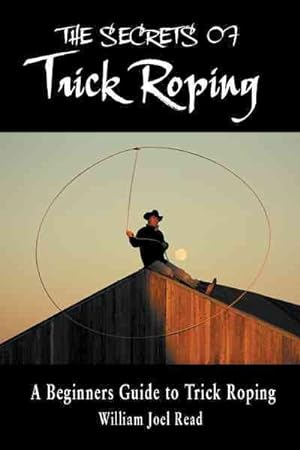
This is a great book for anyone who wants to learn how to trick rope. I give away all my tips on how to get started, what types of ropes to use and how to perform all of the famous tricks. I have been performing since i was 15 at school assemblies, rodeos and many other social events. Because i went through all the trial and error of learning to trick rope, i am able to give you the secrets you will need to help you master the rare the art.
The Secrets of Trick Roping
A Beginners Guide to Trick RopingBy William Joel ReadAuthorHouse
Copyright © 2012 William Joel Read
All right reserved.ISBN: 978-1-4685-4497-8 Contents
Chapter 1: Types of Ropes.......................1Chapter 2: Hondas...............................3Chapter 3: Leather Burner.......................5Chapter 4: Flat Spin............................7Chapter 5: The Wedding Ring.....................11Chapter 6: The Hand Shake.......................13Chapter 7: The Bounce...........................17Chapter 8: The Big Loop.........................21Chapter 9: The Texas Skip.......................25Chapter 10: The Butterfly.......................29Chapter 11: Roll Overs..........................33Chapter 12: Ocean Wave..........................37Chapter 13: The Flat Around.....................41
Chapter One
Types of Ropes
First, the types of ropes you choose make a huge difference. I never use a nylon team rope because they are to stiff and kink up really fast. Braided cotton ropes are the best for all tricks and they will make it much easier for you to learn. They are very flexible so you can spin your rope far longer before it kinks up and stops your routine. You can order cotton ropes online in at any length you would like. Just search for "cotton spot chord" or "trick ropes." I also use poly calf ropes, which are just right for many tricks. Since poly ropes are stiffer, I would advice staying away from them until your learn everything with a cotton rope.
Chapter Two
Hondas
Hondas are the small 3-inch eye at the end of your rope that holds the rope in a circle. You can tape, tie, or wire the end together. While you can perform all smaller tricks without weighted hondas, you will have to use metal hondas for the two biggest tricks that defy gravity. Those tricks are the "Texas Skip" and the "Big Loop." I will discuss those later in the book.
Chapter Three
Leather Burner
The leather piece around the honda that the rope slides through is called a burner. If you have a slick burner that comes with a regular calf rope, your loop will tend to slide shut quickly and you will have to spin the rope faster to keep it open. With a roughed up piece of leather you can slow all the tricks down and make it easier while learning. I always use an old worn out work glove and cut out a square piece of leather, punch four holes, and attach it with a wire or string (see picture in Chapter 1: Hondas). Once you have mastered all the tricks you will find you won't need a leather burner and that you can spin all tricks as fast as possible for a better performance.
Chapter Four
Flat Spin
"Flat Spins" are the easiest tricks of all. You want to start out with braided cotton or poly rope, around 14 feet long. Make sure you learn this trick on a flat surface so the grass or gravel does not interfere with the momentum of your loop. Make a circle and hold on about two feet from the honda and the end of the rope like I demonstrate in the picture. Now spin it once before letting go of the inside rope so that you are spinning a loop in a horizontal spin in front of you or to your side. Keep in mind that this is how you can start a spinning loop for all tricks. Also know that all tricks can be performed with either hand and in either spinning direction.
You can also learn how to step in and out of the flat loop spinning horizontally by your side with one foot called the "Texas Tommy". Or you can jump over the "spoke" (the rope in between your hand and the honda) with both feet, which is called the "Spoke Hop".
Chapter Five
The Wedding Ring
Now that you have learned the basic flat spin, you can learn how to jump in the loop so it's spinning around you. The "Wedding Ring" trick is actually easier than it sounds. You spin the flat loop in front of you and when the honda is at your feet you jump in and quickly position your spinning hand directly over the center of your head.
Another way to begin this trick is from starting it just like the "Flat Loop" to your side but instead turn your palm upwards and flip the loop up over your head with your arm and let it fall down around you into the "Wedding Ring". You can also start the "Wedding Ring" like the flat loop, only by spinning it around you instead. Start out by holding the end of the rope and the inside rope about three feet from the honda. Lay the open loop around you as you give it one fast spin to get the momentum going, before letting go of the inside rope of the loop you are in. You can use your other hand to help keep the circle open when you are taking your first spin. Once you give the rope it's first big spin you will notice the rope doesn't need much force to keep it spinning around you. The key here is keeping your spinning hand directly centered over your head and know that you only need your arm for the first big spin to get it going. It's all in the wrist after that. I have actually taught some people to do this trick in less than 10 minutes.
Chapter Six
The Hand Shake
The steps for the "Hand Shake" begin while spinning the "Wedding Ring". Drop your right hand down quickly across the front of your body to your left side. Next switch the end of the rope from right hand to left hand around your body and repeat these steps continuously.
CH7[ The Bounce
With this "Bounce" trick you can combine one "Handshake" with one "Wedding Ring" spin, where you move the spinning loop up and down around your body. Another harder and more spectacular way is to spin it up and down without a "Hand Shake" which is more difficult and requires faster spinning. This trick is basically a fast "Wedding Ring" being pulled toward and away from you using fast arm and wrist movements. This trick can also be done vertically or with a small "Butterfly" which is called the "Arm Juggle". ]CH7
CH8[ The Big Loop
Learning the "Big Loop" is going to require you to purchase a rope anywhere from sixty to a hundred feet in length depending on how much rope you can feed out before it drags the ground. Since this trick requires a lot of rope to fight gravity and air resistance, I always use a metal honda like in the photo in Chapter 2. You can find metal hondas online or at most ranch supply or hardware stores.
The "Big Loop" is just like the "Wedding Ring" but you will have to start out spinning a lot faster. To make it easier, stand on a barrel or a higher object to get you further away from the ground. To make starting the "Big Loop" easier, always start out with a vertical up and down loop. You are going to have to start with around a 10-foot vertical loop to your side and the remaining rope laid out to your other side. Take one big spin then let go of the inside rope and spin as fast as you can to keep the loop open. Once the loop is fully open, the weight and momentum of the metal honda will allow you to feed out the loop through your hands to slowly make it bigger. After a while you can let gravity take over and slowly level it out around you. Once you have mastered the big loop you can also try it out on your horse taking care not to let the loop hit your horse. ]CH8
CH9[ The Texas Skip
The "Texas Skip" trick is the most impressive and most difficult in my opinion. You are going to need a 24-foot metal weighted rope with a frayed leather burner to slow it down a bit. You can experiment with different weights by wrapping a heavy copper wire under the burner to see which weight keeps the loop open in a perfect circle.
Although you can spin the rope either direction for this trick, it is easier for me to spin a clockwise loop to my side big enough to jump through. When the honda gets to your feet, pull the rope across the front of your body and jump through the spinning loop. Now you can repeat the step, and jump back through it in several different combinations. You can spin the rope once, twice or three times on each side. I am also able to spin my body in a 360-degree rotation while jumping through continuously. It is also easier to do this trick while jogging forward or backwards believe it or not. ]CH9
CH10[ The Butterfly
The "Butterfly" trick is the same as the "Texas Skip" only it's a lot smaller. You are not jumping through it and you don't need a weighted honda. It is just two vertical spins on each side in front of you. Since the butterfly switches the direction of rotation on it's own from side to side each time, you can keep this going non-stop without kinks forming. Start with a 3-foot loop spinning at your side in either direction of rotation then bring it back and forth from side to side with your arm in front of you. If you spin it once on each side it's called a "Zigzag." You can also bring the "Butterfly" behind your back and around you about four times before it starts to kink up. Which at this point you can switch directions and around you to get all the kinks back out.
My favorite trick of all, because of the challenge is doing a continuous butterfly behind my back. I start out with a "Butterfly" in front of me and then bring it behind my back, where I keep it going back and forth behind my back. For this trick you are going to have to lean as far backwards as possible so it doesn't hit your back. Since this trick is going on behind you. It's only possible for you to look to your left and right to keep your eye on the spinning loop. 0
CH11[ Roll Overs
The "Roll Over" trick is actually pretty easy once you learn it. You start by doing a "Butterfly," then bring it to your side and behind you to let it roll over your shoulder. You can keep a shoulder roll going as long as you want because of the way this trick keeps it self from kinking up every time it rotates around and over you. Every time the loop rolls over your shoulder it turns right back into the butterfly. So basically a "Roll Over" is a "Butterfly" behind your back, only you bring it over you where it touches your shoulder every time it goes over you. You will notice the part of the loop that touches your shoulder stays put for a second, kind of like army tank tracks go over the ground. You can also learn to roll loops over the crease of your hat and arm with this same trick. 1
CH12[ Ocean Wave
The "Ocean Wave" is basically a continuing "Reverse Butterfly" behind the back and can be performed from either direction. The easiest way to learn this trick is to start with a 4-foot vertical clockwise loop to your right if you are right handed, left side if you are left handed. Next pull it across to the left, just as in the skip, except that the loop will travel in front of your body and around you. When the loop reaches the left side, it will be spinning in a counter-clockwise direction. Give it one full spin on the left side and at the same time bring your arm back over your head, which will carry the rope back far enough behind you to clear your body. From this point it is pulled across the back to the right side again where you first started this trick. It also makes it easier to learn if you tape the honda to the spoke where the rope won't slide shut while you are practicing. This trick will eventually kink up so you will have to do a "Flat Around" or "Wedding Ring" to change the ropes direction of the spin to unkink the rope. Another way to avoid the kink up problem is to purchase a lightweight aluminum swiveled honda and it won't be an issue. 2
CH13[ The Flat Around
The "Flat Around" trick is fairly easy and is a flat loop that you let spin all the way around the outside of your body in either direction. This trick will kink up after a few rotations around your body. To unkink it, I always switch into the "Wedding Ring" or "Ocean Wave". Also keep in mind that the "Ocean Wave" is like the "Flat Around." The only difference is when doing the "Ocean Wave" you take one underneath spin on you right side if your right handed, and one underneath spin on your left side if you left handed.
After you get the feel of all these tricks it will be as easy as riding a bike. I think the key to a good performance is to never stop spinning unless you need to switch ropes. You can also pick a volunteer from the audience and have them try a simple trick to show everyone how difficult trick roping can be.
I have also found the best way to learn is by watching videos so you can view the tricks in slow motion, making it is easier to study the exact hand movements required. My whole roping demo is on YouTube. Just search for "Will Read Trick Roping" and you can watch my video to see how these tricks look in action. I learned by watching the 1925 film "Roping Fool" by Will Rogers who is my namesake. Most of his awe-inspiring film is in slow motion so you can see exactly what to do if you are having trouble learning a certain trick.
Once you have been roping a while you will be able to see how all the tricks tie in with one another. You will also start coming up with your own combinations that will feel natural to you. Always remember your wrist and hand will be doing all the fast small spinning, while your arm moves the rope in different directions and positions around you. Always keep the coils rolled up tight in your hand and close to your body to keep it away from the traveling loop. You can also practice in the dark, in tall grass or in the wind to help you better master this rare art.
(Continues...) 3
Excerpted from The Secrets of Trick Ropingby William Joel Read Copyright © 2012 by William Joel Read. Excerpted by permission of AuthorHouse. All rights reserved. No part of this excerpt may be reproduced or reprinted without permission in writing from the publisher.
Excerpts are provided by Dial-A-Book Inc. solely for the personal use of visitors to this web site.