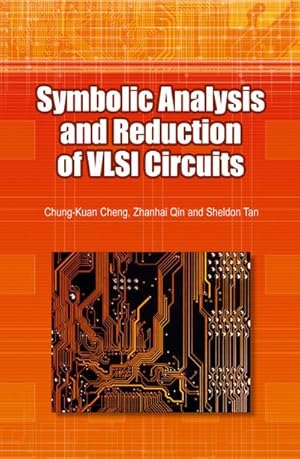
Symbolic Analysis and Reduction of VLSI Circuits
Sprache: Englisch
Verlag: Springer US Dez 2004, 2004
- Softcover
- Neu

Anbieter: BuchWeltWeit Ludwig Meier e.K., Bergisch Gladbach, DeutschlandBuchWeltWeit Ludwig Meier e.K.
AbeBooks-Verkäufer/-in seit 11. Januar 2012
Zustand: Neu
EUR 106,99
Anzahl: 2 verfügbar
In den WarenkorbArtikelbeschreibung vom Verkäufer
This item is printed on demand - it takes 3-4 days longer - Neuware -Symbolic analysis is an intriguing topic in VLSI designs.The analysis methods are crucial for the applications to the parasitic reduction and analog circuit evaluation. However, analyzing circuits symbolically remains a challenging research issue. Therefore, in this book, we survey the recent results as the progress of on-going works rather than as the solution of the field.For parasitic reduction, we approximate a huge amount of electrical parameters into a simplified RLC network. This reduction allows us to handle very large integrated circuits with given memory capacity and CPU time. A symbolic analysis approach reduces the circuit according to the network topology. Thus, the designer can maintain the meaning of the original network and perform the analysis hierarchically.For analog circuit designs, symbolic analysis provides the relation between the tunable parameters and the characteristics of the circuit. The analysis allows us to optimize the circuit behavior.The book is divided into three parts. Part I touches on the basics of circuit analysis in time domain and in s domain. For an s domain expression, the Taylor's expansion with s approaching infinity is equivalent to the time domain solution after the inverse Laplace transform. On the other hand, the Taylor's expansion when s approaches zero derives the moments of the output responses in time domain.Part II focuses on the techniques for parasitic reduction.In Chapter 2, we present the approximation methods to matchthe first few moments with reduced circuit orders.In Chapter 3, we apply the Y-Delta transformation to reduce the dynamic linear network. The method finds the exact values of the low order coefficients of the numerator and denominator of the transfer function and thus matches part of the moments. In Chapter 4, we handle two major issues of the Y-Deltatransformation: common factors in fractional expressions and round-off errors. Chapter 5 explains the stability of the reduced expression, in particular the Ruth-Hurwitz Criterion. We make an effort to describe the proof of the Criterion because the details are omitted in most of the contemporary textbooks. In Chapter 6, we present techniques to synthesize circuits to approximate the reduced expressions after the transformation.In Part III, we discuss symbolic generation of the determinants and cofactors for the application to analog designs. In Chapter 7, we depict the classical topological analysis approach. In Chapter 8, we describe a determinant decision diagram approach that exploits the sparsity of the matrix to accelerate the computation. In Chapter 9, we take only significant terms when we search through determinant decision diagram to approximate the solution.In Chapter 10, we extend the determinant decision diagramto a hierarchical model. The construction of the modules through the hierarchy is similar to the Y-Delta transformation in the sense that a byproduct of common factors appears in the numerator and denominator. Therefore, we describe the method to prune the common factors. 308 pp. Englisch.…
Bestandsnummer des Verkäufers 9780387239040
- Titel
- Symbolic Analysis and Reduction of VLSI Circuits
- Autor
- Chung-Kuan Cheng
- Verlag
- Springer US Dez 2004
- Veröffentlichungsjahr
- 2004
- Zustand
- Neu
- Einband
- Buch
- Sprache
- Englisch
- ISBN-10
- 0387239049
- ISBN-13
- 9780387239040
- Artikelgewicht
- 629 Gramm
- Abmessungen
- 241x160x22 mm
Symbolic analysis is an intriguing topic in VLSI designs.
The analysis methods are crucial for the applications to the parasitic reduction and analog circuit evaluation. However, analyzing circuits symbolically remains a challenging research issue. Therefore, in this book, we survey the recent results as the progress of on-going works rather than as the solution of the field.
For parasitic reduction, we approximate a huge amount of electrical parameters into a simplified RLC network. This reduction allows us to handle very large integrated circuits with given memory capacity and CPU time. A symbolic analysis approach reduces the circuit according to the network topology. Thus, the designer can maintain the meaning of the original network and perform the analysis hierarchically.
For analog circuit designs, symbolic analysis provides the relation between the tunable parameters and the characteristics of the circuit. The analysis allows us to optimize the circuit behavior.
The book is divided into three parts. Part I touches on the basics of circuit analysis in time domain and in s domain. For an s domain expression, the Taylor's expansion with s approaching infinity is equivalent to the time domain solution after the inverse Laplace transform. On the other hand, the Taylor's expansion when s approaches zero derives the moments of the output responses in time domain.
Part II focuses on the techniques for parasitic reduction.
In Chapter 2, we present the approximation methods to match
the first few moments with reduced circuit orders.
In Chapter 3, we apply the Y-Delta transformation to reduce the dynamic linear network. The method finds the exact values of the low order coefficients of the numerator and denominator of the transfer function and thus matches part of the moments. In Chapter 4, we handle two major issues of the Y-Delta
transformation: common factors in fractional expressions and round-off errors. Chapter 5 explains the stability of the reduced expression, in particular the Ruth-Hurwitz Criterion. We make an effort to describe the proof of the Criterion because the details are omitted in most of the contemporary textbooks. In Chapter 6, we present techniques to synthesize circuits to approximate the reduced expressions after the transformation.
In Part III, we discuss symbolic generation of the determinants and cofactors for the application to analog designs. In Chapter 7, we depict the classical topological analysis approach. In Chapter 8, we describe a determinant decision diagram approach that exploits the sparsity of the matrix to accelerate the computation. In Chapter 9, we take only significant terms when we search through
determinant decision diagram to approximate the solution.
In Chapter 10, we extend the determinant decision diagram
to a hierarchical model. The construction of the modules through the hierarchy is similar to the Y-Delta transformation in the sense that a byproduct of common factors appears in the numerator and denominator. Therefore, we describe the method to prune the common factors.
„Inhaltsangabe“ gehört möglicherweise zu einer anderen Auflage dieses Titels.
Über die Autorin bzw. den Autor
Zhanhai Qin received his B.S. degree in computer science and technology from Tsinghua University in 1999, and his Ph.D. degree in computer science and engineering from University of California, San Diego in 2003. He is now working at Synopsys Inc. His research interests include circuit analysis and simulation, signal integrity issues in deep sub-micron VLSI designs.
Sheldon X.-D. Tan received his B.S. and M.S. degrees in electrical engineering from Fudan University, Shanghai, China in 1992 and 1995, respectively and his Ph.D. in electrical and computer engineering from the University of Iowa, Iowa City, in 1999. He is an Assistant Professor in the Department of Electrical Engineering, University of California, Riverside. His research interests include several aspects of design automation for VLSI integrated circuits -- modeling, analysis and optimization of mixed-signal/RF/analog circuits, high-performance and intelligent embedded systems, signal integrity issues in VLSI physical design, high performance power/ground distribution network design and optimization. Dr. Tan received a Best Paper Award from the 1999 IEEE/ACM Design Automation Conference.
Chung-Kuan Cheng received B.S. and M.S. degrees in electrical engineering from National Taiwan University, and a Ph.D. in electrical engineering and computer sciences from University of California, Berkeley in 1984. He is a Professor in the Computer Science and Engineering Department, University of California, San Diego, and an IEEE fellow. He received the best paper award IEEE Trans. on Computer-Aided Design in 1997, and in 2002 received the NCR excellence in teaching award from the UCSD School of Engineering. His research interests include circuit analysis, physical synthesis, and interconnect optimization.
„Über diesen Titel“ gehört möglicherweise zu einer anderen Auflage dieses Titels.
BuchWeltWeit Ludwig Meier e.K.
Bergisch Gladbach, Deutschland
AbeBooks-Verkäufer/-in seit 11. Januar 2012
Versandkosten von Deutschland nach USA
| Artikel | 5 bis 15 Werktage | 5 bis 15 Werktage |
|---|---|---|
| Erster Artikel | EUR 23,00 | EUR 23,00 |
Zahlungsarten
- Banküberweisung
- PayPal
- Vorauskasse
Unternehmensdaten der Verkäuferin bzw. des Verkäufers
BuchWeltWeit Ludwig Meier e.K.
Deutschland
Verkaufsbedingungen
BuchWeltWeit Inh. Ludwig Meier e.K.
Inhaber: Ludwig Meier
De-Gasperi-Str. 8
51469 Bergisch Gladbach
Deutschland
Tel.: +49(0)22028659300
Fax: +49(0)22028659301
E-Mail: info@buchweltweit.de
Registergericht: Amtsgericht Köln
Registernummer: HRA 28253
Umsatzsteuer-Identifikationsnummer: DE815259907
Wir sind zur Teilnahme an einem Streitbeilegungsverfahren vor einer Verbraucherschlichtungsstelle weder verpflichtet noch bereit.
Widerrufsrecht
Wenn Sie Verbraucher sind, können Sie gemäß den folgenden Bestimmungen vom Vertrag zurücktreten. Verbraucher ist jede natürliche Person, die zu Zwecken handelt, die nicht ihrer kaufmännischen, gewerblichen, künstlerischen oder beruflichen Tätigkeit zugerechnet werden können.
Informationen zum Widerrufsrecht
Gesetzliches Widerrufsrecht
Sie haben das Recht, den Vertrag innerhalb von 14 Tagen ohne Angabe von Gründen zu widerrufen.
Die Widerrufsfrist beträgt 14 Tage ab dem Tag, an dem Sie oder ein von Ihnen benannter Dritter, der nicht der Transporteur ist, die letzte Ware oder den letzten Posten oder das letzte Exemplar in Besitz genommen hat.
Um das Widerrufsrecht auszuüben, füllen Sie auf unserer Website unter „Meine Einkäufe" in „Mein Nutzerkonto" eine eindeutige Erklärung elektronisch aus und senden Sie sie ab. Wir werden Ihnen unverzüglich eine Bestätigung über den Eingang eines solchen Widerrufs auf einem dauerhaften Datenträger (z. B. per E-Mail) übermitteln.
Um die Widerrufsfrist einzuhalten, reicht es aus, dass Sie Ihre Mitteilung über die Ausübung des Widerrufsrechts vor Ablauf der Widerrufsfrist absenden.
Auswirkungen des Widerrufs
Wenn Sie diesen Vertrag widerrufen, erstatten wir Ihnen alle Zahlungen, die wir von Ihnen erhalten haben, einschließlich der Lieferkosten (mit Ausnahme der zusätzlichen Kosten, die entstehen, wenn Sie eine andere Art der Lieferung als die von uns angebotene günstigste Standardlieferung gewählt haben).
Wir können einen Abzug von der Rückerstattung für den Wertverlust der gelieferten Waren vornehmen, wenn der Verlust auf eine unnötige Behandlung durch Sie zurückzuführen ist.
Wir werden die Rückerstattung unverzüglich und nicht später als 14 Tage nach dem Tag vornehmen, an dem wir über Ihre Entscheidung, diesen Vertrag zu widerrufen, informiert wurden.
Für die Rückerstattung verwenden wir dasselbe Zahlungsmittel, das Sie für die ursprüngliche Transaktion verwendet haben, es sei denn, Sie haben ausdrücklich etwas anderes vereinbart; in keinem Fall werden Ihnen aufgrund einer solchen Rückerstattung Gebühren berechnet.
Wir können die Rückzahlung verweigern, bis wir die Waren wieder zurückerhalten haben oder Sie den Nachweis erbracht haben, dass Sie die Waren zurückgesandt haben, je nachdem, was eher eintritt.
Sie müssen die Waren unverzüglich und in jedem Fall spätestens 14 Tage ab dem Tag, an dem Sie uns über den Widerruf dieses Vertrags unterrichten, an BuchWeltWeit Ludwig Meier e.K., Bergisch Gladbach, Germany, zurücksenden oder übergeben. Die Frist ist eingehalten, wenn Sie die Ware vor Ablauf der Frist von 14 Tagen zurücksenden. Sie müssen die direkten Kosten der Rücksendung der Waren tragen. Sie haften nur für einen etwaigen Wertverlust der Waren, der auf eine Behandlung zurückzuführen ist, die nicht zur Prüfung der Art, Eigenschaften und Funktionsweise der Waren erforderlich ist.
Ausnahmen vom Widerrufsrecht
Das Widerrufsrecht gilt nicht für:
- Die Lieferung von Zeitungen, Zeitschriften oder Magazinen mit Ausnahme von Abonnementverträgen; und
- Die Lieferung digitaler Inhalte, die nicht auf einem physischen Medium (z. B. auf einer CD oder DVD) geliefert werden, wenn Sie bei Ihrer Bestellung akzeptiert haben, dass wir mit der Lieferung beginnen können und dass Sie nach Beginn der Lieferung den Vertrag nicht mehr widerrufen können.
Versandbedingungen
Der Versand ins Ausland findet IMMER mit DHL statt. Auch nach Österreich verschicken wir nur mit DHL! Daher Standardversand == Luftpost!