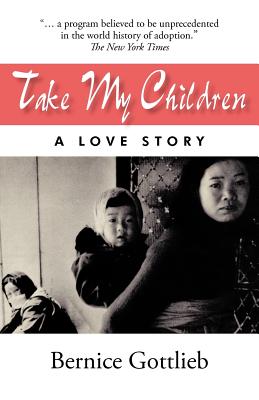
In the 1960s, adoptions of foreign babies by residents of the United States were relatively rare. One woman sought to change that trend. In her memoir, Take My Children, author Bernice Gottlieb shares the story of her involvement in international adoptions. Gottlieb tells not only of her personal experience adopting a baby girl from Korea, but also of her of mission to find homes in the United States for children of Korean families banished to living in leprosy colonies. At the time, leprosy was an ugly word for Koreans, and society sought to separate these individuals suffering from the malady, also known as Hansen's disease. The children of these people often endured harsh discrimination, and their parents wished for a better life for them. Including touching photos, Take My Children describes how Gottlieb's tenacity helped her to overcome the many hurdles to help these Korean children. It recounts Gottlieb's tireless efforts to find homes in the United States for healthy children of sick parents-efforts that reverberate even today.
Take My Children
AN ADOPTION STORYBy Bernice GottliebiUniverse, Inc.
Copyright © 2010 Bernice Gottlieb
All right reserved.ISBN: 978-1-4502-7547-7 Contents
List of Illustrations...........................................ixAuthor's Note...................................................xiiiAcknowledgments.................................................xvChapter 1. Going Home: 1934.....................................1Chapter 2. The Gift of Young-ah: 1968...........................5Chapter 3. Outreach Is Born: 1972...............................19Chapter 4. Carville, Louisiana: 1973............................29Chapter 5. The Right Parents....................................47Chapter 6. St. Lazarus Village: March 1974......................53Chapter 7. A Difficult Search...................................77Chapter 8. The Bureaucratic Nightmare: 1974.....................85Chapter 9. The Struggle: 1975...................................103Chapter 10. The Last Stretch: 1976..............................121Chapter 11. Answered Prayers....................................135Chapter 12. Living in the United States.........................145Afterword.......................................................161
Chapter One
Going Home: 1934
I can remember Mrs. Thompson holding me on her lap on a fast-moving train. It was the summer of 1934, and the BMT line to Brooklyn had glassless windows with wrought-iron safety bars. It was a breezy, bumpy ride as the train went through winding tunnels, and there was a sweet, sickly subway train smell. Straddled across her lap, face to face, I remember kissing "Mama's" smiling, shiny brown face and laughing a lot. She was saying, "We're going home to your real mama, baby." I was just three years old.
In 1930, as the Depression's true weight began to be felt, my parents had suffered the tragic loss of two children in a polio epidemic. Emotionally unhinged, they were unable to take care of me when I unexpectedly came along in 1931. Mother was in the throes of a mental breakdown, and when she recovered, my father followed suit. He disappeared one day from our home in the Bronx and was found six weeks later wandering aimlessly in an amnesiac state. While he was recovering, his partners lost their nine meat supply stores and a slaughterhouse to the faltering economy. My parents had to start all over again.
Eventually my father's cousin gave him a job at his small butcher shop in Brooklyn. Mother and Dad left their home in the Bronx in the spring of 1934 when Dad found an apartment in Brooklyn near the shop. It consisted of three small rooms in a pretentious-looking building with a doorman. The lobby had Tennessee marble floors and walls, an ornate fireplace, and gilded maroon velvet benches. Our apartment was on the lobby floor at the back of the building overlooking the courtyard and back alley. Our rent was $42.50 a month. This is where I grew up.
Mother had not known she was pregnant when my brother Robert and sister Dorothy took ill and died just weeks apart. When I was born, she gave my care over to her friend Mrs. Thompson, who had given birth to her own child a few months earlier. My surviving brother Arthur, who was eleven years old when I was born, came with me.
Mrs. Thompson and her husband lived in Harlem, and Mother knew her from their days in silent films. Mrs. Thompson had been a wardrobe mistress at the old Biograph Studios in the Bronx where Mother was a bit player and where my brother Arthur had made nine movies with Milton Sills; Sills was a popular and prolific actor, a heartthrob in the twenties. Arthur and I lived with the Thompsons off and on for more than three years, visiting our parents regularly while they were getting their lives back together again. After returning home, it took me quite a while to think of myself as a white person.
During one overnight visit home when Mother was feeling stronger, I ran a high fever and went into convulsions. This was enough to set her back again. She felt she didn't have the capacity to keep her children alive. There is an ancient Hebrew ceremony to quell such fears, and so Mother consulted with a rabbi and asked for this rite to be performed. A family with healthy children volunteered to participate and to "adopt" me. My Hebrew name was changed at this ceremony in order to fool the Angel of Death.
When I was about eight, I came home from school one day to find Mother crying. It was winter and she sat in a kitchen chair near the radiator. Our Friday night Shabbat dinner was cooking on the stove behind her. She was wearing an apron; she blotted her eyes when I came in.
"Mommy, what's the matter?" I asked, saddened by her red-rimmed eyes.
"Sorry, love, but I have the wigwams," Mother said. I had heard her use that expression before. I knew it meant she was depressed. I put my school case down, took off my galoshes and overcoat, and put my arms around her. She gathered me close to her soft large bosom, and the scent of rosewater and glycerin filled my nostrils.
Then she told me about Dorothy and Robert for the first time. I was terribly upset to know I could have had a sister and another brother.
"It was a polio epidemic," she said, rocking me in her arms. "Daddy wanted us to go to South Fallsburg for vacation even though he knew there was talk of an epidemic. We never should have gone."
Then she said something that has haunted me. "When I was giving birth to you, I had a dream. I dreamed that Dorothy was smiling at me and saying, `Don't worry, Mommy, I'm coming back,' and then my lovely baby girl was born. I was so happy you were a girl."
Her words made me wonder whether I was Dorothy or me. I didn't really understand what she was saying. Dorothy and Robert were never again discussed in my presence, but every Friday night Mother lit candles for them. And I remembered an incident from when I was four or five years old. My mother and father were sitting at the tall secretary desk in our living room. Photograph albums were kept in its bottom drawer, and they were looking at one of them. Mother was crying, and my father had his arm around her shoulders. I could see that they were looking at pictures of a little boy and a little girl I had never seen. That night I had a dream (which recurred for a long time) of two little white caskets being carried down the long entry hall of our apartment. Mother was walking behind them, and she was screaming. Soon after that, I took my box of crayons and scribbled on all the photographs of the little boy and girl, blotting out their faces completely.
Chapter Two
The Gift of Young-ah: 1968
I had never thought about adopting a child. We had discussed having a third child, but Fred was pushing fifty and wasn't into the baby/ not sleeping/diaper mode. In 1967, my good friend Shirley Collins had a miscarriage and was told she should not try again to become pregnant. I was visiting her right after the miscarriage, and she was distraught. I suggested she try to adopt a child, and I said she should find out whether Vietnamese children were being brought into the country. (The war was still raging, and pictures of napalm-bombed children were in everyone's psyches.) Caucasian babies were almost impossible to get, and in any case, Shirley was borderline in terms of age and probably would not qualify through the usual channels. Shirley was intimidated by my suggestion and asked me to make inquiries on her behalf. I agreed, but I soon learned that the Vietnamese were not...