
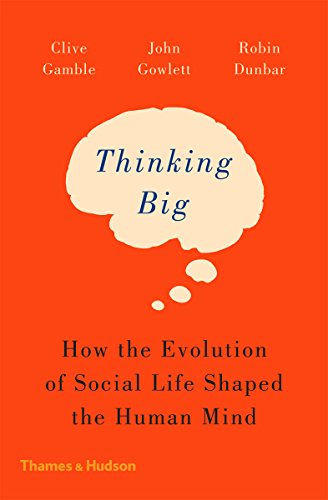
Thinking Big: How the Evolution of Social Life Shaped the Human Mind
Gamble, Clive; Gowlett, John; Dunbar, Robin
ISBN 10: 0500293821 ISBN 13: 9780500293829
Verlag: Thames & Hudson, 2018
Gebraucht
paperback
Verkäufer
Gulf Coast Books, Cypress, TX, USA
Verkäuferbewertung 5 von 5 Sternen

AbeBooks-Verkäufer seit 27. Juni 2017
Dieser Artikel ist nicht mehr verfügbar.
Beschreibung
Beschreibung:
Bestandsnummer des Verkäufers 0500293821-3-37134929
Inhaltsangabe:
When and how did the brains of our hominin ancestors become human minds? When and why did our capacity for language, art, music and dance evolve? This pathbreaking book proposes that it was the need for early humans to live in ever-larger social groups over greater distancesthe ability to think bigthat drove the enlargement of the human brain and the development of the human mind. This social brain hypothesis, put forward by evolutionary psychologists such as Robin Dunbar, can be tested against archaeological and fossil evidence.The conclusions herethe fruits of over seven years of researchbuild on the insight that modern humans live in effective social groups of about 150 (so-called Dunbars number), some three times the size of those of apes and our early ancestors. We live in a world dominated by social networking. Yet our virtual contact lists, whether on Facebook or Twitter, are on average no bigger than Dunbars number.
Über die Autorinnen und Autoren:
Clive Gamble is Professor of Archaeology at the University of Southampton. His publications include Origins and Revolutions: Human Identity in Earliest Prehistory (2007) and Archaeology: The Basics (2007).
John Gowlett is Professor of Archaeology at Liverpool University. He has published numerous articles and contributions within edited volumes.
Robin Dunbar is head of the Social and Evolutionary Neuroscience Research Group at the University of Oxford. He has published numerous books including Grooming Gossip and the Evolution of Language (2004), The Human Story (2005), How Many Friends Does One Person Need?: Dunbar's Number and Other Evolutionary Quirks (2011), The Science of Love (2012) and The Science of Love and Betrayal (2013).
„Über diesen Titel“ kann sich auf eine andere Ausgabe dieses Titels beziehen.
Bibliografische Details
Titel: Thinking Big: How the Evolution of Social ...
Verlag: Thames & Hudson
Erscheinungsdatum: 2018
Einband: paperback
Zustand: Good
Beste Suchergebnisse bei AbeBooks

Beispielbild für diese ISBN
Thinking Big : How the Evolution of Social Life Shaped the Human Mind
Anbieter: Better World Books Ltd, Dunfermline, Vereinigtes Königreich
Verkäuferbewertung 5 von 5 Sternen
Zustand: Good. Pages intact with minimal writing/highlighting. The binding may be loose and creased. Dust jackets/supplements are not included. Stock photo provided. Product includes identifying sticker. Better World Books: Buy Books. Do Good. Bestandsnummer des Verkäufers 53399484-20
Gebraucht kaufen
EUR 5,57
EUR 5,79 Versand
Versand von Vereinigtes Königreich nach USA
Versand von Vereinigtes Königreich nach USA
Anzahl: 1 verfügbar
Beispielbild für diese ISBN
Thinking Big: How the Evolution of Social Life Shaped the Human Mind
Anbieter: MusicMagpie, Stockport, Vereinigtes Königreich
Verkäuferbewertung 5 von 5 Sternen
Zustand: Very Good. 1780597025. 6/4/2026 6:17:05 PM. Bestandsnummer des Verkäufers U9780500293829
Gebraucht kaufen
EUR 5,70
EUR 6,36 Versand
Versand von Vereinigtes Königreich nach USA
Versand von Vereinigtes Königreich nach USA
Anzahl: 1 verfügbar
Beispielbild für diese ISBN
Thinking Big: How the Evolution of Social Life Shaped the Human Mind
Anbieter: Greener Books, London, Vereinigtes Königreich
Verkäuferbewertung 4 von 5 Sternen

Paperback. Zustand: Used; Very Good. **SHIPPED FROM UK** We believe you will be completely satisfied with our quick and reliable service. All orders are dispatched as swiftly as possible! Buy with confidence! Greener Books. Bestandsnummer des Verkäufers 5126587
Gebraucht kaufen
EUR 5,75
EUR 18,53 Versand
Versand von Vereinigtes Königreich nach USA
Versand von Vereinigtes Königreich nach USA
Anzahl: 1 verfügbar
Beispielbild für diese ISBN
Thinking Big: How the Evolution of Social Life Shaped the Human Mind
Anbieter: WorldofBooks, Goring-By-Sea, WS, Vereinigtes Königreich
Verkäuferbewertung 5 von 5 Sternen
Paperback. Zustand: Very Good. The book has been read, but is in excellent condition. Pages are intact and not marred by notes or highlighting. The spine remains undamaged. Bestandsnummer des Verkäufers GOR009370025
Gebraucht kaufen
EUR 5,88
EUR 6,49 Versand
Versand von Vereinigtes Königreich nach USA
Versand von Vereinigtes Königreich nach USA
Anzahl: 5 verfügbar
Beispielbild für diese ISBN
Thinking Big: How the Evolution of Social Life Shaped the Human Mind
Anbieter: Gulf Coast Books, Cypress, TX, USA
Verkäuferbewertung 5 von 5 Sternen
paperback. Zustand: Very Good. Bestandsnummer des Verkäufers 0500293821-2-37134929
Gebraucht kaufen
EUR 6,17
Versand gratis
Versand innerhalb von USA
Versand innerhalb von USA
Anzahl: 1 verfügbar
Beispielbild für diese ISBN
Thinking Big : How the Evolution of Social Life Shaped the Human Mind
Anbieter: Better World Books: West, Reno, NV, USA
Verkäuferbewertung 5 von 5 Sternen
Zustand: Good. Former library copy. Pages intact with minimal writing/highlighting. The binding may be loose and creased. Dust jackets/supplements are not included. Includes library markings. Stock photo provided. Product includes identifying sticker. Better World Books: Buy Books. Do Good. Bestandsnummer des Verkäufers 48237092-75
Gebraucht kaufen
EUR 6,18
Versand gratis
Versand innerhalb von USA
Versand innerhalb von USA
Anzahl: 2 verfügbar
Foto des Verkäufers
Thinking Big: How the Evolution of Social Life Shaped the Human Mind
Anbieter: Book Grocer, Tullamarine, VIC, Australien
Verkäuferbewertung 5 von 5 Sternen
Paperback. Clive Gamble, Thames & Hudson Ltd. When and how did the brains of our hominin ancestors become human minds? When and why did our capacity for language or art, music and dance evolve? It is the contention of this pathbreaking and provocative book that it was the need for early humans to live in ever-larger social groups, and to maintain social relations over ever-greater distances - the ability to 'think big' - that drove the enlargement of the human brain and the development of the human mind. This 'social brain hypothesis', put forward by evolutionary psychologists such as Robin Dunbar, one of the authors of this book, can be tested against archaeological and fossil evidence, as archaeologists Clive Gamble and John Gowlett show in the second part of Thinking Big . Along the way, the three authors touch on subjects as diverse and diverting as the switch from finger-tip grooming to vocal grooming or the crucial importance of making fire for the lengthening of the social day. As this remarkable book shows, it seems we still inhabit social worlds that originated deep in our evolutionary past - by the fireside, in the hunt and on the grasslands of Africa. Paperback. Bestandsnummer des Verkäufers 9780500293829-SECONDHAND
Gebraucht kaufen
EUR 7,53
EUR 25,92 Versand
Versand von Australien nach USA
Versand von Australien nach USA
Anzahl: 2 verfügbar
Beispielbild für diese ISBN
Thinking Big: How the Evolution of Social Life Shaped the Human Mind
Anbieter: ThriftBooks-Atlanta, AUSTELL, GA, USA
Verkäuferbewertung 5 von 5 Sternen
Paperback. Zustand: As New. No Jacket. Pages are clean and are not marred by notes or folds of any kind. ~ ThriftBooks: Read More, Spend Less. Bestandsnummer des Verkäufers G0500293821I2N00
Gebraucht kaufen
EUR 8,98
Versand gratis
Versand innerhalb von USA
Versand innerhalb von USA
Anzahl: 1 verfügbar
Beispielbild für diese ISBN
Thinking Big: How the Evolution of Social Life Shaped the Human Mind
Anbieter: ThriftBooks-Dallas, Dallas, TX, USA
Verkäuferbewertung 5 von 5 Sternen
Paperback. Zustand: Good. No Jacket. Pages can have notes/highlighting. Spine may show signs of wear. ~ ThriftBooks: Read More, Spend Less. Bestandsnummer des Verkäufers G0500293821I3N00
Gebraucht kaufen
EUR 8,98
Versand gratis
Versand innerhalb von USA
Versand innerhalb von USA
Anzahl: 1 verfügbar
Beispielbild für diese ISBN
Thinking Big: How the Evolution of Social Life Shaped the Human Mind
Anbieter: ThriftBooks-Atlanta, AUSTELL, GA, USA
Verkäuferbewertung 5 von 5 Sternen
Paperback. Zustand: Very Good. No Jacket. May have limited writing in cover pages. Pages are unmarked. ~ ThriftBooks: Read More, Spend Less. Bestandsnummer des Verkäufers G0500293821I4N00
Gebraucht kaufen
EUR 8,98
Versand gratis
Versand innerhalb von USA
Versand innerhalb von USA
Anzahl: 1 verfügbar