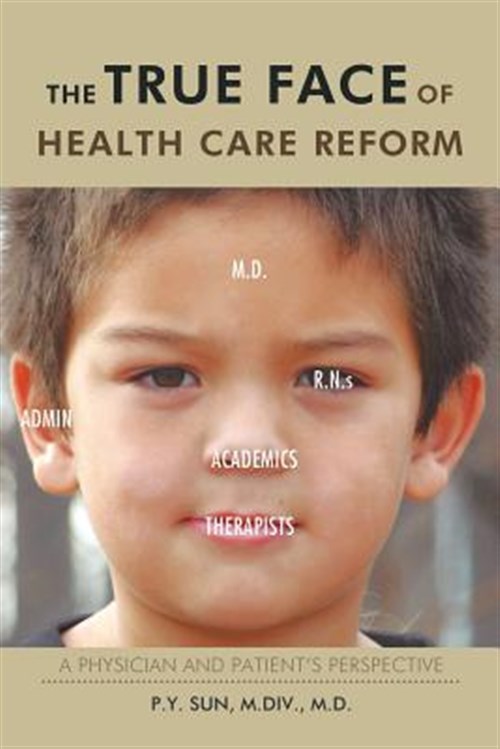
'At last, a book about Health Care Reform that speaks from the medical team's point-of-view, most especially the physician's and the patient's' - Dr. Drew Torigian, Clinical Medical Doctor " 'It makes sense for Health Care policy to have the input of physicians and the medical team in finding the solution to our nation's needs' - The Rev. Dr. Abigail Rian Evans, Charlotte W. Newcombe Professor of Pastoral Theology Emerita, Princeton Theological Seminary" " 'It's an important topic' - Chaplain Ralph Ciampa, Director of Pastoral Care, University of Pennsyvania Medicial Center" For the next third of the Back page: " The recent Health Care bill affects 307 billion people in the United States. Yet, are the people who actually know what's happening first-hand in Medicine writing the Health Care Reform- the physicians and medical team? With personal stories and humor, the author tells what's it like to be a physician in the medical system, as well as the patient. Everyone is affected by Health Care. 'The Face of True Health Care Reform: A Physician and Patient's Perspective' taps into the debate ignited by the Health Care bill, tying together the diverse themes of Managed Care, litigative suits, Medicare, the Patient-Physician relationship and much more that is on the hearts and minds of billions of Americans"
The TRUE Face of Health Care Reform
A Physician and Patient's PerspectiveBy P.Y. SunAuthorHouse
Copyright © 2011 P.Y. Sun, M.Div., M.D.
All right reserved.ISBN: 978-1-4567-2134-3Contents
Preface..............................................................................................viiIntroduction.........................................................................................1Act I: Conflict of Interests.........................................................................8Chapter 1: "The Cheapest Health Care is to let them die".............................................9Chapter 2: Law and an osteoma, "Another missed starting point".......................................15Chapter 3: Medicare, "If I'm a Physician and I can't understand these forms ...".....................31Act II: Separation of Interests......................................................................41Chapter 4: Patient Care first, The Patient-Physician Relationship....................................41Chapter 5: Teamwork matters, "The True Face of Health Care"..........................................57Chapter 6: Balance of Power, "Our Founding fathers would be proud"...................................71Act III: Health Care Reform..........................................................................83Chapter 7: Therapeutic Medicine......................................................................83Chapter 8: Medical Reform............................................................................91BONUS................................................................................................103Chapter 9: "Do I want this Professional for my mother?"..............................................103Chapter 10: Poems....................................................................................109Acknowledgements.....................................................................................113
Chapter One
"The Cheapest Health Care is to let them die"
Mistakes
Root Canal with pulp — reinfection (broke cap right away)
Place cap with infection on x-ray and don't address infection
Apicoectomy not at infection site on x-ray
No debridement upon extraction
No antibiotic prophylaxis, only treatment during course
No follow-up
Managed Care, when it was introduced in the 90's, was touted as the cure for all medical care ills. Doctors did not know how to keep costs down, so the responsibility was given to the administrators. The problem is that the administrators were given the power to make medical care decisions as well. How a person without the requisite four years pre-medical, four years medical school, and three to seven years residency experience was able to be deemed capable of such decisions is one of the mysteries of the history of medicine. Or, as I shared in the preface of my experience with the medical administrative director, the "cap" worn was that of an executive of "consumerization," and not that of a physician.
The distribution of medical resources according to a consumer model violates the principle of assigning proper tasks to medical professionals. In fact, in the model of Managed Care, whereby the physician is paid a set amount for each patient, the incentive then is to give no Health Care. The pre-set amount is a cap, thus the model is called "capitation." The provider has a strong incentive to ration at best, or deny at worst, Health Care— since providing care takes money out of the prepaid amount. Managed care capitation meant that the physician had a conflict of interest in delivering Health Care, if the physician wanted to be able to earn her living as a practicing physician.
As the drawbacks and limitations of Managed Care are being seen more clearly, the country is looking towards new models of Health Care. Proposals include:
• Health Savings Plan- proposed by the previous administration in which American citizens takes an active role in deciding their Health Care, • Single payer model- as seen in Canada where the government pays for basic care out of governmental taxes, • Two-tier system- as seen in Germany in which different levels of Health Care are available, and • Piecemeal Plans- the majority of proposals coming out of the legislature, including the recently passed bill which will again raise costs. I believe in the spirit of "life, liberty, and the pursuit of happiness" as written by our founding nation. The American people do not need to be spoon-fed what is right and what is wrong. We the people can decide for ourselves what is necessary for our life, liberty, and happiness.
Health is a major factor in the perception of happiness. And yet our founders knew that it cannot be guaranteed as a "right." The wisdom of the ages has always known that Health is not something one can control, but a blessing which one desires. Scripture tells of the wisest king obtaining riches and wisdom and long life, but Health was not one of the guarantees.
I believe that Americans should have a choice in what they want to spend on Health Care. Our system is based on choice, and the belief that the citizen can always achieve more. Therefore, we look to have at least a three-tiered system, one that is basic and may be run by the government/ public or private sector and another with more features. The second can be administered by the private sector and have more coverage features. The third method of payment should be made directly by the patient.
In terms of costs, I have to agree that greed did fuel the escalating medical costs of the 80's. Some physicians were taking to heart the credo of the capitalist society, and thinking mostly of profit. Managed Care has done its share by providing competition for fee-for-service, which resulted in administrative costs being reduced. For example, fee-for-service was spending 41% on administrative costs in 1987. By 1990, fee-for-service was spending only 5% on administrative costs. Figuring a spending of about $2,800 per person in the US in 1991, that was a savings of 700 billion dollars!
By comparison, Managed Care was spending 32% in administrative costs in 1987, better than fee-for-service when it began, but spent 57% in administrative costs by 1990. We can see how money travels to those who are in the decisionmaking seat. As administrators, the interests are capitalism and the running of programs. As physicians, the interests are the patient-physician relationship and professionalism.
Chapter Two
"Another missed starting point"
Reaction Osteoma - nice name for a piece of bone Not normally part of The 208 - counted body
- could this be a reaction to 1. loss of bone due to apicoectomy and therefore merely a mechanical compensation of shifted forces?
2. reaction to chronic and flareups of infection...