
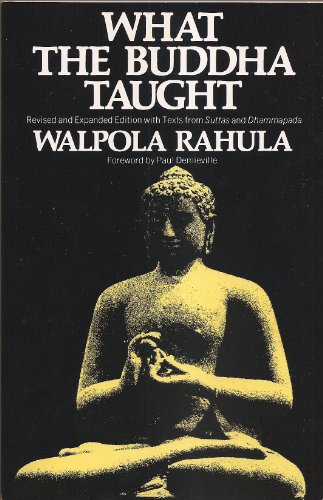
What the Buddha Taught: Revised and Expanded Edition with Texts from Suttas and Dhammapada
Walpola Rahula
ISBN 10: 0802130313 ISBN 13: 9780802130310
Verlag: Grove Press, 1994
Gebraucht
Paperback
Verkäufer
Your Online Bookstore, Houston, TX, USA
Verkäuferbewertung 5 von 5 Sternen

AbeBooks-Verkäufer seit 6. Juli 2010
Dieser Artikel ist nicht mehr verfügbar.
Beschreibung
Beschreibung:
Bestandsnummer des Verkäufers 0802130313-4-19380303
Inhaltsangabe:
This comprehensive, compact, lucid, and faithful account of the Buddha’s teachings persistently enjoys great popularity in colleges, universities, and theological schools both here and abroad. “An exposition of Buddhism conceived in a resolutely modern spirit.”—from the Foreword.
“For years,” says the Journal of the Buddhist Society, “the newcomer to Buddhism has lacked a simple and reliable introduction to the complexities of the subject. Dr. Rahula’s What the Buddha Taught fills the need as only could be done by one having a firm grasp of the vast material to be sifted. It is a model of what a book should be that is addressed first of all to ‘the educated and intelligent reader.’ Authoritative and clear, logical and sober, this study is as comprehensive as it is masterly.”
A classic introductory book to Buddhism, What the Buddha Taught, contains a selection of illustrative texts from the original Pali texts, including the Suttas and the Dhammapada (specially translated by the author), sixteen illustrations, and a bibliography, glossary, and index.
Auszug. © Genehmigter Nachdruck. Alle Rechte vorbehalten.:
What the Buddha Taught
By Walpola Sri RahulaGrove Atlantic, Inc.
Copyright © 1974 W. Rahula
All rights reserved.
ISBN: 978-0-8021-3031-0All rights reserved.
Contents
List of Illustrations,
Foreword,
Preface,
The Buddha,
CHAPTER I The Buddhist Attitude of Mind,
THE FOUR-NOBLE TRUTHS,
CHAPTER II The First Noble Truth: Dukkha,
CHAPTER III The Second Noble Truth: Samudaya: 'The Arising of Dukkha',
CHAPTER IV The Third Noble Truth: Nirodha: 'The Cessation of Dukkha',
CHAPTER V Noble Truth: Magga: 'The Path',
CHAPTER VI The Doctrine of No-Soul: Anatta,
CHAPTER VII 'Meditation' or Mental Culture: Bhavana,
CHAPTER VIII What the Buddha Taught and the World Today,
SELECTED TEXTS,
Setting in Motion the Wheel of Truth (Dhammacakkappavattanasutta),
The Fire Sermon (Adittapariyaya-sutta),
Universal Love (Metta-sutta),
Blessings (Ma?gala-sutta),
Getting rid of All Cares and Troubles (Sabbasava-sutta),
The Parable of the Piece of Cloth (Vattbupama-sutta),
The Foundations of Mindfulness (Satipatthana-sutta),
Advice to Sigala (Sigalovada-sutta),
The Words of Truth (Dhammapada),
The Last Words of the Buddha (from the Mahaparinibbanasutta),
Abbreviations,
Selected Bibliography,
Glossary,
Index,
CHAPTER 1
THE BUDDHIST ATTITUDE OF MIND
Among the founders of religions the Buddha (if we are permitted to call him the founder of a religion in the popular sense of the term) was the only teacher who did not claim to be other than a human being, pure and simple. Other teachers were either God, or his incarnations in different forms, or inspired by him. The Buddha was not only a human being; he claimed no inspiration from any god or external power either. He attributed all his realization, attainments and achievements to human endeavour and human intelligence. A man and only a man can become a Buddha. Every man has within himself the potentiality of becoming a Buddha, if he so wills it and endeavours. We can call the Buddha a man par excellence. He was so perfect in his 'humanness' that he came to be regarded later in popular religion almost as 'super-human'.
Man's position, according to Buddhism, is supreme. Man is his own master, and there is no higher being or power that sits in judgment over his destiny.
'One is one's own refuge, who else could be the refuge?' said the Buddha. He admonished his disciples to 'be a refuge to themselves', and never to seek refuge in or help from anybody else. He taught, encouraged and stimulated each person to develop himself and to work out his own emancipation, for man has the power to liberate himself from all bondage through his own personal effort and intelligence. The Buddha says: 'You should do your work, for the Tathagatas only teach the way.' If the Buddha is to be called a 'saviour' at all, it is only in the sense that he discovered and showed the Path to Liberation, Nirvana. But we must tread the Path ourselves.
It is on this principle of individual responsibility that the Buddha allows freedom to his disciples. In the Mabaparinibbana-sutta the Buddha says that he never thought of controlling the Sangba (Order of Monks), nor did he want the Sangha to depend on him. He said that there was no esoteric doctrine in his teaching, nothing hidden in the 'closed-fist of the teacher' (acariya-mutthi), or to put it in other words, there never was anything 'up his sleeve'.
The freedom of thought allowed by the Buddha is unheard of elsewhere in the history of religions. This freedom is necessary because, according to the Buddha, man's emancipation depends on his own realization of Truth, and not on the benevolent grace of a god or any external power as a reward for his obedient good behaviour.
The Buddha once visited a small town called Kesaputta in the kingdom of Kosala. The inhabitants of this town were known by the common name Kalama. When they heard that the Buddha was in their town, the Kalamas paid him a visit, and told him:
'Sir, there are some recluses and brahmanas who visit Kesaputta. They explain and illumine only their own doctrines, and despise, condemn and spurn others' doctrines. Then come other recluses and brahmanas, and they, too, in their turn, explain and illumine only their own doctrines, and despise, condemn and spurn others' doctrines. But, for us, Sir, we have always doubt and perplexity as to who among these venerable recluses and brahmanas spoke the truth, and who spoke falsehood.'
Then the Buddha gave them this advice, unique in the history of religions:
'Yes, Kalamas, it is proper that you have doubt, that you have perplexity, for a doubt has arisen in a matter which is doubtful. Now, look you Kalamas, do not be led by reports, or tradition, or hearsay. Be not led by the authority of religious texts, nor by mere logic or inference, nor by considering appearances, nor by the delight in speculative opinions, nor by seeming possibilities, nor by the idea: 'this is our teacher'. But, O Kalamas, when you know for yourselves that certain things are unwholesome (akusala), and wrong, and bad, then give them up ... And when you know for yourselves that certain things are wholesome (kusala) and good, then accept them and follow them.'
The Buddha went even further. He told the bhikkhus that a disciple should examine even the Tathagata (Buddha) himself, so that he (the disciple) might be fully convinced of the true value of the teacher whom he followed.
According to the Buddha's teaching, doubt (vicikiccba) is one of the five Hindrances (nivarana) to the clear understanding of Truth and to spiritual progress (or for that matter to any progress). Doubt, however, is not a 'sin', because there are no articles of faith in Buddhism. In fact there is no 'sin' in Buddhism, as sin is understood in some religions. The root of all evil is ignorance (avijja) and false views (micchaditthi.) It is an undeniable fact that as long as there is doubt, perplexity, wavering, no progress is possible. It is also equally undeniable that there must be doubt as long as one does not understand or see clearly. But in order to progress further it is absolutely necessary to get rid of doubt. To get rid of doubt one has to see clearly.
There is no point in saying that one should not doubt or one should believe. Just to say 'I believe' does not mean that you understand and see. When a student works on a mathematical problem, he comes to a stage beyond which he does not know how to proceed, and where he is in doubt and perplexity. As long as he has this doubt, he cannot proceed. If he wants to proceed, he must resolve this doubt. And there are ways of resolving that doubt. Just to say 'I believe', or 'I do not doubt' will certainly not solve the problem. To force oneself to believe and to accept a thing without understanding is political, and not spiritual or intellectual.
The Buddha was always eager to dispel doubt. Even just a few minutes before his death, he requested his disciples several times to ask him if they had any doubts about his teaching, and not to feel sorry later that they could not clear those doubts. But the disciples were silent. What he said then was touching: 'If it is through respect for the Teacher that you do not ask anything, let even one of you inform his friend' (i.e., let one tell his friend so that the latter may ask the question on the other's behalf).
Not only the freedom of thought, but also the tolerance allowed by the Buddha is astonishing...
„Über diesen Titel“ kann sich auf eine andere Ausgabe dieses Titels beziehen.
Bibliografische Details
Titel: What the Buddha Taught: Revised and Expanded...
Verlag: Grove Press
Erscheinungsdatum: 1994
Einband: Paperback
Zustand: Fair