

Gesamtpreis (1 Artikel Artikel):
Versandziel:

cio strike (2 Ergebnisse)
Direkt zu den wichtigsten Suchergebnissen
Suchfilter
Produktart
- Alle Product Types
- Bücher (1)
- Magazine & Zeitschriften (Keine weiteren Ergebnisse entsprechen dieser Verfeinerung)
- Comics (Keine weiteren Ergebnisse entsprechen dieser Verfeinerung)
- Noten (Keine weiteren Ergebnisse entsprechen dieser Verfeinerung)
- Kunst, Grafik & Poster (Keine weiteren Ergebnisse entsprechen dieser Verfeinerung)
- Fotografien (1)
- Karten (Keine weiteren Ergebnisse entsprechen dieser Verfeinerung)
- Manuskripte & Papierantiquitäten (Keine weiteren Ergebnisse entsprechen dieser Verfeinerung)
Zustand Mehr dazu
- Neu (Keine weiteren Ergebnisse entsprechen dieser Verfeinerung)
- Wie Neu, Sehr Gut oder Gut Bis Sehr Gut (Keine weiteren Ergebnisse entsprechen dieser Verfeinerung)
- Gut oder Befriedigend (Keine weiteren Ergebnisse entsprechen dieser Verfeinerung)
- Ausreichend oder Schlecht (Keine weiteren Ergebnisse entsprechen dieser Verfeinerung)
- Wie beschrieben (2)
Einband
- alle Einbände
- Hardcover (Keine weiteren Ergebnisse entsprechen dieser Verfeinerung)
- Softcover (Keine weiteren Ergebnisse entsprechen dieser Verfeinerung)
Weitere Eigenschaften
- Erstausgabe (Keine weiteren Ergebnisse entsprechen dieser Verfeinerung)
- Signiert (Keine weiteren Ergebnisse entsprechen dieser Verfeinerung)
- Schutzumschlag (Keine weiteren Ergebnisse entsprechen dieser Verfeinerung)
- Angebotsfoto (2)
- Keine Print-on-Demand Angebote (2)
Sprache (1)
Preis
- Beliebiger Preis
- Weniger als EUR 20 (Keine weiteren Ergebnisse entsprechen dieser Verfeinerung)
- EUR 20 bis EUR 45
- Mehr als EUR 45
Gratisversand
- Kostenloser Versand nach USA (Keine weiteren Ergebnisse entsprechen dieser Verfeinerung)
Land des Verkäufers
Verkäuferbewertung
-
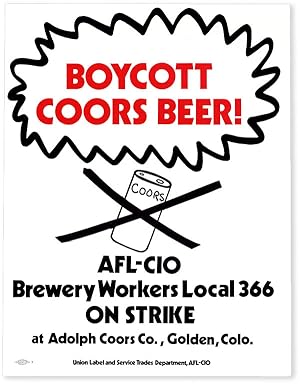
Strike Flyer: "Boycott Coors Beer! AFL-CIO Brewery Workers Local 366 On Strike at Adolph Coors Co., Golden, Colo."
Verlag: Brewery Workers Local 366 n.d. - ca. 1978], [Golden, CO, 1978
Anbieter: Lorne Bair Rare Books, ABAA, Winchester, VA, USA
Verbandsmitglied: ABAA ILAB IOBA
Verkäuferbewertung 5 von 5 Sternen

Broadsheet, 11" x 8-1/2; printed by offset in red and black on both sides of a single sheet of white stock. Recto prints graphic of a Coors can beneath a large "X"; verso prints text explaining strikers' grievances. Fine. Local 366 of the International Brewery, Bottling, Can and Allied Industrial Union struck the Coors brewery in Golden, Colorado in 1977, citing discriminatory hiring practices and, especially, the company's intrusive use of polygraph tests to terminate "undesirable" employees. By 1979 the Local had disbanded, successfully quashed by Coors' use of scab labor; however, the AFL-CIO continued to publicize the Coors boycott through the 1980s, and was credited with impeding Coors' efforts to penetrate the East Coast market. This flyer dates from the first two years of the boycott, when the strike was still active.
-
United Auto Workers and CIO Strike and Bargaining Action Demanding Labor Reform in the U.S. Auto Industry Photo Archive, 1938-1949
Erscheinungsdatum: 1938
Anbieter: Max Rambod Inc, Woodland Hills, CA, USA
Verbandsmitglied: ABAA ILAB PADA
Verkäuferbewertung 5 von 5 Sternen
Fotografie
[Labor Organizing] United Auto Workers and CIO labor photograph archive documenting strike action, union leadership, and collective bargaining negotiations during the expansion of organized labor in the American automobile industry, 1938-1949. The archive traces the period immediately following the 1935 Wagner Act, when unions gained federal legal protection for collective bargaining but still faced violent resistance from corporations, police departments, and municipal governments. Several scenes connect directly to the years surrounding the 1937 Battle of the Overpass in Dearborn, when Ford security men beat UAW organizers attempting to distribute union literature outside the River Rouge complex, and to the broader wave of sit-down strikes and factory shutdowns that forced General Motors, Chrysler, and eventually Ford into formal negotiations with the UAW. The captions identify senior labor figures including Walter Reuther, R. J. Thomas, George Addes, and Richard T. Leonard, establishing the archive as documentation not merely of rank-and-file unrest but of the institutional consolidation of the UAW-CIO into one of the most powerful industrial unions in the United States. The material also records how labor disputes extended beyond factory gates into courts, city halls, state legislatures, and police jurisdictions, revealing the political dimensions of industrial unionism during the New Deal and early Cold War years. Photo archive of 12 Large silver gelatin press photographs, one large panorama measuring 9.5 x 16.5 inches, 11 press photos ranging from 6 x 8 inches to 8 x 10 inches, primarily Detroit, Dearborn, South Gate, and Atlantic City, circa 1938-1949. A large-format scene dated 1939 records tear gas and street violence during a UAW strike at the Fisher Body plant, with clouds of gas spreading across trolley tracks as helmeted police advance toward crowds of fleeing workers and spectators. Another image shows hundreds of demonstrators carrying a massive American flag through downtown Detroit toward City Hall during protests following clashes between union pickets and police at Federal Screw Works; the verso caption notes approximately forty injuries and references accusations of "police brutality" raised before city council. Additional photographs show UAW-CIO officials seated at conference tables, negotiating contracts and appearing in municipal hearing rooms beneath desk microphones and courthouse lighting. Captions identify figures including Walter Reuther, George Addes, and R. J. Thomas, while a 1940 Dearborn caption records the arrest of union leaders for distributing handbills asserting workers' rights under the National Labor Relations Act. South Gate strike scenes outside a General Motors facility show workers carrying placards demanding a thirty percent wage increase while Rev. Louis R. Loe conducts prayer services along the picket line. Convention and leadership photographs from Atlantic City and Washington document labor leaders gathered under the authority of Samuel Gompers and later CIO leadership structures, linking local strike activity to national labor organization. The archive illustrates the transformation of the automobile industry from one of the nation's most violently anti-union industrial sectors into the center of postwar collective bargaining power. Ford Motor Company resisted union recognition longer than General Motors or Chrysler, relying on private security forces, local police cooperation, labor espionage, and anti-handbill ordinances to suppress organizing inside and outside its plants. Several captions directly reference these legal confrontations, including arrests tied to leaflet distribution and disputes over municipal authority to restrict labor organizing in public space. By the late 1940s, many of the same figures shown here were negotiating contracts that established wage standards, pensions, grievance procedures, and health benefits that reshaped industrial employment across the United States. Creasing, edge wear, scattered minor losses, adhesive residue, and newsroom markings to versos; images remain clear and intact overall. Overall good condition.

