
Gesamtpreis (1 Artikel Artikel):
Versandziel:

davisson clinton (7 Ergebnisse)
Direkt zu den wichtigsten Suchergebnissen
Suchfilter
Produktart
- Alle Product Types
- Bücher (6)
- Magazine & Zeitschriften (Keine weiteren Ergebnisse entsprechen dieser Verfeinerung)
- Comics (Keine weiteren Ergebnisse entsprechen dieser Verfeinerung)
- Noten (Keine weiteren Ergebnisse entsprechen dieser Verfeinerung)
- Kunst, Grafik & Poster (Keine weiteren Ergebnisse entsprechen dieser Verfeinerung)
- Fotografien (Keine weiteren Ergebnisse entsprechen dieser Verfeinerung)
- Karten (Keine weiteren Ergebnisse entsprechen dieser Verfeinerung)
- Manuskripte & Papierantiquitäten (1)
Zustand Mehr dazu
- Neu (1)
- Wie Neu, Sehr Gut oder Gut Bis Sehr Gut (Keine weiteren Ergebnisse entsprechen dieser Verfeinerung)
- Gut oder Befriedigend (1)
- Ausreichend oder Schlecht (Keine weiteren Ergebnisse entsprechen dieser Verfeinerung)
- Wie beschrieben (5)
Einband
- alle Einbände
- Hardcover (Keine weiteren Ergebnisse entsprechen dieser Verfeinerung)
- Softcover (4)
Weitere Eigenschaften
- Erstausgabe (4)
- Signiert (Keine weiteren Ergebnisse entsprechen dieser Verfeinerung)
- Schutzumschlag (Keine weiteren Ergebnisse entsprechen dieser Verfeinerung)
- Angebotsfoto (4)
- Keine Print-on-Demand Angebote (6)
Sprache (1)
Gratisversand
- Kostenloser Versand nach USA (Keine weiteren Ergebnisse entsprechen dieser Verfeinerung)
Land des Verkäufers
Verkäuferbewertung
-

Hegemonia: Vellanda
Verlag: Avec Editora e Comércio de Livros Ltda
ISBN 10: 8554472772 ISBN 13: 9788554472771
Anbieter: Livraria Ingá, Niterói, RJ, Brasilien
Verkäuferbewertung 5 von 5 Sternen

paperback. Jun Vellanda se vê no centro de um conflito que ameaça destruir o frágil equilíbrio entre duas espécies. O que começa como uma brincadeira inocente logo se transforma em um risco iminente para sua vida. Ao consumir uma poção misteriosa, Jun adquire conhecimentos proibidos e secretos, e seu pai, Jorost, luta para protegê-la. Mas o conhecimento é um caminho sem volta, e cada passo a leva mais fundo em um mundo cada vez mais complexo de intriga, magia e poder. Em um universo onde a magia e a ciência se entrelaçam de formas inesperadas, Hegemonia Vellanda desafia as convenções e nos transporta para uma jornada que transita pela fantasia, ficção científica e terror, com elementos bizarros e deslumbrantes. Prepare-se para uma narrativa imprevisível, onde a realidade é moldada pelas escolhas e os destinos, e os segredos são mais poderosos que qualquer feitiço.
-
Diffraction of Electrons by a Crystal of Nickel
Verlag: The American Physical Society, Minneapolis, 1927
Anbieter: Manhattan Rare Book Company, ABAA, ILAB, New York, NY, USA
Verkäuferbewertung 5 von 5 Sternen
Erstausgabe
Original wrappers. Zustand: Very Good. First edition. FIRST EDITION IN ORIGINAL WRAPPERS of Davisson and Germer's confirmation of de Broglie's hypothesis that matter has wave-like properties. "A 1927 paper in the Physical Review demonstrated that particles of matter can act like waves, just as light waves sometimes behave like particles. Clinton Davisson and Lester Germer of the Bell Telephone Laboratories, then in New York, found that electrons scatter from a crystal in the same way that x rays do. The work began as a result of a laboratory accident and ultimately earned Davisson a Nobel Prize. "In 1924, Louis de Broglie. proposed that matter, like light, has a dual nature. The next year, graduate student Walter Elsasser of the University of Göttingen in Germany proposed a way to test it: If electrons do have a wave nature, they should, like light, exhibit wave phenomena such as diffraction. In one form of diffraction, a light beam passing through a regular series of holes or slits, called a grating, exhibits "dark spots" in directions where the wave troughs coming from some holes cancel the peaks coming from others. "Bright spots" appear in directions where the peaks reinforce one another. A beam of tiny marbles, as electrons were conceived of until this point, could never show such cancellation and enhancement. "By chance, Davisson and his junior partner Germer were well-positioned to quickly follow Elsasser's suggestion. They had been attempting to probe the structure of the atom by firing low-speed electrons at nickel and measuring the scatter. Their experiments weren't turning up anything of interest, and in 1925 they were saved from frustration and ultimately obscurity by an accident. Their equipment broke, and extreme heating recrystallized their nickel target into a few large crystals, where previously there had been many smaller ones. Their data, showing the amount of scattered electrons at each detector position, began exhibiting some intriguing peaks. "It was only later, when Davisson discussed his results with physicists during his 1926 summer vacation in England, that he learned of de Broglie's theory and realized that his data likely contained the world's first glimpse of electron diffraction. The atoms in the recrystallized nickel had acted as a grating. Following this realization, Davisson and Germer began a deliberate search for diffraction patterns, especially the peaks in their data plots that would indicate extra electrons scattering in specific directions. After some disappointing initial results, they found a single peak that agreed both with de Broglie's theory and with separate experiments using x rays in place of electrons. Eventually they found 30 peaks, 29 of which could be explained by diffraction. One was left unexplained, and they failed to find eight additional peaks that they had expected to appear. "The team published a short paper in Nature in early 1927 and then a more complete article later that year in the Physical Review. George Paget Thomson of the University of Aberdeen in Scotland published his own experimental proof of electron diffraction just a month later and shared the 1937 Nobel Prize in physics with Davisson" (Chelsea Wald, American Physical Society). Particle Physics: One Hundred Years of Discoveries: "Discovery of the diffraction of electrons by crystals. Confirmation of the wave properties of moving electrons. Nobel Prize to C.J. Davisson awarded in 1937 and to co-winner G.P. Thomson 'for their experimental discovery of the diffraction of electrons by crystals.'" IN: The Physical Review, Vol 30, No. 6, December 1927, pp. 705-740. Minneapolis, MN: The American Physical Society, 1927. Octavo, original wrappers; custom box. Some fading to spine and wrapper edges; otherwise fine. RARE in wrappers.
-
The Scattering of Electrons by a Single Crystal of Nickel. - [ELECTRON DIFFRACTION - NOBEL PRIZE IN PHYSICS 1937.]
Anbieter: Herman H. J. Lynge & Søn ILAB-ABF, Copenhagen, Dänemark
Verkäuferbewertung 4 von 5 Sternen

Erstausgabe
London, Macmillian and Co, 1927. Royal8vo. Bound in contemporary half cloth with whilte title paper-label to spine. In "Nature", vol. 119, 1927, entire volume offered. Stamp to front free end-paper and title-pages of each issue.Light wear to extremieies, otherwise fine. Pp. 558-560. [Entire volume: LIX, (1), 948, 100]. First edition of this seminal and highly influential paper on electron diffraction. Today the paper is regarded as one of the most important in the entire journal of Nature, and it led directly to Davisson receiving the Nobel Prize in physics in 1937. It advanced understanding of physics at the quantum level and led to inventions such as the electron microscope. Davisson and Germer's confirmation of the de Broglie hypothesis if today known as the Davisson-Germer experiment."Davisson's investigations on the scattering of electrons entered a new phase when, in April 1925, his taget was heavily oxidized by an accidental explosion of a liquid-air bottle. He cleaned the target by prolonged heating and then found the distribution-inangle of the secondary electrons completely changed, new showing a strong dependence on crystal direction. Prior to the accident the target had consisted of many tiny crystals, but heating converted it to several large crystals. Davisson and L. H. Germer, who had replaced Kunsman before the accident, at once began bombarding targets of single crystals. [.] When Davisson returned from England, he and Germer began a systematic research for some sort of interference phenomenon, and in January 1927 they observed electron beams resulting from diffraction by a single crystal of nickle. The results were in good agreement with de Broglie's prediction. For his confirmation of electron waves Davisson shared the Nobel Prize in physics in 1937 with G. P. Thomson." (DSB, III, 597b-598a).
-

The Scattering of Electrons by a Single Crystal of Nickel. - [ELECTRON DIFFRACTION - NOBEL PRIZE IN PHYSICS 1937.]
Anbieter: Herman H. J. Lynge & Søn ILAB-ABF, Copenhagen, Dänemark
Verkäuferbewertung 4 von 5 Sternen
Erstausgabe
London, Macmillian and Co, 1927. Royal8vo. Bound in a nice black full cloth with title, year and exlibris (Grosvenor Library) in gilt on spine. The entire volume 119, 1927, of "Nature" offered. Pasted library stamp to pasted down free front end-paper. Binding tight, clean and externally as well as internally. Pp. 558-560. [Entire volume: LIX, (1), 948, 100]. First edition of this seminal and highly influential paper on electron diffraction. Today the paper is regarded as one of the most important in the entire journal of Nature, and it led directly to Davisson receiving the Nobel Prize in physics in 1937. It advanced understanding of physics at the quantum level and led to inventions such as the electron microscope. Davisson and Germer's confirmation of the de Broglie hypothesis if today known as the Davisson-Germer experiment."Davisson's investigations on the scattering of electrons entered a new phase when, in April 1925, his taget was heavily oxidized by an accidental explosion of a liquid-air bottle. He cleaned the target by prolonged heating and then found the distribution-inangle of the secondary electrons completely changed, new showing a strong dependence on crystal direction. Prior to the accident the target had consisted of many tiny crystals, but heating converted it to several large crystals. Davisson and L. H. Germer, who had replaced Kunsman before the accident, at once began bombarding targets of single crystals. [.] When Davisson returned from England, he and Germer began a systematic research for some sort of interference phenomenon, and in January 1927 they observed electron beams resulting from diffraction by a single crystal of nickle. The results were in good agreement with de Broglie's prediction. For his confirmation of electron waves Davisson shared the Nobel Prize in physics in 1937 with G. P. Thomson." (DSB, III, 597b-598a).
-

Eigenh. Brief mit Unterschrift.
Verlag: Short Hills, 31. XII. 1937., 1937
Anbieter: Kotte Autographs GmbH, Roßhaupten, Deutschland
Verkäuferbewertung 5 von 5 Sternen
Manuskript / Papierantiquität
EUR 2.500,00
EUR 20,00 Versand
Versand von Deutschland nach USAAnzahl: 1 verfügbar
In den Warenkorb8vo. 2 pp. Gelocht. Doppelblatt. An den Physiker und Nobelpreisträger Max von Laue, der ihm zum Gewinn des Nobelpreises gratuliert hatte: You will know that [I] appreciate very much indeed the kind letter you wrote me about the Nobel Prize award. It has been a special pleasure to know that the award has met with the approval of so many of the older physicists and of the prize winners of previous years. I have always thought that it must have been a source of satisfaction to y[ou] that our demonstrations of the same proportion of electrons resembled so closely your demonstrations of the same proportion of x-rays- it has been to me. I agree with you that this is still much to be learned about electron diffractions, and I am glad to hear that you are continuing your work in this field at the Kaiser-Wilhelm-Institute. My active work on the project ceased, I am sorry to say, s[ome] years ago. Dr. Germer, as you know, has continued and has developed into a remarkably good experimenter and analysist. His interests, however, are primarily in crystal structures rather in the phenomenon of diffracturs. Mrs. Davisson went with me to Stockhom, and we had a glorious and altogether enjoyable time as you will know without my telling []" Minimaler Textverlust durch Lochung. Selten in dieser Form. - Davisson erhielt 1937 den Physik-Nobelpreis für die experimentelle Bestätigung der von de Broglie vorhergesagten Materiewellen, die ihm 1926 zusammen mit Lester Germer durch den Nachweis der Diffraktion von Elektronen an Kristallen gelungen war. LEED ist heute eine wichtige analytische Methode in der Oberflächenchemie. Die zweite Hälfte des Preises ging an George Paget Thomson.
-
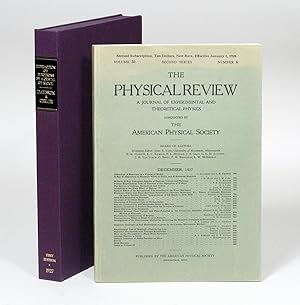
Diffraction of Electrons by a Crystal of Nickel.
Anbieter: Herman H. J. Lynge & Søn ILAB-ABF, Copenhagen, Dänemark
Verkäuferbewertung 4 von 5 Sternen
Erstausgabe
Minneapolis, The Collegiate Press, 1927. 4to. As extracted from "The Physical Review, Volume 30, Second Series, July-December, 1927". Title-page detached, with vague library stamp to top right corner. A fine and clean copy. (2), 704-740 pp. First printing of Davisson and Germer's paper in which they present some additional discoveries not published in their groundbreaking paper "The Scattering of Electrons by a Single Crystal of Nickel" published the same year. This led directly to Davisson receiving the Nobel Prize in physics in 1937. It advanced understanding of physics at the quantum level and led to inventions such as the electron microscope."Davisson and Germer submitted their results to Nature in early March and their paper was published on 16 April. It contains a detailed comparison between their replcted beams and those that would be produced by illuminationg the crystal with X-rays. There were thirteen reflected beams in all, of which ten corresponded to those seen in X-ray diffraction". (Gerwin, A Century of Nature, 28 p.) They could not account for the last three wave and this was not published in their first paper. "The remaining three peaks for which Davisson and Germer could not find any correspondence with X-ray data were later identified as being due to diffraction from atoms absorb ed on the surfaces of the target crystal." (Ibid.). This information was published in the present paper. "Davisson's investigations on the scattering of electrons entered a new phase when, in April 1925, his taget was heavily oxidized by an accidental explosion of a liquid-air bottle. He cleaned the target by prolonged heating and then found the distribution-inangle of the secondary electrons completely changed, new showing a strong dependence on crystal direction. Prior to the accident the target had consisted of many tiny crystals, but heating converted it to several large crystals. Davisson and L. H. Germer, who had replaced Kunsman before the accident, at once began bombarding targets of single crystals. [.] When Davisson returned from England, he and Germer began a systematic research for some sort of interference phenomenon, and in January 1927 they observed electron beams resulting from diffraction by a single crystal of nickle. The results were in good agreement with de Broglie's prediction. For his confirmation of electron waves Davisson shared the Nobel Prize in physics in 1937 with G. P. Thomson." (DSB, III, 597b-598a).Davisson and Germer's confirmation of the de Broglie hypothesis if today known as the Davisson-Germer experiment.
-

Baluartes: Terra sombria
ISBN 10: 8554471156 ISBN 13: 9788554471156
Anbieter: Distribras, NESPOULS, Frankreich
Verkäuferbewertung 5 von 5 Sternen
Capa Comum. Zustand: New. WE CAN PROVIDE ANY BOOK FROM BRAZIL ! ---- All our books are Shipped with Fedex or DHL. ---- For more information, please contact us. ---- The book will be sent from Brazil. ----- This is a Print on Demand book (POD).

![Bild des Verkäufers für The Scattering of Electrons by a Single Crystal of Nickel. - [ELECTRON DIFFRACTION - NOBEL PRIZE IN PHYSICS 1937.] zum Verkauf von Herman H. J. Lynge & Søn ILAB-ABF](https://pictures.abebooks.com/inventory/md/md30918200232.jpg)

