Gesamtpreis (1 Artikel Artikel):
Versandziel:

dimitris e manolakis (3 Ergebnisse)
Direkt zu den wichtigsten Suchergebnissen
Suchfilter
Produktart
- Alle Product Types
- Bücher (3)
- Magazine & Zeitschriften (Keine weiteren Ergebnisse entsprechen dieser Verfeinerung)
- Comics (Keine weiteren Ergebnisse entsprechen dieser Verfeinerung)
- Noten (Keine weiteren Ergebnisse entsprechen dieser Verfeinerung)
- Kunst, Grafik & Poster (Keine weiteren Ergebnisse entsprechen dieser Verfeinerung)
- Fotografien (Keine weiteren Ergebnisse entsprechen dieser Verfeinerung)
- Karten (Keine weiteren Ergebnisse entsprechen dieser Verfeinerung)
- Manuskripte & Papierantiquitäten (Keine weiteren Ergebnisse entsprechen dieser Verfeinerung)
Zustand Mehr dazu
- Neu (2)
- Wie Neu, Sehr Gut oder Gut Bis Sehr Gut (1)
- Gut oder Befriedigend (Keine weiteren Ergebnisse entsprechen dieser Verfeinerung)
- Ausreichend oder Schlecht (Keine weiteren Ergebnisse entsprechen dieser Verfeinerung)
- Wie beschrieben (Keine weiteren Ergebnisse entsprechen dieser Verfeinerung)
Einband
- alle Einbände
- Hardcover (Keine weiteren Ergebnisse entsprechen dieser Verfeinerung)
- Softcover (3)
Weitere Eigenschaften
- Erstausgabe (Keine weiteren Ergebnisse entsprechen dieser Verfeinerung)
- Signiert (Keine weiteren Ergebnisse entsprechen dieser Verfeinerung)
- Schutzumschlag (Keine weiteren Ergebnisse entsprechen dieser Verfeinerung)
- Angebotsfoto (2)
- Keine Print-on-Demand Angebote (3)
Sprache (2)
Gratisversand
- Kostenloser Versand nach USA (Keine weiteren Ergebnisse entsprechen dieser Verfeinerung)
Land des Verkäufers
Verkäuferbewertung
-
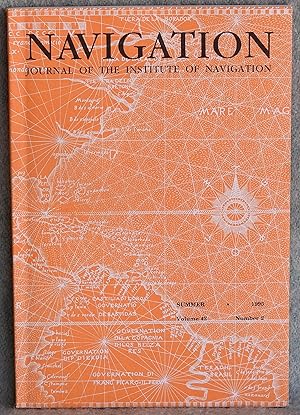
Navigation: Journal of the Institute of Navigation Summer 1995 Volume 42 Number 2
Sprache: Englisch
Verlag: Institute of Navigation, 1995
Anbieter: Argyl Houser, Bookseller, Altadena, CA, USA
Verkäuferbewertung 4 von 5 Sternen

Soft cover. Zustand: Near Fine. The previous owner's name is stamped on the bottom of the book (outer page edges). The rest of the book is spotless and completely free of wear or damage. It will be bubble-wrapped and carefully packed in a sturdy box to ensure safe transit. This issue includes: "Practical Sailing Formulas for Rhumb-line Tracks on an Oblate Earth" by George H. Kaplan; "A Low-power Postprocessed DGPS System for Logging the Locations of Sheep on Hill Pastures" by Gwyn Roberts, Aled Williams, J. David Last, Peter D. Penning and S. Mark Rutter; "Training Experiences with GPS in the Merchant Marine" by Samuel G. Shaw and John M. Keever; "Potential Ionospheric Limitations to GPS Wide-Area Augmentation System (WAAS)" by John A. Klobuchar, Patricia H. Doherty and M. Bakry El-Arini; "A Comparison of the FASF and Least-Squares Search Algorithms for On-the-Fly Ambiguity Resolution" by D. Chen and Gerard Lachapelle; "Epoch-by-Epoch Ambiguity Resolution for Real-Time Attitude Determination Using a GPS Multi-Antenna System" by Ahmed El-Mowafy and K.P. Schwarz; and "Station Arrangement Effects on Ground-Referenced Aircraft Height Computation Based on Time Differences of Arrival" by Dimitris E. Manolakis and Chris C. Lefas.
-

Digital Signal Processing : Principles. Algorithms. and Applications ( 4th Edition ) ( English )(Chinese Edition)
Sprache: Englisch
Verlag: Electronic Industry Press, 2013
ISBN 10: 7121204371 ISBN 13: 9787121204371
paperback. Zustand: New. Ship out in 2 business day, And Fast shipping, Free Tracking number will be provided after the shipment.Paperback. Pub Date :2013-06-01 Publisher: Electronic Industry Press Digital Signal Processing : Principles. Algorithms. and Applications ( 4th Edition ) ( English Version ) comprehensive and systematic exposition of the basics of digital signal processing . of which the first Chapter 10 describes the deterministic knowledge of digital signal processing . discrete- time signals and systems . including the introduction . z transform . Fourier transform . frequency analysis. and filter design .Four Satisfaction guaranteed,or money back.
-

paperback. Zustand: New. Ship out in 2 business day, And Fast shipping, Free Tracking number will be provided after the shipment.Paperback. Pub Date: 2012 08 Pages: 382 Publisher: Xi'an University of Electronic Science and Technology Publishing House series of textbooks of foreign electronic information: statistical and adaptive signal processing (English adaptation) describes the basic statistical and adaptive signal processing concepts and applications. including random sequence analysis. spectral estimation and adaptive filtering. Book can serve as electronics. communications. automation. electrical. biomedical and mechanical engineering graduate students as teaching materials or reference books. self-Reader can also be used as the engineers and technicians or reference book. Contents: CHAPTER 1 Introduction1.1 Random Signals1.2 Spectral Estimation1.3 Signal Modeling1.4 Adaptive Filtering1.4.1 Applicatior of Adaptive Filter1.4.2 Features of Adaptive Filter1.5 Organization of the BookCHAPTER 2 Random Sequences2.1 Discrete-Time Stochastic Processes2. 1.1 Description Using Probability Functior2.1.2 Second-Order Statistical Description2.1.3 Stationarity2.1.4 Ergodicity2.1.5 Random Signal Variability2.1.6 Frequency-Domain Description of Stationary Processes2.2 Linear Systems with Stationary Random Inputs2.2.1 Time-Domain Analysis2.2.2 Frequency- Domain Analysis2.2.3 Random Signal Memory2.2.4 General Correlation Matrices2.2.5 Correlation Matrices from Random Processes2.3 Innovatior Representation of Random Vector2.4 Principles of Estimation Theory2.4.1 Properties of Estimator2.4.2 Estimation of Mean2.4.3 Estimation of Variance2.5 SummaryProblemsCHAPTER 3 Linear Signal Models3.1 Introduction3.1.1 Linear Nonparametric Signal Models3.1.2 Parametric Pole-Zero Signal Models3.1.3 Mixed Processes and Wold Decomposition3.2 All-Pole Models3.2.1 Model Properties3.2.2 All-Pole Modeling and Linear Prediction3.2.3 Autoregressive Models3.2.4 Lower-Order Models3.3 All-Zero Models3.3.1 Model Properties3.3.2 Moving-Average Models3.3.3 Lower-Order Models3.4 Pole-Zero Models3.4.1 Model Properties3.4.2 Autoregressive Moving-Average Models3.4.3 The Firt -Order Pole-Zero Model: PZ (1.1) 3.4.4 Summary and Dualities3.5 SummaryProblemsCHAPTER 4 Nonparametric Power Spectrum Estimation4.1 Spectral Analysis of Deterministic Signals4.1.1 Effect of Signal Sampling4.1.2 Windowing. Periodic Exterion. and Extrapolation4. 1.3 Effect of Spectrum Sampling4.1.4 Effects of Windowing: Leakage and Loss of Resolution4.1.5 Summary4.2 Estimation of the Autocorrelation of Stationary Random Signals4.3 Estimation of the Power Spectrum of Stationary Random Signals4.3.1 Power Spectrum Estimation Using the Periodogram4.3.2 Power Spectrum Estimation by Smoothing a Single Periodogram - The Blackman-Tukey Method4.3.3 Power Spectrum Estimation by Averaging Multiple Periodograms - The Welch-Bartlett Method4.3.4 Some Practical Corideratior and Examples4.4 Multitaper Power Spectrum Estimation4.5 SummaryProblemsCHAPTER 5 Optimum Linear Filter5.1 Optimum Signal Estimation5.2 Linear Mean Square Error Estimation5.2.1 Error Performance Surface5.2.2 Derivation of the Linear MMSE Estimator5.2.3 Principal-Component Analysis of the Optimum Linear Estimator5.2.4 Geometric Interpretatior and the Principle of Orthogonality5.2.5 Summary and Further Properties5.3 Optimum Finite Impulse Respore Filter5.3.1 Design and Properties5.3.2 Optimum FIR Filter for Stationary Processes5.3.3 Frequency-Domain Interpretatior5.4 Linear Prediction5.4.1 Linear Signal Estimation5.4.2 Forward Linear Prediction5.4.3 Backward Linear Prediction5.4.4 Stationary Processes5.4.5 Properties5.5 Optimum Infinite Impulse Respore Filter5.5.1 Noncausal IIR Filter5.5.2 Causal IIR Filter5.5.3 Filtering of Additive Noise5.5.4 Linear Prediction Using the Infinite Past - Whitening5.6 Invere Filtering and Deconvolution5.7 SummaryProblemsCHAPTER 6 Algorthms and Structures for Optimum Linear Filter6.1 Fundamentals of Order-Recurive Algorithms6.1.1 Matrix Partiti.