Gesamtpreis (1 Artikel Artikel):
Versandziel:

edited clark hunter (8 Ergebnisse)
Direkt zu den wichtigsten Suchergebnissen
Suchfilter
Produktart
- Alle Product Types
- Bücher (8)
- Magazine & Zeitschriften (Keine weiteren Ergebnisse entsprechen dieser Verfeinerung)
- Comics (Keine weiteren Ergebnisse entsprechen dieser Verfeinerung)
- Noten (Keine weiteren Ergebnisse entsprechen dieser Verfeinerung)
- Kunst, Grafik & Poster (Keine weiteren Ergebnisse entsprechen dieser Verfeinerung)
- Fotografien (Keine weiteren Ergebnisse entsprechen dieser Verfeinerung)
- Karten (Keine weiteren Ergebnisse entsprechen dieser Verfeinerung)
- Manuskripte & Papierantiquitäten (Keine weiteren Ergebnisse entsprechen dieser Verfeinerung)
Zustand Mehr dazu
- Neu (Keine weiteren Ergebnisse entsprechen dieser Verfeinerung)
- Wie Neu, Sehr Gut oder Gut Bis Sehr Gut (Keine weiteren Ergebnisse entsprechen dieser Verfeinerung)
- Gut oder Befriedigend (2)
- Ausreichend oder Schlecht (Keine weiteren Ergebnisse entsprechen dieser Verfeinerung)
- Wie beschrieben (6)
Einband
Weitere Eigenschaften
- Erstausgabe (5)
- Signiert (Keine weiteren Ergebnisse entsprechen dieser Verfeinerung)
- Schutzumschlag (1)
- Angebotsfoto (6)
- Keine Print-on-Demand Angebote (8)
Sprache (2)
Preis
- Beliebiger Preis
- Weniger als EUR 20 (Keine weiteren Ergebnisse entsprechen dieser Verfeinerung)
- EUR 20 bis EUR 45
- Mehr als EUR 45
Gratisversand
Land des Verkäufers
Verkäuferbewertung
-
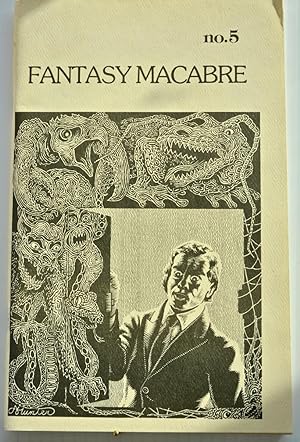
Fantasy Macabre no.5
Verlag: Richard Fawcett, 1985
Anbieter: Sherwood Frazier Books, Laconia, NH, USA
Verkäuferbewertung 4 von 5 Sternen

Soft cover. Zustand: Very Good. Cover & Interior Art by Alan Hunter, Thomas Clark, & Wendy Wees (illustrator). Issue 5 of this fantastic small-press dark fantasy fiction zine, published in 1985. Features stories by B. Richard Parks, Phillip C. Heath, Frank Belknap Long, Jessica Amanda Salmonson, Billy Wolfenbarger, Bobby G. Warner, Margaret Widdemer, Richard Le Gallienne, M. Jesse Hoare, Joseph Payne Brennan, Delia Shiflet, Theophile Gautier, and many more. There where seventeen issues between 1980-1996, the first four edited by UK fan Dave Reeder, the rest by American author Jessica Amanda Salmonson. The first two issues (1980-1981) were published by Dave Reeder himself, the following fifteen issues (no 3 and 4 with Reeder still as editor) by Richard Fawcett in the USA. Contains an ad card for issue #6 with discritions of that issue and back issues. Perfect for the collector of horror and fantasy zines. Good to very good; covers are dirty and show slight discoloration as do the inside pages. No tears, rips, or missing pages. Protected in an acid free plastic sleeve.
-
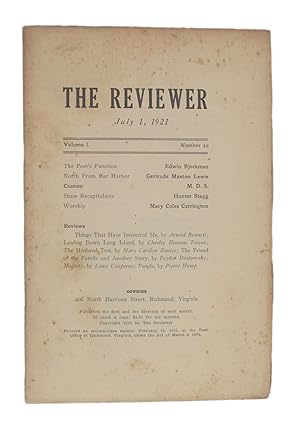
THE REVIEWER: July 1, 1921 (Volume 1, Number 10)
Verlag: The Reviewer, Richmond, 1921
Anbieter: Michael Pyron, Bookseller, ABAA, Conshohocken, PA, USA
Verbandsmitglied: ABAA ILAB IOBA
Verkäuferbewertung 5 von 5 Sternen

Erstausgabe
Stapled Pamphlet. Zustand: Very Good binding. Octavo. 291-322 pp. First edition. As issued in self wrappers. This copy is fairly clean but for some light soiling and toning to the covers. The Reviewer began as a biweekly, shifted to a monthly and concluded its final years as a quarterly. A significant publication begun by Emily Clark, Hunter Stagg, Mary Dallas Street, and Margaret Freeman in Richmond in 1921. While its earliest issues are largely if not exclusively southern writers, over its 4 years it published work from some of the most talented writers of the period, southern and otherwise. In addition to publishing heavyweights like Gertrude Stein, Ellen Glasgow, H.L. Mencken, Carl Van Vechten, Amy Lowell, and others, it brought out new writers like Julia Peterkin who would go on to be the first southern novelist to win a Pulitzer Prize. In 1924 it was moved to Chapel Hill where Paul Green took over editing the magazine for its final year. In 1925, all unpublished manuscripts were used to begin The Southwest Review, still in publication today. In his article, "'An Experiment of Southern Letters': Reconsidering the Role of The Reviewer in the Southern Renaissance," Benjamin Wise writes, "The magazine was essential in the literary awakening of the region during this timeand is essential to our understanding of the periodnot just because it was published, but because of what it published, who published it, and when it was published." He goes on to write, "The Reviewer changed over time in its short career, and the writing in its pages reflected the contested cultural terrain of the South in these years. It provided a forum for writing from and about the South, and in doing so The Reviewer played a crucial role in the development of a new artistic sensibility that reshaped southern literature." For such a significant publication which had at its peak over a thousand subscribers, it is fairly uncommon to find individual issues. Smith, Leanne. "Reviewer, The" Encyclopedia Virginia. Virginia Humanities. Wise, Benjamin E. "'An Experiment in Southern Letters': Reconsidering the Role of The Reviewer in the Southern Renaissance." The Virginia Magazine of History and Biography 113. 2 (2005): 146178.
-
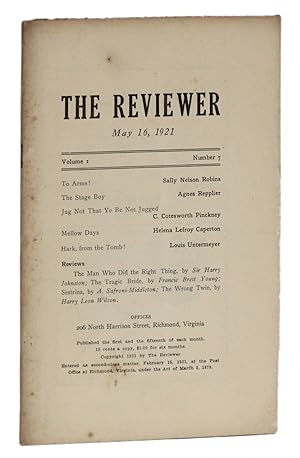
THE REVIEWER: May 16, 1921 (Volume 1, Number 7)
Verlag: The Reviewer, Richmond, 1921
Anbieter: Michael Pyron, Bookseller, ABAA, Conshohocken, PA, USA
Verbandsmitglied: ABAA ILAB IOBA
Verkäuferbewertung 5 von 5 Sternen
Erstausgabe
Stapled Pamphlet. Zustand: Very Good binding. Octavo. [2] 197-226 pp. First edition. As issued in self wrappers. This copy has covers that are toned and a trifled soiled; contents clean. The Reviewer began as a biweekly, shifted to a monthly and concluded its final years as a quarterly. A significant publication begun by Emily Clark, Hunter Stagg, Mary Dallas Street, and Margaret Freeman in Richmond in 1921. While its earliest issues are largely if not exclusively southern writers, over its 4 years it published work from some of the most talented writers of the period, southern and otherwise. In addition to publishing heavyweights like Gertrude Stein, Ellen Glasgow, H.L. Mencken, Carl Van Vechten, Amy Lowell, and others, it brought out new writers like Julia Peterkin who would go on to be the first southern novelist to win a Pulitzer Prize. In 1924 it was moved to Chapel Hill where Paul Green took over editing the magazine for its final year. In 1925, all unpublished manuscripts were used to begin The Southwest Review, still in publication today. In his article, "'An Experiment of Southern Letters': Reconsidering the Role of The Reviewer in the Southern Renaissance," Benjamin Wise writes, "The magazine was essential in the literary awakening of the region during this timeand is essential to our understanding of the periodnot just because it was published, but because of what it published, who published it, and when it was published." He goes on to write, "The Reviewer changed over time in its short career, and the writing in its pages reflected the contested cultural terrain of the South in these years. It provided a forum for writing from and about the South, and in doing so The Reviewer played a crucial role in the development of a new artistic sensibility that reshaped southern literature." For such a significant publication which had at its peak over a thousand subscribers, it is fairly uncommon to find individual issues. Smith, Leanne. "Reviewer, The" Encyclopedia Virginia. Virginia Humanities. Wise, Benjamin E. "'An Experiment in Southern Letters': Reconsidering the Role of The Reviewer in the Southern Renaissance." The Virginia Magazine of History and Biography 113. 2 (2005): 146178.
-
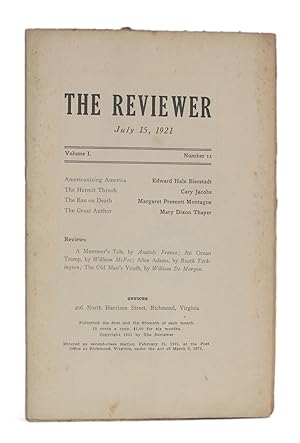
THE REVIEWER: July 15, 1921 (Volume 1, Number 11)
Verlag: The Reviewer, Richmond, 1921
Anbieter: Michael Pyron, Bookseller, ABAA, Conshohocken, PA, USA
Verbandsmitglied: ABAA ILAB IOBA
Verkäuferbewertung 5 von 5 Sternen
Erstausgabe
Stapled Pamphlet. Zustand: near Very Good binding. Octavo. 291-322 pp. First edition. As issued in self wrappers. This copy has some closed tears to the margins of several leaves from being opened roughly, otherwise, it is fairly clean but for some light soiling and toning to the covers. The Reviewer began as a biweekly, shifted to a monthly and concluded its final years as a quarterly. A significant publication begun by Emily Clark, Hunter Stagg, Mary Dallas Street, and Margaret Freeman in Richmond in 1921. While its earliest issues are largely if not exclusively southern writers, over its 4 years it published work from some of the most talented writers of the period, southern and otherwise. In addition to publishing heavyweights like Gertrude Stein, Ellen Glasgow, H.L. Mencken, Carl Van Vechten, Amy Lowell, and others, it brought out new writers like Julia Peterkin who would go on to be the first southern novelist to win a Pulitzer Prize. In 1924 it was moved to Chapel Hill where Paul Green took over editing the magazine for its final year. In 1925, all unpublished manuscripts were used to begin The Southwest Review, still in publication today. In his article, "'An Experiment of Southern Letters': Reconsidering the Role of The Reviewer in the Southern Renaissance," Benjamin Wise writes, "The magazine was essential in the literary awakening of the region during this timeand is essential to our understanding of the periodnot just because it was published, but because of what it published, who published it, and when it was published." He goes on to write, "The Reviewer changed over time in its short career, and the writing in its pages reflected the contested cultural terrain of the South in these years. It provided a forum for writing from and about the South, and in doing so The Reviewer played a crucial role in the development of a new artistic sensibility that reshaped southern literature." For such a significant publication which had at its peak over a thousand subscribers, it is fairly uncommon to find individual issues. Smith, Leanne. "Reviewer, The" Encyclopedia Virginia. Virginia Humanities. Wise, Benjamin E. "'An Experiment in Southern Letters': Reconsidering the Role of The Reviewer in the Southern Renaissance." The Virginia Magazine of History and Biography 113. 2 (2005): 146178.
-
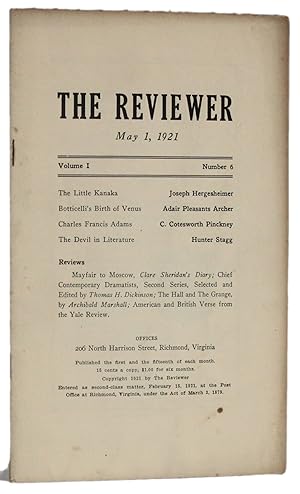
THE REVIEWER: May 1, 1921 (Volume 1, Number 6)
Verlag: The Reviewer, Richmond, 1921
Anbieter: Michael Pyron, Bookseller, ABAA, Conshohocken, PA, USA
Verbandsmitglied: ABAA ILAB IOBA
Verkäuferbewertung 5 von 5 Sternen
Erstausgabe
Stapled Pamphlet. Zustand: Very Good binding. Octavo. 165-196 pp. First edition. As issued in self wrappers. This copy has covers that are toned and a trifled soiled; contents clean. The Reviewer began as a biweekly, shifted to a monthly and concluded its final years as a quarterly. A significant publication begun by Emily Clark, Hunter Stagg, Mary Dallas Street, and Margaret Freeman in Richmond in 1921. While its earliest issues are largely if not exclusively southern writers, over its 4 years it published work from some of the most talented writers of the period, southern and otherwise. In addition to publishing heavyweights like Gertrude Stein, Ellen Glasgow, H.L. Mencken, Carl Van Vechten, Amy Lowell, and others, it brought out new writers like Julia Peterkin who would go on to be the first southern novelist to win a Pulitzer Prize. In 1924 it was moved to Chapel Hill where Paul Green took over editing the magazine for its final year. In 1925, all unpublished manuscripts were used to begin The Southwest Review, still in publication today. In his article, "'An Experiment of Southern Letters': Reconsidering the Role of The Reviewer in the Southern Renaissance," Benjamin Wise writes, "The magazine was essential in the literary awakening of the region during this timeand is essential to our understanding of the periodnot just because it was published, but because of what it published, who published it, and when it was published." He goes on to write, "The Reviewer changed over time in its short career, and the writing in its pages reflected the contested cultural terrain of the South in these years. It provided a forum for writing from and about the South, and in doing so The Reviewer played a crucial role in the development of a new artistic sensibility that reshaped southern literature." For such a significant publication which had at its peak over a thousand subscribers, it is fairly uncommon to find individual issues. Smith, Leanne. "Reviewer, The" Encyclopedia Virginia. Virginia Humanities. Wise, Benjamin E. "'An Experiment in Southern Letters': Reconsidering the Role of The Reviewer in the Southern Renaissance." The Virginia Magazine of History and Biography 113. 2 (2005): 146178.
-

THE REVIEWER: March 1, 1921 (Volume 1, Number 2)
Verlag: The Reviewer, Richmond, 1921
Anbieter: Michael Pyron, Bookseller, ABAA, Conshohocken, PA, USA
Verbandsmitglied: ABAA ILAB IOBA
Verkäuferbewertung 5 von 5 Sternen
Erstausgabe
Stapled Pamphlet. Zustand: Very Good binding. Octavo. 37-68 pp. First edition. As issued, in self wrappers. This copy has covers that are toned and a trifled soiled, a closed tear to the margin of two leaves; contents clean. The Reviewer began as a biweekly, shifted to a monthly and concluded its final years as a quarterly. A significant publication begun by Emily Clark, Hunter Stagg, Mary Dallas Street, and Margaret Freeman in Richmond in 1921. While its earliest issues are largely if not exclusively southern writers, over its 4 years it published work from some of the most talented writers of the period, southern and otherwise. In addition to publishing heavyweights like Gertrude Stein, Ellen Glasgow, H.L. Mencken, Carl Van Vechten, Amy Lowell, and others, it brought out new writers like Julia Peterkin who would go on to be the first southern novelist to win a Pulitzer Prize. In 1924 it was moved to Chapel Hill where Paul Green took over editing the magazine for its final year. In 1925, all unpublished manuscripts were used to begin The Southwest Review, still in publication today. In his article, "'An Experiment of Southern Letters': Reconsidering the Role of The Reviewer in the Southern Renaissance," Benjamin Wise writes, "The magazine was essential in the literary awakening of the region during this timeand is essential to our understanding of the periodnot just because it was published, but because of what it published, who published it, and when it was published." He goes on to write, "The Reviewer changed over time in its short career, and the writing in its pages reflected the contested cultural terrain of the South in these years. It provided a forum for writing from and about the South, and in doing so The Reviewer played a crucial role in the development of a new artistic sensibility that reshaped southern literature." For such a significant publication which had at its peak over a thousand subscribers, it is fairly uncommon to find individual issues. Smith, Leanne. "Reviewer, The" Encyclopedia Virginia. Virginia Humanities. Wise, Benjamin E. "'An Experiment in Southern Letters': Reconsidering the Role of The Reviewer in the Southern Renaissance." The Virginia Magazine of History and Biography 113. 2 (2005): 146178.
-

Ascetic Behavior in Greco-Roman Antiquity: A Sourcebook
Sprache: Englisch
Verlag: Fortress Press, Minneapolis, Minnesota, 1990
ISBN 10: 0800631056 ISBN 13: 9780800631055
Anbieter: Andover Books and Antiquities, Andover, MA, USA
Verkäuferbewertung 5 von 5 Sternen
Hardcover. Zustand: Very good condition. Zustand des Schutzumschlags: Very good. xxvii, 514 pp. Studies in Antiquity and Christianity. LCC: 9044980.
-
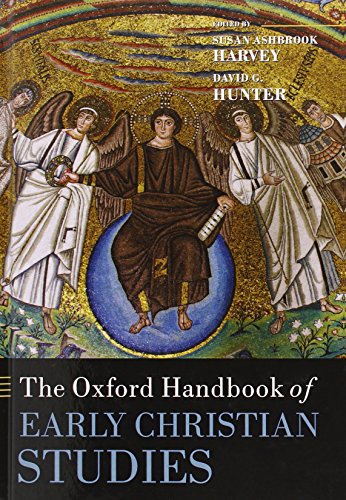
The Oxford Handbook of Early Christian Studies:
Sprache: Englisch
Verlag: Oxford University Press 2008, 2011, Oxford, England / New York, New York, 2008
ISBN 10: 0199271569 ISBN 13: 9780199271566
Anbieter: Andover Books and Antiquities, Andover, MA, USA
Verkäuferbewertung 5 von 5 Sternen
Hardcover. xxvii, 1020 pp. Oxford Handbooks. Very good condition; a few touches of wear on edges of covers.