

Gesamtpreis (1 Artikel Artikel):
Versandziel:

eric gartzke (4 Ergebnisse)
Meinten Sie:
erik gartzke
Direkt zu den wichtigsten Suchergebnissen
Suchfilter
Produktart
- Alle Product Types
- Bücher (4)
- Magazine & Zeitschriften (Keine weiteren Ergebnisse entsprechen dieser Verfeinerung)
- Comics (Keine weiteren Ergebnisse entsprechen dieser Verfeinerung)
- Noten (Keine weiteren Ergebnisse entsprechen dieser Verfeinerung)
- Kunst, Grafik & Poster (Keine weiteren Ergebnisse entsprechen dieser Verfeinerung)
- Fotografien (Keine weiteren Ergebnisse entsprechen dieser Verfeinerung)
- Karten (Keine weiteren Ergebnisse entsprechen dieser Verfeinerung)
- Manuskripte & Papierantiquitäten (Keine weiteren Ergebnisse entsprechen dieser Verfeinerung)
Zustand Mehr dazu
- Neu (4)
- Wie Neu, Sehr Gut oder Gut Bis Sehr Gut (Keine weiteren Ergebnisse entsprechen dieser Verfeinerung)
- Gut oder Befriedigend (Keine weiteren Ergebnisse entsprechen dieser Verfeinerung)
- Ausreichend oder Schlecht (Keine weiteren Ergebnisse entsprechen dieser Verfeinerung)
- Wie beschrieben (Keine weiteren Ergebnisse entsprechen dieser Verfeinerung)
Einband
Weitere Eigenschaften
- Erstausgabe (Keine weiteren Ergebnisse entsprechen dieser Verfeinerung)
- Signiert (Keine weiteren Ergebnisse entsprechen dieser Verfeinerung)
- Schutzumschlag (Keine weiteren Ergebnisse entsprechen dieser Verfeinerung)
- Angebotsfoto (1)
- Keine Print-on-Demand Angebote (1)
Sprache (1)
Preis
- Beliebiger Preis
- Weniger als EUR 20 (Keine weiteren Ergebnisse entsprechen dieser Verfeinerung)
- EUR 20 bis EUR 40 (Keine weiteren Ergebnisse entsprechen dieser Verfeinerung)
- Mehr als EUR 40
Gratisversand
Land des Verkäufers
Verkäuferbewertung
-
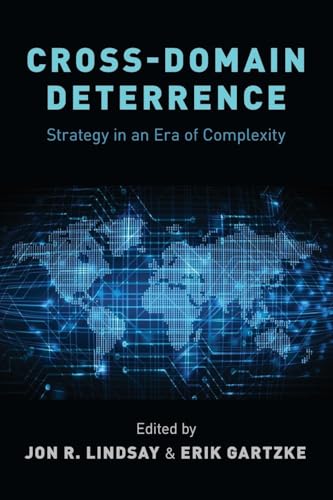
Cross-domain Deterrence (Paperback)
Sprache: Englisch
Verlag: Oxford University Press Inc, New York, 2019
ISBN 10: 0190908653 ISBN 13: 9780190908652
Anbieter: Grand Eagle Retail, Bensenville, IL, USA
Verkäuferbewertung 5 von 5 Sternen

Paperback. Zustand: new. Paperback. The complexity of the twenty-first century threat landscape contrasts markedly with the bilateral nuclear bargaining context envisioned by classical deterrence theory. Nuclear and conventional arsenals continue to develop alongside anti-satellite programs, autonomous robotics or drones, cyber operations, biotechnology, and other innovations barely imagined in the early nuclear age. The concept of cross-domain deterrence (CDD) emerged near the end of the George W. Bush administration as policymakers and commanders confronted emerging threats to vital military systems in space and cyberspace. The Pentagon now recognizes five operational environments or so-called domains (land, sea, air, space, and cyberspace), and CDD poses serious problems in practice. In Cross-Domain Deterrence, Erik Gartzke and Jon R. Lindsay assess the theoretical relevance of CDD for the field of International Relations. As a general concept, CDD posits that how actors choose to deter affects the quality of the deterrence they achieve. Contributors to this volume include senior and junior scholars and national security practitioners. Their chapters probe the analytical utility of CDD by examining how differences across, and combinations of, different military and non-military instruments can affect choices and outcomes in coercive policy in historical and contemporary cases. Deterrence theory, which emerged during the Cold War, explains how states can use nuclear threats to prevent nuclear war. Today, however, the threat landscape is significantly more complex. Alongside ever-more sophisticated nuclear weapons arsenals, contemporary threats include cyberwarfare, anti-satellite weapons, robotic drones, and advanced conventional weapons. To deal with the new threat environment, the Pentagon identified five operational domains: land, sea,air, space, and cyberspace. The resulting model is an integrated, flexible regime that is able to deter threats across domains. In this volume, a leading cast of scholars and national security practitioners explore the logic and application of cross-domain deterrence in theory andpractice. Shipping may be from multiple locations in the US or from the UK, depending on stock availability.
-

Cross-domain Deterrence (Paperback)
Sprache: Englisch
Verlag: Oxford University Press Inc, New York, 2019
ISBN 10: 0190908653 ISBN 13: 9780190908652
Anbieter: CitiRetail, Stevenage, Vereinigtes Königreich
Verkäuferbewertung 5 von 5 Sternen
EUR 41,24
EUR 42,34 Versand
Versand von Vereinigtes Königreich nach USAAnzahl: 1 verfügbar
In den WarenkorbPaperback. Zustand: new. Paperback. The complexity of the twenty-first century threat landscape contrasts markedly with the bilateral nuclear bargaining context envisioned by classical deterrence theory. Nuclear and conventional arsenals continue to develop alongside anti-satellite programs, autonomous robotics or drones, cyber operations, biotechnology, and other innovations barely imagined in the early nuclear age. The concept of cross-domain deterrence (CDD) emerged near the end of the George W. Bush administration as policymakers and commanders confronted emerging threats to vital military systems in space and cyberspace. The Pentagon now recognizes five operational environments or so-called domains (land, sea, air, space, and cyberspace), and CDD poses serious problems in practice. In Cross-Domain Deterrence, Erik Gartzke and Jon R. Lindsay assess the theoretical relevance of CDD for the field of International Relations. As a general concept, CDD posits that how actors choose to deter affects the quality of the deterrence they achieve. Contributors to this volume include senior and junior scholars and national security practitioners. Their chapters probe the analytical utility of CDD by examining how differences across, and combinations of, different military and non-military instruments can affect choices and outcomes in coercive policy in historical and contemporary cases. Deterrence theory, which emerged during the Cold War, explains how states can use nuclear threats to prevent nuclear war. Today, however, the threat landscape is significantly more complex. Alongside ever-more sophisticated nuclear weapons arsenals, contemporary threats include cyberwarfare, anti-satellite weapons, robotic drones, and advanced conventional weapons. To deal with the new threat environment, the Pentagon identified five operational domains: land, sea,air, space, and cyberspace. The resulting model is an integrated, flexible regime that is able to deter threats across domains. In this volume, a leading cast of scholars and national security practitioners explore the logic and application of cross-domain deterrence in theory andpractice. This item is printed on demand. Shipping may be from our UK warehouse or from our Australian or US warehouses, depending on stock availability.
-

Cross-Domain Deterrence
Sprache: Englisch
Verlag: Oxford University Press Inc, 2019
ISBN 10: 0190908645 ISBN 13: 9780190908645
Anbieter: PBShop.store US, Wood Dale, IL, USA
Verkäuferbewertung 5 von 5 Sternen
HRD. Zustand: New. New Book. Shipped from UK. THIS BOOK IS PRINTED ON DEMAND. Established seller since 2000.
-
Cross-Domain Deterrence
Sprache: Englisch
Verlag: Oxford University Press Inc, 2019
ISBN 10: 0190908645 ISBN 13: 9780190908645
Anbieter: PBShop.store UK, Fairford, GLOS, Vereinigtes Königreich
Verkäuferbewertung 4 von 5 Sternen

EUR 189,46
EUR 6,72 Versand
Versand von Vereinigtes Königreich nach USAAnzahl: Mehr als 20 verfügbar
In den WarenkorbHRD. Zustand: New. New Book. Delivered from our UK warehouse in 4 to 14 business days. THIS BOOK IS PRINTED ON DEMAND. Established seller since 2000.

