

Gesamtpreis (1 Artikel Artikel):
Versandziel:

f hutchenson (10 Ergebnisse)
Direkt zu den wichtigsten Suchergebnissen
Suchfilter
Produktart
- Alle Product Types
- Bücher (10)
- Magazine & Zeitschriften (Keine weiteren Ergebnisse entsprechen dieser Verfeinerung)
- Comics (Keine weiteren Ergebnisse entsprechen dieser Verfeinerung)
- Noten (Keine weiteren Ergebnisse entsprechen dieser Verfeinerung)
- Kunst, Grafik & Poster (Keine weiteren Ergebnisse entsprechen dieser Verfeinerung)
- Fotografien (Keine weiteren Ergebnisse entsprechen dieser Verfeinerung)
- Karten (Keine weiteren Ergebnisse entsprechen dieser Verfeinerung)
- Manuskripte & Papierantiquitäten (Keine weiteren Ergebnisse entsprechen dieser Verfeinerung)
Zustand Mehr dazu
- Neu (9)
- Wie Neu, Sehr Gut oder Gut Bis Sehr Gut (1)
- Gut oder Befriedigend (Keine weiteren Ergebnisse entsprechen dieser Verfeinerung)
- Ausreichend oder Schlecht (Keine weiteren Ergebnisse entsprechen dieser Verfeinerung)
- Wie beschrieben (Keine weiteren Ergebnisse entsprechen dieser Verfeinerung)
Einband
Weitere Eigenschaften
- Erstausgabe (Keine weiteren Ergebnisse entsprechen dieser Verfeinerung)
- Signiert (Keine weiteren Ergebnisse entsprechen dieser Verfeinerung)
- Schutzumschlag (Keine weiteren Ergebnisse entsprechen dieser Verfeinerung)
- Angebotsfoto (6)
- Keine Print-on-Demand Angebote (10)
Sprache (1)
Preis
- Beliebiger Preis
- Weniger als EUR 20
- EUR 20 bis EUR 45
- Mehr als EUR 45 (Keine weiteren Ergebnisse entsprechen dieser Verfeinerung)
Gratisversand
Land des Verkäufers
Verkäuferbewertung
-

Essay on the Nature and Conduct of the Passions and Affections with Illustrations on the Moral Sense
Anbieter: Rarewaves.com USA, London, LONDO, Vereinigtes Königreich
Verkäuferbewertung 5 von 5 Sternen

EUR 15,77
Versand gratis
Versand von Vereinigtes Königreich nach USAAnzahl: 1 verfügbar
In den WarenkorbPaperback. Zustand: New. Francis Hutcheson is considered by many scholars of philosophy to be the father of the Scottish Enlightenment. He was influential in defining the modern social, political, economic, and institutional world. Despite his influence, he has been widely forgotten, until now. This considerable volume in Hutcheson's vast work addresses the nature of human nature. In the great tradition of Enlightenment thinkers before and after him, Hutcheson is here engaged in a process of defining terms on which social, political, and economic liberty could be justified in light of centuries of rule by various tyrants and monarchs. As editor Aaron Garrett notes, "In the Essay Hutcheson provides his crucial argument against Hobbes and Mandeville, that not just egoistic self preservation, but also benevolence, is an essential feature of human nature." Professor Garrett has constructed a critical variorum edition of this great work. As there are no manuscripts of the work, this could be done only by comparing all extant lifetime editions.
-

Paperback. Zustand: New. Francis Hutcheson is considered by many scholars of philosophy to be the father of the Scottish Enlightenment. He was influential in defining the modern social, political, economic, and institutional world. Despite his influence, he has been widely forgotten, until now. This considerable volume in Hutcheson's vast work addresses the nature of human nature. In the great tradition of Enlightenment thinkers before and after him, Hutcheson is here engaged in a process of defining terms on which social, political, and economic liberty could be justified in light of centuries of rule by various tyrants and monarchs. As editor Aaron Garrett notes, "In the Essay Hutcheson provides his crucial argument against Hobbes and Mandeville, that not just egoistic self preservation, but also benevolence, is an essential feature of human nature." Professor Garrett has constructed a critical variorum edition of this great work. As there are no manuscripts of the work, this could be done only by comparing all extant lifetime editions.
-
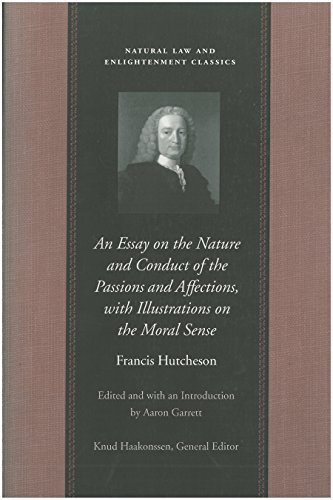
Essay on the Nature & Conduct of the Passions & Affections with Illustrations on the Moral Sense (Paperback)
Sprache: Englisch
Verlag: Liberty Fund Inc, Indianapolis, IN, 2002
ISBN 10: 0865973873 ISBN 13: 9780865973879
Anbieter: Grand Eagle Retail, Bensenville, IL, USA
Verkäuferbewertung 5 von 5 Sternen
Paperback. Zustand: new. Paperback. Francis Hutcheson is considered by many scholars of philosophy to be the father of the Scottish Enlightenment. He was influential in defining the modern social, political, economic, and institutional world. Despite his influence, he has been widely forgotten, until now. This considerable volume in Hutcheson's vast work addresses the nature of human nature. In the great tradition of Enlightenment thinkers before and after him, Hutcheson is here engaged in a process of defining terms on which social, political, and economic liberty could be justified in light of centuries of rule by various tyrants and monarchs. As editor Aaron Garrett notes, "In the Essay Hutcheson provides his crucial argument against Hobbes and Mandeville, that not just egoistic self preservation, but also benevolence, is an essential feature of human nature." Professor Garrett has constructed a critical variorum edition of this great work. As there are no manuscripts of the work, this could be done only by comparing all extant lifetime editions. This considerable volume in Hutcheson's vast work addresses the nature of human nature. Hutcheson is here engaged in a process of defining terms on which social, political and economic liberty could be justified in light of centuries of rule by various tyrants and monarchs. Shipping may be from multiple locations in the US or from the UK, depending on stock availability.
-

Hardback. Zustand: New. Francis Hutcheson is considered by many scholars of philosophy to be the father of the Scottish Enlightenment. He was influential in defining the modern social, political, economic, and institutional world. Despite his influence, he has been widely forgotten, until now. This considerable volume in Hutcheson's vast work addresses the nature of human nature. In the great tradition of Enlightenment thinkers before and after him, Hutcheson is here engaged in a process of defining terms on which social, political, and economic liberty could be justified in light of centuries of rule by various tyrants and monarchs. As editor Aaron Garrett notes, "In the Essay Hutcheson provides his crucial argument against Hobbes and Mandeville, that not just egoistic self preservation, but also benevolence, is an essential feature of human nature." Professor Garrett has constructed a critical variorum edition of this great work. As there are no manuscripts of the work, this could be done only by comparing all extant lifetime editions.
-
An Essay on the Nature and Conduct of the Passions and Affections, with Illustrations on the Moral Sense
Anbieter: Kennys Bookshop and Art Galleries Ltd., Galway, GY, Irland
Verkäuferbewertung 5 von 5 Sternen
Zustand: New. 2003. Paperback. Editor(s): Garrett, Aaron. Series: Natural Law & Enlightenment Classics. Num Pages: 220 pages. BIC Classification: HPCD; HPS. Category: (P) Professional & Vocational; (UP) Postgraduate, Research & Scholarly; (UU) Undergraduate. Dimension: 229 x 153 x 18. Weight in Grams: 438. . . . . .
-
An Essay on the Nature and Conduct of the Passions and Affections, with Illustrations on the Moral Sense
Anbieter: Kennys Bookstore, Olney, MD, USA
Verkäuferbewertung 5 von 5 Sternen
Zustand: New. 2003. Paperback. Editor(s): Garrett, Aaron. Series: Natural Law & Enlightenment Classics. Num Pages: 220 pages. BIC Classification: HPCD; HPS. Category: (P) Professional & Vocational; (UP) Postgraduate, Research & Scholarly; (UU) Undergraduate. Dimension: 229 x 153 x 18. Weight in Grams: 438. . . . . . Books ship from the US and Ireland.
-
An Essay on the Nature and Conduct of the Passions and Affections, with Illustrations on the Moral Sense (Natural Law & Enlightenment Classics) (Natural Law and Enlightenment Classics)
Anbieter: Aardvark Rare Books, Presteigne, HEREF, Vereinigtes Königreich
Verkäuferbewertung 5 von 5 Sternen
EUR 12,42
EUR 16,19 Versand
Versand von Vereinigtes Königreich nach USAAnzahl: 1 verfügbar
In den Warenkorbpaperback. Zustand: Fine. **PAPERBACK** No stamps or inscriptions;
-

Essay on the Nature and Conduct of the Passions and Affections with Illustrations on the Moral Sense
Anbieter: Rarewaves USA United, OSWEGO, IL, USA
Verkäuferbewertung 5 von 5 Sternen
Paperback. Zustand: New. Francis Hutcheson is considered by many scholars of philosophy to be the father of the Scottish Enlightenment. He was influential in defining the modern social, political, economic, and institutional world. Despite his influence, he has been widely forgotten, until now. This considerable volume in Hutcheson's vast work addresses the nature of human nature. In the great tradition of Enlightenment thinkers before and after him, Hutcheson is here engaged in a process of defining terms on which social, political, and economic liberty could be justified in light of centuries of rule by various tyrants and monarchs. As editor Aaron Garrett notes, "In the Essay Hutcheson provides his crucial argument against Hobbes and Mandeville, that not just egoistic self preservation, but also benevolence, is an essential feature of human nature." Professor Garrett has constructed a critical variorum edition of this great work. As there are no manuscripts of the work, this could be done only by comparing all extant lifetime editions.
-

Essay on the Nature and Conduct of the Passions and Affections, with Illustrations on the Moral Sense
Anbieter: Rarewaves USA United, OSWEGO, IL, USA
Verkäuferbewertung 5 von 5 Sternen
Hardback. Zustand: New. Francis Hutcheson is considered by many scholars of philosophy to be the father of the Scottish Enlightenment. He was influential in defining the modern social, political, economic, and institutional world. Despite his influence, he has been widely forgotten, until now. This considerable volume in Hutcheson's vast work addresses the nature of human nature. In the great tradition of Enlightenment thinkers before and after him, Hutcheson is here engaged in a process of defining terms on which social, political, and economic liberty could be justified in light of centuries of rule by various tyrants and monarchs. As editor Aaron Garrett notes, "In the Essay Hutcheson provides his crucial argument against Hobbes and Mandeville, that not just egoistic self preservation, but also benevolence, is an essential feature of human nature." Professor Garrett has constructed a critical variorum edition of this great work. As there are no manuscripts of the work, this could be done only by comparing all extant lifetime editions.
-

Essay on the Nature and Conduct of the Passions and Affections with Illustrations on the Moral Sense
Anbieter: Rarewaves.com UK, London, Vereinigtes Königreich
Verkäuferbewertung 5 von 5 Sternen
EUR 13,61
EUR 75,16 Versand
Versand von Vereinigtes Königreich nach USAAnzahl: 1 verfügbar
In den WarenkorbPaperback. Zustand: New. Francis Hutcheson is considered by many scholars of philosophy to be the father of the Scottish Enlightenment. He was influential in defining the modern social, political, economic, and institutional world. Despite his influence, he has been widely forgotten, until now. This considerable volume in Hutcheson's vast work addresses the nature of human nature. In the great tradition of Enlightenment thinkers before and after him, Hutcheson is here engaged in a process of defining terms on which social, political, and economic liberty could be justified in light of centuries of rule by various tyrants and monarchs. As editor Aaron Garrett notes, "In the Essay Hutcheson provides his crucial argument against Hobbes and Mandeville, that not just egoistic self preservation, but also benevolence, is an essential feature of human nature." Professor Garrett has constructed a critical variorum edition of this great work. As there are no manuscripts of the work, this could be done only by comparing all extant lifetime editions.
