

Gesamtpreis (1 Artikel Artikel):
Versandziel:

flagle charles (9 Ergebnisse)
Direkt zu den wichtigsten Suchergebnissen
Suchfilter
Produktart
- Alle Product Types
- Bücher (9)
- Magazine & Zeitschriften (Keine weiteren Ergebnisse entsprechen dieser Verfeinerung)
- Comics (Keine weiteren Ergebnisse entsprechen dieser Verfeinerung)
- Noten (Keine weiteren Ergebnisse entsprechen dieser Verfeinerung)
- Kunst, Grafik & Poster (Keine weiteren Ergebnisse entsprechen dieser Verfeinerung)
- Fotografien (Keine weiteren Ergebnisse entsprechen dieser Verfeinerung)
- Karten (Keine weiteren Ergebnisse entsprechen dieser Verfeinerung)
- Manuskripte & Papierantiquitäten (Keine weiteren Ergebnisse entsprechen dieser Verfeinerung)
Zustand Mehr dazu
- Neu (Keine weiteren Ergebnisse entsprechen dieser Verfeinerung)
- Wie Neu, Sehr Gut oder Gut Bis Sehr Gut (2)
- Gut oder Befriedigend (5)
- Ausreichend oder Schlecht (Keine weiteren Ergebnisse entsprechen dieser Verfeinerung)
- Wie beschrieben (2)
Einband
- alle Einbände
- Hardcover (8)
- Softcover (Keine weiteren Ergebnisse entsprechen dieser Verfeinerung)
Weitere Eigenschaften
- Erstausgabe (3)
- Signiert (Keine weiteren Ergebnisse entsprechen dieser Verfeinerung)
- Schutzumschlag (3)
- Angebotsfoto (2)
- Keine Print-on-Demand Angebote (9)
Sprache (2)
Gratisversand
Land des Verkäufers
Verkäuferbewertung
-

Operations Research and Systems Engineering
Sprache: Englisch
Verlag: The Johns Hopkins University Press, 1960
ISBN 10: 0801801982 ISBN 13: 9780801801983
Anbieter: Affordable Collectibles, Columbia, MO, USA
Verkäuferbewertung 5 von 5 Sternen

Hardcover. Zustand: Very Good. Excellent with no marks or dj splits. Price intact.
-
Operations Research and Systems Engineering.
Anbieter: Brentwood Books, Kinnelon, NJ, USA
Verkäuferbewertung 5 von 5 Sternen
Hardcover. Zustand: Used, very good. Almost like new book without jacket. Red hardcover, 1960, Johns Hopkins Press. Cover has no wear, very lightly soiled by use, binding tight and square, interior as new except upper right corner of first page clipped off as if to remove name and prior owner's embossed logo on lower right corner. Nice condition. **We provide professional service and individual attention to your order, daily shipments, and sturdy packaging. FREE TRACKING ON ALL SHIPMENTS WITHIN USA.
-

Health systems-- the challenge of change: Proceedings of the Fifth International Conference on System Science in Health Care
Anbieter: Alien Bindings, BALTIMORE, MD, USA
Verkäuferbewertung 4 von 5 Sternen

Erstausgabe
Hardcover. Zustand: Very Good. No Jacket. First Edition. Hardcover edition. The covers have nice sharp edges and points. The binding is a little weak; however, all pages are intact. The front flyleaf is stamped. The interior pages are clean and unmarked. Electronic delivery tracking will be issued free of charge.
-

Operations Research and Systems Engineering
Verlag: The Johns Hopkins University, Baltimore, MD, 1960
Anbieter: Saucony Book Shop, Kutztown, PA, USA
Verkäuferbewertung 5 von 5 Sternen
Erstausgabe
Hardcover. Zustand: Near Fine. Zustand des Schutzumschlags: VG+. 1st Edition. Red-orange cloth, lettered in black. Slightly rubbed corners and extremities, text block edges typically a bit tanned. Small hole on one leaf (pp. 19-20), slightly affecting text. Dust jacket slightly chipped at head of spine panel, minor edge wear, now in mylar. x,889 pp. 1st ed. Size: 8vo - over 7¾" - 9¾" tall. Book.
-
Operations Research and Systems Engineering
Verlag: The Johns Hopkins Press, 1960
Anbieter: BookDepart, Shepherdstown, WV, USA
Verkäuferbewertung 5 von 5 Sternen
Hardcover. Zustand: UsedGood. Hardcover; surplus government copy with stampings on page edges and inside front board; fading and shelf wear to exterior; bump to bottom front corner; in good condition with clean text, firm binding. Dust jacket shows fading, scuffing, and small edge tears.
-
Operations Research and Systems Engineering
Verlag: The Johns Hopkins Press, 1960
Anbieter: Chattanooga Public Library Foundation, Chattanooga, TN, USA
Verkäuferbewertung 4 von 5 Sternen
Zustand: Interior is excellent. Minimal wear to cover and jacket.
-
Operations Research and Systems Engineering
Sprache: Englisch
Verlag: The Johns Hopkins University Press, 1960
ISBN 10: 0801801982 ISBN 13: 9780801801983
Anbieter: Basement Seller 101, Cincinnati, OH, USA
Verkäuferbewertung 5 von 5 Sternen
Hardcover. Zustand: As New. 1964 prrinting.
-
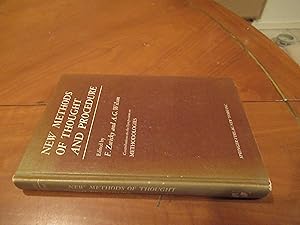
New Methods Of Thought And Procedure. Contributions To The Symposium On Methodologies
Sprache: Englisch
Verlag: Springer-Verlag / Office For Industrial Associates Of The California Institute Of Technology / Society For Morphological Research, New York, 1967
Anbieter: Arroyo Seco Books, Pasadena, Member IOBA, Pasadena, CA, USA
Verbandsmitglied: IOBA
Verkäuferbewertung 5 von 5 Sternen
Erstausgabe
Hardcover. Zustand: Very Good +. 1st Edition. Viii, 338 Pp.Brown Cloth Lettered In White. First Printing, 1967. Lght Wear. Fine Essays, First Published Here. Bookplate Of Garrett Hardin, Which Is Signed By Someone Else And With That Person's Signature On Front Free Endpaper. Garrett James Hardin (1915 -2003) Was An American Ecologist. He Focused His Career On The Issue Of Human Overpopulation, And Is Best Known For His Exposition Of The Tragedy Of The Commons In A 1968 Paper Of The Same Title In Science, Which Called Attention To "The Damage That Innocent Actions By Individuals Can Inflict On The Environment". He Is Also Known For Hardin's First Law Of Human Ecology: "We Can Never Do Merely One Thing. Any Intrusion Into Nature Has Numerous Effects, Many Of Which Are Unpredictable." A Major Focus Of His Career, And One To Which He Returned Repeatedly, Was The Issue Of Human Overpopulation. This Led To Writings On Controversial Subjects Such As Advocating Abortion Rights, Which Earned Him Criticism From The Political Right, And Advocating Strict Limits To All Immigration, Which Earned Him Criticism From The Political Left. In His Essays, He Also Tackled Subjects Such As Conservation And Creationism. He Was Also A Proponent Of Eugenics And A Vice-President Of American Eugenics Society. In 1968, Hardin Applied His Conceptual Model Developed In His Essay "The Tragedy Of The Commons" To Human Population Growth, The Use Of The Earth's Natural Resources, And The Welfare State. His Essay Cited An 1833 Pamphlet By The English Economist William Forster Lloyd Which Included An Example Of Herders Sharing A Common Parcel Of Land, Which Would Lead To Overgrazing. Hardin Blamed The Welfare State For Allowing The Tragedy Of The Commons; Where The State Provides For Children And Supports Over-Breeding As A Fundamental Human Right.] Malthusian Catastrophe Is Inevitable. Hardin Stated In His Analysis Of The Tragedy Of The Commons That "Freedom In A Commons Brings Ruin To All." Environmental Historians Joachim Radkau, Alfred Thomas Grove And Oliver Rackham Criticized Hardin "As An American With No Notion At All How Commons Actually Work". In Addition, Hardin's Pessimistic Outlook Was Subsequently Contradicted By Elinor Ostrom's Later Work On Success Of Co-Operative Structures Like The Management Of Common Land, For Which She Shared The 2009 Nobel Memorial Prize In Economic Sciences With Oliver E. Williamson. In Contrast To Hardin, They Stated Neither Commons Or "Allmende" In The Generic Nor Classical Meaning Are Bound To Fail; To The Contrary "The Wealth Of The Commons" Has Gained Renewed Interest In The Scientific Community. Hardin's Work Was Also Criticized As Historically Inaccurate In Failing To Account For The Demographic Transition, And For Failing To Distinguish Between Common Property And Open Access Resources. Despite The Criticisms, The Theory Has Nonetheless Been Influential. In 1993, Garrett Hardin Published Living Within Limits: Ecology, Economics, And Population Taboos, Which He Described At The Time As A Summation Of All His Previous Works. The Book Won The 1993 Phi Beta Kappa Award In Science. In The Book, He Argues That The Natural Sciences Are Grounded In The Concept Of Limits (Such As The Speed Of Light), While Social Sciences, Such As Economics, Are Grounded In Concepts That Have No Limits (Such As The Widespread "Infinite-Earth" Economic Models). He Notes That Most Of The More Notable Scientific (As Opposed To Political) Debates Concerning Ecological Economics Are Between Natural Scientists, Such As Paul R. Ehrlich, And Economists, Such As Julian Simon, One Of Ehrlich's Most Well Known And Vocal Detractors. A Strong Theme Throughout The Book Is That Economics, As A Discipline, Can Be As Much About Mythology And Ideology As It Is About Real Science. Hardin Goes On To Label Those Who Reflexively Argue For Growth As "Growthmaniacs", And Argues Against The Institutional Faith In Exponential Growth On A Finite Planet.
-

Hardcover. Zustand: Good. X, 889 S.: Ill. Dutch.


