Gesamtpreis (1 Artikel Artikel):
Versandziel:

gosling e m (14 Ergebnisse)
Direkt zu den wichtigsten Suchergebnissen
Suchfilter
Produktart
- Alle Product Types
- Bücher (13)
- Magazine & Zeitschriften (1)
- Comics (Keine weiteren Ergebnisse entsprechen dieser Verfeinerung)
- Noten (Keine weiteren Ergebnisse entsprechen dieser Verfeinerung)
- Kunst, Grafik & Poster (Keine weiteren Ergebnisse entsprechen dieser Verfeinerung)
- Fotografien (Keine weiteren Ergebnisse entsprechen dieser Verfeinerung)
- Karten (Keine weiteren Ergebnisse entsprechen dieser Verfeinerung)
- Manuskripte & Papierantiquitäten (Keine weiteren Ergebnisse entsprechen dieser Verfeinerung)
Zustand Mehr dazu
- Neu (1)
- Wie Neu, Sehr Gut oder Gut Bis Sehr Gut (2)
- Gut oder Befriedigend (6)
- Ausreichend oder Schlecht (Keine weiteren Ergebnisse entsprechen dieser Verfeinerung)
- Wie beschrieben (5)
Einband
- alle Einbände
- Hardcover (Keine weiteren Ergebnisse entsprechen dieser Verfeinerung)
- Softcover (9)
Weitere Eigenschaften
- Erstausgabe (5)
- Signiert (2)
- Schutzumschlag (Keine weiteren Ergebnisse entsprechen dieser Verfeinerung)
- Angebotsfoto (6)
- Keine Print-on-Demand Angebote (14)
Sprache (3)
Gratisversand
Land des Verkäufers
Verkäuferbewertung
-
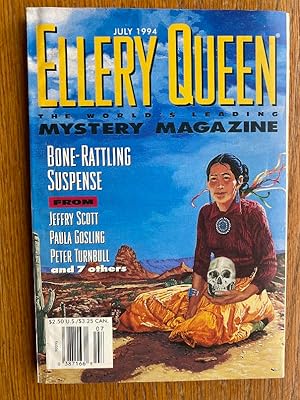
Ellery Queen Mystery Magazine July 1994
Sprache: Englisch
Verlag: Dell Magazine, New York, 1994
Anbieter: Scene of the Crime, ABAC, IOBA, St. Catharines, ON, Kanada
Verkäuferbewertung 5 von 5 Sternen

Magazin / Zeitschrift Erstausgabe
Soft cover. Zustand: Near Fine. 1st Edition. First Edition, First Printing of this Collection of 11 Short Stories. Featured are The 1944 Bullet by Jeffry Scott, A Fondness for Steam by Edward D Hoch, Passion Flower by Jo Bannister, The Case of the Runaway Husband by Tom Tolnay, The Saturday Shopper by Paula Gosling, The Jury Box by Jon L Breen, A Delicate Balance by Judith Lea Koretsky, Skeleton in the Cupboard by Tony Wilmot, Death on the Reach by Claire M Caterer, Gains and Losses by Michael Z Lewin and Iceman by Peter Turnbull. In Near Fine Condition.
-

Codes for Computers and Microprocessors
Anbieter: BRIMSTONES, Lewes, Vereinigtes Königreich
Verkäuferbewertung 5 von 5 Sternen
EUR 5,95
EUR 23,10 shipping
Versand von Vereinigtes Königreich nach USAAnzahl: 1 verfügbar
In den WarenkorbSoft cover. Zustand: Good. paperback, large 8vo, x,65pp, owner's name on endpaper, edges slightly browned, contents clean and tight, Good condition. ISBN: 0333258258.
-

Códigos para ordenadores y microprocesadores
Sprache: Spanisch
ISBN 10: 8428311374 ISBN 13: 9788428311373
Zustand: Bueno. : Este libro, titulado 'Códigos para ordenadores y microprocesadores', es una obra de P. E. Gosling y Q.L.M. Laarhoven, publicado por Ed. Paraninfo en 1980. El libro aborda temas de informática, incluyendo códigos ponderados y procedimientos prácticos. Con 80 páginas, esta edición en tapa blanda ofrece una introducción a los códigos utilizados en ordenadores y microprocesadores. EAN: 9788428311373 Tipo: Libros Categoría: Tecnología Título: Códigos para ordenadores y microprocesadores Autor: P. E. Gosling| Q.L.M. Laarhoven Idioma: es-ES Páginas: 80 Formato: tapa blanda.
-

Evidence for selective mortality in Chlamys varia transplant experiments. In 8vo, offp., pp. 8 with 1 figs. Disbound from Journal of the Marine Biological Association of the UK, Volume 68
Erscheinungsdatum: 1988
Anbieter: Riccardo Giannuzzi Savelli, Palermo, PA, Italien
Verkäuferbewertung 3 von 5 Sternen

-
Reproduction and settlement of Mytilus edulis on a exposed rocky shores in Galway Bay, Wedst coast of Ireland. In 8vo, offp., pp. 11 with 4 figs. Disbound from Joutrn. Mar. Biol. Ass. UK, 69(2)
Erscheinungsdatum: 1989
Anbieter: Riccardo Giannuzzi Savelli, Palermo, PA, Italien
Verkäuferbewertung 3 von 5 Sternen
-
Códigos para ordenadores y microprocesadores.
Verlag: Ed. Paraninfo, 1980
ISBN 10: 8428311374 ISBN 13: 9788428311373
Anbieter: Tik Books GO, Madrid, M, Spanien
Verkäuferbewertung 5 von 5 Sternen
Encuadernación de tapa blanda. Zustand: Aceptable. R802906. Ed. Paraninfo - 80pp Códigos ponderacos, procedimientos prácticos, etc. CA. G109125.
-

The java language specification(Chinese Edition)
Sprache: Englisch
Verlag: China Electric Power Press, 2000
ISBN 10: 7508342925 ISBN 13: 9787508342924
paperback. Zustand: New. Language:Chinese.Paperback. Publisher: China Electric Power Press. This book describes in detail the syntax. type. value. and.
-
Le médecin en formation
Verlag: Payot, Paris, 1979
Anbieter: LibrairieLaLettre2, Villefranche de Lauragais, Frankreich
Verkäuferbewertung 5 von 5 Sternen
Broché. Zustand: Etat satisfaisant. in-8 Description :169 pp. Collection "Science de l'homme". Poinçons "SP" sur le 4ème plat et les dernières pages. Ouvrage jauni. Couverture défraichie. Langue : Français Nb de volumes : 1.
-

Códigos para ordenadores y microprocesadores
Verlag: Thomson Paraninfo,S.A., 1981
ISBN 10: 8428311374 ISBN 13: 9788428311373
Anbieter: Almacen de los Libros Olvidados, Barakaldo, BI, Spanien
Verkäuferbewertung 5 von 5 Sternen
Tapa blanda. Zustand: 2ª Mano. , . . Firma de anterior propietario , Marcas de cello por forro, Portada sobada. Moteado en cantos y guardas. Tapa blanda; 80 p; 22x16 cm.
-
Physical Studies of Nucleic Acid. Crystalline Structure of DNA. Nucleic Acid: An Extensible Molecule? (Wilkins) WITH Evidence on the Structure of Deoxyribonucleic Acid from Measurements with Polarized Infra-red Radiation (Fraser) WITH Automatic Computing Engine of The National Physical Laboratory (Woodger) in Nature 167, 1951
Verlag: Macmillian & Sons, London, 1951
Anbieter: Atticus Rare Books, West Branch, IA, USA
Verkäuferbewertung 5 von 5 Sternen
Erstausgabe
1st Edition. FIRST EDITION OF A NUMBER OF IMPORTANT PAPERS. ALSO INCLUDED: Armenteros, R.; Barker, K. H. "Decay of Neutral V-Particles" WITH Mackay, D. M., Calculating Machines and Human Thought WITH Bragg, W. L. Elimination of the Unwanted Image in Diffraction Microscopy WITH Martyn, D. G. The Theory of Magnetic Storms and Auroras. CONDITION & DETAILS: London: Macmillian & Sons. Complete volume. 4to (10.25.x 7.5 inches; 256 x 186mm). 1076 pp. & lv name and title index. Ex-libris bearing only discrete stamps on the flyleaf, pastedown and title page; no spine markings whatsoever. Bound in blue cloth, gilt-lettered at the spine. Solidly and tightly bound; light rubbing at the edges. Very clean inside and out. Very good condition.
-
PHYSICAL STUDIES OF NUCLEIC ACID. NUCLEIC ACID: AN EXTENSIBLE MOLECULE! and EVIDENCE ON THE STRUCTURE OF DEOXYRIBONUCLEIC ACID (DNA) FROM MEASUREMENTS WITH POLARIZED INFRA-RED RADIATION
Anbieter: Brainbooks, Gainesville, FL, USA
Verkäuferbewertung 5 von 5 Sternen
Soft cover. Zustand: Very Good. In: Nature, Vol. 167, No. 4254, May 12, 1951, pp. 759-760, pp. 761-762. London: Macmillan, 1951. Offered is Very Good+ entire issue disbound from volume of Nature with spine wear, minimal soil covers, small library stamp front cover. 8vo. Paperback. Very Good+.Francis Crick , James Watson and Maurice Wilkins were awarded the Nobel Prize in Physiology or Medicine in 1962. In the words of the Nobel Committee "For their discoveries concerning the molecular structure of nucleic acids and its significance for information transfer in living material". //// DW ////Ask for pictures.
-

Molecular Structure of Nucleic Acids: A Structure for Deoxyribose Nucleic Acid; Molecular Structure of Deoxypentose Nucleic Acids; Molecular Configuration in Sodium Thymonucleate; Three papers in a single offprint from Nature, Vol. 171, No. 4356, April 25, 1953
Verlag: Fisher, Knight & Co, St. Albans, 1953
Anbieter: Alex Hime, Los Angeles, CA, USA
Verbandsmitglied: ABAA ILAB IOBA
Verkäuferbewertung 5 von 5 Sternen
Erstausgabe Signiert
Zustand: Near fine. First Edition. First edition, the three-paper offprint issue, of the primary record of the co-discovery of the molecular structure of DNA, the most transformative moment in twentieth-century biology. Octavo, pp. 14. with two diagrams (including the double helix) and two illustrations from photographs. Stapled in self-wrappers as issued. Signed by Maurice Wilkins on the first page. Very lightly toned and a coulpe soft creases, near fine. Grolier Club, One Hundred Books Famous in Medicine, 99; Dibner, Heralds of Science, 200. Garrison-Morton 256.3; Judson, Eighth Day of Creation, pp. 145-56. Ex-Dr. Myron Printzmetal. The discovery of DNA's double helix structure emerged from an intense period of competitive collaboration between research teams at Cambridge and King's College London. Watson and Crick's theoretical breakthrough synthesized crucial experimental evidence from multiple sources: Erwin Chargaff's base composition rules demonstrating the 1:1 ratio of adenine to thymine and guanine to cytosine, X-ray crystallographic data revealing DNA's helical structure, and most critically, the precise measurements of backbone positioning and molecular dimensions. Their elegant model proposed complementary base pairing (A-T and C-G) held together by hydrogen bonds, immediately suggesting a mechanism for genetic replication where each strand could serve as a template for its complement. The accompanying papers by Wilkins, Stokes, and Wilson, and by Franklin and Gosling, provided essential experimental validation through X-ray diffraction analysis, creating a unified presentation of both theoretical insight and empirical evidence that established the foundation of molecular biology. The contentious history surrounding this discovery has generated enduring scholarly debate, particularly regarding the systematic marginalization of Rosalind Franklin's contributions. Franklin's meticulous X-ray crystallographic work, conducted with her graduate student Raymond Gosling, had independently determined many key structural features including the antiparallel orientation of DNA strands, the external positioning of phosphate groups, and precise helical parameters. Her famous "Photograph 51" provided definitive evidence of DNA's helical structure, while her systematic analysis of A-form and B-form DNA revealed critical dimensions that enabled Watson and Crick's model construction. As Brenda Maddox documents in "Rosalind Franklin: The Dark Lady of DNA," Franklin's data was shown to Watson and Crick without her knowledge through Maurice Wilkins, creating an ethical controversy that persists in discussions of scientific collaboration and gender bias. Franklin's death from ovarian cancer in 1958, four years before the Nobel Prize was awarded to Watson, Crick, and Wilkins, has intensified debates about recognition and the complex dynamics of mid-twentieth century scientific discovery, with many scholars arguing that her rigorous experimental approach was as fundamental to the breakthrough as the theoretical modeling that received greater acclaim. This publication represents the founding document of modern molecular biology, establishing the conceptual framework for understanding heredity, genetic replication, and the molecular basis of life itself. The discovery immediately suggested mechanisms for protein synthesis and genetic information transfer, creating the theoretical foundation for subsequent developments in genetic engineering, biotechnology, and genomic medicine. As Francis Crick later observed, the structure's elegant simplicitywith its complementary base pairing and antiparallel strandsprovided not merely a static model but a dynamic mechanism explaining how genetic information could be accurately copied and transmitted across generations. The offprint's scientific significance extends far beyond its immediate discovery, representing the moment when biology transformed from a primarily descriptive science into a molecular discipline capable of manipulating the fundamental mechanisms of life, establishing the intellectual foundation for the biotechnology revolution that continues to reshape medicine, agriculture, and our understanding of evolutionary processes seventy years after its publication.
-
'Molecular Structure of Nucleic Acids: A Structure for Deoxyribose Nucleic Acid'; 'Molecular Structure of Deoxypentose Nucleic Acids'; 'Molecular Configuration in Sodium Thymonucleate'. Three papers in a single offprint from Nature, Vol. 171, No. 4356, April 25, 1953
Verlag: Fisher, Knight & Co, St. Albans, 1953
Anbieter: SOPHIA RARE BOOKS, Koebenhavn V, Dänemark
Verkäuferbewertung 5 von 5 Sternen
Erstausgabe
First edition. DISCOVERY OF THE STRUCTURE OF DNA. First edition, in the rare offprint form, of one of the most important scientific papers of the twentieth century, which "records the discovery of the molecular structure of deoxyribonucleic acid (DNA), the main component of chromosomes and the material that transfers genetic characteristics in all life forms. Publication of this paper initiated the science of molecular biology. Forty years after Watson and Crick's discovery, so much of the basic understanding of medicine and disease has advanced to the molecular level that their paper may be considered the most significant single contribution to biology and medicine in the twentieth century" (One Hundred Books Famous in Medicine, p. 362). "The discovery in 1953 of the double helix, the twisted-ladder structure of deoxyribonucleic acid (DNA), by James Watson and Francis Crick marked a milestone in the history of science and gave rise to modern molecular biology, which is largely concerned with understanding how genes control the chemical processes within cells. In short order, their discovery yielded ground-breaking insights into the genetic code and protein synthesis. During the 1970s and 1980s, it helped to produce new and powerful scientific techniques, specifically recombinant DNA research, genetic engineering, rapid gene sequencing, and monoclonal antibodies, techniques on which today's multi-billion dollar biotechnology industry is founded. Major current advances in science, namely genetic fingerprinting and modern forensics, the mapping of the human genome, and the promise, yet unfulfilled, of gene therapy, all have their origins in Watson and Crick's inspired work. The double helix has not only reshaped biology, it has become a cultural icon, represented in sculpture, visual art, jewelry, and toys" (Francis Crick Papers, National Library of Medicine, profiles./SC/Views/Exhibit/narrative/). In 1962, Watson, Crick, and Wilkins shared the Nobel Prize in Physiology or Medicine "for their discoveries concerning the molecular structure of nucleic acids and its significance for information transfer in living material." In 1869, the Swiss physiological chemist Friedrich Miescher (1844-95) first identified what he called 'nuclein' inside the nuclei of human white blood cells. (The term 'nuclein' was later changed to 'nucleic acid' and eventually to 'deoxyribonucleic acid,' or 'DNA.') Miescher's plan was to isolate and characterize not the nuclein (which nobody at that time realized existed) but instead the protein components of leukocytes (white blood cells). Miescher thus made arrangements for a local surgical clinic to send him used, pus-coated patient bandages; once he received the bandages, he planned to wash them, filter out the leukocytes, and extract and identify the various proteins within the white blood cells. But when he came across a substance from the cell nuclei that had chemical properties unlike any protein, including a much higher phosphorous content and resistance to proteolysis (protein digestion), Miescher realized that he had discovered a new substance. Sensing the importance of his findings, Miescher wrote, "It seems probable to me that a whole family of such slightly varying phosphorous-containing substances will appear, as a group of nucleins, equivalent to proteins". But Miescher's discovery of nucleic acids was not appreciated by the scientific community, and his name had fallen into obscurity by the 20th century. "Researchers working on DNA in the early 1950s used the term 'gene' to mean the smallest unit of genetic information, but they did not know what a gene actually looked like structurally and chemically, or how it was copied, with very few errors, generation after generation. In 1944, Oswald Avery had shown that DNA was the 'transforming principle,' the carrier of hereditary information, in pneumococcal bacteria. Nevertheless, many scientists continued to believe that DNA had a structure too uniform and simple to store genetic information for making complex living organisms. The genetic material, they reasoned, must consist of proteins, much more diverse and intricate molecules known to perform a multitude of biological functions in the cell. "Crick and Watson recognized, at an early stage in their careers, that gaining a detailed knowledge of the three-dimensional configuration of the gene was the central problem in molecular biology. Without such knowledge, heredity and reproduction could not be understood. They seized on this problem during their very first encounter, in the summer of 1951, and pursued it with single-minded focus over the course of the next eighteen months. This meant taking on the arduous intellectual task of immersing themselves in all the fields of science involved: genetics, biochemistry, chemistry, physical chemistry, and X-ray crystallography. Drawing on the experimental results of others (they conducted no DNA experiments of their own), taking advantage of their complementary scientific backgrounds in physics and X-ray crystallography (Crick) and viral and bacterial genetics (Watson), and relying on their brilliant intuition, persistence, and luck, the two showed that DNA had a structure sufficiently complex and yet elegantly simple enough to be the master molecule of life. "Other researchers had made important but seemingly unconnected findings about the composition of DNA; it fell to Watson and Crick to unify these disparate findings into a coherent theory of genetic transfer. The organic chemist Alexander Todd had determined that the backbone of the DNA molecule contained repeating phosphate and deoxyribose sugar groups. The biochemist Erwin Chargaff had found that while the amount of DNA and of its four types of bases the purine bases adenine (A) and guanine (G), and the pyrimidine bases cytosine (C) and thymine (T) varied widely from species to species, A and T always appeared in ratios of one-to-one, as did G and C. Maurice Wilkins an.
-
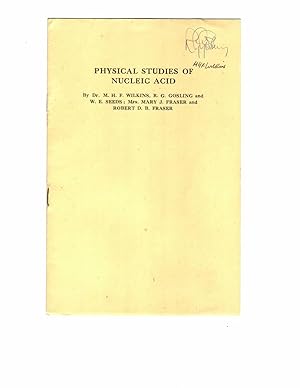
"Physical Studies of Nucleic Acid. Crystalline Structure of DNA. Nucleic Acid: An Extensible Molecule?" With: Mary J. FRASER & Robert D. B. FRASER: "Evidence on the Structure of Deoxyribonucleic Acid from Measurements with Polarized Infra-red Radiation." Offprint from Nature, Vol. 167, May 12, 1951. SIGNED BY MAURICE WILKINS AND BY RAYMOND GOSLING
Erscheinungsdatum: 1951
Anbieter: Scientia Books, ABAA ILAB, Arlington, MA, USA
Verbandsmitglied: ABAA ILAB SNEAB
Verkäuferbewertung 4 von 5 Sternen

Erstausgabe Signiert
Soft cover. Zustand: Very Good. 1st Edition. 7 pp. Original wrappers. Very Good. First Edition. SIGNED BY MAURICE WILKINS AND BY RAYMOND GOSLING, on the front wrapper. At a meeting of the Faraday Society in May 1950, Rudolf Signer "gave out samples of his best [DNA], and Wilkins took some home to King's. A few days later, he was preparing part of this DNA in highly viscous solution for the ultraviolet studies he was doing. Unexpectedly, he noticed that every time he touched the stuff with the tip of a glass rod and then drew the rod away, 'I had spun a very thin fibre of DNA, almost invisible, like a filament of spider web.' The fibres seemed so perfect and uniform that the molecules in them must have been neatly aligned alongside one another. Examined under a microscope, in polarized light, the fibres behaved as though they were made up of well-ordered crystals. So Wilkins took the fibres to a graduate student in the unit, Raymond Gosling, who was doing the crystallography with rams' sperm and had borrowed the use of an antiquated x-ray apparatus in a lead-lined basement of the chemistry department. Several dozen of Wilkins's fibres had to be bundled together, in a tiny tungsten-wire frame where they could be tightened like a violin bow, to constitute a large enough specimen for the soft focus of the x-ray tube. Wilkins and Gosling remembered that Bernal, fifteen years before, had got the first good x-ray patterns from protein crystals by keeping them wet. Accordingly, they maintained the DNA fibres at high humidity. They got striking patterns, with many spots, sharp and detailed, far better than ever before seen from DNA, and for the first time unmistakably from a substance in crystalline form. . . . That series of diffraction pictures taken in May or June of 1950 provided the one Wilkins showed at the meeting in Naples, a year later, that galvanized Watson's enthusiasm for DNA and x-ray crystallography" (Judson, Eighth Day of Creation, expanded ed., pp. 78-79). Olby, The Path to the Double Helix, pp. 332-35 (including an illustration taken from Wilkins and Gosling's paper). Maurice Wilkins shared the Nobel Prize in 1962 in Physiology or Medicine with Francis H. C. Crick and James D. Watson "for their discoveries concerning the molecular structure of nucleic acids and its significance for information transfer in living material." NOTE: Another copy--also signed by Wilkins and Gosling--sold for $2400 (buyer's premium included) on April 6, 2017, at the Pacific Book Auctions sale 611 (lot 239). Signed by Author(s).