
Gesamtpreis (1 Artikel Artikel):
Versandziel:

heidorn george (24 Ergebnisse)
Direkt zu den wichtigsten Suchergebnissen
Suchfilter
Produktart
- Alle Product Types
- Bücher (24)
- Magazine & Zeitschriften (Keine weiteren Ergebnisse entsprechen dieser Verfeinerung)
- Comics (Keine weiteren Ergebnisse entsprechen dieser Verfeinerung)
- Noten (Keine weiteren Ergebnisse entsprechen dieser Verfeinerung)
- Kunst, Grafik & Poster (Keine weiteren Ergebnisse entsprechen dieser Verfeinerung)
- Fotografien (Keine weiteren Ergebnisse entsprechen dieser Verfeinerung)
- Karten (Keine weiteren Ergebnisse entsprechen dieser Verfeinerung)
- Manuskripte & Papierantiquitäten (Keine weiteren Ergebnisse entsprechen dieser Verfeinerung)
Zustand Mehr dazu
- Neu (19)
- Wie Neu, Sehr Gut oder Gut Bis Sehr Gut (2)
- Gut oder Befriedigend (2)
- Ausreichend oder Schlecht (1)
- Wie beschrieben (Keine weiteren Ergebnisse entsprechen dieser Verfeinerung)
Einband
Weitere Eigenschaften
- Erstausgabe (1)
- Signiert (Keine weiteren Ergebnisse entsprechen dieser Verfeinerung)
- Schutzumschlag (Keine weiteren Ergebnisse entsprechen dieser Verfeinerung)
- Angebotsfoto (10)
- Keine Print-on-Demand Angebote (16)
Sprache (2)
Preis
- Beliebiger Preis
- Weniger als EUR 20 (Keine weiteren Ergebnisse entsprechen dieser Verfeinerung)
- EUR 20 bis EUR 45 (Keine weiteren Ergebnisse entsprechen dieser Verfeinerung)
- Mehr als EUR 45
Gratisversand
Land des Verkäufers
Verkäuferbewertung
-

Natural Language Processing : The Plnlp Approach
Anbieter: GreatBookPrices, Columbia, MD, USA
Verkäuferbewertung 5 von 5 Sternen

EUR 52,55
EUR 2,26 shipping
Versand innerhalb von USAAnzahl: Mehr als 20 verfügbar
In den WarenkorbZustand: New.
-

Natural Language Processing: The PLNLP Approach (Paperback)
Sprache: Englisch
Verlag: Springer-Verlag New York Inc., New York, NY, 2013
ISBN 10: 1461363896 ISBN 13: 9781461363897
Anbieter: Grand Eagle Retail, Bensenville, IL, USA
Verkäuferbewertung 5 von 5 Sternen
Paperback. Zustand: new. Paperback. Natural language is easy for people and hard for machines. For two generations, the tantalizing goal has been to get computers to handle human languages in ways that will be compelling and useful to people. Obstacles are many and legendary. Natural Language Processing: The PLNLP Approach describes one group's decade of research in pursuit of that goal. A very broad coverage NLP system, including a programming language (PLNLP) development tools, and analysis and synthesis components, was developed and incorporated into a variety of well-known practical applications, ranging from text critiquing (CRITIQUE) to machine translation (e.g. SHALT). This books represents the first published collection of papers describing the system and how it has been used. Twenty-six authors from nine countries contributed to this volume. Natural language analysis, in the PLNLP approach, is done is six stages that move smoothly from syntax through semantics into discourse. The initial syntactic sketch is provided by an Augmented Phrase Structure Grammar (APSG) that uses exclusively binary rules and aims to produce some reasonable analysis for any input string. Its `approximate' analysis passes to the reassignment component, which takes the default syntactic attachments and adjusts them, using semantic information obtained by parsing definitions and example sentences from machine-readable dictionaries. This technique is an example of one facet of the PLNLP approach: the use of natural language itself as a knowledge representation language -- an innovation that permits a wide variety of online text materials to be exploited as sources of semantic information. The next stage computes the intrasential argument structure and resolves all references, both NP- and VP-anaphora, that can be treated at this point in the processing. Subsequently, additional components, currently not so well developed as the earlier ones, handle the further disambiguation of word senses, the normalization of paraphrases, and the construction of a paragraph (discourse) model by joining sentential semantic graphs. Natural Language Processing: The PLNLP Approach acquaints the reader with the theory and application of a working, real-world, domain-free NLP system, and attempts to bridge the gap between computational and theoretical models of linguistic structure. It provides a valuable resource for students, teachers, and researchers in the areas of computational linguistics, natural processing, artificial intelligence, and information science. This technique is an example of one facet of the PLNLP approach: the use of natural language itself as a knowledge representation language -- an innovation that permits a wide variety of online text materials to be exploited as sources of semantic information. Shipping may be from multiple locations in the US or from the UK, depending on stock availability.
-
Natural Language Processing: The PLNLP Approach (The Springer International Series in Engineering and Computer Science)
Anbieter: Lucky's Textbooks, Dallas, TX, USA
Verkäuferbewertung 5 von 5 Sternen
EUR 52,39
EUR 3,41 shipping
Versand innerhalb von USAAnzahl: Mehr als 20 verfügbar
In den WarenkorbZustand: New.
-

Natural Language Processing : The PLNLP Approach
Anbieter: Better World Books, Mishawaka, IN, USA
Verkäuferbewertung 5 von 5 Sternen
Erstausgabe
Zustand: Good. 1st Edition. Former library book; may include library markings. Used book that is in clean, average condition without any missing pages.
-
hardcover. Zustand: Acceptable. Connecting readers with great books since 1972. Used textbooks may not include companion materials such as access codes, etc. May have condition issues including wear and notes/highlighting. We ship orders daily and Customer Service is our top priority!
-

Natural Language Processing : The Plnlp Approach
Anbieter: GreatBookPrices, Columbia, MD, USA
Verkäuferbewertung 5 von 5 Sternen
EUR 60,99
EUR 2,26 shipping
Versand innerhalb von USAAnzahl: Mehr als 20 verfügbar
In den WarenkorbZustand: As New. Unread book in perfect condition.
-
Natural Language Processing: The PLNLP Approach (The Springer International Series in Engineering and Computer Science)
Anbieter: Ria Christie Collections, Uxbridge, Vereinigtes Königreich
Verkäuferbewertung 5 von 5 Sternen
EUR 58,30
EUR 13,75 shipping
Versand von Vereinigtes Königreich nach USAAnzahl: Mehr als 20 verfügbar
In den WarenkorbZustand: New. In.
-
Natural Language Processing: The Plnlp Approach (The Springer International Series in Engineering and Computer Science)
Anbieter: Chiron Media, Wallingford, Vereinigtes Königreich
Verkäuferbewertung 5 von 5 Sternen
EUR 56,67
EUR 17,78 shipping
Versand von Vereinigtes Königreich nach USAAnzahl: 10 verfügbar
In den WarenkorbPaperback. Zustand: New.
-

Natural Language Processing : The Plnlp Approach
Anbieter: GreatBookPricesUK, Woodford Green, Vereinigtes Königreich
Verkäuferbewertung 5 von 5 Sternen
EUR 58,29
EUR 17,22 shipping
Versand von Vereinigtes Königreich nach USAAnzahl: Mehr als 20 verfügbar
In den WarenkorbZustand: New.
-
Zustand: New. pp. 348.
-
Natural Language Processing: The PLNLP Approach
Sprache: Englisch
Verlag: Springer-Verlag New York Inc., 2013
ISBN 10: 1461363896 ISBN 13: 9781461363897
Anbieter: THE SAINT BOOKSTORE, Southport, Vereinigtes Königreich
Verkäuferbewertung 5 von 5 Sternen
EUR 61,87
EUR 19,57 shipping
Versand von Vereinigtes Königreich nach USAAnzahl: 1 verfügbar
In den WarenkorbPaperback / softback. Zustand: New. New copy - Usually dispatched within 4 working days.
-

Natural Language Processing : The Plnlp Approach
Anbieter: GreatBookPricesUK, Woodford Green, Vereinigtes Königreich
Verkäuferbewertung 5 von 5 Sternen
EUR 66,12
EUR 17,22 shipping
Versand von Vereinigtes Königreich nach USAAnzahl: Mehr als 20 verfügbar
In den WarenkorbZustand: As New. Unread book in perfect condition.
-
Natural Language Processing: The PLNLP Approach (The Springer International Series in Engineering and Computer Science)
Anbieter: Revaluation Books, Exeter, Vereinigtes Königreich
Verkäuferbewertung 5 von 5 Sternen
EUR 79,16
EUR 14,35 shipping
Versand von Vereinigtes Königreich nach USAAnzahl: 2 verfügbar
In den WarenkorbPaperback. Zustand: Brand New. 341 pages. 9.60x6.69x0.79 inches. In Stock.
-
Natural Language Processing: The PLNLP Approach (Paperback)
Sprache: Englisch
Verlag: Springer-Verlag New York Inc., New York, NY, 2013
ISBN 10: 1461363896 ISBN 13: 9781461363897
Anbieter: AussieBookSeller, Truganina, VIC, Australien
Verkäuferbewertung 5 von 5 Sternen
Paperback. Zustand: new. Paperback. Natural language is easy for people and hard for machines. For two generations, the tantalizing goal has been to get computers to handle human languages in ways that will be compelling and useful to people. Obstacles are many and legendary. Natural Language Processing: The PLNLP Approach describes one group's decade of research in pursuit of that goal. A very broad coverage NLP system, including a programming language (PLNLP) development tools, and analysis and synthesis components, was developed and incorporated into a variety of well-known practical applications, ranging from text critiquing (CRITIQUE) to machine translation (e.g. SHALT). This books represents the first published collection of papers describing the system and how it has been used. Twenty-six authors from nine countries contributed to this volume. Natural language analysis, in the PLNLP approach, is done is six stages that move smoothly from syntax through semantics into discourse. The initial syntactic sketch is provided by an Augmented Phrase Structure Grammar (APSG) that uses exclusively binary rules and aims to produce some reasonable analysis for any input string. Its `approximate' analysis passes to the reassignment component, which takes the default syntactic attachments and adjusts them, using semantic information obtained by parsing definitions and example sentences from machine-readable dictionaries. This technique is an example of one facet of the PLNLP approach: the use of natural language itself as a knowledge representation language -- an innovation that permits a wide variety of online text materials to be exploited as sources of semantic information. The next stage computes the intrasential argument structure and resolves all references, both NP- and VP-anaphora, that can be treated at this point in the processing. Subsequently, additional components, currently not so well developed as the earlier ones, handle the further disambiguation of word senses, the normalization of paraphrases, and the construction of a paragraph (discourse) model by joining sentential semantic graphs. Natural Language Processing: The PLNLP Approach acquaints the reader with the theory and application of a working, real-world, domain-free NLP system, and attempts to bridge the gap between computational and theoretical models of linguistic structure. It provides a valuable resource for students, teachers, and researchers in the areas of computational linguistics, natural processing, artificial intelligence, and information science. This technique is an example of one facet of the PLNLP approach: the use of natural language itself as a knowledge representation language -- an innovation that permits a wide variety of online text materials to be exploited as sources of semantic information. Shipping may be from our Sydney, NSW warehouse or from our UK or US warehouse, depending on stock availability.
-
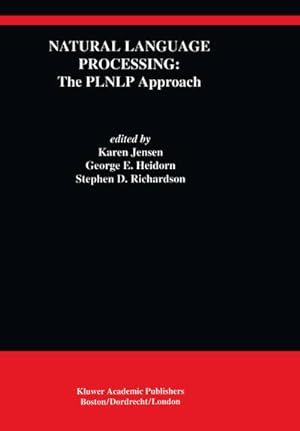
Natural Language Processing: The PLNLP Approach
Anbieter: AHA-BUCH GmbH, Einbeck, Deutschland
Verkäuferbewertung 5 von 5 Sternen
Taschenbuch. Zustand: Neu. Druck auf Anfrage Neuware - Printed after ordering - Natural language is easy for people and hard for machines. For two generations, the tantalizing goal has been to get computers to handle human languages in ways that will be compelling and useful to people. Obstacles are many and legendary. Natural Language Processing: The PLNLP Approach describes one group's decade of research in pursuit of that goal. A very broad coverage NLP system, including a programming language (PLNLP) development tools, and analysis and synthesis components, was developed and incorporated into a variety of well-known practical applications, ranging from text critiquing (CRITIQUE) to machine translation (e.g. SHALT). This books represents the first published collection of papers describing the system and how it has been used. Twenty-six authors from nine countries contributed to this volume. Natural language analysis, in the PLNLP approach, is done is six stages that move smoothly from syntax through semantics into discourse. The initial syntactic sketch is provided by an Augmented Phrase Structure Grammar (APSG) that uses exclusively binary rules and aims to produce some reasonable analysis for any input string. Its `approximate' analysis passes to the reassignment component, which takes the default syntactic attachments and adjusts them, using semantic information obtained by parsing definitions and example sentences from machine-readable dictionaries. This technique is an example of one facet of the PLNLP approach: the use of natural language itself as a knowledge representation language -- an innovation that permits a wide variety of online text materials to be exploited as sources of semantic information. The next stage computes the intrasential argument structure and resolves all references, both NP- and VP-anaphora, that can be treated at this point in the processing. Subsequently, additional components, currently not so well developed as the earlier ones, handle the further disambiguation of word senses, the normalization of paraphrases, and the construction of a paragraph (discourse) model by joining sentential semantic graphs. Natural Language Processing: The PLNLP Approach acquaints the reader with the theory and application of a working, real-world, domain-free NLP system, and attempts to bridge the gap between computational and theoretical models of linguistic structure. It provides a valuable resource for students, teachers, and researchers in the areas of computational linguistics, natural processing, artificial intelligence, and information science.
-
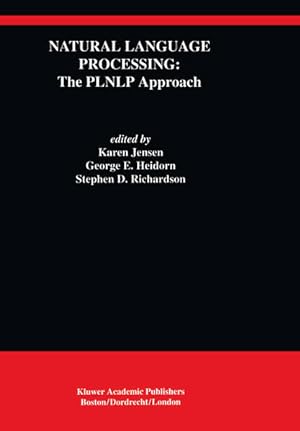
Natural Language Processing: The PLNLP Approach
Anbieter: NEPO UG, Rüsselsheim am Main, Deutschland
Verkäuferbewertung 5 von 5 Sternen
Unbekannt. Zustand: Gut. 1993. 324 S. Natural language is easy for people and hard for machines. For two generations, the tantalizing goal has been to get computers to handle human languages in ways that will be compelling and useful to people. Obstacles are many and legendary. Natural Language Processing: The PLNLP Approach describes one group's decade of research in pursuit of that goal. A very broad coverage NLP system, including a programming language (PLNLP) development tools, and analysis and synthesis components, was developed and incorporated into a variety of well-known practical applications, ranging from text critiquing (CRITIQUE) to machine translation (e.g. SHALT). This books represents the first published collection of papers describing the system and how it has been used. Twenty-six authors from nine countries contributed to this volume. Natural language analysis, in the PLNLP approach, is done is six stages that move smoothly from syntax through semantics into discourse. The initial syntactic sketch is provided by an Augmented Phrase Structure Grammar (APSG) that uses exclusively binary rules and aims to produce some reasonable analysis for any input string. Its 'approximate' analysis passes to the reassignment component, which takes the default syntactic attachments and adjusts them, using semantic information obtained by parsing definitions and example sentences from machine-readable dictionaries. This technique is an example of one facet of the PLNLP approach: the use of natural language itself as a knowledge representation language -- an innovation that permits a wide variety of online text materials to be exploited as sources of semantic information. The next stage computes the intrasential argument structure and resolves all references, both NP- and VP-anaphora, that can be treated at this point in the processing. Subsequently, additional components, currently not so well developed as the earlier ones, handle the further disambiguation of word senses, the normalization of paraphrases, and the construction of a paragraph (discourse) model by joining sentential semantic graphs. Natural Language Processing: The PLNLP Approach acquaints the reader with the theory and application of a working, real-world, domain-free NLP system, and attempts to bridge the gap between computational and theoretical models of linguistic structure. It provides a valuable resource for students, teachers, and researchers in the areas of computational linguistics, natural processing, artificial intelligence, and information science. Sprache: Deutsch Gewicht in Gramm: 775.
-
Natural Language Processing: The PLNLP Approach (The Springer International Series in Engineering and Computer Science)
Anbieter: Revaluation Books, Exeter, Vereinigtes Königreich
Verkäuferbewertung 5 von 5 Sternen
EUR 53,20
EUR 14,35 shipping
Versand von Vereinigtes Königreich nach USAAnzahl: 1 verfügbar
In den WarenkorbPaperback. Zustand: Brand New. 341 pages. 9.60x6.69x0.79 inches. In Stock. This item is printed on demand.
-

Natural Language Processing: The PLNLP Approach
Sprache: Englisch
Verlag: Springer US, Springer Feb 2013, 2013
ISBN 10: 1461363896 ISBN 13: 9781461363897
Anbieter: BuchWeltWeit Ludwig Meier e.K., Bergisch Gladbach, Deutschland
Verkäuferbewertung 5 von 5 Sternen
Taschenbuch. Zustand: Neu. This item is printed on demand - it takes 3-4 days longer - Neuware -Natural language is easy for people and hard for machines. For two generations, the tantalizing goal has been to get computers to handle human languages in ways that will be compelling and useful to people. Obstacles are many and legendary. Natural Language Processing: The PLNLP Approach describes one group's decade of research in pursuit of that goal. A very broad coverage NLP system, including a programming language (PLNLP) development tools, and analysis and synthesis components, was developed and incorporated into a variety of well-known practical applications, ranging from text critiquing (CRITIQUE) to machine translation (e.g. SHALT). This books represents the first published collection of papers describing the system and how it has been used. Twenty-six authors from nine countries contributed to this volume. Natural language analysis, in the PLNLP approach, is done is six stages that move smoothly from syntax through semantics into discourse. The initial syntactic sketch is provided by an Augmented Phrase Structure Grammar (APSG) that uses exclusively binary rules and aims to produce some reasonable analysis for any input string. Its `approximate' analysis passes to the reassignment component, which takes the default syntactic attachments and adjusts them, using semantic information obtained by parsing definitions and example sentences from machine-readable dictionaries. This technique is an example of one facet of the PLNLP approach: the use of natural language itself as a knowledge representation language -- an innovation that permits a wide variety of online text materials to be exploited as sources of semantic information. The next stage computes the intrasential argument structure and resolves all references, both NP- and VP-anaphora, that can be treated at this point in the processing. Subsequently, additional components, currently not so well developed as the earlier ones, handle the further disambiguation of word senses, the normalization of paraphrases, and the construction of a paragraph (discourse) model by joining sentential semantic graphs. Natural Language Processing: The PLNLP Approach acquaints the reader with the theory and application of a working, real-world, domain-free NLP system, and attempts to bridge the gap between computational and theoretical models of linguistic structure. It provides a valuable resource for students, teachers, and researchers in the areas of computational linguistics, natural processing, artificial intelligence, and information science. 348 pp. Englisch.
-
Natural Language Processing
Anbieter: Majestic Books, Hounslow, Vereinigtes Königreich
Verkäuferbewertung 4 von 5 Sternen

EUR 75,81
EUR 7,46 shipping
Versand von Vereinigtes Königreich nach USAAnzahl: 4 verfügbar
In den WarenkorbZustand: New. Print on Demand pp. 348 67:B&W 6.69 x 9.61 in or 244 x 170 mm (Pinched Crown) Perfect Bound on White w/Gloss Lam.
-
Natural Language Processing: The PLNLP Approach
Sprache: Englisch
Verlag: Springer-Verlag New York Inc., 2013
ISBN 10: 1461363896 ISBN 13: 9781461363897
Anbieter: THE SAINT BOOKSTORE, Southport, Vereinigtes Königreich
Verkäuferbewertung 5 von 5 Sternen
EUR 67,81
EUR 19,57 shipping
Versand von Vereinigtes Königreich nach USAAnzahl: Mehr als 20 verfügbar
In den WarenkorbPaperback / softback. Zustand: New. This item is printed on demand. New copy - Usually dispatched within 5-9 working days.
-
Natural Language Processing
Anbieter: Biblios, Frankfurt am main, HESSE, Deutschland
Verkäuferbewertung 4 von 5 Sternen
Zustand: New. PRINT ON DEMAND pp. 348.
-

EUR 48,37
EUR 48,99 shipping
Versand von Deutschland nach USAAnzahl: Mehr als 20 verfügbar
In den WarenkorbZustand: New. Dieser Artikel ist ein Print on Demand Artikel und wird nach Ihrer Bestellung fuer Sie gedruckt. Natural language is easy for people and hard for machines. For two generations, the tantalizing goal has been to get computers to handle human languages in ways that will be compelling and useful to people. Obstacles are many and legendary. Na.
-

Natural Language Processing: The PLNLP Approach
Sprache: Englisch
Verlag: Springer US, Springer New York Feb 2013, 2013
ISBN 10: 1461363896 ISBN 13: 9781461363897
Anbieter: buchversandmimpf2000, Emtmannsberg, BAYE, Deutschland
Verkäuferbewertung 5 von 5 Sternen
Taschenbuch. Zustand: Neu. This item is printed on demand - Print on Demand Titel. Neuware -Natural language is easy for people and hard for machines. For two generations, the tantalizing goal has been to get computers to handle human languages in ways that will be compelling and useful to people. Obstacles are many and legendary.Natural Language Processing: The PLNLP Approach describes one group's decade of research in pursuit of that goal. A very broad coverage NLP system, including a programming language (PLNLP) development tools, and analysis and synthesis components, was developed and incorporated into a variety of well-known practical applications, ranging from text critiquing (CRITIQUE) to machine translation (e.g. SHALT). This books represents the first published collection of papers describing the system and how it has been used. Twenty-six authors from nine countries contributed to this volume.Natural language analysis, in the PLNLP approach, is done is six stages that move smoothly from syntax through semantics into discourse. The initial syntactic sketch is provided by an Augmented Phrase Structure Grammar (APSG) that uses exclusively binary rules and aims to produce some reasonable analysis for any input string. Its `approximate' analysis passes to the reassignment component, which takes the default syntactic attachments and adjusts them, using semantic information obtained by parsing definitions and example sentences from machine-readable dictionaries. This technique is an example of one facet of the PLNLP approach: the use of natural language itself as a knowledge representation language -- an innovation that permits a wide variety of online text materials to be exploited as sources of semantic information.The next stage computes the intrasential argument structure and resolves all references, both NP- and VP-anaphora, that can be treated at this point in the processing. Subsequently, additional components, currently not so well developed as the earlier ones, handle the further disambiguation of word senses, the normalization of paraphrases, and the construction of a paragraph (discourse) model by joining sentential semantic graphs.Natural Language Processing: The PLNLP Approach acquaints the reader with the theory and application of a working, real-world, domain-free NLP system, and attempts to bridge the gap between computational and theoretical models of linguistic structure. It provides a valuable resource for students, teachers, and researchers in the areas of computational linguistics, natural processing, artificial intelligence, and information science.Springer Verlag GmbH, Tiergartenstr. 17, 69121 Heidelberg 348 pp. Englisch.
-
Taschenbuch. Zustand: Neu. Natural Language Processing: The PLNLP Approach | Karen Jensen (u. a.) | Taschenbuch | xvii | Englisch | 2013 | Springer | EAN 9781461363897 | Verantwortliche Person für die EU: Springer Verlag GmbH, Tiergartenstr. 17, 69121 Heidelberg, juergen[dot]hartmann[at]springer[dot]com | Anbieter: preigu Print on Demand.


