

Gesamtpreis (1 Artikel Artikel):
Versandziel:

9781611210941 - Protecting the Flank at Gettysburg: The Battles for Brinkerhoff's Ridge and East Cavalry Field, July 2 -3, 1863: The Battles for Brinkerhoff's Ridge and East Cavalr... (23 Ergebnisse)
Direkt zu den wichtigsten Suchergebnissen
Suchfilter
Produktart
- Alle Product Types
- Bücher (23)
- Magazine & Zeitschriften (Keine weiteren Ergebnisse entsprechen dieser Verfeinerung)
- Comics (Keine weiteren Ergebnisse entsprechen dieser Verfeinerung)
- Noten (Keine weiteren Ergebnisse entsprechen dieser Verfeinerung)
- Kunst, Grafik & Poster (Keine weiteren Ergebnisse entsprechen dieser Verfeinerung)
- Fotografien (Keine weiteren Ergebnisse entsprechen dieser Verfeinerung)
- Karten (Keine weiteren Ergebnisse entsprechen dieser Verfeinerung)
- Manuskripte & Papierantiquitäten (Keine weiteren Ergebnisse entsprechen dieser Verfeinerung)
Zustand Mehr dazu
- Neu (15)
- Wie Neu, Sehr Gut oder Gut Bis Sehr Gut (2)
- Gut oder Befriedigend (5)
- Ausreichend oder Schlecht (Keine weiteren Ergebnisse entsprechen dieser Verfeinerung)
- Wie beschrieben (1)
Einband
- alle Einbände
- Hardcover (Keine weiteren Ergebnisse entsprechen dieser Verfeinerung)
- Softcover (23)
Weitere Eigenschaften
- Erstausgabe (Keine weiteren Ergebnisse entsprechen dieser Verfeinerung)
- Signiert (1)
- Schutzumschlag (Keine weiteren Ergebnisse entsprechen dieser Verfeinerung)
- Angebotsfoto (6)
- Keine Print-on-Demand Angebote (23)
Sprache (1)
Gratisversand
Land des Verkäufers
Verkäuferbewertung
-
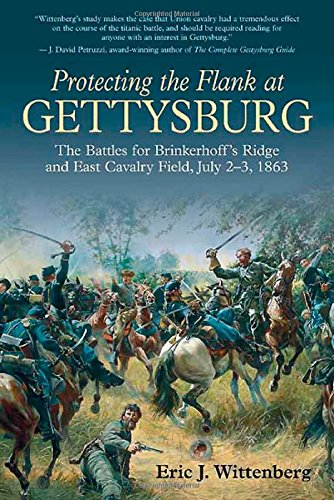
Protecting the Flank at Gettysburg: The Battles for Brinkerhoff's Ridge and East Cavalry Field, July 2 -3, 1863
Sprache: Englisch
Verlag: Savas Beatie (edition Reprint), 2013
ISBN 10: 1611210941 ISBN 13: 9781611210941
Paperback. Zustand: Very Good. Reprint. It's a well-cared-for item that has seen limited use. The item may show minor signs of wear. All the text is legible, with all pages included. It may have slight markings and/or highlighting.
-
Protecting the Flank at Gettysburg: The Battles for Brinkerhoff's Ridge and East Cavalry Field, July 2 -3, 1863
Anbieter: ThriftBooks-Atlanta, AUSTELL, GA, USA
Verkäuferbewertung 5 von 5 Sternen

Paperback. Zustand: Good. No Jacket. Pages can have notes/highlighting. Spine may show signs of wear. ~ ThriftBooks: Read More, Spend Less.
-
Protecting the Flank at Gettysburg: The Battles for Brinkerhoff's Ridge and East Cavalry Field, July 2 -3, 1863
Anbieter: ThriftBooks-Atlanta, AUSTELL, GA, USA
Verkäuferbewertung 5 von 5 Sternen
Paperback. Zustand: Very Good. No Jacket. May have limited writing in cover pages. Pages are unmarked. ~ ThriftBooks: Read More, Spend Less.
-
Paperback. Zustand: Very Good. Connecting readers with great books since 1972! Used books may not include companion materials, and may have some shelf wear or limited writing. We ship orders daily and Customer Service is our top priority!
-
Protecting the Flank at Gettysburg: The Battles for Brinkerhoff's Ridge and East Cavalry Field, July 2 -3, 1863
Anbieter: Night Heron Books, Laramie, WY, USA
Verkäuferbewertung 5 von 5 Sternen
paperback. Zustand: Very Good. Binding tight.Cover clean.Minor wear to page edges and corners. Paperback.No writing, highlighting, or marks in text.
-
Protecting the Flank at Gettysburg (Paperback)
Sprache: Englisch
Verlag: Savas Beatie, El Dorado Hills, 2012
ISBN 10: 1611210941 ISBN 13: 9781611210941
Anbieter: Grand Eagle Retail, Bensenville, IL, USA
Verkäuferbewertung 5 von 5 Sternen
Paperback. Zustand: new. Paperback. On July 3, 1863, a large-scale cavalry fight was waged on Crest Ridge four miles east of Gettysburg. There, on what is commonly referred to as East Cavalry Field, Union horsemen under Brig. Gen. David M. Gregg tangled with the vaunted Confederates riding with Maj. Gen. J.E.B. Stuart. This magnificent mounted clash, however, cannot be fully appreciated without an understanding of what happened the previous day at Brinkerhoffs Ridge, where elements of Greggs division pinned down the legendary infantry of the Stonewall Brigade, preventing it from participating in the fighting for Culps Hill that raged that evening.Stuart arrived at Gettysburg on the afternoon of July 2 after his long ride around the Army of the Potomac just in time to witness the climax of the fighting at Brinkerhoffs Ridge, and spot good ground for mounted operations one ridge line to the east. Stuart also knew that Greggs troopers held the important Hanover and Low Dutch road intersection, blocking a direct route into the rear of the Union centre. If Stuart could defeat Greggs troopers, he could dash thousands of his own men behind enemy lines and wreak havoc. The ambitious offensive thrust resulted the following day in a giant clash of horse and steel on East Cavalry Field. The combat featured artillery duels, dismounted fighting, hand-to-hand engagements, and the most magnificent mounted charge and countercharge of the entire Civil War.About the AuthorEric J. Wittenberg is an accomplished American Civil War cavalry historian and author. An attorney in Ohio, Wittenberg, he has authored more than two dozen articles in popular military magazines and has written over ten books. On July 3, 1863, a large-scale cavalry fight was waged on Crest Ridge four miles east of Gettysburg. There, on what is commonly referred to as East Cavalry Field, Union horsemen under Brig. Gen. David M. Gregg tangled with the vaunted Confederates riding with Maj. Gen. J.E.B. Stuart. Shipping may be from multiple locations in the US or from the UK, depending on stock availability.
-

Protecting the Flank at Gettysburg : The Battles for Brinkerhoff's Ridge and East Cavalry Field, July 2-4, 1863
Anbieter: GreatBookPrices, Columbia, MD, USA
Verkäuferbewertung 5 von 5 Sternen
Zustand: New.
-
Zustand: New. Brand New.
-

Paperback. Zustand: New. On July 3, 1863, a large-scale cavalry fight was waged on Crest Ridge four miles east of Gettysburg. There, on what is commonly referred to as East Cavalry Field, Union horsemen under Brig. Gen. David M. Gregg tangled with the vaunted Confederates riding with Maj. Gen. J.E.B. Stuart. This magnificent mounted clash, however, cannot be fully appreciated without an understanding of what happened the previous day at Brinkerhoff's Ridge, where elements of Gregg's division pinned down the legendary infantry of the Stonewall Brigade, preventing it from participating in the fighting for Culp's Hill that raged that evening.Stuart arrived at Gettysburg on the afternoon of July 2 after his long ride around the Army of the Potomac just in time to witness the climax of the fighting at Brinkerhoff's Ridge, and spot good ground for mounted operations one ridge line to the east. Stuart also knew that Gregg's troopers held the important Hanover and Low Dutch road intersection, blocking a direct route into the rear of the Union centre. If Stuart could defeat Gregg's troopers, he could dash thousands of his own men behind enemy lines and wreak havoc. The ambitious offensive thrust resulted the following day in a giant clash of horse and steel on East Cavalry Field. The combat featured artillery duels, dismounted fighting, hand-to-hand engagements, and the most magnificent mounted charge and countercharge of the entire Civil War.About the AuthorEric J. Wittenberg is an accomplished American Civil War cavalry historian and author. An attorney in Ohio, Wittenberg, he has authored more than two dozen articles in popular military magazines and has written over ten books.
-
Protecting the Flank at Gettysburg: The Battles for Brinkerhoff's Ridge and East Cavalry Field, July 2 -3, 1863
Anbieter: Book Bunker USA, Havertown, PA, USA
Verkäuferbewertung 5 von 5 Sternen
Paperback. Zustand: New. *Brand new* Ships from USA.
-

Protecting the Flank at Gettysburg
Anbieter: Rarewaves.com USA, London, LONDO, Vereinigtes Königreich
Verkäuferbewertung 5 von 5 Sternen
EUR 19,47
Versand gratis
Versand von Vereinigtes Königreich nach USAAnzahl: 19 verfügbar
In den WarenkorbPaperback. Zustand: New. On July 3, 1863, a large-scale cavalry fight was waged on Crest Ridge four miles east of Gettysburg. There, on what is commonly referred to as East Cavalry Field, Union horsemen under Brig. Gen. David M. Gregg tangled with the vaunted Confederates riding with Maj. Gen. J.E.B. Stuart. This magnificent mounted clash, however, cannot be fully appreciated without an understanding of what happened the previous day at Brinkerhoff's Ridge, where elements of Gregg's division pinned down the legendary infantry of the Stonewall Brigade, preventing it from participating in the fighting for Culp's Hill that raged that evening.Stuart arrived at Gettysburg on the afternoon of July 2 after his long ride around the Army of the Potomac just in time to witness the climax of the fighting at Brinkerhoff's Ridge, and spot good ground for mounted operations one ridge line to the east. Stuart also knew that Gregg's troopers held the important Hanover and Low Dutch road intersection, blocking a direct route into the rear of the Union centre. If Stuart could defeat Gregg's troopers, he could dash thousands of his own men behind enemy lines and wreak havoc. The ambitious offensive thrust resulted the following day in a giant clash of horse and steel on East Cavalry Field. The combat featured artillery duels, dismounted fighting, hand-to-hand engagements, and the most magnificent mounted charge and countercharge of the entire Civil War.About the AuthorEric J. Wittenberg is an accomplished American Civil War cavalry historian and author. An attorney in Ohio, Wittenberg, he has authored more than two dozen articles in popular military magazines and has written over ten books.
-

Protecting the Flank at Gettysburg : The Battles for Brinkerhoff's Ridge and East Cavalry Field, July 2-4, 1863
Anbieter: GreatBookPrices, Columbia, MD, USA
Verkäuferbewertung 5 von 5 Sternen
Zustand: As New. Unread book in perfect condition.
-
Protecting the Flank at Gettysburg: The Battles for Brinkerhoff's Ridge and East Cavalry Field, July 2 -3, 1863
Anbieter: Cottage Street Books, Greenwich, NY, USA
Verkäuferbewertung 5 von 5 Sternen
Signiert
2013. Savas Beatie. 8vo. Softcover. As new. Signed by the author on the title page.
-
Paperback. Zustand: new. New Copy. Customer Service Guaranteed.
-
Protecting the Flank at Gettysburg: The Battles for Brinkerhoff's Ridge and East Cavalry Field, July 2-3, 1863
Anbieter: Kennys Bookshop and Art Galleries Ltd., Galway, GY, Irland
Verkäuferbewertung 5 von 5 Sternen
EUR 19,67
EUR 10,50 Versand
Versand von Irland nach USAAnzahl: Mehr als 20 verfügbar
In den WarenkorbZustand: New. On July 3, 1863, a large-scale cavalry fight was waged on Crest Ridge four miles east of Gettysburg. There, on what is commonly referred to as East Cavalry Field, Union horsemen under Brig. Gen. David M. Gregg tangled with the vaunted Confederates riding with Maj. Gen. J.E.B. Stuart. Num Pages: 192 pages, 7 maps and 54 photos and illustrations throughout. BIC Classification: 1KBB; 3JH; HBJK; HBLL; HBWJ. Category: (G) General (US: Trade). Dimension: 229 x 152 x 18. Weight in Grams: 363. . 2011. Reprint. paperback. . . . .
-
Protecting the Flank at Gettysburg: The Battles for Brinkerhoff?s Ridge and East Cavalry Field, July 2?3, 1863
Anbieter: Kennys Bookstore, Olney, MD, USA
Verkäuferbewertung 5 von 5 Sternen
Zustand: New. On July 3, 1863, a large-scale cavalry fight was waged on Crest Ridge four miles east of Gettysburg. There, on what is commonly referred to as East Cavalry Field, Union horsemen under Brig. Gen. David M. Gregg tangled with the vaunted Confederates riding with Maj. Gen. J.E.B. Stuart. Num Pages: 192 pages, 7 maps and 54 photos and illustrations throughout. BIC Classification: 1KBB; 3JH; HBJK; HBLL; HBWJ. Category: (G) General (US: Trade). Dimension: 229 x 152 x 18. Weight in Grams: 363. . 2011. Reprint. paperback. . . . . Books ship from the US and Ireland.
-
Protecting the Flank at Gettysburg: The Battles for Brinkerhoff's Ridge and East Cavalry Field, July 2 -3, 1863 [Paperback] Wittenberg, Eric J.
Anbieter: DeckleEdge LLC, Albuquerque, NM, USA
Verkäuferbewertung 5 von 5 Sternen
-
Protecting the Flank at Gettysburg (Paperback)
Sprache: Englisch
Verlag: Savas Beatie, El Dorado Hills, 2012
ISBN 10: 1611210941 ISBN 13: 9781611210941
Anbieter: AussieBookSeller, Truganina, VIC, Australien
Verkäuferbewertung 5 von 5 Sternen
Paperback. Zustand: new. Paperback. On July 3, 1863, a large-scale cavalry fight was waged on Crest Ridge four miles east of Gettysburg. There, on what is commonly referred to as East Cavalry Field, Union horsemen under Brig. Gen. David M. Gregg tangled with the vaunted Confederates riding with Maj. Gen. J.E.B. Stuart. This magnificent mounted clash, however, cannot be fully appreciated without an understanding of what happened the previous day at Brinkerhoffs Ridge, where elements of Greggs division pinned down the legendary infantry of the Stonewall Brigade, preventing it from participating in the fighting for Culps Hill that raged that evening.Stuart arrived at Gettysburg on the afternoon of July 2 after his long ride around the Army of the Potomac just in time to witness the climax of the fighting at Brinkerhoffs Ridge, and spot good ground for mounted operations one ridge line to the east. Stuart also knew that Greggs troopers held the important Hanover and Low Dutch road intersection, blocking a direct route into the rear of the Union centre. If Stuart could defeat Greggs troopers, he could dash thousands of his own men behind enemy lines and wreak havoc. The ambitious offensive thrust resulted the following day in a giant clash of horse and steel on East Cavalry Field. The combat featured artillery duels, dismounted fighting, hand-to-hand engagements, and the most magnificent mounted charge and countercharge of the entire Civil War.About the AuthorEric J. Wittenberg is an accomplished American Civil War cavalry historian and author. An attorney in Ohio, Wittenberg, he has authored more than two dozen articles in popular military magazines and has written over ten books. On July 3, 1863, a large-scale cavalry fight was waged on Crest Ridge four miles east of Gettysburg. There, on what is commonly referred to as East Cavalry Field, Union horsemen under Brig. Gen. David M. Gregg tangled with the vaunted Confederates riding with Maj. Gen. J.E.B. Stuart. Shipping may be from our Sydney, NSW warehouse or from our UK or US warehouse, depending on stock availability.
-
Protecting the Flank at Gettysburg (Paperback)
Sprache: Englisch
Verlag: Savas Beatie, El Dorado Hills, 2012
ISBN 10: 1611210941 ISBN 13: 9781611210941
Anbieter: CitiRetail, Stevenage, Vereinigtes Königreich
Verkäuferbewertung 5 von 5 Sternen
EUR 20,89
EUR 42,91 Versand
Versand von Vereinigtes Königreich nach USAAnzahl: 1 verfügbar
In den WarenkorbPaperback. Zustand: new. Paperback. On July 3, 1863, a large-scale cavalry fight was waged on Crest Ridge four miles east of Gettysburg. There, on what is commonly referred to as East Cavalry Field, Union horsemen under Brig. Gen. David M. Gregg tangled with the vaunted Confederates riding with Maj. Gen. J.E.B. Stuart. This magnificent mounted clash, however, cannot be fully appreciated without an understanding of what happened the previous day at Brinkerhoffs Ridge, where elements of Greggs division pinned down the legendary infantry of the Stonewall Brigade, preventing it from participating in the fighting for Culps Hill that raged that evening.Stuart arrived at Gettysburg on the afternoon of July 2 after his long ride around the Army of the Potomac just in time to witness the climax of the fighting at Brinkerhoffs Ridge, and spot good ground for mounted operations one ridge line to the east. Stuart also knew that Greggs troopers held the important Hanover and Low Dutch road intersection, blocking a direct route into the rear of the Union centre. If Stuart could defeat Greggs troopers, he could dash thousands of his own men behind enemy lines and wreak havoc. The ambitious offensive thrust resulted the following day in a giant clash of horse and steel on East Cavalry Field. The combat featured artillery duels, dismounted fighting, hand-to-hand engagements, and the most magnificent mounted charge and countercharge of the entire Civil War.About the AuthorEric J. Wittenberg is an accomplished American Civil War cavalry historian and author. An attorney in Ohio, Wittenberg, he has authored more than two dozen articles in popular military magazines and has written over ten books. On July 3, 1863, a large-scale cavalry fight was waged on Crest Ridge four miles east of Gettysburg. There, on what is commonly referred to as East Cavalry Field, Union horsemen under Brig. Gen. David M. Gregg tangled with the vaunted Confederates riding with Maj. Gen. J.E.B. Stuart. Shipping may be from our UK warehouse or from our Australian or US warehouses, depending on stock availability.
-
Protecting the Flank at Gettysburg
Anbieter: Rarewaves USA United, OSWEGO, IL, USA
Verkäuferbewertung 5 von 5 Sternen
Paperback. Zustand: New. On July 3, 1863, a large-scale cavalry fight was waged on Crest Ridge four miles east of Gettysburg. There, on what is commonly referred to as East Cavalry Field, Union horsemen under Brig. Gen. David M. Gregg tangled with the vaunted Confederates riding with Maj. Gen. J.E.B. Stuart. This magnificent mounted clash, however, cannot be fully appreciated without an understanding of what happened the previous day at Brinkerhoff's Ridge, where elements of Gregg's division pinned down the legendary infantry of the Stonewall Brigade, preventing it from participating in the fighting for Culp's Hill that raged that evening.Stuart arrived at Gettysburg on the afternoon of July 2 after his long ride around the Army of the Potomac just in time to witness the climax of the fighting at Brinkerhoff's Ridge, and spot good ground for mounted operations one ridge line to the east. Stuart also knew that Gregg's troopers held the important Hanover and Low Dutch road intersection, blocking a direct route into the rear of the Union centre. If Stuart could defeat Gregg's troopers, he could dash thousands of his own men behind enemy lines and wreak havoc. The ambitious offensive thrust resulted the following day in a giant clash of horse and steel on East Cavalry Field. The combat featured artillery duels, dismounted fighting, hand-to-hand engagements, and the most magnificent mounted charge and countercharge of the entire Civil War.About the AuthorEric J. Wittenberg is an accomplished American Civil War cavalry historian and author. An attorney in Ohio, Wittenberg, he has authored more than two dozen articles in popular military magazines and has written over ten books.
-
EUR 22,97
EUR 48,99 Versand
Versand von Deutschland nach USAAnzahl: Mehr als 20 verfügbar
In den WarenkorbZustand: New. KlappentextrnrnOn July 3, 1863, a large-scale cavalry fight was waged on Crest Ridge four miles east of Gettysburg. There, on what is commonly referred to as East Cavalry Field, Union horsemen under Brig. Gen. David M. Gregg tangled with the vau.
-
Protecting the Flank at Gettysburg: The Battles for Brinkerhoff's Ridge and East Cavalry Field, July 2-4, 1863
Anbieter: Revaluation Books, Exeter, Vereinigtes Königreich
Verkäuferbewertung 5 von 5 Sternen
EUR 77,79
EUR 11,60 Versand
Versand von Vereinigtes Königreich nach USAAnzahl: 1 verfügbar
In den WarenkorbPaperback. Zustand: Brand New. reprint edition. 202 pages. 9.25x5.75x0.75 inches. In Stock.
-

Protecting the Flank at Gettysburg
Anbieter: Rarewaves.com UK, London, Vereinigtes Königreich
Verkäuferbewertung 5 von 5 Sternen
EUR 20,88
EUR 75,39 Versand
Versand von Vereinigtes Königreich nach USAAnzahl: 19 verfügbar
In den WarenkorbPaperback. Zustand: New. On July 3, 1863, a large-scale cavalry fight was waged on Crest Ridge four miles east of Gettysburg. There, on what is commonly referred to as East Cavalry Field, Union horsemen under Brig. Gen. David M. Gregg tangled with the vaunted Confederates riding with Maj. Gen. J.E.B. Stuart. This magnificent mounted clash, however, cannot be fully appreciated without an understanding of what happened the previous day at Brinkerhoff's Ridge, where elements of Gregg's division pinned down the legendary infantry of the Stonewall Brigade, preventing it from participating in the fighting for Culp's Hill that raged that evening.Stuart arrived at Gettysburg on the afternoon of July 2 after his long ride around the Army of the Potomac just in time to witness the climax of the fighting at Brinkerhoff's Ridge, and spot good ground for mounted operations one ridge line to the east. Stuart also knew that Gregg's troopers held the important Hanover and Low Dutch road intersection, blocking a direct route into the rear of the Union centre. If Stuart could defeat Gregg's troopers, he could dash thousands of his own men behind enemy lines and wreak havoc. The ambitious offensive thrust resulted the following day in a giant clash of horse and steel on East Cavalry Field. The combat featured artillery duels, dismounted fighting, hand-to-hand engagements, and the most magnificent mounted charge and countercharge of the entire Civil War.About the AuthorEric J. Wittenberg is an accomplished American Civil War cavalry historian and author. An attorney in Ohio, Wittenberg, he has authored more than two dozen articles in popular military magazines and has written over ten books.

