
Gesamtpreis (1 Artikel Artikel):
Versandziel:

9783642664403 - Syntactic Pattern Recognition, Applications: 14 (Communication and Cybernetics) (16 Ergebnisse)
Direkt zu den wichtigsten Suchergebnissen
Suchfilter
Produktart
- Alle Product Types
- Bücher (16)
- Magazine & Zeitschriften (Keine weiteren Ergebnisse entsprechen dieser Verfeinerung)
- Comics (Keine weiteren Ergebnisse entsprechen dieser Verfeinerung)
- Noten (Keine weiteren Ergebnisse entsprechen dieser Verfeinerung)
- Kunst, Grafik & Poster (Keine weiteren Ergebnisse entsprechen dieser Verfeinerung)
- Fotografien (Keine weiteren Ergebnisse entsprechen dieser Verfeinerung)
- Karten (Keine weiteren Ergebnisse entsprechen dieser Verfeinerung)
- Manuskripte & Papierantiquitäten (Keine weiteren Ergebnisse entsprechen dieser Verfeinerung)
Zustand Mehr dazu
- Neu (13)
- Wie Neu, Sehr Gut oder Gut Bis Sehr Gut (3)
- Gut oder Befriedigend (Keine weiteren Ergebnisse entsprechen dieser Verfeinerung)
- Ausreichend oder Schlecht (Keine weiteren Ergebnisse entsprechen dieser Verfeinerung)
- Wie beschrieben (Keine weiteren Ergebnisse entsprechen dieser Verfeinerung)
Einband
- alle Einbände
- Hardcover (Keine weiteren Ergebnisse entsprechen dieser Verfeinerung)
- Softcover (16)
Weitere Eigenschaften
- Erstausgabe (Keine weiteren Ergebnisse entsprechen dieser Verfeinerung)
- Signiert (Keine weiteren Ergebnisse entsprechen dieser Verfeinerung)
- Schutzumschlag (Keine weiteren Ergebnisse entsprechen dieser Verfeinerung)
- Angebotsfoto (9)
- Keine Print-on-Demand Angebote (10)
Sprache (1)
Preis
- Beliebiger Preis
- Weniger als EUR 20 (Keine weiteren Ergebnisse entsprechen dieser Verfeinerung)
- EUR 20 bis EUR 45 (Keine weiteren Ergebnisse entsprechen dieser Verfeinerung)
- Mehr als EUR 45
Gratisversand
Land des Verkäufers
Verkäuferbewertung
-
Syntactic Pattern Recognition, Applications
Anbieter: GreatBookPrices, Columbia, MD, USA
Verkäuferbewertung 5 von 5 Sternen

EUR 103,11
EUR 2,24 shipping
Versand innerhalb von USAAnzahl: Mehr als 20 verfügbar
In den WarenkorbZustand: New.
-

Syntactic Pattern Recognition, Applications (Communication and Cybernetics)
Anbieter: Lucky's Textbooks, Dallas, TX, USA
Verkäuferbewertung 5 von 5 Sternen
EUR 101,94
EUR 3,39 shipping
Versand innerhalb von USAAnzahl: Mehr als 20 verfügbar
In den WarenkorbZustand: New.
-
Syntactic Pattern Recognition, Applications (Communication and Cybernetics)
Anbieter: California Books, Miami, FL, USA
Verkäuferbewertung 5 von 5 Sternen
Zustand: New.
-

Syntactic Pattern Recognition, Applications
Anbieter: GreatBookPricesUK, Woodford Green, Vereinigtes Königreich
Verkäuferbewertung 5 von 5 Sternen
EUR 123,87
EUR 17,17 shipping
Versand von Vereinigtes Königreich nach USAAnzahl: Mehr als 20 verfügbar
In den WarenkorbZustand: New.
-
Zustand: New. pp. 288.
-
Syntactic Pattern Recognition, Applications (Communication and Cybernetics)
Sprache: Englisch
Verlag: Springer Berlin Heidelberg, 2011
ISBN 10: 3642664407 ISBN 13: 9783642664403
Anbieter: Revaluation Books, Exeter, Vereinigtes Königreich
Verkäuferbewertung 5 von 5 Sternen
EUR 151,07
EUR 14,31 shipping
Versand von Vereinigtes Königreich nach USAAnzahl: 2 verfügbar
In den WarenkorbPaperback. Zustand: Brand New. reprint edition. 288 pages. 9.60x6.60x0.80 inches. In Stock.
-

Syntactic Pattern Recognition, Applications
Sprache: Englisch
Verlag: Springer Berlin Heidelberg, 2011
ISBN 10: 3642664407 ISBN 13: 9783642664403
Anbieter: AHA-BUCH GmbH, Einbeck, Deutschland
Verkäuferbewertung 5 von 5 Sternen
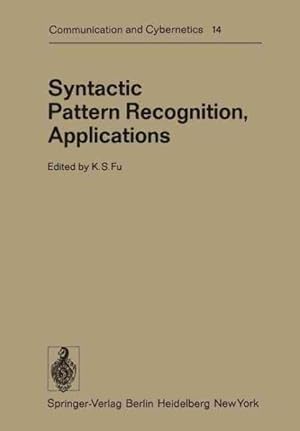
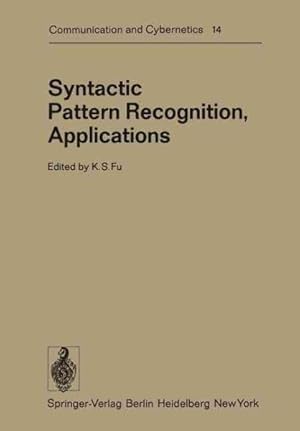
Taschenbuch. Zustand: Neu. Druck auf Anfrage Neuware - Printed after ordering - The many different mathematical techniques used to solve pattem recognition problems may be grouped into two general approaches: the decision-theoretic (or discriminant) approach and the syntactic (or structural) approach. In the decision-theoretic approach, aset of characteristic measurements, called features, are extracted from the pattems. Each pattem is represented by a feature vector, and the recognition of each pattem is usually made by partitioning the feature space. Applications of decision-theoretic approach indude character recognition, medical diagnosis, remote sensing, reliability and socio-economics. A relatively new approach is the syntactic approach. In the syntactic approach, ea ch pattem is expressed in terms of a composition of its components. The recognition of a pattem is usually made by analyzing the pattem structure according to a given set of rules. Earlier applications of the syntactic approach indude chromosome dassification, English character recognition and identification of bubble and spark chamber events. The purpose of this monograph is to provide a summary of the major reeent applications of syntactic pattem recognition. After a brief introduction of syntactic pattem recognition in Chapter 1, the nin e mai n chapters (Chapters 2-10) can be divided into three parts. The first three chapters concem with the analysis of waveforms using syntactic methods. Specific application examples indude peak detection and interpretation of electro cardiograms and the recognition of speech pattems. The next five chapters deal with the syntactic recognition of two-dimensional pictorial pattems.
-
Syntactic Pattern Recognition, Applications (Communication and Cybernetics (14))
Anbieter: Mispah books, Redhill, SURRE, Vereinigtes Königreich
Verkäuferbewertung 4 von 5 Sternen

EUR 161,55
EUR 28,62 shipping
Versand von Vereinigtes Königreich nach USAAnzahl: 1 verfügbar
In den WarenkorbPaperback. Zustand: Like New. Like New. book.
-

Syntactic Pattern Recognition, Applications
Anbieter: GreatBookPricesUK, Woodford Green, Vereinigtes Königreich
Verkäuferbewertung 5 von 5 Sternen
EUR 170,97
EUR 17,17 shipping
Versand von Vereinigtes Königreich nach USAAnzahl: Mehr als 20 verfügbar
In den WarenkorbZustand: As New. Unread book in perfect condition.
-
Syntactic Pattern Recognition, Applications
Anbieter: GreatBookPrices, Columbia, MD, USA
Verkäuferbewertung 5 von 5 Sternen
EUR 193,55
EUR 2,24 shipping
Versand innerhalb von USAAnzahl: Mehr als 20 verfügbar
In den WarenkorbZustand: As New. Unread book in perfect condition.
-

Syntactic Pattern Recognition, Applications
Sprache: Englisch
Verlag: Springer, Springer Dez 2011, 2011
ISBN 10: 3642664407 ISBN 13: 9783642664403
Anbieter: BuchWeltWeit Ludwig Meier e.K., Bergisch Gladbach, Deutschland
Verkäuferbewertung 5 von 5 Sternen
Taschenbuch. Zustand: Neu. This item is printed on demand - it takes 3-4 days longer - Neuware -The many different mathematical techniques used to solve pattem recognition problems may be grouped into two general approaches: the decision-theoretic (or discriminant) approach and the syntactic (or structural) approach. In the decision-theoretic approach, aset of characteristic measurements, called features, are extracted from the pattems. Each pattem is represented by a feature vector, and the recognition of each pattem is usually made by partitioning the feature space. Applications of decision-theoretic approach indude character recognition, medical diagnosis, remote sensing, reliability and socio-economics. A relatively new approach is the syntactic approach. In the syntactic approach, ea ch pattem is expressed in terms of a composition of its components. The recognition of a pattem is usually made by analyzing the pattem structure according to a given set of rules. Earlier applications of the syntactic approach indude chromosome dassification, English character recognition and identification of bubble and spark chamber events. The purpose of this monograph is to provide a summary of the major reeent applications of syntactic pattem recognition. After a brief introduction of syntactic pattem recognition in Chapter 1, the nin e mai n chapters (Chapters 2-10) can be divided into three parts. The first three chapters concem with the analysis of waveforms using syntactic methods. Specific application examples indude peak detection and interpretation of electro cardiograms and the recognition of speech pattems. The next five chapters deal with the syntactic recognition of two-dimensional pictorial pattems. 288 pp. Englisch.
-

Syntactic Pattern Recognition, Applications
Sprache: Englisch
Verlag: Springer Berlin Heidelberg, 2011
ISBN 10: 3642664407 ISBN 13: 9783642664403
EUR 92,27
EUR 48,99 shipping
Versand von Deutschland nach USAAnzahl: Mehr als 20 verfügbar
In den WarenkorbZustand: New. Dieser Artikel ist ein Print on Demand Artikel und wird nach Ihrer Bestellung fuer Sie gedruckt. The many different mathematical techniques used to solve pattem recognition problems may be grouped into two general approaches: the decision-theoretic (or discriminant) approach and the syntactic (or structural) approach. In the decision-theoretic approach.
-
Syntactic Pattern Recognition, Applications
Anbieter: Majestic Books, Hounslow, Vereinigtes Königreich
Verkäuferbewertung 4 von 5 Sternen
EUR 145,60
EUR 7,44 shipping
Versand von Vereinigtes Königreich nach USAAnzahl: 4 verfügbar
In den WarenkorbZustand: New. Print on Demand pp. 288 67:B&W 6.69 x 9.61 in or 244 x 170 mm (Pinched Crown) Perfect Bound on White w/Gloss Lam.
-
Syntactic Pattern Recognition, Applications
Anbieter: Biblios, Frankfurt am main, HESSE, Deutschland
Verkäuferbewertung 4 von 5 Sternen
Zustand: New. PRINT ON DEMAND pp. 288.
-

Syntactic Pattern Recognition, Applications
Sprache: Englisch
Verlag: Springer Berlin Heidelberg, Springer Berlin Heidelberg Dez 2011, 2011
ISBN 10: 3642664407 ISBN 13: 9783642664403
Anbieter: buchversandmimpf2000, Emtmannsberg, BAYE, Deutschland
Verkäuferbewertung 5 von 5 Sternen
Taschenbuch. Zustand: Neu. This item is printed on demand - Print on Demand Titel. Neuware -The many different mathematical techniques used to solve pattem recognition problems may be grouped into two general approaches: the decision-theoretic (or discriminant) approach and the syntactic (or structural) approach. In the decision-theoretic approach, aset of characteristic measurements, called features, are extracted from the pattems. Each pattem is represented by a feature vector, and the recognition of each pattem is usually made by partitioning the feature space. Applications of decision-theoretic approach indude character recognition, medical diagnosis, remote sensing, reliability and socio-economics. A relatively new approach is the syntactic approach. In the syntactic approach, ea ch pattem is expressed in terms of a composition of its components. The recognition of a pattem is usually made by analyzing the pattem structure according to a given set of rules. Earlier applications of the syntactic approach indude chromosome dassification, English character recognition and identification of bubble and spark chamber events. The purpose of this monograph is to provide a summary of the major reeent applications of syntactic pattem recognition. After a brief introduction of syntactic pattem recognition in Chapter 1, the nin e mai n chapters (Chapters 2-10) can be divided into three parts. The first three chapters concem with the analysis of waveforms using syntactic methods. Specific application examples indude peak detection and interpretation of electro cardiograms and the recognition of speech pattems. The next five chapters deal with the syntactic recognition of two-dimensional pictorial pattems.Springer Verlag GmbH, Tiergartenstr. 17, 69121 Heidelberg 288 pp. Englisch.
-
Taschenbuch. Zustand: Neu. Syntactic Pattern Recognition, Applications | K. S. Fu | Taschenbuch | xii | Englisch | 2011 | Springer | EAN 9783642664403 | Verantwortliche Person für die EU: Springer Verlag GmbH, Tiergartenstr. 17, 69121 Heidelberg, juergen[dot]hartmann[at]springer[dot]com | Anbieter: preigu Print on Demand.


