Gesamtpreis (1 Artikel Artikel):
Versandziel:

applied graph theory computer (22 Ergebnisse)
Direkt zu den wichtigsten Suchergebnissen
Suchfilter
Produktart
- Alle Product Types
- Bücher (22)
- Magazine & Zeitschriften (Keine weiteren Ergebnisse entsprechen dieser Verfeinerung)
- Comics (Keine weiteren Ergebnisse entsprechen dieser Verfeinerung)
- Noten (Keine weiteren Ergebnisse entsprechen dieser Verfeinerung)
- Kunst, Grafik & Poster (Keine weiteren Ergebnisse entsprechen dieser Verfeinerung)
- Fotografien (Keine weiteren Ergebnisse entsprechen dieser Verfeinerung)
- Karten (Keine weiteren Ergebnisse entsprechen dieser Verfeinerung)
- Manuskripte & Papierantiquitäten (Keine weiteren Ergebnisse entsprechen dieser Verfeinerung)
Zustand Mehr dazu
- Neu (14)
- Wie Neu, Sehr Gut oder Gut Bis Sehr Gut (5)
- Gut oder Befriedigend (2)
- Ausreichend oder Schlecht (Keine weiteren Ergebnisse entsprechen dieser Verfeinerung)
- Wie beschrieben (1)
Einband
Weitere Eigenschaften
- Erstausgabe (1)
- Signiert (Keine weiteren Ergebnisse entsprechen dieser Verfeinerung)
- Schutzumschlag (Keine weiteren Ergebnisse entsprechen dieser Verfeinerung)
- Angebotsfoto (13)
- Keine Print-on-Demand Angebote (17)
Sprache (2)
Gratisversand
Land des Verkäufers
Verkäuferbewertung
-

Graph Theory: An Algorithmic Approach . Computer science and applied mathematics.
Verlag: Academic Press. 1975., 1975
Anbieter: Antiquariaat Ovidius, Bredevoort, Niederlande
Verkäuferbewertung 4 von 5 Sternen

Zustand: Gebraucht / Used. Hardcover. Very good. Xv,400pp.
-

hardcover. Zustand: Good. Connecting readers with great books since 1972! Used textbooks may not include companion materials such as access codes, etc. May have some wear or writing/highlighting. We ship orders daily and Customer Service is our top priority!
-
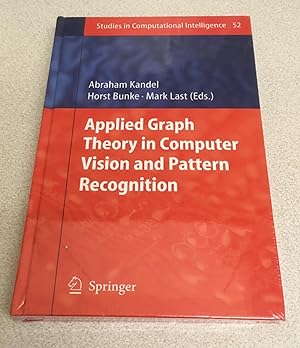
Applied Graph Theory in Computer Vision and Pattern Recognition
Sprache: Englisch
Verlag: Springer Berlin / Heidelberg, 2007
ISBN 10: 3540680195 ISBN 13: 9783540680192
Anbieter: Better World Books, Mishawaka, IN, USA
Verkäuferbewertung 5 von 5 Sternen

Zustand: Good. Pages intact with minimal writing/highlighting. The binding may be loose and creased. Dust jackets/supplements are not included. Stock photo provided. Product includes identifying sticker. Better World Books: Buy Books. Do Good.
-
Applied Graph Theory in Computer Vision and Pattern Recognition (Studies in Computational Intelligence, 52)
Anbieter: Ria Christie Collections, Uxbridge, Vereinigtes Königreich
Verkäuferbewertung 5 von 5 Sternen
EUR 112,09
EUR 13,83 Versand
Versand von Vereinigtes Königreich nach USAAnzahl: Mehr als 20 verfügbar
In den WarenkorbZustand: New. In.
-

Applied Graph Theory in Computer Vision and Pattern Recognition
Anbieter: GreatBookPrices, Columbia, MD, USA
Verkäuferbewertung 5 von 5 Sternen
Zustand: New.
-

Applied Graph Theory in Computer Vision and Pattern Recognition
Anbieter: GreatBookPricesUK, Woodford Green, Vereinigtes Königreich
Verkäuferbewertung 5 von 5 Sternen
EUR 112,08
EUR 17,31 Versand
Versand von Vereinigtes Königreich nach USAAnzahl: Mehr als 20 verfügbar
In den WarenkorbZustand: New.
-

Applied Graph Theory in Computer Vision and Pattern Recognition
Anbieter: GreatBookPricesUK, Woodford Green, Vereinigtes Königreich
Verkäuferbewertung 5 von 5 Sternen
EUR 124,08
EUR 17,31 Versand
Versand von Vereinigtes Königreich nach USAAnzahl: Mehr als 20 verfügbar
In den WarenkorbZustand: As New. Unread book in perfect condition.
-
Applied Graph Theory in Computer Vision and Pattern Recognition
Anbieter: Scarthin Books ABA, ILAB., Cromford, Vereinigtes Königreich
Verkäuferbewertung 4 von 5 Sternen
Erstausgabe
EUR 118,87
EUR 34,04 Versand
Versand von Vereinigtes Königreich nach USAAnzahl: 1 verfügbar
In den WarenkorbBook Hardcover. Zustand: As New. No Jacket. 1st Edition. Springer, 2007. 1st Edition . As New/No Jacket. Book still in original shrink-wrap.
-

Applied Graph Theory in Computer Vision and Pattern Recognition
Anbieter: GreatBookPrices, Columbia, MD, USA
Verkäuferbewertung 5 von 5 Sternen
Zustand: As New. Unread book in perfect condition.
-

Applied Graph Theory in Computer Vision and Pattern Recognition (Studies in Computational Intelligence)
Sprache: Englisch
Verlag: Springer Berlin Heidelberg, 2007
ISBN 10: 3642087647 ISBN 13: 9783642087646
Anbieter: Revaluation Books, Exeter, Vereinigtes Königreich
Verkäuferbewertung 5 von 5 Sternen
EUR 152,64
EUR 11,54 Versand
Versand von Vereinigtes Königreich nach USAAnzahl: 2 verfügbar
In den WarenkorbPaperback. Zustand: Brand New. 276 pages. 9.25x6.10x0.63 inches. In Stock.
-

Taschenbuch. Zustand: Neu. Applied Graph Theory in Computer Vision and Pattern Recognition | Abraham Kandel (u. a.) | Taschenbuch | x | Englisch | 2010 | Springer | EAN 9783642087646 | Verantwortliche Person für die EU: Springer Verlag GmbH, Tiergartenstr. 17, 69121 Heidelberg, juergen[dot]hartmann[at]springer[dot]com | Anbieter: preigu.
-

Applied Graph Theory in Computer Vision and Pattern Recognition
Sprache: Englisch
Verlag: Springer Berlin Heidelberg, 2007
ISBN 10: 3540680195 ISBN 13: 9783540680192
EUR 118,64
EUR 48,99 Versand
Versand von Deutschland nach USAAnzahl: Mehr als 20 verfügbar
In den WarenkorbGebunden. Zustand: New. Will serve as a foundation for a variety of useful applications of the graph theory to computer vision, pattern recognition, and related areasCovers a representative set of novel graph-theoretic methods for complex computer vision and pattern reco.
-

Applied Graph Theory in Computer Vision and Pattern Recognition
Sprache: Englisch
Verlag: Springer, Springer Spektrum, 2010
ISBN 10: 3642087647 ISBN 13: 9783642087646
Anbieter: AHA-BUCH GmbH, Einbeck, Deutschland
Verkäuferbewertung 5 von 5 Sternen
Taschenbuch. Zustand: Neu. Druck auf Anfrage Neuware - Printed after ordering - Graph theory has strong historical roots in mathematics, especially in topology. Its birth is usually associated with the 'four-color problem' posed by Francis Guthrie 1 in 1852, but its real origin probably goes back to the Seven Bridges of Konigsber g 2 problem proved by Leonhard Euler in 1736. A computational solution to these two completely different problems could be found after each problem was abstracted to the level of a graph model while ignoring such irrelevant details as country shapes or cross-river distances. In general, a graph is a nonempty set of points (vertices) and the most basic information preserved by any graph structure refers to adjacency relationships (edges) between some pairs of points. In the simplest graphs, edges do not have to hold any attributes, except their endpoints, but in more sophisticated graph structures, edges can be associated with a direction or assigned a label. Graph vertices can be labeled as well. A graph can be represented graphically as a drawing (vertex=dot,edge=arc),but,aslongaseverypairofadjacentpointsstaysconnected by the same edge, the graph vertices can be moved around on a drawing without changing the underlying graph structure. The expressive power of the graph models placing a special emphasis on c- nectivity between objects has made them the models of choice in chemistry, physics, biology, and other elds.
-
Applied Graph Theory in Computer Vision and Pattern Recognition (Studies in Computational Intelligence, 52)
Anbieter: Ria Christie Collections, Uxbridge, Vereinigtes Königreich
Verkäuferbewertung 5 von 5 Sternen
EUR 159,64
EUR 13,83 Versand
Versand von Vereinigtes Königreich nach USAAnzahl: Mehr als 20 verfügbar
In den WarenkorbZustand: New. In.
-

Applied Graph Theory in Computer Vision and Pattern Recognition
Sprache: Englisch
Verlag: Springer, Berlin, Springer, 2007
ISBN 10: 3540680195 ISBN 13: 9783540680192
Anbieter: AHA-BUCH GmbH, Einbeck, Deutschland
Verkäuferbewertung 5 von 5 Sternen
Buch. Zustand: Neu. Druck auf Anfrage Neuware - Printed after ordering - Graph theory has strong historical roots in mathematics, especially in topology. Its birth is usually associated with the 'four-color problem' posed by Francis Guthrie 1 in 1852, but its real origin probably goes back to the Seven Bridges of Konigsber g 2 problem proved by Leonhard Euler in 1736. A computational solution to these two completely different problems could be found after each problem was abstracted to the level of a graph model while ignoring such irrelevant details as country shapes or cross-river distances. In general, a graph is a nonempty set of points (vertices) and the most basic information preserved by any graph structure refers to adjacency relationships (edges) between some pairs of points. In the simplest graphs, edges do not have to hold any attributes, except their endpoints, but in more sophisticated graph structures, edges can be associated with a direction or assigned a label. Graph vertices can be labeled as well. A graph can be represented graphically as a drawing (vertex=dot,edge=arc),but,aslongaseverypairofadjacentpointsstaysconnected by the same edge, the graph vertices can be moved around on a drawing without changing the underlying graph structure. The expressive power of the graph models placing a special emphasis on c- nectivity between objects has made them the models of choice in chemistry, physics, biology, and other elds.
-
Applied Graph Theory in Computer Vision and Pattern Recognition (Studies in Computational Intelligence (52))
Anbieter: Mispah books, Redhill, SURRE, Vereinigtes Königreich
Verkäuferbewertung 4 von 5 Sternen
EUR 166,41
EUR 28,85 Versand
Versand von Vereinigtes Königreich nach USAAnzahl: 1 verfügbar
In den WarenkorbHardcover. Zustand: Like New. LIKE NEW. SHIPS FROM MULTIPLE LOCATIONS. book.
-
Applied Graph Theory in Computer Vision and Pattern Recognition (Studies in Computational Intelligence (52))
Anbieter: Mispah books, Redhill, SURRE, Vereinigtes Königreich
Verkäuferbewertung 4 von 5 Sternen
EUR 184,24
EUR 28,85 Versand
Versand von Vereinigtes Königreich nach USAAnzahl: 1 verfügbar
In den WarenkorbPaperback. Zustand: Like New. Like New. book.
-
Applied Graph Theory in Computer Vision and Pattern Recognition (eng)
Anbieter: Brook Bookstore On Demand, Napoli, NA, Italien
Verkäuferbewertung 4 von 5 Sternen
EUR 86,24
EUR 5,50 Versand
Versand von Italien nach USAAnzahl: Mehr als 20 verfügbar
In den WarenkorbZustand: new. Questo è un articolo print on demand.
-

Applied Graph Theory in Computer Vision and Pattern Recognition
Sprache: Englisch
Verlag: Springer, Berlin, Springer Berlin Heidelberg, Springer, 2007
ISBN 10: 3540680195 ISBN 13: 9783540680192
Anbieter: BuchWeltWeit Ludwig Meier e.K., Bergisch Gladbach, Deutschland
Verkäuferbewertung 5 von 5 Sternen
Buch. Zustand: Neu. This item is printed on demand - it takes 3-4 days longer - Neuware -Graph theory has strong historical roots in mathematics, especially in topology. Its birth is usually associated with the 'four-color problem' posed by Francis Guthrie 1 in 1852, but its real origin probably goes back to the Seven Bridges of Konigsber g 2 problem proved by Leonhard Euler in 1736. A computational solution to these two completely different problems could be found after each problem was abstracted to the level of a graph model while ignoring such irrelevant details as country shapes or cross-river distances. In general, a graph is a nonempty set of points (vertices) and the most basic information preserved by any graph structure refers to adjacency relationships (edges) between some pairs of points. In the simplest graphs, edges do not have to hold any attributes, except their endpoints, but in more sophisticated graph structures, edges can be associated with a direction or assigned a label. Graph vertices can be labeled as well. A graph can be represented graphically as a drawing (vertex=dot,edge=arc),but,aslongaseverypairofadjacentpointsst aysconnected by the same edge, the graph vertices can be moved around on a drawing without changing the underlying graph structure. The expressive power of the graph models placing a special emphasis on c- nectivity between objects has made them the models of choice in chemistry, physics, biology, and other elds. 266 pp. Englisch.
-

Applied Graph Theory in Computer Vision and Pattern Recognition
Sprache: Englisch
Verlag: Springer Berlin Heidelberg Nov 2010, 2010
ISBN 10: 3642087647 ISBN 13: 9783642087646
Anbieter: BuchWeltWeit Ludwig Meier e.K., Bergisch Gladbach, Deutschland
Verkäuferbewertung 5 von 5 Sternen
Taschenbuch. Zustand: Neu. This item is printed on demand - it takes 3-4 days longer - Neuware -This book presents novel graph-theoretic methods for complex computer vision and pattern recognition tasks. It presents the application of graph theory to low-level processing of digital images, presents graph-theoretic learning algorithms for high-level computer vision and pattern recognition applications, and provides detailed descriptions of several applications of graph-based methods to real-world pattern recognition tasks. 276 pp. Englisch.
-

Applied Graph Theory in Computer Vision and Pattern Recognition
Sprache: Englisch
Verlag: Springer Berlin Heidelberg, 2010
ISBN 10: 3642087647 ISBN 13: 9783642087646
EUR 92,27
EUR 48,99 Versand
Versand von Deutschland nach USAAnzahl: Mehr als 20 verfügbar
In den WarenkorbZustand: New. Dieser Artikel ist ein Print on Demand Artikel und wird nach Ihrer Bestellung fuer Sie gedruckt. Will serve as a foundation for a variety of useful applications of the graph theory to computer vision, pattern recognition, and related areasCovers a representative set of novel graph-theoretic methods for complex computer vision and pattern reco.
-

Applied Graph Theory in Computer Vision and Pattern Recognition
Sprache: Englisch
Verlag: Springer Berlin Heidelberg, Springer Berlin Heidelberg Nov 2010, 2010
ISBN 10: 3642087647 ISBN 13: 9783642087646
Anbieter: buchversandmimpf2000, Emtmannsberg, BAYE, Deutschland
Verkäuferbewertung 5 von 5 Sternen
Taschenbuch. Zustand: Neu. This item is printed on demand - Print on Demand Titel. Neuware -Graph theory has strong historical roots in mathematics, especially in topology. Its birth is usually associated with the ¿four-color problem¿ posed by Francis Guthrie 1 in 1852, but its real origin probably goes back to the Seven Bridges of Konigsber ¿ g 2 problem proved by Leonhard Euler in 1736. A computational solution to these two completely different problems could be found after each problem was abstracted to the level of a graph model while ignoring such irrelevant details as country shapes or cross-river distances. In general, a graph is a nonempty set of points (vertices) and the most basic information preserved by any graph structure refers to adjacency relationships (edges) between some pairs of points. In the simplest graphs, edges do not have to hold any attributes, except their endpoints, but in more sophisticated graph structures, edges can be associated with a direction or assigned a label. Graph vertices can be labeled as well. A graph can be represented graphically as a drawing (vertex=dot,edge=arc),but,aslongaseverypairofadjacentpointsstay sconnected by the same edge, the graph vertices can be moved around on a drawing without changing the underlying graph structure. The expressive power of the graph models placing a special emphasis on c- nectivity between objects has made them the models of choice in chemistry, physics, biology, and other elds.Springer Verlag GmbH, Tiergartenstr. 17, 69121 Heidelberg 276 pp. Englisch.