

Gesamtpreis (1 Artikel Artikel):
Versandziel:

forest development cold climates (19 Ergebnisse)
Direkt zu den wichtigsten Suchergebnissen
Suchfilter
Produktart
- Alle Product Types
- Bücher (19)
- Magazine & Zeitschriften (Keine weiteren Ergebnisse entsprechen dieser Verfeinerung)
- Comics (Keine weiteren Ergebnisse entsprechen dieser Verfeinerung)
- Noten (Keine weiteren Ergebnisse entsprechen dieser Verfeinerung)
- Kunst, Grafik & Poster (Keine weiteren Ergebnisse entsprechen dieser Verfeinerung)
- Fotografien (Keine weiteren Ergebnisse entsprechen dieser Verfeinerung)
- Karten (Keine weiteren Ergebnisse entsprechen dieser Verfeinerung)
- Manuskripte & Papierantiquitäten (Keine weiteren Ergebnisse entsprechen dieser Verfeinerung)
Zustand Mehr dazu
- Neu (18)
- Wie Neu, Sehr Gut oder Gut Bis Sehr Gut (1)
- Gut oder Befriedigend (Keine weiteren Ergebnisse entsprechen dieser Verfeinerung)
- Ausreichend oder Schlecht (Keine weiteren Ergebnisse entsprechen dieser Verfeinerung)
- Wie beschrieben (Keine weiteren Ergebnisse entsprechen dieser Verfeinerung)
Einband
Weitere Eigenschaften
- Erstausgabe (Keine weiteren Ergebnisse entsprechen dieser Verfeinerung)
- Signiert (Keine weiteren Ergebnisse entsprechen dieser Verfeinerung)
- Schutzumschlag (Keine weiteren Ergebnisse entsprechen dieser Verfeinerung)
- Angebotsfoto (10)
- Keine Print-on-Demand Angebote (10)
Sprache (1)
Preis
- Beliebiger Preis
- Weniger als EUR 20 (Keine weiteren Ergebnisse entsprechen dieser Verfeinerung)
- EUR 20 bis EUR 40 (Keine weiteren Ergebnisse entsprechen dieser Verfeinerung)
- Mehr als EUR 40
Gratisversand
- Kostenloser Versand nach USA (Keine weiteren Ergebnisse entsprechen dieser Verfeinerung)
Land des Verkäufers
Verkäuferbewertung
-

Forest Development in Cold Climates: (Closed)) (NATO Science Series A:)
Anbieter: Lucky's Textbooks, Dallas, TX, USA
Verkäuferbewertung 5 von 5 Sternen

EUR 200,76
EUR 3,37 Versand
Versand innerhalb von USAAnzahl: Mehr als 20 verfügbar
In den WarenkorbZustand: New.
-

Forest Development in Cold Climates (NATO Science Series A:, 244)
Anbieter: Lucky's Textbooks, Dallas, TX, USA
Verkäuferbewertung 5 von 5 Sternen
EUR 200,76
EUR 3,37 Versand
Versand innerhalb von USAAnzahl: Mehr als 20 verfügbar
In den WarenkorbZustand: New.
-
Forest Development in Cold Climates (NATO Science Series A:, 244)
Anbieter: Ria Christie Collections, Uxbridge, Vereinigtes Königreich
Verkäuferbewertung 5 von 5 Sternen
EUR 218,29
EUR 13,78 Versand
Versand von Vereinigtes Königreich nach USAAnzahl: Mehr als 20 verfügbar
In den WarenkorbZustand: New. In.
-
Forest Development in Cold Climates: (Closed)) (NATO Science Series A:)
Anbieter: Ria Christie Collections, Uxbridge, Vereinigtes Königreich
Verkäuferbewertung 5 von 5 Sternen
EUR 218,29
EUR 13,78 Versand
Versand von Vereinigtes Königreich nach USAAnzahl: Mehr als 20 verfügbar
In den WarenkorbZustand: New. In.
-
Zustand: New. pp. 586.
-

Forest Development in Cold Climates
Sprache: Englisch
Verlag: Springer US, Springer US Jun 1993, 1993
ISBN 10: 0306444801 ISBN 13: 9780306444807
Anbieter: buchversandmimpf2000, Emtmannsberg, BAYE, Deutschland
Verkäuferbewertung 5 von 5 Sternen
Buch. Zustand: Neu. Neuware -As forests decline in temperate and tropical climates, highly-developed countries and those striving for greater economic and social benefits are beginning to utilize marginal forests of high-latitude and mountainous regions for resources to satisfy human needs. The benefits of marginal forests range from purely aesthetic to providing resources for producing many goods and services demanded by a growing world population. Increased demands for forest resources and amenities and recent warming of high latitude climates have generated interest in reforestation and afforestation of marginal habitats in cold regions. Afforestation of treeless landscapes improves the environment for human habitation and provides for land use and economic prosperity. Trees are frequently planted in cold climates to rehabilitate denuded sites, for the amenity of homes and villages, and for wind shelter, recreation, agroforestry, and industrial uses. In addition, forests in cold climates reduce the albedo of the earth's surface in winter, and in summer they are small but significant long-lived sinks for atmospheric carbon dioxide. Finally, growth and reproductive success of forests at their geographic limits are sensitive indices of climatic change. As efforts to adapt forests to cold climates increase, however, new afforestation problems arise and old ones intensify. Austral, northern, and altitudinal tree limits are determined by many different factors. Current hypotheses for high-latitude tree limits are based on low growing-season temperatures that inhibit plant development and reproduction.Springer Verlag GmbH, Tiergartenstr. 17, 69121 Heidelberg 584 pp. Englisch.
-

Forest Development in Cold Climates
Anbieter: AHA-BUCH GmbH, Einbeck, Deutschland
Verkäuferbewertung 5 von 5 Sternen
Taschenbuch. Zustand: Neu. Druck auf Anfrage Neuware - Printed after ordering - As forests decline in temperate and tropical climates, highly-developed countries and those striving for greater economic and social benefits are beginning to utilize marginal forests of high-latitude and mountainous regions for resources to satisfy human needs. The benefits of marginal forests range from purely aesthetic to providing resources for producing many goods and services demanded by a growing world population. Increased demands for forest resources and amenities and recent warming of high latitude climates have generated interest in reforestation and afforestation of marginal habitats in cold regions. Afforestation of treeless landscapes improves the environment for human habitation and provides for land use and economic prosperity. Trees are frequently planted in cold climates to rehabilitate denuded sites, for the amenity of homes and villages, and for wind shelter, recreation, agroforestry, and industrial uses. In addition, forests in cold climates reduce the albedo of the earth's surface in winter, and in summer they are small but significant long-lived sinks for atmospheric carbon dioxide. Finally, growth and reproductive success of forests at their geographic limits are sensitive indices of climatic change. As efforts to adapt forests to cold climates increase, however, new afforestation problems arise and old ones intensify. Austral, northern, and altitudinal tree limits are determined by many different factors. Current hypotheses for high-latitude tree limits are based on low growing-season temperatures that inhibit plant development and reproduction.
-
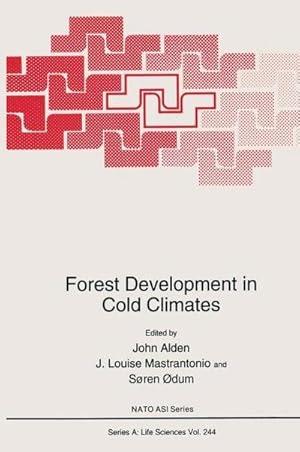
Forest Development in Cold Climates
Anbieter: AHA-BUCH GmbH, Einbeck, Deutschland
Verkäuferbewertung 5 von 5 Sternen
Buch. Zustand: Neu. Druck auf Anfrage Neuware - Printed after ordering - As forests decline in temperate and tropical climates, highly-developed countries and those striving for greater economic and social benefits are beginning to utilize marginal forests of high-latitude and mountainous regions for resources to satisfy human needs. The benefits of marginal forests range from purely aesthetic to providing resources for producing many goods and services demanded by a growing world population. Increased demands for forest resources and amenities and recent warming of high latitude climates have generated interest in reforestation and afforestation of marginal habitats in cold regions. Afforestation of treeless landscapes improves the environment for human habitation and provides for land use and economic prosperity. Trees are frequently planted in cold climates to rehabilitate denuded sites, for the amenity of homes and villages, and for wind shelter, recreation, agroforestry, and industrial uses. In addition, forests in cold climates reduce the albedo of the earth's surface in winter, and in summer they are small but significant long-lived sinks for atmospheric carbon dioxide. Finally, growth and reproductive success of forests at their geographic limits are sensitive indices of climatic change. As efforts to adapt forests to cold climates increase, however, new afforestation problems arise and old ones intensify. Austral, northern, and altitudinal tree limits are determined by many different factors. Current hypotheses for high-latitude tree limits are based on low growing-season temperatures that inhibit plant development and reproduction.
-
Forest Development in Cold Climates (Nato Science Series A: (closed))
Anbieter: Revaluation Books, Exeter, Vereinigtes Königreich
Verkäuferbewertung 5 von 5 Sternen
EUR 298,19
EUR 14,37 Versand
Versand von Vereinigtes Königreich nach USAAnzahl: 2 verfügbar
In den WarenkorbPaperback. Zustand: Brand New. reprint edition. 580 pages. 9.26x6.11x1.32 inches. In Stock.
-
Forest Development in Cold Climates (Nato Science Series A: (244))
Anbieter: Mispah books, Redhill, SURRE, Vereinigtes Königreich
Verkäuferbewertung 4 von 5 Sternen

EUR 292,56
EUR 28,75 Versand
Versand von Vereinigtes Königreich nach USAAnzahl: 1 verfügbar
In den WarenkorbHardcover. Zustand: Like New. LIKE NEW. SHIPS FROM MULTIPLE LOCATIONS. book.
-

EUR 180,07
EUR 48,99 Versand
Versand von Deutschland nach USAAnzahl: Mehr als 20 verfügbar
In den WarenkorbGebunden. Zustand: New. Dieser Artikel ist ein Print on Demand Artikel und wird nach Ihrer Bestellung fuer Sie gedruckt. Proceedings of a NATO ARW held in Laugarvatn, Iceland, June 18-23, 1991 As forests decline in temperate and tropical climates, highly-developed countries and those striving for greater economic and social benefits are beginning to utilize marginal fore.
-

EUR 180,07
EUR 48,99 Versand
Versand von Deutschland nach USAAnzahl: Mehr als 20 verfügbar
In den WarenkorbZustand: New. Dieser Artikel ist ein Print on Demand Artikel und wird nach Ihrer Bestellung fuer Sie gedruckt. Proceedings of a NATO ARW held in Laugarvatn, Iceland, June 18-23, 1991 As forests decline in temperate and tropical climates, highly-developed countries and those striving for greater economic and social benefits are beginning to utilize marginal fore.
-

Forest Development in Cold Climates
Anbieter: BuchWeltWeit Ludwig Meier e.K., Bergisch Gladbach, Deutschland
Verkäuferbewertung 5 von 5 Sternen
Buch. Zustand: Neu. This item is printed on demand - it takes 3-4 days longer - Neuware -As forests decline in temperate and tropical climates, highly-developed countries and those striving for greater economic and social benefits are beginning to utilize marginal forests of high-latitude and mountainous regions for resources to satisfy human needs. The benefits of marginal forests range from purely aesthetic to providing resources for producing many goods and services demanded by a growing world population. Increased demands for forest resources and amenities and recent warming of high latitude climates have generated interest in reforestation and afforestation of marginal habitats in cold regions. Afforestation of treeless landscapes improves the environment for human habitation and provides for land use and economic prosperity. Trees are frequently planted in cold climates to rehabilitate denuded sites, for the amenity of homes and villages, and for wind shelter, recreation, agroforestry, and industrial uses. In addition, forests in cold climates reduce the albedo of the earth's surface in winter, and in summer they are small but significant long-lived sinks for atmospheric carbon dioxide. Finally, growth and reproductive success of forests at their geographic limits are sensitive indices of climatic change. As efforts to adapt forests to cold climates increase, however, new afforestation problems arise and old ones intensify. Austral, northern, and altitudinal tree limits are determined by many different factors. Current hypotheses for high-latitude tree limits are based on low growing-season temperatures that inhibit plant development and reproduction. 580 pp. Englisch.
-
Buch. Zustand: Neu. Forest Development in Cold Climates | John Alden (u. a.) | Buch | xiv | Englisch | 1993 | Springer US | EAN 9780306444807 | Verantwortliche Person für die EU: Springer Verlag GmbH, Tiergartenstr. 17, 69121 Heidelberg, juergen[dot]hartmann[at]springer[dot]com | Anbieter: preigu Print on Demand.
-

Taschenbuch. Zustand: Neu. Forest Development in Cold Climates | John Alden (u. a.) | Taschenbuch | XIV | Englisch | 2013 | Springer | EAN 9781489916020 | Verantwortliche Person für die EU: Springer Verlag GmbH, Tiergartenstr. 17, 69121 Heidelberg, juergen[dot]hartmann[at]springer[dot]com | Anbieter: preigu Print on Demand.
-

Forest Development in Cold Climates
Sprache: Englisch
Verlag: Springer US, Springer US Jun 2013, 2013
ISBN 10: 1489916024 ISBN 13: 9781489916020
Anbieter: buchversandmimpf2000, Emtmannsberg, BAYE, Deutschland
Verkäuferbewertung 5 von 5 Sternen
Taschenbuch. Zustand: Neu. This item is printed on demand - Print on Demand Titel. Neuware -As forests decline in temperate and tropical climates, highly-developed countries and those striving for greater economic and social benefits are beginning to utilize marginal forests of high-latitude and mountainous regions for resources to satisfy human needs. The benefits of marginal forests range from purely aesthetic to providing resources for producing many goods and services demanded by a growing world population. Increased demands for forest resources and amenities and recent warming of high latitude climates have generated interest in reforestation and afforestation of marginal habitats in cold regions. Afforestation of treeless landscapes improves the environment for human habitation and provides for land use and economic prosperity. Trees are frequently planted in cold climates to rehabilitate denuded sites, for the amenity of homes and villages, and for wind shelter, recreation, agroforestry, and industrial uses. In addition, forests in cold climates reduce the albedo of the earth's surface in winter, and in summer they are small but significant long-lived sinks for atmospheric carbon dioxide. Finally, growth and reproductive success of forests at their geographic limits are sensitive indices of climatic change. As efforts to adapt forests to cold climates increase, however, new afforestation problems arise and old ones intensify. Austral, northern, and altitudinal tree limits are determined by many different factors. Current hypotheses for high-latitude tree limits are based on low growing-season temperatures that inhibit plant development and reproduction.Springer Verlag GmbH, Tiergartenstr. 17, 69121 Heidelberg 584 pp. Englisch.
-
Forest Development in Cold Climates
Anbieter: Majestic Books, Hounslow, Vereinigtes Königreich
Verkäuferbewertung 4 von 5 Sternen
EUR 277,89
EUR 7,47 Versand
Versand von Vereinigtes Königreich nach USAAnzahl: 4 verfügbar
In den WarenkorbZustand: New. Print on Demand pp. 586 49:B&W 6.14 x 9.21 in or 234 x 156 mm (Royal 8vo) Perfect Bound on White w/Gloss Lam.
-
Forest Development in Cold Climates
Anbieter: Biblios, Frankfurt am main, HESSE, Deutschland
Verkäuferbewertung 4 von 5 Sternen
Zustand: New. PRINT ON DEMAND pp. 586.
-

Forest Development in Cold Climates
Anbieter: BuchWeltWeit Ludwig Meier e.K., Bergisch Gladbach, Deutschland
Verkäuferbewertung 5 von 5 Sternen
Taschenbuch. Zustand: Neu. This item is printed on demand - it takes 3-4 days longer - Neuware -As forests decline in temperate and tropical climates, highly-developed countries and those striving for greater economic and social benefits are beginning to utilize marginal forests of high-latitude and mountainous regions for resources to satisfy human needs. The benefits of marginal forests range from purely aesthetic to providing resources for producing many goods and services demanded by a growing world population. Increased demands for forest resources and amenities and recent warming of high latitude climates have generated interest in reforestation and afforestation of marginal habitats in cold regions. Afforestation of treeless landscapes improves the environment for human habitation and provides for land use and economic prosperity. Trees are frequently planted in cold climates to rehabilitate denuded sites, for the amenity of homes and villages, and for wind shelter, recreation, agroforestry, and industrial uses. In addition, forests in cold climates reduce the albedo of the earth's surface in winter, and in summer they are small but significant long-lived sinks for atmospheric carbon dioxide. Finally, growth and reproductive success of forests at their geographic limits are sensitive indices of climatic change. As efforts to adapt forests to cold climates increase, however, new afforestation problems arise and old ones intensify. Austral, northern, and altitudinal tree limits are determined by many different factors. Current hypotheses for high-latitude tree limits are based on low growing-season temperatures that inhibit plant development and reproduction. 584 pp. Englisch.


