

Gesamtpreis (1 Artikel Artikel):
Versandziel:

litigation settlement game incomplete (9 Ergebnisse)
Direkt zu den wichtigsten Suchergebnissen
Suchfilter
Produktart
- Alle Product Types
- Bücher (9)
- Magazine & Zeitschriften (Keine weiteren Ergebnisse entsprechen dieser Verfeinerung)
- Comics (Keine weiteren Ergebnisse entsprechen dieser Verfeinerung)
- Noten (Keine weiteren Ergebnisse entsprechen dieser Verfeinerung)
- Kunst, Grafik & Poster (Keine weiteren Ergebnisse entsprechen dieser Verfeinerung)
- Fotografien (Keine weiteren Ergebnisse entsprechen dieser Verfeinerung)
- Karten (Keine weiteren Ergebnisse entsprechen dieser Verfeinerung)
- Manuskripte & Papierantiquitäten (Keine weiteren Ergebnisse entsprechen dieser Verfeinerung)
Zustand Mehr dazu
- Neu (7)
- Wie Neu, Sehr Gut oder Gut Bis Sehr Gut (Keine weiteren Ergebnisse entsprechen dieser Verfeinerung)
- Gut oder Befriedigend (Keine weiteren Ergebnisse entsprechen dieser Verfeinerung)
- Ausreichend oder Schlecht (Keine weiteren Ergebnisse entsprechen dieser Verfeinerung)
- Wie beschrieben (2)
Einband
- alle Einbände
- Hardcover (Keine weiteren Ergebnisse entsprechen dieser Verfeinerung)
- Softcover (9)
Weitere Eigenschaften
- Erstausgabe (Keine weiteren Ergebnisse entsprechen dieser Verfeinerung)
- Signiert (Keine weiteren Ergebnisse entsprechen dieser Verfeinerung)
- Schutzumschlag (Keine weiteren Ergebnisse entsprechen dieser Verfeinerung)
- Angebotsfoto (6)
- Keine Print-on-Demand Angebote (6)
Sprache (1)
Gratisversand
- Kostenloser Versand nach USA (Keine weiteren Ergebnisse entsprechen dieser Verfeinerung)
Land des Verkäufers
Verkäuferbewertung
-
![Beispielbild für Litigation and Settlement in a Game with Incomplete Information. An Experimental Study. [Lecture Notes in Economics and Mathematical Systems, Vol. 440]. zum Verkauf von Antiquariat Thomas Haker GmbH & Co. KG](https://pictures.abebooks.com/isbn/9783540613046-de-300.jpg)
Litigation and Settlement in a Game with Incomplete Information. An Experimental Study. [Lecture Notes in Economics and Mathematical Systems, Vol. 440].
Buch 68 von 126: Lecture Notes in Economics and Mathematical SystemsAnbieter: Antiquariat Thomas Haker GmbH & Co. KG, Berlin, Deutschland
Verbandsmitglied: GIAQ
Verkäuferbewertung 5 von 5 Sternen

Softcover/Paperback. 188 p. Very good. Shrink wrapped. / Sehr guter Zustand. In Folie verschweißt. Sprache: Englisch Gewicht in Gramm: 275.
-
Litigation and Settlement in a Game with Incomplete Information: An Experimental Study (Lecture Notes in Economics and Mathematical Systems, 440)
Buch 68 von 126: Lecture Notes in Economics and Mathematical SystemsAnbieter: Ria Christie Collections, Uxbridge, Vereinigtes Königreich
Verkäuferbewertung 5 von 5 Sternen
EUR 60,39
EUR 13,83 Versand
Versand von Vereinigtes Königreich nach USAAnzahl: Mehr als 20 verfügbar
In den WarenkorbZustand: New. In.
-
Litigation and Settlement in a Game with Incomplete Information : An Experimental Study
Buch 68 von 126: Lecture Notes in Economics and Mathematical SystemsAnbieter: Chiron Media, Wallingford, Vereinigtes Königreich
Verkäuferbewertung 5 von 5 Sternen
EUR 56,69
EUR 17,88 Versand
Versand von Vereinigtes Königreich nach USAAnzahl: 10 verfügbar
In den WarenkorbPF. Zustand: New.
-

Litigation and settlement in a game with incomplete information. An experimental study.
Buch 68 von 126: Lecture Notes in Economics and Mathematical SystemsAnbieter: Antiquariat Bookfarm, Löbnitz, Deutschland
Verkäuferbewertung 5 von 5 Sternen
Softcover. 174 S. Ehem. Bibliotheksexemplar mit Signatur und Stempel. GUTER Zustand, ein paar Gebrauchsspuren. Ex-library with stamp and library-signature. GOOD condition, some traces of use. L07634 9783540613046 Sprache: Englisch Gewicht in Gramm: 340.
-

Litigation and Settlement in a Game with Incomplete Information : An Experimental Study
Buch 68 von 126: Lecture Notes in Economics and Mathematical SystemsAnbieter: AHA-BUCH GmbH, Einbeck, Deutschland
Verkäuferbewertung 5 von 5 Sternen
Taschenbuch. Zustand: Neu. Druck auf Anfrage Neuware - Printed after ordering - We investigate a two-person game of litigation and settlement with incomplete information on one side. So far, various theoretical attempts have been made to answer the question of why some people choose not to resolve their disputes and instead go to court and incur litigation costs, even if bargaining leaves room for both parties to fare better when avoiding the conflict. We can distinguish between games which focus on strategic elements like games with incomplete information (see, for example, P'ng (1983), Samuelson (1982) and Schweizer (1989' and decision-theoretic models neglecting strategic elements (see, for example, Landes (1971) and Gould (1973'. The single-person decision theory approach to litigation assumes litigants to have a subjective estimate of the likelihood that the plaintiff will win the action. Differing views on the probability of winning the court case help to explain the fraction of cases that actually go to trial. Among others, P'ng (1983) points out the shortcomings of the single-person decision theory approach which does not take into account, for example, the different fee systems in England and the U.S. and the differences in information conflicting parties may have. P'ng constructs a model of one-sided incomplete information where the settlement terms are given exogenously. Schweizer (1989), on the other hand, extends P'ng's model and allows for two-sided asymmetric information where the settlement terms are determined endogenously.
-

Taschenbuch. Zustand: Neu. Litigation and Settlement in a Game with Incomplete Information | An Experimental Study | Wolfgang Ryll | Taschenbuch | Lecture Notes in Economics and Mathematical Systems | viii | Englisch | 1996 | Springer | EAN 9783540613046 | Verantwortliche Person für die EU: Springer Verlag GmbH, Tiergartenstr. 17, 69121 Heidelberg, juergen[dot]hartmann[at]springer[dot]com | Anbieter: preigu.
-
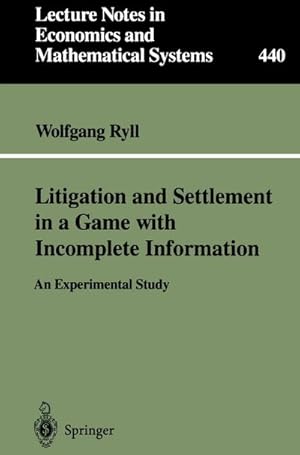
Litigation and Settlement in a Game with Incomplete Information
Buch 68 von 126: Lecture Notes in Economics and Mathematical SystemsSprache: Englisch
Verlag: Springer Berlin Heidelberg Jul 1996, 1996
ISBN 10: 3540613048 ISBN 13: 9783540613046
Anbieter: BuchWeltWeit Ludwig Meier e.K., Bergisch Gladbach, Deutschland
Verkäuferbewertung 5 von 5 Sternen
Taschenbuch. Zustand: Neu. This item is printed on demand - it takes 3-4 days longer - Neuware -We investigate a two-person game of litigation and settlement with incomplete information on one side. So far, various theoretical attempts have been made to answer the question of why some people choose not to resolve their disputes and instead go to court and incur litigation costs, even if bargaining leaves room for both parties to fare better when avoiding the conflict. We can distinguish between games which focus on strategic elements like games with incomplete information (see, for example, P'ng (1983), Samuelson (1982) and Schweizer (1989' and decision-theoretic models neglecting strategic elements (see, for example, Landes (1971) and Gould (1973'. The single-person decision theory approach to litigation assumes litigants to have a subjective estimate of the likelihood that the plaintiff will win the action. Differing views on the probability of winning the court case help to explain the fraction of cases that actually go to trial. Among others, P'ng (1983) points out the shortcomings of the single-person decision theory approach which does not take into account, for example, the different fee systems in England and the U.S. and the differences in information conflicting parties may have. P'ng constructs a model of one-sided incomplete information where the settlement terms are given exogenously. Schweizer (1989), on the other hand, extends P'ng's model and allows for two-sided asymmetric information where the settlement terms are determined endogenously. 188 pp. Englisch.
-

Litigation and Settlement in a Game with Incomplete Information
Buch 68 von 126: Lecture Notes in Economics and Mathematical SystemsSprache: Englisch
Verlag: Springer Berlin Heidelberg, 1996
ISBN 10: 3540613048 ISBN 13: 9783540613046
EUR 48,37
EUR 48,99 Versand
Versand von Deutschland nach USAAnzahl: Mehr als 20 verfügbar
In den WarenkorbZustand: New. Dieser Artikel ist ein Print on Demand Artikel und wird nach Ihrer Bestellung fuer Sie gedruckt. We investigate a two-person game of litigation and settlement with incomplete information on one side. So far, various theoretical attempts have been made to answer the question of why some people choose not to resolve their disputes and instead go to court.
-

Litigation and Settlement in a Game with Incomplete Information
Buch 68 von 126: Lecture Notes in Economics and Mathematical SystemsSprache: Englisch
Verlag: Springer, J.B. Metzler Jul 1996, 1996
ISBN 10: 3540613048 ISBN 13: 9783540613046
Anbieter: buchversandmimpf2000, Emtmannsberg, BAYE, Deutschland
Verkäuferbewertung 5 von 5 Sternen
Taschenbuch. Zustand: Neu. This item is printed on demand - Print on Demand Titel. Neuware -We investigate a two-person game of litigation and settlement with incomplete information on one side. So far, various theoretical attempts have been made to answer the question of why some people choose not to resolve their disputes and instead go to court and incur litigation costs, even if bargaining leaves room for both parties to fare better when avoiding the conflict. We can distinguish between games which focus on strategic elements like games with incomplete information (see, for example, P'ng (1983), Samuelson (1982) and Schweizer (1989» and decision-theoretic models neglecting strategic elements (see, for example, Landes (1971) and Gould (1973». The single-person decision theory approach to litigation assumes litigants to have a subjective estimate of the likelihood that the plaintiff will win the action. Differing views on the probability of winning the court case help to explain the fraction of cases that actually go to trial. Among others, P'ng (1983) points out the shortcomings of the single-person decision theory approach which does not take into account, for example, the different fee systems in England and the U.S. and the differences in information conflicting parties may have. P'ng constructs a model of one-sided incomplete information where the settlement terms are given exogenously. Schweizer (1989), on the other hand, extends P'ng's model and allows for two-sided asymmetric information where the settlement terms are determined endogenously.Springer-Verlag KG, Sachsenplatz 4-6, 1201 Wien 188 pp. Englisch.
