

Gesamtpreis (1 Artikel Artikel):
Versandziel:

modality theory mind elements (17 Ergebnisse)
Direkt zu den wichtigsten Suchergebnissen
Suchfilter
Produktart
- Alle Product Types
- Bücher (17)
- Magazine & Zeitschriften (Keine weiteren Ergebnisse entsprechen dieser Verfeinerung)
- Comics (Keine weiteren Ergebnisse entsprechen dieser Verfeinerung)
- Noten (Keine weiteren Ergebnisse entsprechen dieser Verfeinerung)
- Kunst, Grafik & Poster (Keine weiteren Ergebnisse entsprechen dieser Verfeinerung)
- Fotografien (Keine weiteren Ergebnisse entsprechen dieser Verfeinerung)
- Karten (Keine weiteren Ergebnisse entsprechen dieser Verfeinerung)
- Manuskripte & Papierantiquitäten (Keine weiteren Ergebnisse entsprechen dieser Verfeinerung)
Zustand Mehr dazu
- Neu (15)
- Wie Neu, Sehr Gut oder Gut Bis Sehr Gut (2)
- Gut oder Befriedigend (Keine weiteren Ergebnisse entsprechen dieser Verfeinerung)
- Ausreichend oder Schlecht (Keine weiteren Ergebnisse entsprechen dieser Verfeinerung)
- Wie beschrieben (Keine weiteren Ergebnisse entsprechen dieser Verfeinerung)
Einband
Weitere Eigenschaften
- Erstausgabe (Keine weiteren Ergebnisse entsprechen dieser Verfeinerung)
- Signiert (Keine weiteren Ergebnisse entsprechen dieser Verfeinerung)
- Schutzumschlag (Keine weiteren Ergebnisse entsprechen dieser Verfeinerung)
- Angebotsfoto (11)
- Keine Print-on-Demand Angebote (12)
Sprache (1)
Preis
- Beliebiger Preis
- Weniger als EUR 20 (Keine weiteren Ergebnisse entsprechen dieser Verfeinerung)
- EUR 20 bis EUR 45 (Keine weiteren Ergebnisse entsprechen dieser Verfeinerung)
- Mehr als EUR 45
Gratisversand
Land des Verkäufers
Verkäuferbewertung
-

Modality and Theory of Mind Elements Across Languages
Buch 229 von 360: Trends in Linguistics. Studies and Monographs [TiLSM]Anbieter: GreatBookPrices, Columbia, MD, USA
Verkäuferbewertung 5 von 5 Sternen

EUR 189,11
EUR 2,25 Versand
Versand innerhalb von USAAnzahl: Mehr als 20 verfügbar
In den WarenkorbZustand: New.
-

Modality and Theory of Mind Elements Across Languages
Buch 229 von 360: Trends in Linguistics. Studies and Monographs [TiLSM]Anbieter: GreatBookPricesUK, Woodford Green, Vereinigtes Königreich
Verkäuferbewertung 5 von 5 Sternen
EUR 174,99
EUR 17,21 Versand
Versand von Vereinigtes Königreich nach USAAnzahl: Mehr als 20 verfügbar
In den WarenkorbZustand: New.
-

Modality and Theory of Mind Elements Across Languages
Buch 229 von 360: Trends in Linguistics. Studies and Monographs [TiLSM]Anbieter: GreatBookPrices, Columbia, MD, USA
Verkäuferbewertung 5 von 5 Sternen
EUR 197,58
EUR 2,25 Versand
Versand innerhalb von USAAnzahl: Mehr als 20 verfügbar
In den WarenkorbZustand: As New. Unread book in perfect condition.
-

Modality and Theory of Mind Elements Across Languages
Buch 229 von 360: Trends in Linguistics. Studies and Monographs [TiLSM]Anbieter: GreatBookPricesUK, Woodford Green, Vereinigtes Königreich
Verkäuferbewertung 5 von 5 Sternen
EUR 198,16
EUR 17,21 Versand
Versand von Vereinigtes Königreich nach USAAnzahl: Mehr als 20 verfügbar
In den WarenkorbZustand: As New. Unread book in perfect condition.
-

Hardback. Zustand: New. Modality is the way a speaker modifies her declaratives and other speech acts to optimally assess the common ground of knowledge and belief of the addressee with the aim to optimally achieve understanding and an assessment of relevant information exchange. In languages such as German (and other Germanic languages outside of English), this may happen in covert terms. Main categories used for this purpose are modal adverbials ("modal particles") and modal verbs. Epistemic uses of modal verbs (like German sollen) cover evidential (reportative) information simultaneously providing the source of the information. Methodologically, description and explanation rest on Karl Bühler's concept of Origo as well as Roman Jakobson's concept of shifter. Typologically, East Asian languages such as Japanese pursue these semasiological fundaments far more closely than the European languages. In particular, Japanese has to mark the source of a statement in the declarative mode such that the reliability may be assessed by the hearer. The contributions in this collection provide insight into these modal techniques.
-
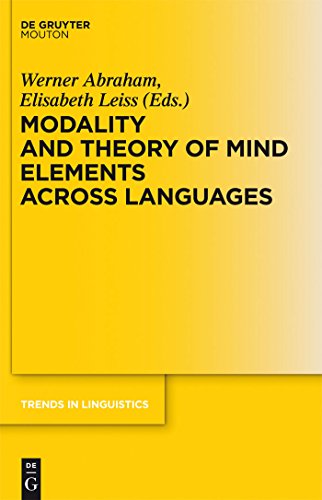
Modality and Theory of Mind Elements Across Languages
Buch 229 von 360: Trends in Linguistics. Studies and Monographs [TiLSM]Sprache: Englisch
Verlag: Walter de Gruyter, Incorporated, 2012
ISBN 10: 3110270196 ISBN 13: 9783110270198
Anbieter: Majestic Books, Hounslow, Vereinigtes Königreich
Verkäuferbewertung 4 von 5 Sternen

EUR 215,92
EUR 7,46 Versand
Versand von Vereinigtes Königreich nach USAAnzahl: 3 verfügbar
In den WarenkorbZustand: New. pp. x + 460 24 Figures, Illus.
-

Modality and Theory of Mind Elements across Languages
Buch 229 von 360: Trends in Linguistics. Studies and Monographs [TiLSM]Anbieter: AHA-BUCH GmbH, Einbeck, Deutschland
Verkäuferbewertung 5 von 5 Sternen
Buch. Zustand: Neu. Druck auf Anfrage Neuware - Printed after ordering - Modality is the way a speaker modifies her declaratives and other speech acts to optimally assess the common ground of knowledge and belief of the addressee with the aim to optimally achieve understanding and an assessment of relevant information exchange. In languages such as German (and other Germanic languages outside of English), this may happen in covert terms. Main categories used for this purpose are modal adverbials ('modal particles') and modal verbs. Epistemic uses of modal verbs (like German sollen) cover evidential (reportative) information simultaneously providing the source of the information. Methodologically, description and explanation rest on Karl Bühler's concept of Origo as well as Roman Jakobson's concept of shifter. Typologically, East Asian languages such as Japanese pursue these semasiological fundaments far more closely than the European languages. In particular, Japanese has to mark the source of a statement in the declarative mode such that the reliability may be assessed by the hearer. The contributions in this collection provide insight into these modal techniques.
-
Modality and Theory of Mind Elements Across Languages
Buch 229 von 360: Trends in Linguistics. Studies and Monographs [TiLSM]Anbieter: Revaluation Books, Exeter, Vereinigtes Königreich
Verkäuferbewertung 5 von 5 Sternen
EUR 218,46
EUR 14,34 Versand
Versand von Vereinigtes Königreich nach USAAnzahl: 2 verfügbar
In den WarenkorbHardcover. Zustand: Brand New. 460 pages. 9.25x6.25x1.25 inches. In Stock.
-
Modality and Theory of Mind Elements Across Languages
Buch 229 von 360: Trends in Linguistics. Studies and Monographs [TiLSM]Sprache: Englisch
Verlag: Walter de Gruyter, Incorporated, 2012
ISBN 10: 3110270196 ISBN 13: 9783110270198
Zustand: New. pp. x + 460.
-

Modality and Theory of Mind Elements across Languages
Buch 229 von 360: Trends in Linguistics. Studies and Monographs [TiLSM]Anbieter: Rarewaves USA United, OSWEGO, IL, USA
Verkäuferbewertung 5 von 5 Sternen
EUR 221,95
EUR 42,65 Versand
Versand innerhalb von USAAnzahl: Mehr als 20 verfügbar
In den WarenkorbHardback. Zustand: New. Modality is the way a speaker modifies her declaratives and other speech acts to optimally assess the common ground of knowledge and belief of the addressee with the aim to optimally achieve understanding and an assessment of relevant information exchange. In languages such as German (and other Germanic languages outside of English), this may happen in covert terms. Main categories used for this purpose are modal adverbials ("modal particles") and modal verbs. Epistemic uses of modal verbs (like German sollen) cover evidential (reportative) information simultaneously providing the source of the information. Methodologically, description and explanation rest on Karl Bühler's concept of Origo as well as Roman Jakobson's concept of shifter. Typologically, East Asian languages such as Japanese pursue these semasiological fundaments far more closely than the European languages. In particular, Japanese has to mark the source of a statement in the declarative mode such that the reliability may be assessed by the hearer. The contributions in this collection provide insight into these modal techniques.
-
Modality and Theory of Mind Elements across Languages
Buch 229 von 360: Trends in Linguistics. Studies and Monographs [TiLSM]Anbieter: Kennys Bookshop and Art Galleries Ltd., Galway, GY, Irland
Verkäuferbewertung 5 von 5 Sternen
EUR 270,31
EUR 10,50 Versand
Versand von Irland nach USAAnzahl: Mehr als 20 verfügbar
In den WarenkorbZustand: New. 2012. Hardcover. . . . . .
-
Modality and Theory of Mind Elements across Languages
Buch 229 von 360: Trends in Linguistics. Studies and Monographs [TiLSM]Anbieter: Kennys Bookstore, Olney, MD, USA
Verkäuferbewertung 5 von 5 Sternen
EUR 335,55
EUR 8,96 Versand
Versand innerhalb von USAAnzahl: Mehr als 20 verfügbar
In den WarenkorbZustand: New. 2012. Hardcover. . . . . . Books ship from the US and Ireland.
-
Modality and Theory of Mind Elements across Languages
Buch 229 von 360: Trends in Linguistics. Studies and Monographs [TiLSM]Anbieter: PBShop.store UK, Fairford, GLOS, Vereinigtes Königreich
Verkäuferbewertung 4 von 5 Sternen
EUR 179,11
EUR 6,74 Versand
Versand von Vereinigtes Königreich nach USAAnzahl: Mehr als 20 verfügbar
In den WarenkorbHRD. Zustand: New. New Book. Delivered from our UK warehouse in 4 to 14 business days. THIS BOOK IS PRINTED ON DEMAND. Established seller since 2000.
-

Modality and Theory of Mind Elements across Languages
Buch 229 von 360: Trends in Linguistics. Studies and Monographs [TiLSM]Sprache: Englisch
Verlag: De Gruyter Mouton, De Gruyter Mouton Mai 2012, 2012
ISBN 10: 3110270196 ISBN 13: 9783110270198
Anbieter: BuchWeltWeit Ludwig Meier e.K., Bergisch Gladbach, Deutschland
Verkäuferbewertung 5 von 5 Sternen
Buch. Zustand: Neu. This item is printed on demand - it takes 3-4 days longer - Neuware -Modality is the way a speaker modifies her declaratives and other speech acts to optimally assess the common ground of knowledge and belief of the addressee with the aim to optimally achieve understanding and an assessment of relevant information exchange. In languages such as German (and other Germanic languages outside of English), this may happen in covert terms. Main categories used for this purpose are modal adverbials ('modal particles') and modal verbs. Epistemic uses of modal verbs (like German sollen) cover evidential (reportative) information simultaneously providing the source of the information. Methodologically, description and explanation rest on Karl Bühler's concept of Origo as well as Roman Jakobson's concept of shifter. Typologically, East Asian languages such as Japanese pursue these semasiological fundaments far more closely than the European languages. In particular, Japanese has to mark the source of a statement in the declarative mode such that the reliability may be assessed by the hearer. The contributions in this collection provide insight into these modal techniques. 472 pp. Englisch.
-

Modality and Theory of Mind Elements across Languages
Buch 229 von 360: Trends in Linguistics. Studies and Monographs [TiLSM]EUR 140,84
EUR 48,99 Versand
Versand von Deutschland nach USAAnzahl: Mehr als 20 verfügbar
In den WarenkorbHardcover. Zustand: New. Dieser Artikel ist ein Print on Demand Artikel und wird nach Ihrer Bestellung fuer Sie gedruckt. Werner Abraham, Vienn.
-

Buch. Zustand: Neu. Modality and Theory of Mind Elements across Languages | Elisabeth Leiss (u. a.) | Buch | X | Englisch | 2012 | De Gruyter Mouton | EAN 9783110270198 | Verantwortliche Person für die EU: Walter de Gruyter GmbH, De Gruyter GmbH, Genthiner Str. 13, 10785 Berlin, productsafety[at]degruyterbrill[dot]com | Anbieter: preigu Print on Demand.
-

Modality and Theory of Mind Elements across Languages
Buch 229 von 360: Trends in Linguistics. Studies and Monographs [TiLSM]Sprache: Englisch
Verlag: De Gruyter Mouton, De Gruyter Mouton Mai 2012, 2012
ISBN 10: 3110270196 ISBN 13: 9783110270198
Anbieter: buchversandmimpf2000, Emtmannsberg, BAYE, Deutschland
Verkäuferbewertung 5 von 5 Sternen
Buch. Zustand: Neu. This item is printed on demand - Print on Demand Titel. Neuware -Modality is the way a speaker modifies her declaratives and other speech acts to optimally assess the common ground of knowledge and belief of the addressee with the aim to optimally achieve understanding and an assessment of relevant information exchange.In languages such as German (and other Germanic languages outside of English), this may happen in covert terms. Main categories used for this purpose are modal adverbials ('modal particles') and modal verbs. Epistemic uses of modal verbs (like German sollen) cover evidential (reportative) information simultaneously providing the source of the information.Methodologically, description and explanation rest on Karl Bühler's concept of Origo as well as Roman Jakobson's concept of shifter. Typologically, East Asian languages such as Japanese pursue these semasiological fundaments far more closely than the European languages. In particular, Japanese has to mark the source of a statement in the declarative mode such that the reliability may be assessed by the hearer.The contributions in this collection provide insight into these modal techniques.Walter de Gruyter GmbH, Genthiner Strasse 13, 10785 Berlin 472 pp. Englisch.

