

Gesamtpreis (1 Artikel Artikel):
Versandziel:

modeling phase transitions brain (20 Ergebnisse)
Direkt zu den wichtigsten Suchergebnissen
Suchfilter
Produktart
- Alle Product Types
- Bücher (20)
- Magazine & Zeitschriften (Keine weiteren Ergebnisse entsprechen dieser Verfeinerung)
- Comics (Keine weiteren Ergebnisse entsprechen dieser Verfeinerung)
- Noten (Keine weiteren Ergebnisse entsprechen dieser Verfeinerung)
- Kunst, Grafik & Poster (Keine weiteren Ergebnisse entsprechen dieser Verfeinerung)
- Fotografien (Keine weiteren Ergebnisse entsprechen dieser Verfeinerung)
- Karten (Keine weiteren Ergebnisse entsprechen dieser Verfeinerung)
- Manuskripte & Papierantiquitäten (Keine weiteren Ergebnisse entsprechen dieser Verfeinerung)
Zustand Mehr dazu
- Neu (18)
- Wie Neu, Sehr Gut oder Gut Bis Sehr Gut (2)
- Gut oder Befriedigend (Keine weiteren Ergebnisse entsprechen dieser Verfeinerung)
- Ausreichend oder Schlecht (Keine weiteren Ergebnisse entsprechen dieser Verfeinerung)
- Wie beschrieben (Keine weiteren Ergebnisse entsprechen dieser Verfeinerung)
Einband
Weitere Eigenschaften
- Erstausgabe (Keine weiteren Ergebnisse entsprechen dieser Verfeinerung)
- Signiert (Keine weiteren Ergebnisse entsprechen dieser Verfeinerung)
- Schutzumschlag (Keine weiteren Ergebnisse entsprechen dieser Verfeinerung)
- Angebotsfoto (8)
- Keine Print-on-Demand Angebote (13)
Sprache (1)
Preis
- Beliebiger Preis
- Weniger als EUR 20 (Keine weiteren Ergebnisse entsprechen dieser Verfeinerung)
- EUR 20 bis EUR 40 (Keine weiteren Ergebnisse entsprechen dieser Verfeinerung)
- Mehr als EUR 40
Gratisversand
Land des Verkäufers
Verkäuferbewertung
-

Modeling Phase Transitions In The Brain
Buch 4 von 17: Springer Series in Computational NeuroscienceAnbieter: Basi6 International, Irving, TX, USA
Verkäuferbewertung 5 von 5 Sternen

Zustand: Brand New. New. US edition. Expediting shipping for all USA and Europe orders excluding PO Box. Excellent Customer Service.
-

Modeling Phase Transitions in the Brain (Springer Series in Computational Neuroscience, 4)
Buch 4 von 17: Springer Series in Computational NeuroscienceAnbieter: Lucky's Textbooks, Dallas, TX, USA
Verkäuferbewertung 5 von 5 Sternen
EUR 199,48
EUR 3,36 Versand
Versand innerhalb von USAAnzahl: Mehr als 20 verfügbar
In den WarenkorbZustand: New.
-
Modeling Phase Transitions in the Brain (Springer Series in Computational Neuroscience, 4)
Buch 4 von 17: Springer Series in Computational NeuroscienceAnbieter: Lucky's Textbooks, Dallas, TX, USA
Verkäuferbewertung 5 von 5 Sternen
EUR 199,87
EUR 3,36 Versand
Versand innerhalb von USAAnzahl: Mehr als 20 verfügbar
In den WarenkorbZustand: New.
-
Modeling Phase Transitions in the Brain (Springer Series in Computational Neuroscience, 4)
Buch 4 von 17: Springer Series in Computational NeuroscienceAnbieter: Ria Christie Collections, Uxbridge, Vereinigtes Königreich
Verkäuferbewertung 5 von 5 Sternen
EUR 218,07
EUR 13,74 Versand
Versand von Vereinigtes Königreich nach USAAnzahl: Mehr als 20 verfügbar
In den WarenkorbZustand: New. In.
-
Zustand: Sehr gut. Zustand: Sehr gut | Seiten: 336 | Sprache: Englisch | Produktart: Bücher | Foreword by Walter J. Freeman. The induction of unconsciousness using anesthetic agents demonstrates that the cerebral cortex can operate in two very different behavioral modes: alert and responsive vs. unaware and quiescent. But the states of wakefulness and sleep are not single-neuron properties---they emerge as bulk properties of cooperating populations of neurons, with the switchover between states being similar to the physical change of phase observed when water freezes or ice melts. Some brain-state transitions, such as sleep cycling, anesthetic induction, epileptic seizure, are obvious and detected readily with a few EEG electrodes; others, such as the emergence of gamma rhythms during cognition, or the ultra-slow BOLD rhythms of relaxed free-association, are much more subtle. The unifying theme of this book is the notion that all of these bulk changes in brain behavior can be treated as phase transitions between distinct brain states. Modeling Phase Transitions in the Brain contains chapter contributions from leading researchers who apply state-space methods, network models, and biophysically-motivated continuum approaches to investigate a range of neuroscientifically relevant problems that include analysis of nonstationary EEG time-series; network topologies that limit epileptic spreading; saddle--node bifurcations for anesthesia, sleep-cycling, and the wake--sleep switch; prediction of dynamical and noise-induced spatiotemporal instabilities underlying BOLD, alpha-, and gamma-band Hopf oscillations, gap-junction-moderated Turing structures, and Hopf-Turing interactions leading to cortical waves.
-
Modeling Phase Transitions in the Brain (Springer Series in Computational Neuroscience, 4)
Buch 4 von 17: Springer Series in Computational NeuroscienceAnbieter: Ria Christie Collections, Uxbridge, Vereinigtes Königreich
Verkäuferbewertung 5 von 5 Sternen
EUR 241,32
EUR 13,74 Versand
Versand von Vereinigtes Königreich nach USAAnzahl: Mehr als 20 verfügbar
In den WarenkorbZustand: New. In.
-
-

Modeling Phase Transitions in the Brain
Buch 4 von 17: Springer Series in Computational NeuroscienceSprache: Englisch
Verlag: Springer New York, Springer New York Feb 2010, 2010
ISBN 10: 1441907955 ISBN 13: 9781441907950
Anbieter: buchversandmimpf2000, Emtmannsberg, BAYE, Deutschland
Verkäuferbewertung 5 von 5 Sternen
Buch. Zustand: Neu. Neuware -Foreword by Walter J. Freeman.The induction of unconsciousness using anesthetic agents demonstrates that the cerebral cortex can operate in two very different behavioral modes: alert and responsive vs. unaware and quiescent. But the states of wakefulness and sleep are not single-neuron properties---they emerge as bulk properties of cooperating populations of neurons, with the switchover between states being similar to the physical change of phase observed when water freezes or ice melts. Some brain-state transitions, such as sleep cycling, anesthetic induction, epileptic seizure, are obvious and detected readily with a few EEG electrodes; others, such as the emergence of gamma rhythms during cognition, or the ultra-slow BOLD rhythms of relaxed free-association, are much more subtle. The unifying theme of this book is the notion that all of these bulk changes in brain behavior can be treated as phase transitions between distinct brain states.Modeling Phase Transitions in the Brain contains chapter contributions from leading researchers who apply state-space methods, network models, and biophysically-motivated continuum approaches to investigate a range of neuroscientifically relevant problems that include analysis of nonstationary EEG time-series; network topologies that limit epileptic spreading; saddle--node bifurcations for anesthesia, sleep-cycling, and the wake--sleep switch; prediction of dynamical and noise-induced spatiotemporal instabilities underlying BOLD, alpha-, and gamma-band Hopf oscillations, gap-junction-moderated Turing structures, and Hopf-Turing interactions leading to cortical waves.Springer Verlag GmbH, Tiergartenstr. 17, 69121 Heidelberg 336 pp. Englisch.
-

Modeling Phase Transitions in the Brain
Buch 4 von 17: Springer Series in Computational NeuroscienceSprache: Englisch
Verlag: Springer New York, Springer US, 2010
ISBN 10: 1441907955 ISBN 13: 9781441907950
Anbieter: AHA-BUCH GmbH, Einbeck, Deutschland
Verkäuferbewertung 5 von 5 Sternen
Buch. Zustand: Neu. Druck auf Anfrage Neuware - Printed after ordering - Foreword by Walter J. Freeman.The induction of unconsciousness using anesthetic agents demonstrates that the cerebral cortex can operate in two very different behavioral modes: alert and responsive vs. unaware and quiescent. But the states of wakefulness and sleep are not single-neuron properties---they emerge as bulk properties of cooperating populations of neurons, with the switchover between states being similar to the physical change of phase observed when water freezes or ice melts. Some brain-state transitions, such as sleep cycling, anesthetic induction, epileptic seizure, are obvious and detected readily with a few EEG electrodes; others, such as the emergence of gamma rhythms during cognition, or the ultra-slow BOLD rhythms of relaxed free-association, are much more subtle. The unifying theme of this book is the notion that all of these bulk changes in brain behavior can be treated as phase transitions between distinct brain states.Modeling Phase Transitions in the Brain contains chapter contributions from leading researchers who apply state-space methods, network models, and biophysically-motivated continuum approaches to investigate a range of neuroscientifically relevant problems that include analysis of nonstationary EEG time-series; network topologies that limit epileptic spreading; saddle--node bifurcations for anesthesia, sleep-cycling, and the wake--sleep switch; prediction of dynamical and noise-induced spatiotemporal instabilities underlying BOLD, alpha-, and gamma-band Hopf oscillations, gap-junction-moderated Turing structures, and Hopf-Turing interactions leading to cortical waves.
-

Modeling Phase Transitions in the Brain
Buch 4 von 17: Springer Series in Computational NeuroscienceSprache: Englisch
Verlag: Springer New York, Springer US, 2012
ISBN 10: 1461425506 ISBN 13: 9781461425502
Anbieter: AHA-BUCH GmbH, Einbeck, Deutschland
Verkäuferbewertung 5 von 5 Sternen
Taschenbuch. Zustand: Neu. Druck auf Anfrage Neuware - Printed after ordering - Foreword by Walter J. Freeman.The induction of unconsciousness using anesthetic agents demonstrates that the cerebral cortex can operate in two very different behavioral modes: alert and responsive vs. unaware and quiescent. But the states of wakefulness and sleep are not single-neuron properties---they emerge as bulk properties of cooperating populations of neurons, with the switchover between states being similar to the physical change of phase observed when water freezes or ice melts. Some brain-state transitions, such as sleep cycling, anesthetic induction, epileptic seizure, are obvious and detected readily with a few EEG electrodes; others, such as the emergence of gamma rhythms during cognition, or the ultra-slow BOLD rhythms of relaxed free-association, are much more subtle. The unifying theme of this book is the notion that all of these bulk changes in brain behavior can be treated as phase transitions between distinct brain states.Modeling Phase Transitions in the Brain contains chapter contributions from leading researchers who apply state-space methods, network models, and biophysically-motivated continuum approaches to investigate a range of neuroscientifically relevant problems that include analysis of nonstationary EEG time-series; network topologies that limit epileptic spreading; saddle--node bifurcations for anesthesia, sleep-cycling, and the wake--sleep switch; prediction of dynamical and noise-induced spatiotemporal instabilities underlying BOLD, alpha-, and gamma-band Hopf oscillations, gap-junction-moderated Turing structures, and Hopf-Turing interactions leading to cortical waves.
-
Modeling Phase Transitions in the Brain (Springer Series in Computational Neuroscience, 4)
Buch 4 von 17: Springer Series in Computational NeuroscienceAnbieter: Mispah books, Redhill, SURRE, Vereinigtes Königreich
Verkäuferbewertung 4 von 5 Sternen

EUR 270,49
EUR 28,67 Versand
Versand von Vereinigtes Königreich nach USAAnzahl: 1 verfügbar
In den WarenkorbHardcover. Zustand: Like New. LIKE NEW. SHIPS FROM MULTIPLE LOCATIONS. book.
-
Modeling Phase Transitions in the Brain
Buch 4 von 17: Springer Series in Computational NeuroscienceAnbieter: Revaluation Books, Exeter, Vereinigtes Königreich
Verkäuferbewertung 5 von 5 Sternen
EUR 292,63
EUR 14,33 Versand
Versand von Vereinigtes Königreich nach USAAnzahl: 2 verfügbar
In den WarenkorbPaperback. Zustand: Brand New. 375 pages. 9.25x6.10x0.76 inches. In Stock.
-
Modeling Phase Transitions in the Brain
Buch 4 von 17: Springer Series in Computational NeuroscienceAnbieter: Revaluation Books, Exeter, Vereinigtes Königreich
Verkäuferbewertung 5 von 5 Sternen
EUR 293,96
EUR 14,33 Versand
Versand von Vereinigtes Königreich nach USAAnzahl: 2 verfügbar
In den WarenkorbHardcover. Zustand: Brand New. 350 pages. 9.75x6.50x1.00 inches. In Stock.
-

Modeling Phase Transitions in the Brain
Buch 4 von 17: Springer Series in Computational NeuroscienceEUR 180,07
EUR 48,99 Versand
Versand von Deutschland nach USAAnzahl: Mehr als 20 verfügbar
In den WarenkorbZustand: New. Dieser Artikel ist ein Print on Demand Artikel und wird nach Ihrer Bestellung fuer Sie gedruckt. Foreword by Walter J. FreemanPresents recent developments in EEG data analysisPlaces cortical modelling in historical contextProvides an overview of the range of modern mass-action continuum approaches used to model cortical function.
-
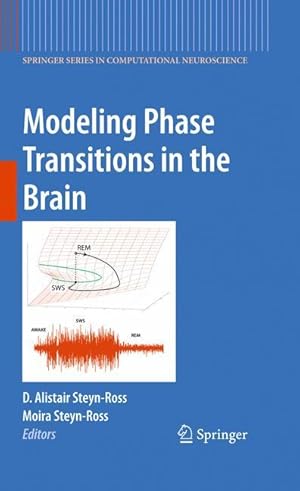
Modeling Phase Transitions in the Brain
Buch 4 von 17: Springer Series in Computational NeuroscienceEUR 180,07
EUR 48,99 Versand
Versand von Deutschland nach USAAnzahl: Mehr als 20 verfügbar
In den WarenkorbGebunden. Zustand: New. Dieser Artikel ist ein Print on Demand Artikel und wird nach Ihrer Bestellung fuer Sie gedruckt. Foreword by Walter J. FreemanPresents recent developments in EEG data analysisPlaces cortical modelling in historical contextProvides an overview of the range of modern mass-action continuum approaches used to model cortical function.
-

Modeling Phase Transitions in the Brain
Buch 4 von 17: Springer Series in Computational NeuroscienceSprache: Englisch
Verlag: Springer New York Feb 2010, 2010
ISBN 10: 1441907955 ISBN 13: 9781441907950
Anbieter: BuchWeltWeit Ludwig Meier e.K., Bergisch Gladbach, Deutschland
Verkäuferbewertung 5 von 5 Sternen
Buch. Zustand: Neu. This item is printed on demand - it takes 3-4 days longer - Neuware - Foreword by Walter J. Freeman.The induction of unconsciousness using anesthetic agents demonstrates that the cerebral cortex can operate in two very different behavioral modes: alert and responsive vs. unaware and quiescent. But the states of wakefulness and sleep are not single-neuron properties---they emerge as bulk properties of cooperating populations of neurons, with the switchover between states being similar to the physical change of phase observed when water freezes or ice melts. Some brain-state transitions, such as sleep cycling, anesthetic induction, epileptic seizure, are obvious and detected readily with a few EEG electrodes; others, such as the emergence of gamma rhythms during cognition, or the ultra-slow BOLD rhythms of relaxed free-association, are much more subtle. The unifying theme of this book is the notion that all of these bulk changes in brain behavior can be treated as phase transitions between distinct brain states.Modeling Phase Transitions in the Brain contains chapter contributions from leading researchers who apply state-space methods, network models, and biophysically-motivated continuum approaches to investigate a range of neuroscientifically relevant problems that include analysis of nonstationary EEG time-series; network topologies that limit epileptic spreading; saddle--node bifurcations for anesthesia, sleep-cycling, and the wake--sleep switch; prediction of dynamical and noise-induced spatiotemporal instabilities underlying BOLD, alpha-, and gamma-band Hopf oscillations, gap-junction-moderated Turing structures, and Hopf-Turing interactions leading to cortical waves. 336 pp. Englisch.
-

Modeling Phase Transitions in the Brain
Buch 4 von 17: Springer Series in Computational NeuroscienceSprache: Englisch
Verlag: Springer New York Mai 2012, 2012
ISBN 10: 1461425506 ISBN 13: 9781461425502
Anbieter: BuchWeltWeit Ludwig Meier e.K., Bergisch Gladbach, Deutschland
Verkäuferbewertung 5 von 5 Sternen
Taschenbuch. Zustand: Neu. This item is printed on demand - it takes 3-4 days longer - Neuware - Foreword by Walter J. Freeman.The induction of unconsciousness using anesthetic agents demonstrates that the cerebral cortex can operate in two very different behavioral modes: alert and responsive vs. unaware and quiescent. But the states of wakefulness and sleep are not single-neuron properties---they emerge as bulk properties of cooperating populations of neurons, with the switchover between states being similar to the physical change of phase observed when water freezes or ice melts. Some brain-state transitions, such as sleep cycling, anesthetic induction, epileptic seizure, are obvious and detected readily with a few EEG electrodes; others, such as the emergence of gamma rhythms during cognition, or the ultra-slow BOLD rhythms of relaxed free-association, are much more subtle. The unifying theme of this book is the notion that all of these bulk changes in brain behavior can be treated as phase transitions between distinct brain states.Modeling Phase Transitions in the Brain contains chapter contributions from leading researchers who apply state-space methods, network models, and biophysically-motivated continuum approaches to investigate a range of neuroscientifically relevant problems that include analysis of nonstationary EEG time-series; network topologies that limit epileptic spreading; saddle--node bifurcations for anesthesia, sleep-cycling, and the wake--sleep switch; prediction of dynamical and noise-induced spatiotemporal instabilities underlying BOLD, alpha-, and gamma-band Hopf oscillations, gap-junction-moderated Turing structures, and Hopf-Turing interactions leading to cortical waves. 336 pp. Englisch.
-

Modeling Phase Transitions in the Brain
Buch 4 von 17: Springer Series in Computational NeuroscienceSprache: Englisch
Verlag: Springer New York, Springer US Mai 2012, 2012
ISBN 10: 1461425506 ISBN 13: 9781461425502
Anbieter: buchversandmimpf2000, Emtmannsberg, BAYE, Deutschland
Verkäuferbewertung 5 von 5 Sternen
Taschenbuch. Zustand: Neu. This item is printed on demand - Print on Demand Titel. Neuware -Foreword by Walter J. Freeman.The induction of unconsciousness using anesthetic agents demonstrates that the cerebral cortex can operate in two very different behavioral modes: alert and responsive vs. unaware and quiescent. But the states of wakefulness and sleep are not single-neuron properties---they emerge as bulk properties of cooperating populations of neurons, with the switchover between states being similar to the physical change of phase observed when water freezes or ice melts. Some brain-state transitions, such as sleep cycling, anesthetic induction, epileptic seizure, are obvious and detected readily with a few EEG electrodes; others, such as the emergence of gamma rhythms during cognition, or the ultra-slow BOLD rhythms of relaxed free-association, are much more subtle. The unifying theme of this book is the notion that all of these bulk changes in brain behavior can be treated as phase transitions between distinct brain states.Modeling Phase Transitions in the Brain contains chapter contributions from leading researchers who apply state-space methods, network models, and biophysically-motivated continuum approaches to investigate a range of neuroscientifically relevant problems that include analysis of nonstationary EEG time-series; network topologies that limit epileptic spreading; saddle--node bifurcations for anesthesia, sleep-cycling, and the wake--sleep switch; prediction of dynamical and noise-induced spatiotemporal instabilities underlying BOLD, alpha-, and gamma-band Hopf oscillations, gap-junction-moderated Turing structures, and Hopf-Turing interactions leading to cortical waves.Springer Verlag GmbH, Tiergartenstr. 17, 69121 Heidelberg 336 pp. Englisch.
-
Modeling Phase Transitions in the Brain
Buch 4 von 17: Springer Series in Computational NeuroscienceAnbieter: Majestic Books, Hounslow, Vereinigtes Königreich
Verkäuferbewertung 4 von 5 Sternen
EUR 274,13
EUR 7,45 Versand
Versand von Vereinigtes Königreich nach USAAnzahl: 4 verfügbar
In den WarenkorbZustand: New. Print on Demand pp. 336 103 Illus. (24 Col.).
-
Modeling Phase Transitions in the Brain
Buch 4 von 17: Springer Series in Computational NeuroscienceAnbieter: Biblios, Frankfurt am main, HESSE, Deutschland
Verkäuferbewertung 4 von 5 Sternen
Zustand: New. PRINT ON DEMAND pp. 336.

