

Gesamtpreis (1 Artikel Artikel):
Versandziel:

nonlinear optics optical computing (11 Ergebnisse)
Direkt zu den wichtigsten Suchergebnissen
Suchfilter
Produktart
- Alle Product Types
- Bücher (11)
- Magazine & Zeitschriften (Keine weiteren Ergebnisse entsprechen dieser Verfeinerung)
- Comics (Keine weiteren Ergebnisse entsprechen dieser Verfeinerung)
- Noten (Keine weiteren Ergebnisse entsprechen dieser Verfeinerung)
- Kunst, Grafik & Poster (Keine weiteren Ergebnisse entsprechen dieser Verfeinerung)
- Fotografien (Keine weiteren Ergebnisse entsprechen dieser Verfeinerung)
- Karten (Keine weiteren Ergebnisse entsprechen dieser Verfeinerung)
- Manuskripte & Papierantiquitäten (Keine weiteren Ergebnisse entsprechen dieser Verfeinerung)
Zustand Mehr dazu
- Neu (9)
- Wie Neu, Sehr Gut oder Gut Bis Sehr Gut (1)
- Gut oder Befriedigend (1)
- Ausreichend oder Schlecht (Keine weiteren Ergebnisse entsprechen dieser Verfeinerung)
- Wie beschrieben (Keine weiteren Ergebnisse entsprechen dieser Verfeinerung)
Einband
Weitere Eigenschaften
- Erstausgabe (Keine weiteren Ergebnisse entsprechen dieser Verfeinerung)
- Signiert (Keine weiteren Ergebnisse entsprechen dieser Verfeinerung)
- Schutzumschlag (Keine weiteren Ergebnisse entsprechen dieser Verfeinerung)
- Angebotsfoto (5)
- Keine Print-on-Demand Angebote (6)
Sprache (1)
Gratisversand
Land des Verkäufers
Verkäuferbewertung
-
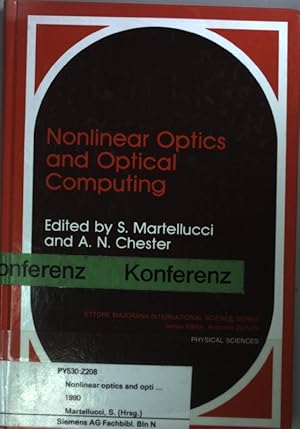
Nonlinear Optics and Optical Computing.
Anbieter: books4less (Versandantiquariat Petra Gros GmbH & Co. KG), Welling, Deutschland
Verkäuferbewertung 5 von 5 Sternen

gebundene Ausgabe. Zustand: Gut. 285 Seiten; Das hier angebotene Buch stammt aus einer teilaufgelösten wissenschaftlichen Bibliothek und trägt die entsprechenden Kennzeichnungen (Rückenschild, Instituts-Stempel.); Schnitt und Einband sind etwas staubschmutzig; der Buchzustand ist ansonsten ordentlich und dem Alter entsprechend gut. Text in ENGLISCHER Sprache! Sprache: Englisch Gewicht in Gramm: 700.
-

Nonlinear Optics and Optical Computing (Polymer Science and Technology Series)
Anbieter: California Books, Miami, FL, USA
Verkäuferbewertung 5 von 5 Sternen
Zustand: New.
-
Nonlinear Optics and Optical Computing (Polymer Science and Technology Series)
Anbieter: Ria Christie Collections, Uxbridge, Vereinigtes Königreich
Verkäuferbewertung 5 von 5 Sternen
EUR 58,73
EUR 13,86 Versand
Versand von Vereinigtes Königreich nach USAAnzahl: Mehr als 20 verfügbar
In den WarenkorbZustand: New. In.
-
Nonlinear Optics and Optical Computing
Anbieter: Chiron Media, Wallingford, Vereinigtes Königreich
Verkäuferbewertung 5 von 5 Sternen
EUR 56,86
EUR 17,91 Versand
Versand von Vereinigtes Königreich nach USAAnzahl: 10 verfügbar
In den WarenkorbPF. Zustand: New.
-

Nonlinear Optics and Optical Computing
Anbieter: AHA-BUCH GmbH, Einbeck, Deutschland
Verkäuferbewertung 5 von 5 Sternen
Taschenbuch. Zustand: Neu. Druck auf Anfrage Neuware - Printed after ordering - The conference 'Nonlinear Optics and Optical Computing' was held May 11-19, 1988 in Erice, Sicily. This was the 13th conference organized by the International School of Quantum Electronics, under the auspices of the 'Ettore Majorana' Center for Scientific Culture. This volume contains both the invited and contributed papers presented at the conference, providing tutorial background, the latest research results, and future directions for the devices, structures and architectures of optical computing. The invention of the transistor and the integrated circuit were followed by an explosion of application as ever faster and more complex microelectronics chips became available. The information revolution occa sioned by digital computers and optical communications is now reaching the limits of silicon semiconductor technology, but the demand for faster com putation is still accelerating. The fundamental limitations of information processing today derive from the performance and cost of three technical factors: speed, density, and software. Optical computation offers the potential for improvements in all three of these critical areas: Speed is provided by the transmission of impulses at optical veloc ities, without the delays caused by parasitic capacitance in the case of conventional electrical interconnects. Speed can also be achieved through the massive parallelism characteristic of many optical computing architec tures; Density can be provided in optical computers in two ways: by high spatial resolution, on the order of wavelengths of light, and by computa tion or interconnection in three dimensions.
-
Nonlinear Optics and Optical Computing (Polymer Science and Technology Series (19))
Anbieter: Mispah books, Redhill, SURRE, Vereinigtes Königreich
Verkäuferbewertung 4 von 5 Sternen

EUR 107,21
EUR 28,91 Versand
Versand von Vereinigtes Königreich nach USAAnzahl: 1 verfügbar
In den WarenkorbPaperback. Zustand: Like New. Like New. book.
-
Nonlinear Optics and Optical Computing, (eng)
Anbieter: Brook Bookstore On Demand, Napoli, NA, Italien
Verkäuferbewertung 4 von 5 Sternen
EUR 46,22
EUR 6,80 Versand
Versand von Italien nach USAAnzahl: Mehr als 20 verfügbar
In den WarenkorbZustand: new. Questo è un articolo print on demand.
-

Nonlinear Optics and Optical Computing
Sprache: Englisch
Verlag: Humana, Springer Apr 2013, 2013
ISBN 10: 1461279003 ISBN 13: 9781461279006
Anbieter: BuchWeltWeit Ludwig Meier e.K., Bergisch Gladbach, Deutschland
Verkäuferbewertung 5 von 5 Sternen
Taschenbuch. Zustand: Neu. This item is printed on demand - it takes 3-4 days longer - Neuware -The conference 'Nonlinear Optics and Optical Computing' was held May 11-19, 1988 in Erice, Sicily. This was the 13th conference organized by the International School of Quantum Electronics, under the auspices of the 'Ettore Majorana' Center for Scientific Culture. This volume contains both the invited and contributed papers presented at the conference, providing tutorial background, the latest research results, and future directions for the devices, structures and architectures of optical computing. The invention of the transistor and the integrated circuit were followed by an explosion of application as ever faster and more complex microelectronics chips became available. The information revolution occa sioned by digital computers and optical communications is now reaching the limits of silicon semiconductor technology, but the demand for faster com putation is still accelerating. The fundamental limitations of information processing today derive from the performance and cost of three technical factors: speed, density, and software. Optical computation offers the potential for improvements in all three of these critical areas: Speed is provided by the transmission of impulses at optical veloc ities, without the delays caused by parasitic capacitance in the case of conventional electrical interconnects. Speed can also be achieved through the massive parallelism characteristic of many optical computing architec tures; Density can be provided in optical computers in two ways: by high spatial resolution, on the order of wavelengths of light, and by computa tion or interconnection in three dimensions. 296 pp. Englisch.
-
Nonlinear Optics and Optical Computing
Sprache: Englisch
Verlag: Springer-Verlag New York Inc., 2013
ISBN 10: 1461279003 ISBN 13: 9781461279006
Anbieter: THE SAINT BOOKSTORE, Southport, Vereinigtes Königreich
Verkäuferbewertung 5 von 5 Sternen
EUR 68,47
EUR 19,16 Versand
Versand von Vereinigtes Königreich nach USAAnzahl: Mehr als 20 verfügbar
In den WarenkorbPaperback / softback. Zustand: New. This item is printed on demand. New copy - Usually dispatched within 5-9 working days.
-

EUR 48,37
EUR 48,99 Versand
Versand von Deutschland nach USAAnzahl: Mehr als 20 verfügbar
In den WarenkorbZustand: New. Dieser Artikel ist ein Print on Demand Artikel und wird nach Ihrer Bestellung fuer Sie gedruckt. The conference Nonlinear Optics and Optical Computing was held May 11-19, 1988 in Erice, Sicily. This was the 13th conference organized by the International School of Quantum Electronics, under the auspices of the Ettore Majorana Center for Scientific C.
-

Nonlinear Optics and Optical Computing
Sprache: Englisch
Verlag: Springer US, Springer New York Apr 2013, 2013
ISBN 10: 1461279003 ISBN 13: 9781461279006
Anbieter: buchversandmimpf2000, Emtmannsberg, BAYE, Deutschland
Verkäuferbewertung 5 von 5 Sternen
Taschenbuch. Zustand: Neu. This item is printed on demand - Print on Demand Titel. Neuware -The conference 'Nonlinear Optics and Optical Computing' was held May 11-19, 1988 in Erice, Sicily. This was the 13th conference organized by the International School of Quantum Electronics, under the auspices of the 'Ettore Majorana' Center for Scientific Culture. This volume contains both the invited and contributed papers presented at the conference, providing tutorial background, the latest research results, and future directions for the devices, structures and architectures of optical computing. The invention of the transistor and the integrated circuit were followed by an explosion of application as ever faster and more complex microelectronics chips became available. The information revolution occa sioned by digital computers and optical communications is now reaching the limits of silicon semiconductor technology, but the demand for faster com putation is still accelerating. The fundamental limitations of information processing today derive from the performance and cost of three technical factors: speed, density, and software. Optical computation offers the potential for improvements in all three of these critical areas: Speed is provided by the transmission of impulses at optical veloc ities, without the delays caused by parasitic capacitance in the case of conventional electrical interconnects. Speed can also be achieved through the massive parallelism characteristic of many optical computing architec tures; Density can be provided in optical computers in two ways: by high spatial resolution, on the order of wavelengths of light, and by computa tion or interconnection in three dimensions.Springer Verlag GmbH, Tiergartenstr. 17, 69121 Heidelberg 296 pp. Englisch.

