

Gesamtpreis (1 Artikel Artikel):
Versandziel:

syntax semantics prepositions (19 Ergebnisse)
Direkt zu den wichtigsten Suchergebnissen
Suchfilter
Produktart
- Alle Product Types
- Bücher (19)
- Magazine & Zeitschriften (Keine weiteren Ergebnisse entsprechen dieser Verfeinerung)
- Comics (Keine weiteren Ergebnisse entsprechen dieser Verfeinerung)
- Noten (Keine weiteren Ergebnisse entsprechen dieser Verfeinerung)
- Kunst, Grafik & Poster (Keine weiteren Ergebnisse entsprechen dieser Verfeinerung)
- Fotografien (Keine weiteren Ergebnisse entsprechen dieser Verfeinerung)
- Karten (Keine weiteren Ergebnisse entsprechen dieser Verfeinerung)
- Manuskripte & Papierantiquitäten (Keine weiteren Ergebnisse entsprechen dieser Verfeinerung)
Zustand Mehr dazu
- Neu (13)
- Wie Neu, Sehr Gut oder Gut Bis Sehr Gut (4)
- Gut oder Befriedigend (Keine weiteren Ergebnisse entsprechen dieser Verfeinerung)
- Ausreichend oder Schlecht (Keine weiteren Ergebnisse entsprechen dieser Verfeinerung)
- Wie beschrieben (2)
Einband
Weitere Eigenschaften
- Erstausgabe (Keine weiteren Ergebnisse entsprechen dieser Verfeinerung)
- Signiert (Keine weiteren Ergebnisse entsprechen dieser Verfeinerung)
- Schutzumschlag (Keine weiteren Ergebnisse entsprechen dieser Verfeinerung)
- Angebotsfoto (15)
- Keine Print-on-Demand Angebote (15)
Sprache (2)
Gratisversand
- Kostenloser Versand nach USA (Keine weiteren Ergebnisse entsprechen dieser Verfeinerung)
Land des Verkäufers
Verkäuferbewertung
-

Prepositions in Old and Middle English: A Study of Prepositional Syntax and the Semantics of At, in and on in Some Old and Middle English Texts
Anbieter: Revaluation Books, Exeter, Vereinigtes Königreich
Verkäuferbewertung 5 von 5 Sternen

EUR 33,18
EUR 11,51 Versand
Versand von Vereinigtes Königreich nach USAAnzahl: 1 verfügbar
In den WarenkorbPaperback. Zustand: Brand New. 203 pages. 8.25x5.75x0.75 inches. In Stock.
-

Syntax and Semantics of Prepositions (Text, Speech and Language Technology, 29).
Anbieter: Universitätsbuchhandlung Herta Hold GmbH, Berlin, Deutschland
Verbandsmitglied: GIAQ ILAB VDA
Verkäuferbewertung 4 von 5 Sternen

2006th ed. 16 x 23 cm. 346 pages. Hardcover. Versand aus Deutschland / We dispatch from Germany via Air Mail. Einband bestoßen, daher Mängelexemplar gestempelt, sonst sehr guter Zustand. Imperfect copy due to slightly bumped cover, apart from this in very good condition. Stamped. Sprache: Englisch.
-

LINGUISTICS AND PHILOSOPHY. Volume 2. No. 1. 1978. M. J. CRESWELL / Prepositions and Points of View. CARLOTA S. SMITH / The Syntax and Interpretations of Temporal Expressions in English. JOHN C. BIGELOW / Believing in Semantics. EMMON BACH and ROBIN COOPER / The NP-S Analysis of Relative Clauses and Compositional Semantics.
Verlag: D. Reidel Publishing Company, 1978, Boston., 1978
Anbieter: Librería y Editorial Renacimiento, S.A., VALENCINA DE LA CONCEPCIÓN, SE, Spanien
Verbandsmitglied: SEVILLA
Verkäuferbewertung 5 von 5 Sternen
24x16. Tapa blanda. 145 pgs. Sello en portada. Texto en inglés. 680702.
-

Syntax and Semantics of Prepositions (Text, Speech and Language Technology)
Anbieter: Vulkaneifel Bücher, Birgel, Deutschland
Verkäuferbewertung 5 von 5 Sternen
Paperback. Zustand: Sehr gut. kleine Lagerspuren am Buch, Inhalt einwandfrei und ungelesen Sprache: Englisch Gewicht in Gramm: 565.
-

Syntax and Semantics of Prepositions (Text, Speech and Language Technology, 29)
Anbieter: Ria Christie Collections, Uxbridge, Vereinigtes Königreich
Verkäuferbewertung 5 von 5 Sternen
EUR 159,17
EUR 13,78 Versand
Versand von Vereinigtes Königreich nach USAAnzahl: Mehr als 20 verfügbar
In den WarenkorbZustand: New. In.
-

Syntax and Semantics of Prepositions
Anbieter: GreatBookPrices, Columbia, MD, USA
Verkäuferbewertung 5 von 5 Sternen
EUR 175,78
EUR 2,28 Versand
Versand innerhalb von USAAnzahl: Mehr als 20 verfügbar
In den WarenkorbZustand: New.
-

Syntax and Semantics of Prepositions
Anbieter: Chiron Media, Wallingford, Vereinigtes Königreich
Verkäuferbewertung 5 von 5 Sternen
EUR 162,01
EUR 17,82 Versand
Versand von Vereinigtes Königreich nach USAAnzahl: 10 verfügbar
In den WarenkorbPF. Zustand: New.
-

Syntax and Semantics of Prepositions
Anbieter: GreatBookPrices, Columbia, MD, USA
Verkäuferbewertung 5 von 5 Sternen
EUR 179,46
EUR 2,28 Versand
Versand innerhalb von USAAnzahl: Mehr als 20 verfügbar
In den WarenkorbZustand: As New. Unread book in perfect condition.
-

Syntax and Semantics of Prepositions
Anbieter: GreatBookPricesUK, Woodford Green, Vereinigtes Königreich
Verkäuferbewertung 5 von 5 Sternen
EUR 164,95
EUR 17,26 Versand
Versand von Vereinigtes Königreich nach USAAnzahl: Mehr als 20 verfügbar
In den WarenkorbZustand: New.
-

Syntax and Semantics of Prepositions
Anbieter: GreatBookPricesUK, Woodford Green, Vereinigtes Königreich
Verkäuferbewertung 5 von 5 Sternen
EUR 180,53
EUR 17,26 Versand
Versand von Vereinigtes Königreich nach USAAnzahl: Mehr als 20 verfügbar
In den WarenkorbZustand: As New. Unread book in perfect condition.
-
Taschenbuch. Zustand: Neu. Syntax and Semantics of Prepositions | Patrick Saint-Dizier | Taschenbuch | xiv | Englisch | 2007 | Springer | EAN 9781402038990 | Verantwortliche Person für die EU: Springer Verlag GmbH, Tiergartenstr. 17, 69121 Heidelberg, juergen[dot]hartmann[at]springer[dot]com | Anbieter: preigu.
-

Syntax and Semantics of Prepositions
Sprache: Englisch
Verlag: Springer Netherlands, Springer Netherlands Jan 2006, 2006
ISBN 10: 1402038496 ISBN 13: 9781402038495
Anbieter: buchversandmimpf2000, Emtmannsberg, BAYE, Deutschland
Verkäuferbewertung 5 von 5 Sternen
Buch. Zustand: Neu. Neuware -A great deal of attention has been devoted in the past ten years in the lingu- tic and computational linguistics communities to the syntax and the semantics of nouns, verbs and also, but to a lesser extent, to adjectives. Related p- nomena such as quanti cation or tense and aspect have motivated a number of in-depth studies and projects. In contrast, prepositions have received less attention. The reasons are quite clear: prepositions are highly polysemic, p- sibly more so than adjectives, and linguistic realizations are extremely dif cult to predict, not to mention the dif culty of identifying cross-linguistic regula- ties. Furthermore, a number of languages do not use prepositions or postpo- tions (or make a limited use of them) and prefer other linguistic forms such as morphological marks, e. g. case marks. Let us mention, however, projects devoted to prepositions expressing space, time and movement in arti cial intelligence and in natural language processing, and also the development of formalisms and heuristics to handle prepositional phrase attachment ambiguities. Prepositions are also present in subcategorization frames of predicative lexical items, but often in an informal and coarse-grained way. Let us also mention the large number of studies in psycholinguistics and in ethnolinguistics around speci c preposition senses. Finally, prepositions seem to reach a very deep level in the cognitive-semantic structure of the brain: cognitive grammar developers often use prepositions in their metalanguage, in order to express very primitive notions.Springer Verlag GmbH, Tiergartenstr. 17, 69121 Heidelberg 348 pp. Englisch.
-

Syntax and Semantics of Prepositions
Sprache: Englisch
Verlag: Springer Netherlands, Springer Netherlands, 2006
ISBN 10: 1402038496 ISBN 13: 9781402038495
Anbieter: AHA-BUCH GmbH, Einbeck, Deutschland
Verkäuferbewertung 5 von 5 Sternen
Buch. Zustand: Neu. Druck auf Anfrage Neuware - Printed after ordering - A great deal of attention has been devoted in the past ten years in the lingu- tic and computational linguistics communities to the syntax and the semantics of nouns, verbs and also, but to a lesser extent, to adjectives. Related p- nomena such as quanti cation or tense and aspect have motivated a number of in-depth studies and projects. In contrast, prepositions have received less attention. The reasons are quite clear: prepositions are highly polysemic, p- sibly more so than adjectives, and linguistic realizations are extremely dif cult to predict, not to mention the dif culty of identifying cross-linguistic regula- ties. Furthermore, a number of languages do not use prepositions or postpo- tions (or make a limited use of them) and prefer other linguistic forms such as morphological marks, e. g. case marks. Let us mention, however, projects devoted to prepositions expressing space, time and movement in arti cial intelligence and in natural language processing, and also the development of formalisms and heuristics to handle prepositional phrase attachment ambiguities. Prepositions are also present in subcategorization frames of predicative lexical items, but often in an informal and coarse-grained way. Let us also mention the large number of studies in psycholinguistics and in ethnolinguistics around speci c preposition senses. Finally, prepositions seem to reach a very deep level in the cognitive-semantic structure of the brain: cognitive grammar developers often use prepositions in their metalanguage, in order to express very primitive notions.
-

Syntax and Semantics of Prepositions
Anbieter: AHA-BUCH GmbH, Einbeck, Deutschland
Verkäuferbewertung 5 von 5 Sternen
Taschenbuch. Zustand: Neu. Druck auf Anfrage Neuware - Printed after ordering - A great deal of attention has been devoted in the past ten years in the lingu- tic and computational linguistics communities to the syntax and the semantics of nouns, verbs and also, but to a lesser extent, to adjectives. Related p- nomena such as quanti cation or tense and aspect have motivated a number of in-depth studies and projects. In contrast, prepositions have received less attention. The reasons are quite clear: prepositions are highly polysemic, p- sibly more so than adjectives, and linguistic realizations are extremely dif cult to predict, not to mention the dif culty of identifying cross-linguistic regula- ties. Furthermore, a number of languages do not use prepositions or postpo- tions (or make a limited use of them) and prefer other linguistic forms such as morphological marks, e. g. case marks. Let us mention, however, projects devoted to prepositions expressing space, time and movement in arti cial intelligence and in natural language processing, and also the development of formalisms and heuristics to handle prepositional phrase attachment ambiguities. Prepositions are also present in subcategorization frames of predicative lexical items, but often in an informal and coarse-grained way. Let us also mention the large number of studies in psycholinguistics and in ethnolinguistics around speci c preposition senses. Finally, prepositions seem to reach a very deep level in the cognitive-semantic structure of the brain: cognitive grammar developers often use prepositions in their metalanguage, in order to express very primitive notions.
-
Syntax and Semantics of Prepositions (Text, Speech and Language Technology)
Anbieter: Mispah books, Redhill, SURRE, Vereinigtes Königreich
Verkäuferbewertung 4 von 5 Sternen
EUR 247,69
EUR 28,77 Versand
Versand von Vereinigtes Königreich nach USAAnzahl: 1 verfügbar
In den WarenkorbHardcover. Zustand: Like New. Like New. book.
-

Syntax and Semantics of Prepositions
Anbieter: BuchWeltWeit Ludwig Meier e.K., Bergisch Gladbach, Deutschland
Verkäuferbewertung 5 von 5 Sternen
Taschenbuch. Zustand: Neu. This item is printed on demand - it takes 3-4 days longer - Neuware -A great deal of attention has been devoted in the past ten years in the lingu- tic and computational linguistics communities to the syntax and the semantics of nouns, verbs and also, but to a lesser extent, to adjectives. Related p- nomena such as quanti cation or tense and aspect have motivated a number of in-depth studies and projects. In contrast, prepositions have received less attention. The reasons are quite clear: prepositions are highly polysemic, p- sibly more so than adjectives, and linguistic realizations are extremely dif cult to predict, not to mention the dif culty of identifying cross-linguistic regula- ties. Furthermore, a number of languages do not use prepositions or postpo- tions (or make a limited use of them) and prefer other linguistic forms such as morphological marks, e. g. case marks. Let us mention, however, projects devoted to prepositions expressing space, time and movement in arti cial intelligence and in natural language processing, and also the development of formalisms and heuristics to handle prepositional phrase attachment ambiguities. Prepositions are also present in subcategorization frames of predicative lexical items, but often in an informal and coarse-grained way. Let us also mention the large number of studies in psycholinguistics and in ethnolinguistics around speci c preposition senses. Finally, prepositions seem to reach a very deep level in the cognitive-semantic structure of the brain: cognitive grammar developers often use prepositions in their metalanguage, in order to express very primitive notions. 332 pp. Englisch.
-
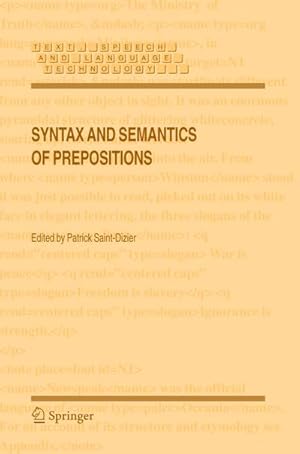
Syntax and Semantics of Prepositions
Sprache: Englisch
Verlag: Springer Netherlands Jan 2006, 2006
ISBN 10: 1402038496 ISBN 13: 9781402038495
Anbieter: BuchWeltWeit Ludwig Meier e.K., Bergisch Gladbach, Deutschland
Verkäuferbewertung 5 von 5 Sternen
Buch. Zustand: Neu. This item is printed on demand - it takes 3-4 days longer - Neuware -This is the first book to provide an integrated view of preposition from morphology to reasoning, via syntax and semantics. It offers new insights in applied and formal linguistics, and cognitive science. It underlines the importance of prepositions in a number of computational linguistics applications, such as information retrieval and machine translation. The book presents a wide range of views and applications to various linguistic frameworks. 348 pp. Englisch.
-

EUR 136,16
EUR 48,99 Versand
Versand von Deutschland nach USAAnzahl: Mehr als 20 verfügbar
In den WarenkorbGebunden. Zustand: New. Dieser Artikel ist ein Print on Demand Artikel und wird nach Ihrer Bestellung fuer Sie gedruckt. The first to provide an integrated view of preposition from morphology to reasoning, via syntax and semanticsProvides new insights in applied and formal linguistics, and in cognitive scienceUnderlines the importance of prepositions in a num.
-

EUR 149,75
EUR 48,99 Versand
Versand von Deutschland nach USAAnzahl: Mehr als 20 verfügbar
In den WarenkorbZustand: New. Dieser Artikel ist ein Print on Demand Artikel und wird nach Ihrer Bestellung fuer Sie gedruckt. The first to provide an integrated view of preposition from morphology to reasoning, via syntax and semanticsProvides new insights in applied and formal linguistics, and in cognitive scienceUnderlines the importance of prepositions in a num.


