Gesamtpreis (1 Artikel Artikel):
Versandziel:

valuing environment methodological measurement issues von pethig rüdiger (17 Ergebnisse)
Direkt zu den wichtigsten Suchergebnissen
Suchfilter
Produktart
- Alle Product Types
- Bücher (17)
- Magazine & Zeitschriften (Keine weiteren Ergebnisse entsprechen dieser Verfeinerung)
- Comics (Keine weiteren Ergebnisse entsprechen dieser Verfeinerung)
- Noten (Keine weiteren Ergebnisse entsprechen dieser Verfeinerung)
- Kunst, Grafik & Poster (Keine weiteren Ergebnisse entsprechen dieser Verfeinerung)
- Fotografien (Keine weiteren Ergebnisse entsprechen dieser Verfeinerung)
- Karten (Keine weiteren Ergebnisse entsprechen dieser Verfeinerung)
- Manuskripte & Papierantiquitäten (Keine weiteren Ergebnisse entsprechen dieser Verfeinerung)
Zustand Mehr dazu
- Neu (14)
- Wie Neu, Sehr Gut oder Gut Bis Sehr Gut (1)
- Gut oder Befriedigend (2)
- Ausreichend oder Schlecht (Keine weiteren Ergebnisse entsprechen dieser Verfeinerung)
- Wie beschrieben (Keine weiteren Ergebnisse entsprechen dieser Verfeinerung)
Einband
Weitere Eigenschaften
- Erstausgabe (1)
- Signiert (Keine weiteren Ergebnisse entsprechen dieser Verfeinerung)
- Schutzumschlag (Keine weiteren Ergebnisse entsprechen dieser Verfeinerung)
- Angebotsfoto (11)
- Keine Print-on-Demand Angebote (11)
Sprache (1)
Preis
- Beliebiger Preis
- Weniger als EUR 20 (Keine weiteren Ergebnisse entsprechen dieser Verfeinerung)
- EUR 20 bis EUR 40
- Mehr als EUR 40
Gratisversand
- Kostenloser Versand nach USA (Keine weiteren Ergebnisse entsprechen dieser Verfeinerung)
Land des Verkäufers
Verkäuferbewertung
-
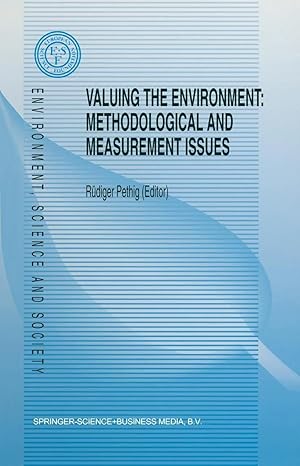
Valuing the Environment: Methodological and Measurement Issues (Environment, Science and Society)
Sprache: Englisch
Verlag: Dordrecht, Kluwer Academ. Publ., 1996
Anbieter: Antiquariat Thomas Haker GmbH & Co. KG, Berlin, Deutschland
Verbandsmitglied: GIAQ
Verkäuferbewertung 5 von 5 Sternen

Erstausgabe
Hardcover / Pappeinband. Zustand: Sehr gut. 1st ed. 348 Seiten Ex.-Libr., Very good condition. Sprache: Englisch Gewicht in Gramm: 800.
-

Valuing the Environment: Methodological and Measurement Issues (Environment, Science and Society, 2)
Anbieter: Phatpocket Limited, Waltham Abbey, HERTS, Vereinigtes Königreich
Verkäuferbewertung 5 von 5 Sternen
EUR 105,32
EUR 12,23 Versand
Versand von Vereinigtes Königreich nach USAAnzahl: 1 verfügbar
In den WarenkorbZustand: Good. Your purchase helps support Sri Lankan Children's Charity 'The Rainbow Centre'. Ex-library, so some stamps and wear, but in good overall condition. Our donations to The Rainbow Centre have helped provide an education and a safe haven to hundreds of children who live in appalling conditions.
-
Valuing the Environment: Methodological and Measurement Issues (Environment, Science and Society)
Anbieter: Penn and Ink Used and Rare Books, Vancouver, WA, USA
Verkäuferbewertung 1 von 5 Sternen

Hardcover. Zustand: Very Good. VG, light shelfwear.
-

EUR 180,07
EUR 48,99 Versand
Versand von Deutschland nach USAAnzahl: Mehr als 20 verfügbar
In den WarenkorbZustand: New.
-

EUR 180,07
EUR 48,99 Versand
Versand von Deutschland nach USAAnzahl: Mehr als 20 verfügbar
In den WarenkorbGebunden. Zustand: New.
-

Valuing the Environment: Methodological and Measurement Issues: Methodological and Measurement Issues (Environment, Science and Society)
Anbieter: Ria Christie Collections, Uxbridge, Vereinigtes Königreich
Verkäuferbewertung 5 von 5 Sternen
EUR 222,12
EUR 13,77 Versand
Versand von Vereinigtes Königreich nach USAAnzahl: Mehr als 20 verfügbar
In den WarenkorbZustand: New. In.
-
Valuing the Environment: Methodological and Measurement Issues (Environment, Science and Society, 2)
Anbieter: Ria Christie Collections, Uxbridge, Vereinigtes Königreich
Verkäuferbewertung 5 von 5 Sternen
EUR 222,12
EUR 13,77 Versand
Versand von Vereinigtes Königreich nach USAAnzahl: Mehr als 20 verfügbar
In den WarenkorbZustand: New. In.
-
Taschenbuch. Zustand: Neu. Valuing the Environment: Methodological and Measurement Issues | Rüdiger Pethig | Taschenbuch | xxii | Englisch | 2010 | Springer | EAN 9789048143450 | Verantwortliche Person für die EU: Springer Verlag GmbH, Tiergartenstr. 17, 69121 Heidelberg, juergen[dot]hartmann[at]springer[dot]com | Anbieter: preigu.
-

Valuing the Environment: Methodological and Measurement Issues
Anbieter: AHA-BUCH GmbH, Einbeck, Deutschland
Verkäuferbewertung 5 von 5 Sternen
Taschenbuch. Zustand: Neu. Druck auf Anfrage Neuware - Printed after ordering - During the last decades, environmental economics as a science has been very successful in improving our understanding of environment-economy interdepen dence. Using conventional economic methodology, environmental aspects have been explicitly incorporated into economic models making use of the concept of externality. This concept was already familiar to economists long before evidence of severe environmental deterioration found its way into the headlines and peo ple's awareness. But before that time, external effects were not considered as being empirically very relevant, they seemed to be -like the example of the bees and the fruit trees - somewhat bucolic in nature. All that changed dramatically when it was no longer possible (or easy) to ignore the large-scale environmental disruption with its negative feedback on consumers and producers caused by growing pollution and excessive use of environmental resources. In diagnosing the discrepancy between private and social cost as the cause of the problem, the externality paradigm proved very useful. The correct diagnosis implies the straightforward cure to internalise all external cost, namely the damage cost of pollution. But it is one thing to identify the qualitative nature of the problem at an abstract conceptual level and quite another thing to place specific money values on pollution damage and society's valuation of the environment, respectively, in the context of specific pollution (control) problems. Very often it is controversial not only how inefficient the no-policy situation is but also what exactly the net benefit of any public action of reducing pollution is.
-

Valuing the Environment: Methodological and Measurement Issues
Sprache: Englisch
Verlag: Springer Netherlands, Springer Netherlands, 1994
ISBN 10: 0792326024 ISBN 13: 9780792326021
Anbieter: AHA-BUCH GmbH, Einbeck, Deutschland
Verkäuferbewertung 5 von 5 Sternen
Buch. Zustand: Neu. Druck auf Anfrage Neuware - Printed after ordering - During the last decades, environmental economics as a science has been very successful in improving our understanding of environment-economy interdepen dence. Using conventional economic methodology, environmental aspects have been explicitly incorporated into economic models making use of the concept of externality. This concept was already familiar to economists long before evidence of severe environmental deterioration found its way into the headlines and peo ple's awareness. But before that time, external effects were not considered as being empirically very relevant, they seemed to be -like the example of the bees and the fruit trees - somewhat bucolic in nature. All that changed dramatically when it was no longer possible (or easy) to ignore the large-scale environmental disruption with its negative feedback on consumers and producers caused by growing pollution and excessive use of environmental resources. In diagnosing the discrepancy between private and social cost as the cause of the problem, the externality paradigm proved very useful. The correct diagnosis implies the straightforward cure to internalise all external cost, namely the damage cost of pollution. But it is one thing to identify the qualitative nature of the problem at an abstract conceptual level and quite another thing to place specific money values on pollution damage and society's valuation of the environment, respectively, in the context of specific pollution (control) problems. Very often it is controversial not only how inefficient the no-policy situation is but also what exactly the net benefit of any public action of reducing pollution is.
-
Valuing the Environment: Methodological and Measurement Issues (Environment, Science and Society)
Anbieter: Revaluation Books, Exeter, Vereinigtes Königreich
Verkäuferbewertung 5 von 5 Sternen
EUR 295,87
EUR 14,37 Versand
Versand von Vereinigtes Königreich nach USAAnzahl: 2 verfügbar
In den WarenkorbPaperback. Zustand: Brand New. 372 pages. 9.25x6.10x0.84 inches. In Stock.
-
Valuing the Environment: Methodological and Measurement Issues (eng)
Anbieter: Brook Bookstore On Demand, Napoli, NA, Italien
Verkäuferbewertung 4 von 5 Sternen

EUR 166,29
EUR 6,80 Versand
Versand von Italien nach USAAnzahl: Mehr als 20 verfügbar
In den WarenkorbZustand: new. Questo è un articolo print on demand.
-

Valuing the Environment: Methodological and Measurement Issues
Sprache: Englisch
Verlag: Springer Netherlands Dez 2010, 2010
ISBN 10: 9048143454 ISBN 13: 9789048143450
Anbieter: BuchWeltWeit Ludwig Meier e.K., Bergisch Gladbach, Deutschland
Verkäuferbewertung 5 von 5 Sternen
Taschenbuch. Zustand: Neu. This item is printed on demand - it takes 3-4 days longer - Neuware -During the last decades, environmental economics as a science has been very successful in improving our understanding of environment-economy interdepen dence. Using conventional economic methodology, environmental aspects have been explicitly incorporated into economic models making use of the concept of externality. This concept was already familiar to economists long before evidence of severe environmental deterioration found its way into the headlines and peo ple's awareness. But before that time, external effects were not considered as being empirically very relevant, they seemed to be -like the example of the bees and the fruit trees - somewhat bucolic in nature. All that changed dramatically when it was no longer possible (or easy) to ignore the large-scale environmental disruption with its negative feedback on consumers and producers caused by growing pollution and excessive use of environmental resources. In diagnosing the discrepancy between private and social cost as the cause of the problem, the externality paradigm proved very useful. The correct diagnosis implies the straightforward cure to internalise all external cost, namely the damage cost of pollution. But it is one thing to identify the qualitative nature of the problem at an abstract conceptual level and quite another thing to place specific money values on pollution damage and society's valuation of the environment, respectively, in the context of specific pollution (control) problems. Very often it is controversial not only how inefficient the no-policy situation is but also what exactly the net benefit of any public action of reducing pollution is. 372 pp. Englisch.
-
Valuing the Environment: Methodological and Measurement Issues
Sprache: Englisch
Verlag: Springer Netherlands Jun 1994, 1994
ISBN 10: 0792326024 ISBN 13: 9780792326021
Anbieter: BuchWeltWeit Ludwig Meier e.K., Bergisch Gladbach, Deutschland
Verkäuferbewertung 5 von 5 Sternen
Buch. Zustand: Neu. This item is printed on demand - it takes 3-4 days longer - Neuware -During the last decades, environmental economics as a science has been very successful in improving our understanding of environment-economy interdepen dence. Using conventional economic methodology, environmental aspects have been explicitly incorporated into economic models making use of the concept of externality. This concept was already familiar to economists long before evidence of severe environmental deterioration found its way into the headlines and peo ple's awareness. But before that time, external effects were not considered as being empirically very relevant, they seemed to be -like the example of the bees and the fruit trees - somewhat bucolic in nature. All that changed dramatically when it was no longer possible (or easy) to ignore the large-scale environmental disruption with its negative feedback on consumers and producers caused by growing pollution and excessive use of environmental resources. In diagnosing the discrepancy between private and social cost as the cause of the problem, the externality paradigm proved very useful. The correct diagnosis implies the straightforward cure to internalise all external cost, namely the damage cost of pollution. But it is one thing to identify the qualitative nature of the problem at an abstract conceptual level and quite another thing to place specific money values on pollution damage and society's valuation of the environment, respectively, in the context of specific pollution (control) problems. Very often it is controversial not only how inefficient the no-policy situation is but also what exactly the net benefit of any public action of reducing pollution is. 372 pp. Englisch.
-
Buch. Zustand: Neu. Valuing the Environment: Methodological and Measurement Issues | Rüdiger Pethig | Buch | xxii | Englisch | 1994 | Springer Netherland | EAN 9780792326021 | Verantwortliche Person für die EU: Springer Verlag GmbH, Tiergartenstr. 17, 69121 Heidelberg, juergen[dot]hartmann[at]springer[dot]com | Anbieter: preigu Print on Demand.
-

Valuing the Environment: Methodological and Measurement Issues
Sprache: Englisch
Verlag: Springer Netherlands, Springer Netherlands Jun 1994, 1994
ISBN 10: 0792326024 ISBN 13: 9780792326021
Anbieter: buchversandmimpf2000, Emtmannsberg, BAYE, Deutschland
Verkäuferbewertung 5 von 5 Sternen
Buch. Zustand: Neu. This item is printed on demand - Print on Demand Titel. Neuware -During the last decades, environmental economics as a science has been very successful in improving our understanding of environment-economy interdepen dence. Using conventional economic methodology, environmental aspects have been explicitly incorporated into economic models making use of the concept of externality. This concept was already familiar to economists long before evidence of severe environmental deterioration found its way into the headlines and peo ple's awareness. But before that time, external effects were not considered as being empirically very relevant, they seemed to be -like the example of the bees and the fruit trees - somewhat bucolic in nature. All that changed dramatically when it was no longer possible (or easy) to ignore the large-scale environmental disruption with its negative feedback on consumers and producers caused by growing pollution and excessive use of environmental resources. In diagnosing the discrepancy between private and social cost as the cause of the problem, the externality paradigm proved very useful. The correct diagnosis implies the straightforward cure to internalise all external cost, namely the damage cost of pollution. But it is one thing to identify the qualitative nature of the problem at an abstract conceptual level and quite another thing to place specific money values on pollution damage and society's valuation of the environment, respectively, in the context of specific pollution (control) problems. Very often it is controversial not only how inefficient the no-policy situation is but also what exactly the net benefit of any public action of reducing pollution is.Springer Verlag GmbH, Tiergartenstr. 17, 69121 Heidelberg 372 pp. Englisch.
-

Valuing the Environment: Methodological and Measurement Issues
Sprache: Englisch
Verlag: Springer Netherlands, Springer Netherlands Dez 2010, 2010
ISBN 10: 9048143454 ISBN 13: 9789048143450
Anbieter: buchversandmimpf2000, Emtmannsberg, BAYE, Deutschland
Verkäuferbewertung 5 von 5 Sternen
Taschenbuch. Zustand: Neu. This item is printed on demand - Print on Demand Titel. Neuware -During the last decades, environmental economics as a science has been very successful in improving our understanding of environment-economy interdepen dence. Using conventional economic methodology, environmental aspects have been explicitly incorporated into economic models making use of the concept of externality. This concept was already familiar to economists long before evidence of severe environmental deterioration found its way into the headlines and peo ple's awareness. But before that time, external effects were not considered as being empirically very relevant, they seemed to be -like the example of the bees and the fruit trees - somewhat bucolic in nature. All that changed dramatically when it was no longer possible (or easy) to ignore the large-scale environmental disruption with its negative feedback on consumers and producers caused by growing pollution and excessive use of environmental resources. In diagnosing the discrepancy between private and social cost as the cause of the problem, the externality paradigm proved very useful. The correct diagnosis implies the straightforward cure to internalise all external cost, namely the damage cost of pollution. But it is one thing to identify the qualitative nature of the problem at an abstract conceptual level and quite another thing to place specific money values on pollution damage and society's valuation of the environment, respectively, in the context of specific pollution (control) problems. Very often it is controversial not only how inefficient the no-policy situation is but also what exactly the net benefit of any public action of reducing pollution is.Springer Verlag GmbH, Tiergartenstr. 17, 69121 Heidelberg 372 pp. Englisch.