

Gesamtpreis (1 Artikel Artikel):
Versandziel:

springer nl (979 Ergebnisse)
Direkt zu den wichtigsten Suchergebnissen
Suchfilter
Produktart
- Alle Product Types
- Bücher (979)
- Magazine & Zeitschriften (Keine weiteren Ergebnisse entsprechen dieser Verfeinerung)
- Comics (Keine weiteren Ergebnisse entsprechen dieser Verfeinerung)
- Noten (Keine weiteren Ergebnisse entsprechen dieser Verfeinerung)
- Kunst, Grafik & Poster (Keine weiteren Ergebnisse entsprechen dieser Verfeinerung)
- Fotografien (Keine weiteren Ergebnisse entsprechen dieser Verfeinerung)
- Karten (Keine weiteren Ergebnisse entsprechen dieser Verfeinerung)
- Manuskripte & Papierantiquitäten (Keine weiteren Ergebnisse entsprechen dieser Verfeinerung)
Zustand Mehr dazu
- Neu (977)
- Wie Neu, Sehr Gut oder Gut Bis Sehr Gut (1)
- Gut oder Befriedigend (Keine weiteren Ergebnisse entsprechen dieser Verfeinerung)
- Ausreichend oder Schlecht (Keine weiteren Ergebnisse entsprechen dieser Verfeinerung)
- Wie beschrieben (1)
Weitere Eigenschaften
- Erstausgabe (Keine weiteren Ergebnisse entsprechen dieser Verfeinerung)
- Signiert (Keine weiteren Ergebnisse entsprechen dieser Verfeinerung)
- Schutzumschlag (Keine weiteren Ergebnisse entsprechen dieser Verfeinerung)
- Angebotsfoto (919)
- Keine Print-on-Demand Angebote (979)
Sprache (3)
Gratisversand
Land des Verkäufers
Verkäuferbewertung
-

Paperback. Zustand: New. The idea of the symposium came during the XVllth General Assembly of the IAU at Montreal. The Working Group on Be stars adopted both the proposal of holding a meeting, and of having it at the Universitats- sternwarte Munich. The meeting was organized under the auspices of IAU Comm. 29 (Stel- lar Spectra) and the sponsorship of Comm. 45 (Stellar Classification). The Scientific Organizing Committee was composed of Mercedes Jaschek (chairman), W. Bonsack, C. de Loore, A. Feinstein, H. G. Groth, P. Harmanec, L. Houziaux, A. M. Hubert-De1p1ace, L. S. Luud, A. Slettebak and A. Underhill. The members of this committee are to be thanked for their devotion to the organization of what turned out to be a very successful meeting. The program was organized on an observational approach, comprising sessions on photometry, polarization, spectroscopy, infrared observations, rotation and binarity, X-ray observations, UV observations and mass loss, and atmospheric models. Each session started with an invited summary paper, followed by a number of contributions. The different sessions were chaired by A. Feinstein, R. Sta1io, C. de Loore, Ch. Fehrenbach, J. P. Swings, C. Jaschek, A. Sapar, G. T.Traving, M. de Groot and H. G. Groth. Upon request of the Working Group., a special session was devoted to bibliographic problems and observing campaigns. The Dean of the Faculty for Physics 0.GBP the Ludwig-Maximilians-, Universitat welcomed the participants at the beginning of the Symposium. The meeting was closed by a summary talk, delivered by . P. Snow. Softcover reprint of the original 1st ed. 1982.
-

Be STARS
Anbieter: Rarewaves.com USA, London, LONDO, Vereinigtes Königreich
Verkäuferbewertung 5 von 5 Sternen

EUR 29,79
Versand gratis
Versand von Vereinigtes Königreich nach USAAnzahl: 4 verfügbar
In den WarenkorbPaperback. Zustand: New. The idea of the symposium came during the XVllth General Assembly of the IAU at Montreal. The Working Group on Be stars adopted both the proposal of holding a meeting, and of having it at the Universitats- sternwarte Munich. The meeting was organized under the auspices of IAU Comm. 29 (Stel- lar Spectra) and the sponsorship of Comm. 45 (Stellar Classification). The Scientific Organizing Committee was composed of Mercedes Jaschek (chairman), W. Bonsack, C. de Loore, A. Feinstein, H. G. Groth, P. Harmanec, L. Houziaux, A. M. Hubert-De1p1ace, L. S. Luud, A. Slettebak and A. Underhill. The members of this committee are to be thanked for their devotion to the organization of what turned out to be a very successful meeting. The program was organized on an observational approach, comprising sessions on photometry, polarization, spectroscopy, infrared observations, rotation and binarity, X-ray observations, UV observations and mass loss, and atmospheric models. Each session started with an invited summary paper, followed by a number of contributions. The different sessions were chaired by A. Feinstein, R. Sta1io, C. de Loore, Ch. Fehrenbach, J. P. Swings, C. Jaschek, A. Sapar, G. T.Traving, M. de Groot and H. G. Groth. Upon request of the Working Group., a special session was devoted to bibliographic problems and observing campaigns. The Dean of the Faculty for Physics 0.GBP the Ludwig-Maximilians-, Universitat welcomed the participants at the beginning of the Symposium. The meeting was closed by a summary talk, delivered by . P. Snow. Softcover reprint of the original 1st ed. 1982.
-

Biomarkers and Mental Illness
Anbieter: Rarewaves.com USA, London, LONDO, Vereinigtes Königreich
Verkäuferbewertung 5 von 5 Sternen
EUR 31,36
Versand gratis
Versand von Vereinigtes Königreich nach USAAnzahl: Mehr als 20 verfügbar
In den WarenkorbPaperback. Zustand: New. Softcover reprint of the original 1st ed. 2017.
-
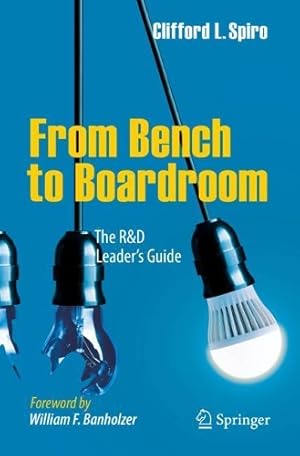
From Bench to Boardroom
Anbieter: Rarewaves.com USA, London, LONDO, Vereinigtes Königreich
Verkäuferbewertung 5 von 5 Sternen
EUR 34,49
Versand gratis
Versand von Vereinigtes Königreich nach USAAnzahl: 1 verfügbar
In den WarenkorbPaperback. Zustand: New. 1st ed. 2018. This must-read guide offers a practical and engaging introduction to the ins and outs of RandD leadership. Innovation is a two-trillion-dollar industry, and, on top of the baseline complexity faced by any manager, the RandD or Innovation leader confronts an additional set of challenges.Armed with years of experience in roles ranging from scientist to Vice President ofRandD to founder of his own company to innovation career coach, Dr. Clifford L. Spiro shares his insights on a carefully curated selection of topics. This indispensable playbook covers:Building, managing, and motivating a teamSetting schedules and goalsAssessing and rewarding project successWorking with other departmentsLegal and intellectual property considerationsDr. Spiro's distinctive blend of big-picturestrategic thinking and day-to-day, nitty-gritty tips (e.g., Five Great Questions For RandD Managers to Ask Every Time) is essential reading for current and aspiring RandD leaders through seasoned managers as well as anyone at an organization that has an RandD, innovation, or technology transfer component. Providing a prescriptive, in-the-trenches assessment of how to lead innovation more effectively, this book ably equips the reader to anticipate potential problems and to succeed both within the RandD department and across his or her company.
-

Biomarkers and Mental Illness
Anbieter: Rarewaves.com USA, London, LONDO, Vereinigtes Königreich
Verkäuferbewertung 5 von 5 Sternen
EUR 36,00
Versand gratis
Versand von Vereinigtes Königreich nach USAAnzahl: Mehr als 20 verfügbar
In den WarenkorbHardback. Zustand: New. 1st ed. 2017.
-

Confessions of the Pricing Man
Anbieter: Rarewaves.com USA, London, LONDO, Vereinigtes Königreich
Verkäuferbewertung 5 von 5 Sternen
EUR 40,96
Versand gratis
Versand von Vereinigtes Königreich nach USAAnzahl: 1 verfügbar
In den WarenkorbPaperback. Zustand: New. 1st ed. 2015.
-

The Perfect Shape
Anbieter: Rarewaves.com USA, London, LONDO, Vereinigtes Königreich
Verkäuferbewertung 5 von 5 Sternen
EUR 42,89
Versand gratis
Versand von Vereinigtes Königreich nach USAAnzahl: Mehr als 20 verfügbar
In den WarenkorbHardback. Zustand: New. 1st ed. 2016.
-

Teaching About Hegemony
Anbieter: Rarewaves.com USA, London, LONDO, Vereinigtes Königreich
Verkäuferbewertung 5 von 5 Sternen
EUR 45,43
Versand gratis
Versand von Vereinigtes Königreich nach USAAnzahl: Mehr als 20 verfügbar
In den WarenkorbPaperback. Zustand: New. 2012.
-

Hardback. Zustand: New. 1st ed. 2016.
-

Open Science: the Very Idea
Anbieter: Rarewaves.com USA, London, LONDO, Vereinigtes Königreich
Verkäuferbewertung 5 von 5 Sternen
EUR 52,30
Versand gratis
Versand von Vereinigtes Königreich nach USAAnzahl: Mehr als 20 verfügbar
In den WarenkorbPaperback. Zustand: New. 1st ed. 2022.
-

The Theory of Turbulence
Buch 49 von 241: Lecture Notes in PhysicsAnbieter: Rarewaves.com USA, London, LONDO, Vereinigtes Königreich
Verkäuferbewertung 5 von 5 Sternen
EUR 52,48
Versand gratis
Versand von Vereinigtes Königreich nach USAAnzahl: Mehr als 20 verfügbar
In den WarenkorbPaperback. Zustand: New.
-

Swinging and Rolling
Buch 209 von 214: Boston Studies in the Philosophy and History of ScienceAnbieter: Rarewaves.com USA, London, LONDO, Vereinigtes Königreich
Verkäuferbewertung 5 von 5 Sternen
EUR 53,91
Versand gratis
Versand von Vereinigtes Königreich nach USAAnzahl: 1 verfügbar
In den WarenkorbHardback. Zustand: New. 2019 ed.
-

Automatic trend estimation
Buch 16 von 117: SpringerBriefs in PhysicsAnbieter: Rarewaves.com USA, London, LONDO, Vereinigtes Königreich
Verkäuferbewertung 5 von 5 Sternen
EUR 55,17
Versand gratis
Versand von Vereinigtes Königreich nach USAAnzahl: Mehr als 20 verfügbar
In den WarenkorbPaperback. Zustand: New.
-

Basic Notes in Psychiatry
Anbieter: Rarewaves.com USA, London, LONDO, Vereinigtes Königreich
Verkäuferbewertung 5 von 5 Sternen
EUR 57,00
Versand gratis
Versand von Vereinigtes Königreich nach USAAnzahl: 1 verfügbar
In den WarenkorbPaperback. Zustand: New. Softcover reprint of the original 1st ed. 1989.
-

Practical Management of Hypertension
Anbieter: Rarewaves.com USA, London, LONDO, Vereinigtes Königreich
Verkäuferbewertung 5 von 5 Sternen
EUR 57,00
Versand gratis
Versand von Vereinigtes Königreich nach USAAnzahl: 1 verfügbar
In den WarenkorbPaperback. Zustand: New. Softcover reprint of the original 1st ed. 1990.
-

Virus Infections and the Developing Nervous System
Anbieter: Rarewaves.com USA, London, LONDO, Vereinigtes Königreich
Verkäuferbewertung 5 von 5 Sternen
EUR 57,00
Versand gratis
Versand von Vereinigtes Königreich nach USAAnzahl: 1 verfügbar
In den WarenkorbPaperback. Zustand: New. Softcover reprint of the original 1st ed. 1988.
-

Clinical Laboratory Science in the Changing Scene of Health Care
Anbieter: Rarewaves.com USA, London, LONDO, Vereinigtes Königreich
Verkäuferbewertung 5 von 5 Sternen
EUR 57,00
Versand gratis
Versand von Vereinigtes Königreich nach USAAnzahl: 1 verfügbar
In den WarenkorbPaperback. Zustand: New. Softcover reprint of the original 1st ed. 1987.
-

Atomic Evidence
Anbieter: Rarewaves.com USA, London, LONDO, Vereinigtes Königreich
Verkäuferbewertung 5 von 5 Sternen
EUR 57,24
Versand gratis
Versand von Vereinigtes Königreich nach USAAnzahl: Mehr als 20 verfügbar
In den WarenkorbHardback. Zustand: New. 1st ed. 2016.
-

Dementia
Anbieter: Rarewaves.com USA, London, LONDO, Vereinigtes Königreich
Verkäuferbewertung 5 von 5 Sternen
EUR 58,03
Versand gratis
Versand von Vereinigtes Königreich nach USAAnzahl: 1 verfügbar
In den WarenkorbPaperback. Zustand: New. Second Edition 1987.
-

Psychiatric Emergencies in Family Practice
Anbieter: Rarewaves.com USA, London, LONDO, Vereinigtes Königreich
Verkäuferbewertung 5 von 5 Sternen
EUR 58,33
Versand gratis
Versand von Vereinigtes Königreich nach USAAnzahl: 1 verfügbar
In den WarenkorbPaperback. Zustand: New. Softcover reprint of the original 1st ed. 1987.
-

A short history of breast cancer
Anbieter: Rarewaves.com USA, London, LONDO, Vereinigtes Königreich
Verkäuferbewertung 5 von 5 Sternen
EUR 58,51
Versand gratis
Versand von Vereinigtes Königreich nach USAAnzahl: 1 verfügbar
In den WarenkorbPaperback. Zustand: New. Softcover reprint of the original 1st ed. 1983.
-

An Introduction to Acupuncture
Anbieter: Rarewaves.com USA, London, LONDO, Vereinigtes Königreich
Verkäuferbewertung 5 von 5 Sternen
EUR 58,51
Versand gratis
Versand von Vereinigtes Königreich nach USAAnzahl: 1 verfügbar
In den WarenkorbPaperback. Zustand: New. Softcover reprint of the original 1st ed. 1987.
-

Principles of Biological Control
Anbieter: Rarewaves.com USA, London, LONDO, Vereinigtes Königreich
Verkäuferbewertung 5 von 5 Sternen
EUR 58,51
Versand gratis
Versand von Vereinigtes Königreich nach USAAnzahl: 1 verfügbar
In den WarenkorbPaperback. Zustand: New. Softcover reprint of the original 1st ed. 1970.
-

Workshop on Ursodeoxycholic Acid
Anbieter: Rarewaves.com USA, London, LONDO, Vereinigtes Königreich
Verkäuferbewertung 5 von 5 Sternen
EUR 58,51
Versand gratis
Versand von Vereinigtes Königreich nach USAAnzahl: 1 verfügbar
In den WarenkorbPaperback. Zustand: New. Softcover reprint of the original 1st ed. 1978.
-

Management and Practice in Emergency Nursing
Anbieter: Rarewaves.com USA, London, LONDO, Vereinigtes Königreich
Verkäuferbewertung 5 von 5 Sternen
EUR 58,51
Versand gratis
Versand von Vereinigtes Königreich nach USAAnzahl: 1 verfügbar
In den WarenkorbPaperback. Zustand: New. 1988 ed.
-

Renal Radiology and Imaging
Anbieter: Rarewaves.com USA, London, LONDO, Vereinigtes Königreich
Verkäuferbewertung 5 von 5 Sternen
EUR 58,51
Versand gratis
Versand von Vereinigtes Königreich nach USAAnzahl: 1 verfügbar
In den WarenkorbPaperback. Zustand: New. Softcover reprint of the original 1st ed. 1981.
-

Starling's Law of The Heart Revisited
Buch 182 von 253: Developments in Cardiovascular MedicineAnbieter: Rarewaves.com USA, London, LONDO, Vereinigtes Königreich
Verkäuferbewertung 5 von 5 Sternen
EUR 58,51
Versand gratis
Versand von Vereinigtes Königreich nach USAAnzahl: 1 verfügbar
In den WarenkorbPaperback. Zustand: New. Softcover reprint of the original 1st ed. 1988.
-

An Unusual Collection of Medical Periodical Sets
Anbieter: Rarewaves.com USA, London, LONDO, Vereinigtes Königreich
Verkäuferbewertung 5 von 5 Sternen
EUR 58,51
Versand gratis
Versand von Vereinigtes Königreich nach USAAnzahl: 1 verfügbar
In den WarenkorbPaperback. Zustand: New. Softcover reprint of the original 1st ed. 1939.
-

Hysterical Conversion Reactions
Anbieter: Rarewaves.com USA, London, LONDO, Vereinigtes Königreich
Verkäuferbewertung 5 von 5 Sternen
EUR 58,51
Versand gratis
Versand von Vereinigtes Königreich nach USAAnzahl: 1 verfügbar
In den WarenkorbPaperback. Zustand: New. Softcover reprint of the original 1st ed. 1983.
-

Language Development and Assessment
Anbieter: Rarewaves.com USA, London, LONDO, Vereinigtes Königreich
Verkäuferbewertung 5 von 5 Sternen
EUR 58,51
Versand gratis
Versand von Vereinigtes Königreich nach USAAnzahl: 1 verfügbar
In den WarenkorbPaperback. Zustand: New. Softcover reprint of the original 1st ed. 1980.
