
Gesamtpreis (1 Artikel Artikel):
Versandziel:

stata press college station (58 Ergebnisse)
Direkt zu den wichtigsten Suchergebnissen
Suchfilter
Produktart
- Alle Product Types
- Bücher (58)
- Magazine & Zeitschriften (Keine weiteren Ergebnisse entsprechen dieser Verfeinerung)
- Comics (Keine weiteren Ergebnisse entsprechen dieser Verfeinerung)
- Noten (Keine weiteren Ergebnisse entsprechen dieser Verfeinerung)
- Kunst, Grafik & Poster (Keine weiteren Ergebnisse entsprechen dieser Verfeinerung)
- Fotografien (Keine weiteren Ergebnisse entsprechen dieser Verfeinerung)
- Karten (Keine weiteren Ergebnisse entsprechen dieser Verfeinerung)
- Manuskripte & Papierantiquitäten (Keine weiteren Ergebnisse entsprechen dieser Verfeinerung)
Zustand Mehr dazu
- Neu (46)
- Wie Neu, Sehr Gut oder Gut Bis Sehr Gut (Keine weiteren Ergebnisse entsprechen dieser Verfeinerung)
- Gut oder Befriedigend (10)
- Ausreichend oder Schlecht (1)
- Wie beschrieben (1)
Einband
- alle Einbände
- Hardcover (Keine weiteren Ergebnisse entsprechen dieser Verfeinerung)
- Softcover (58)
Weitere Eigenschaften
- Erstausgabe (2)
- Signiert (Keine weiteren Ergebnisse entsprechen dieser Verfeinerung)
- Schutzumschlag (Keine weiteren Ergebnisse entsprechen dieser Verfeinerung)
- Angebotsfoto (11)
- Keine Print-on-Demand Angebote (58)
Sprache (2)
Gratisversand
Land des Verkäufers
Verkäuferbewertung
-

A Visual Guide to Stata Graphics
Sprache: Englisch
Verlag: Stata Press, United States, College Station, 2012
ISBN 10: 1597181064 ISBN 13: 9781597181068
Anbieter: WorldofBooks, Goring-By-Sea, WS, Vereinigtes Königreich
Verkäuferbewertung 5 von 5 Sternen

EUR 7,43
EUR 6,47 shipping
Versand von Vereinigtes Königreich nach USAAnzahl: 1 verfügbar
In den WarenkorbPaperback. Zustand: Very Good. Whether you are new to Stata graphics or a seasoned veteran, A Visual Guide to Stata Graphics, Third Edition will reach you how to use Stata to make publication-quality graphics that will stand out and enhance your statistical results. With over 900 illustrated examples and quick-reference tabs, this book quickly guides you to the information you need for creating and customizing high-quality graphs for any type of statistical data. Each graph is displayed in full color with simple and clear instructions that illustrate how to create and customize graphs using either Stata commands or the Stata Graph Editor. Statas powerful graphics system gives you complete control over how the elements of your graph look, from marker symbols to lines, from legends to captions and titles, from axis labels to grid lines, and more. Whether you use this book as a learning tool or a quick reference, you will have the power of Stata graphics at your fingertips. The third edition has been updated and expanded to reflect new Stat graphics features, and includes many additional examples. This updated edition illustrates new features to specify fonts and symbols. New sections have been added that illustrate the use of the marginsplot command as well as the use of contour plots. The book has been read, but is in excellent condition. Pages are intact and not marred by notes or highlighting. The spine remains undamaged.
-
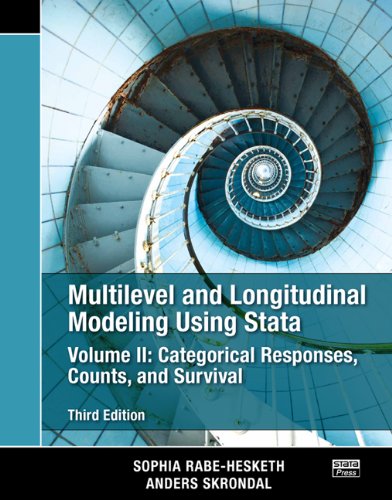
Multilevel and Longitudinal Modeling Using Stata, Volume II: Categorical Responses, Counts, and Survival, Third Edition.
Sprache: Englisch
Verlag: Stata Press, United States, College Station, 2012
ISBN 10: 1597181048 ISBN 13: 9781597181044
Anbieter: WorldofBooks, Goring-By-Sea, WS, Vereinigtes Königreich
Verkäuferbewertung 5 von 5 Sternen
EUR 11,14
EUR 6,47 shipping
Versand von Vereinigtes Königreich nach USAAnzahl: 1 verfügbar
In den WarenkorbPaperback. Zustand: Very Good. Volume II is devoted to generalized linear mixed models for binary, categorical, count, and survival outcomes. The second volume has seven chapters also organized in four parts. The first three parts in volume II cover models for categorical responses, including binary, ordinal, and nominal (a new chapter); models for count data; and models for survival data, including discrete-time and continuous-time (a new chapter) survival responses. The final part in volume II describes models with nested and crossed-random effects with an emphasis on binary outcomes. The book has been read, but is in excellent condition. Pages are intact and not marred by notes or highlighting. The spine remains undamaged.
-

An Introduction to Modern Econometrics Using Stata
Sprache: Englisch
Verlag: Stata Press, United States, College Station, 2006
ISBN 10: 1597180130 ISBN 13: 9781597180139
Anbieter: WorldofBooks, Goring-By-Sea, WS, Vereinigtes Königreich
Verkäuferbewertung 5 von 5 Sternen
EUR 11,56
EUR 6,47 shipping
Versand von Vereinigtes Königreich nach USAAnzahl: 1 verfügbar
In den WarenkorbPaperback. Zustand: Very Good. Integrating a contemporary approach to econometrics with the powerful computational tools offered by Stata, An Introduction to Modern Econometrics Using Stata focuses on the role of method-of-moments estimators, hypothesis testing, and specification analysis and provides practical examples that show how the theories are applied to real data sets using Stata. As an expert in Stata, the author successfully guides readers from the basic elements of Stata to the core econometric topics. He first describes the fundamental components needed to effectively use Stata. The book then covers the multiple linear regression model, linear and nonlinear Wald tests, constrained least-squares estimation, Lagrange multiplier tests, and hypothesis testing of nonnested models. Subsequent chapters center on the consequences of failures of the linear regression model's assumptions. The book also examines indicator variables, interaction effects, weak instruments, underidentification, and generalized method-of-moments estimation. The final chapters introduce panel-data analysis and discrete- and limited-dependent variables and the two appendices discuss how to import data into Stata and Stata programming. Presenting many of the econometric theories used in modern empirical research, this introduction illustrates how to apply these concepts using Stata. The book serves both as a supplementary text for undergraduate and graduate students and as a clear guide for economists and financial analysts. The book has been read, but is in excellent condition. Pages are intact and not marred by notes or highlighting. The spine remains undamaged.
-
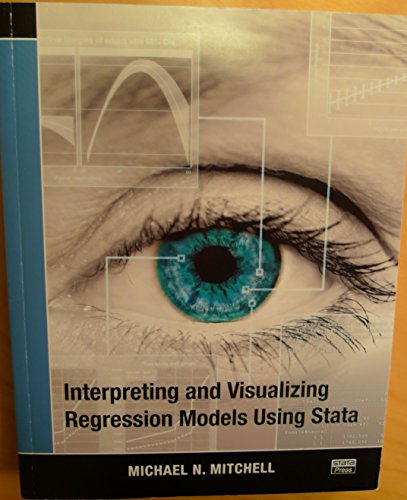
Interpreting and Visualizing Regression Models Using Stata
Sprache: Englisch
Verlag: Stata Press, United States, College Station, 2012
ISBN 10: 1597181072 ISBN 13: 9781597181075
Anbieter: WorldofBooks, Goring-By-Sea, WS, Vereinigtes Königreich
Verkäuferbewertung 5 von 5 Sternen
EUR 16,50
EUR 6,47 shipping
Versand von Vereinigtes Königreich nach USAAnzahl: 2 verfügbar
In den WarenkorbPaperback. Zustand: Very Good. Michael Mitchell's Interpreting and Visualizing Regression Models Using Stata is a clear treatment of how to carefully present results from model-fitting in a wide variety of settings. It is a boon to anyone who has to present the tangible meaning of a complex model in a clear fashion, regardless of the audience. As an example, many experienced researchers start to squirm when asked to give a simple explanation of the applied meaning of interactions in nonlinear models such as logistic regression. The tools in Mitchell's book make this task much more enjoyable and comprehensible. Mitchell starts with simple linear regression (which is simple in all ways), and then adds polynomials and discontinuities. This is followed by 2-way and 3-way interaction until interpretation of coefficients through words is difficult. By careful use of Stata's marginsplot command, Mitchell shows how well graphs can be used to show effects. He also includes careful verbal interpretation of coefficients to make communications complete. He then extends the methods from linear regression to various types of nonlinear regression, such as multilevel or survival models. A significant difference between this book and most others on regression models is that Mitchell spends quite some time on fitting and visualizing discontinuous models' models where the outcome can change value suddenly at thresholds. Such models are natural in settings such as education and policy evaluation, where graduation or policy changes can make sudden changes in income or revenue. This book is a worthwhile addition to the library of anyone involved in statistical consulting, teaching, or collaborative applied statistical environments. The book has been read, but is in excellent condition. Pages are intact and not marred by notes or highlighting. The spine remains undamaged.
-
An Introduction to Modern Econometrics Using Stata
Sprache: Englisch
Verlag: Stata Press, United States, College Station, 2006
ISBN 10: 1597180130 ISBN 13: 9781597180139
Anbieter: WorldofBooks, Goring-By-Sea, WS, Vereinigtes Königreich
Verkäuferbewertung 5 von 5 Sternen
EUR 17,09
EUR 6,47 shipping
Versand von Vereinigtes Königreich nach USAAnzahl: 1 verfügbar
In den WarenkorbPaperback. Zustand: Fair. Integrating a contemporary approach to econometrics with the powerful computational tools offered by Stata, An Introduction to Modern Econometrics Using Stata focuses on the role of method-of-moments estimators, hypothesis testing, and specification analysis and provides practical examples that show how the theories are applied to real data sets using Stata. As an expert in Stata, the author successfully guides readers from the basic elements of Stata to the core econometric topics. He first describes the fundamental components needed to effectively use Stata. The book then covers the multiple linear regression model, linear and nonlinear Wald tests, constrained least-squares estimation, Lagrange multiplier tests, and hypothesis testing of nonnested models. Subsequent chapters center on the consequences of failures of the linear regression model's assumptions. The book also examines indicator variables, interaction effects, weak instruments, underidentification, and generalized method-of-moments estimation. The final chapters introduce panel-data analysis and discrete- and limited-dependent variables and the two appendices discuss how to import data into Stata and Stata programming. Presenting many of the econometric theories used in modern empirical research, this introduction illustrates how to apply these concepts using Stata. The book serves both as a supplementary text for undergraduate and graduate students and as a clear guide for economists and financial analysts. A readable copy of the book which may include some defects such as highlighting and notes. Cover and pages may be creased and show discolouration.
-

An Introduction to Survival Analysis Using Stata, Revised Edition
Sprache: Englisch
Verlag: Stata Press, College Station, TX
ISBN 10: 1881228843 ISBN 13: 9781881228844
Anbieter: Alien Bindings, BALTIMORE, MD, USA
Verkäuferbewertung 4 von 5 Sternen

Softcover. Zustand: Very Good. No Jacket. 2nd Edition. Revised 2nd Edition in Very Good+/Near Fine condition. The covers are in great shape with only light shelf wear. The binding is square and tight. An organization stamp is neatly marked out on the half-title page. The interior pages are clean and unmarked. The book will be carefully packaged for shipment for protection from the elements. USPS electronic tracking number issued free of charge. Developing the statistical concepts unique to survival data, An Introduction to Survival Analysis Using Stata, Revised Edition includes statistical theory, step-by-step procedures for analyzing survival data, a detailed usage guide for Stata's most widely used st commands, and pointers for using Stata to analyze survival data and present the results. The first several chapters cover basic theoretical concepts as well as censoring and truncation. The next few chapters describe the formatting, manipulation, stsetting, and error-checking involved in preparing survival data for analysis using Stata's st analysis commands. The book also discusses Cox regression and includes various examples of fitting a Cox model, obtaining predictions, interpreting results, building models, and modeling diagnostics. The final chapters cover parametric models, which are fitted using Stata's streg command.
-

Data Analysis Using Stata, Third Edition
Sprache: Englisch
Verlag: Stata Press, United States, College Station, 2012
ISBN 10: 1597181102 ISBN 13: 9781597181105
Anbieter: WorldofBooks, Goring-By-Sea, WS, Vereinigtes Königreich
Verkäuferbewertung 5 von 5 Sternen
EUR 21,39
EUR 6,47 shipping
Versand von Vereinigtes Königreich nach USAAnzahl: 1 verfügbar
In den WarenkorbPaperback. Zustand: Very Good. Data Analysis Using Stata, Third Edition is a comprehensive introduction to both statistical methods and Stata. Beginners will learn the logic of data analysis and interpretation and easily become self-sufficient data analysts. Readers already familiar with Stata will find it an enjoyable resource for picking up new tips and tricks. The book is written as a self-study tutorial and organized around examples. It interactively introduces statistical techniques such as data exploration, description, and regression techniques for continuous and binary dependent variables. Step by step, readers move through the entire process of data analysis and in doing so learn the principles of Stata, data manipulation, graphical representation, and programs to automate repetitive tasks. This third edition includes advanced topics, such as factor-variables notation, average marginal effects, standard errors in complex survey, and multiple imputation in a way, that beginners of both data analysis and Stata can understand. Using data from a longitudinal study of private households, the authors provide examples from the social sciences that are relatable to researchers from all disciplines. The examples emphasize good statistical practice and reproducible research. Readers are encouraged to download the companion package of datasets to replicate the examples as they work through the book. Each chapter ends with exercises to consolidate acquired skills. The book has been read, but is in excellent condition. Pages are intact and not marred by notes or highlighting. The spine remains undamaged.
-

An Introduction to Stata Programming
Sprache: Englisch
Verlag: Stata Press, United States, College Station, 2009
ISBN 10: 1597180459 ISBN 13: 9781597180450
Anbieter: WorldofBooks, Goring-By-Sea, WS, Vereinigtes Königreich
Verkäuferbewertung 5 von 5 Sternen
EUR 22,06
EUR 6,47 shipping
Versand von Vereinigtes Königreich nach USAAnzahl: 2 verfügbar
In den WarenkorbPaperback. Zustand: Very Good. This work focuses on three types of Stata programming: do-file programming, ado-file programming, and Mata functions that work in conjunction with do- and ado-files. It explains how to usefully automate work with Stata and how to use Stata more effectively through programming on one or more of these levels. After presenting elementary concepts of the command-line interface and commonly used tools for working with programs and data sets, the text follows a unique format by offering "cookbook" chapters after each main chapter. These cookbook chapters look at how to perform a specific programming task with Stata and provide a complete solution to the problem. The text also includes numerous examples of Mata, Statas matrix programming language. The book has been read, but is in excellent condition. Pages are intact and not marred by notes or highlighting. The spine remains undamaged.
-

A Gentle Introduction to Stata, Fourth Edition
Sprache: Englisch
Verlag: Stata Press, United States, College Station, 2014
ISBN 10: 1597181420 ISBN 13: 9781597181426
Anbieter: WorldofBooks, Goring-By-Sea, WS, Vereinigtes Königreich
Verkäuferbewertung 5 von 5 Sternen
EUR 44,07
EUR 6,47 shipping
Versand von Vereinigtes Königreich nach USAAnzahl: 2 verfügbar
In den WarenkorbPaperback. Zustand: Very Good. A Gentle Introduction to Stata, Fourth Edition is for people who need to learn Stata but who may not have a strong background in statistics or prior experience with statistical software packages. After working through this book, you will be able to enter, build, and manage a dataset, and perform fundamental statistical analyses. This book is organized like the unfolding of a research project. You begin by learning how to enter and manage data and how to do basic descriptive statistics and graphical analysis. Then you learn how to perform standard statistical procedures from t tests, nonparametric tests, and measures of association through ANOVA, multiple regression, and logistic regression. Readers who have experience with another statistical package may benefit more by reading chapters selectively and referring to this book as needed. The fourth edition has incorporated numerous changes that were new with Stata 13. Coverage of the marginsplot command has expanded. This simplifies the construction of compelling graphs. There is a new chapter showing how to estimate path models using the sem (structural equation modeling) command. Menus have been updated, and several minor changes and corrections have been included based on suggestions from readers. The book has been read, but is in excellent condition. Pages are intact and not marred by notes or highlighting. The spine remains undamaged.
-

Stata Tips, Fourth Edition, Volume I: Tips 1-119 (Paperback)
Sprache: Englisch
Verlag: Stata Press, College Station, 2024
ISBN 10: 1597184071 ISBN 13: 9781597184076
Anbieter: Grand Eagle Retail, Bensenville, IL, USA
Verkäuferbewertung 5 von 5 Sternen
Paperback. Zustand: new. Paperback. Stata Tips provides concise and insightful notes about commands, features, and tricks that will help you obtain a deeper understanding of Stata.The book comprises the contributions of the Stata community that have appeared in the Stata Journal since 2003. Each tip is a brief article that provides practical advice on using Stata. With tips covering a breadth of topics in statistics, graphics, data management, and programming, both new and experienced Stata users are sure to find tips that will be useful in their research. Stata Tips provides concise and insightful notes about commands, features, and tricks that will help you obtain a deeper understanding of Stata. The book comprises the contributions of the Stata community that have appeared in the Stata Journal since 2003. Each tip is a brief article that provides practical advice on using Stata. Shipping may be from multiple locations in the US or from the UK, depending on stock availability.
-

Thirty Years with Stata (Paperback)
Sprache: Englisch
Verlag: Stata Press, College Station, 2015
ISBN 10: 1597181722 ISBN 13: 9781597181723
Anbieter: Grand Eagle Retail, Bensenville, IL, USA
Verkäuferbewertung 5 von 5 Sternen
Paperback. Zustand: new. Paperback. This volume is a sometimes serious and sometimes whimsical retrospective of Stata, its development, and its use over the last 30 years.The view from the inside opens with an essay by Bill Gould, Stata's president and cofounder, that discusses the challenges and concepts that guided the design and implementation of Stata. This is followed by an interview of Bill by Joe Newton that discusses Bill's early interest in computing, his early work on a program for matching prom dates in the days when you had to purchase time on computers, and further exploration of the guiding principles behind Stata. Finally, Sean Becketti, Stata's first employee, delves into the not-to-be-missed culture of Stata in its infancy.The view from the outside comprises 14 essays by prominent researchers and members of the Stata community. Most discuss Stata's use and evolution in disciplines such as behavioral sciences, business, economics, epidemiology, time series, political science, public health, public policy, veterinary epidemiology, and statistics. Some take a sweeping overview. Others are more intimate personal recollections. Mostly, we simply wanted to celebrate the relationship between Stata users and Stata software. We hope that this volume holds something interesting for everyone. Shipping may be from multiple locations in the US or from the UK, depending on stock availability.
-
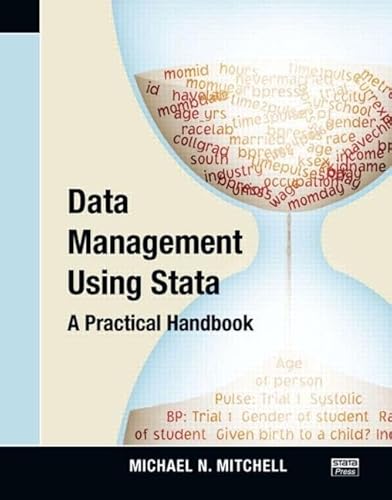
Data Management Using Stata: A Practical Handbook
Sprache: Englisch
Verlag: Stata Press, United States, College Station, 2010
ISBN 10: 1597180769 ISBN 13: 9781597180764
Anbieter: WorldofBooks, Goring-By-Sea, WS, Vereinigtes Königreich
Verkäuferbewertung 5 von 5 Sternen
EUR 54,14
EUR 6,47 shipping
Versand von Vereinigtes Königreich nach USAAnzahl: 2 verfügbar
In den WarenkorbPaperback. Zustand: Very Good. Using simple language and illustrative examples, this book comprehensively covers data management tasks that bridge the gap between raw data and statistical analysis. Rather than focus on clusters of commands, the author takes a modular approach that enables readers to quickly identify and implement the necessary task without having to access background information first. Each section in the chapters presents a self-contained lesson that illustrates a particular data management task via examples, such as creating data variables and automating error checking. The text also discusses common pitfalls and how to avoid them and provides strategic data management advice. Ideal for both beginning statisticians and experienced users, this handy book helps readers solve problems and learn comprehensive data management skills. The book has been read, but is in excellent condition. Pages are intact and not marred by notes or highlighting. The spine remains undamaged.
-

Generalized Linear Models and Extensions.
Sprache: Deutsch
Verlag: College Station, Texas, Stata Press, 2001., 2001
Anbieter: Antiquariat Bader Tübingen, Tübingen, Deutschland
Verkäuferbewertung 5 von 5 Sternen
XIV, 245 Seiten. Gr.-8vo. Kartoniert. Ehemaliges Bibliotheksexemplar, im Impressum gestempelt u. mit Rückenschild. Leichte Gebrauchsspuren. Sprache: Deutsch Gewicht in Gramm: 650.
-

An Introduction to Stata for Health Researchers (Paperback)
Sprache: Englisch
Verlag: Stata Press, College Station, 2021
ISBN 10: 1597183156 ISBN 13: 9781597183154
Anbieter: Grand Eagle Retail, Bensenville, IL, USA
Verkäuferbewertung 5 von 5 Sternen
Paperback. Zustand: new. Paperback. An Introduction to Stata for Health Researchers, Fifth Edition updates this classic book that has become a standard reference for health researchers. As with previous editions, readers will learn to work effectively in Stata to perform data management, compute descriptive statistics, create meaningful graphs, fit regression models, and perform survival analysis. The fifth edition adds examples of performing power, precision, and sample-size analysis; working with Unicode characters; managing data with ICD-9 and ICD-10 codes; and creating customized tables.With many worked examples and downloadable datasets, this text is the ideal resource for hands-on learning, whether for students in a statistics course or for researchers in fields such as epidemiology, biostatistics, and public health who are learning to use Stata's tools for health research. An Introduction to Stata for Health Researchers, Fifth Edition updates this classic book that has become a standard reference for health researchers. Shipping may be from multiple locations in the US or from the UK, depending on stock availability.
-

Introduction to Time Series Using Stata, Revised Edition
Sprache: Englisch
Verlag: Stata Press, United States, College Station, 2013
ISBN 10: 1597181323 ISBN 13: 9781597181327
Anbieter: WorldofBooks, Goring-By-Sea, WS, Vereinigtes Königreich
Verkäuferbewertung 5 von 5 Sternen
EUR 66,92
EUR 6,47 shipping
Versand von Vereinigtes Königreich nach USAAnzahl: 1 verfügbar
In den WarenkorbPaperback. Zustand: Very Good. Introduction to Time Series Using Stata, Revised Edition provides a step-by-step guide to essential time-series techniquesfrom the incredibly simple to the quite complex and, at the same time, demonstrates how these techniques can be applied in the Stata statistical package. The emphasis is on an understanding of the intuition underlying theoretical innovations and an ability to apply them. Real-world examples illustrate the application of each concept as it is introduced, and care is taken to highlight the pitfalls, as well as the power, of each new tool. The Revised Edition has been updated for Stata 16. The book has been read, but is in excellent condition. Pages are intact and not marred by notes or highlighting. The spine remains undamaged.
-

A Gentle Introduction to Stata, Revised Sixth Edition (Paperback)
Sprache: Englisch
Verlag: Stata Press, College Station, 2023
ISBN 10: 1597183679 ISBN 13: 9781597183673
Anbieter: Grand Eagle Retail, Bensenville, IL, USA
Verkäuferbewertung 5 von 5 Sternen
Paperback. Zustand: new. Paperback. Alan C. Acock's A Gentle Introduction to Stata, Revised Sixth Edition is aimed at new Stata users who want to become proficient in Stata. After reading this introductory text, new users will be able to not only use Stata well but also learn new aspects of Stata.Acock assumes that the user is not familiar with any statistical software. This assumption of a blank slate is central to the structure and contents of the book. Acock starts with the basics; for example, the part of the book that deals with data management begins with a careful and detailed example of turning survey data on paper into a Stata-ready dataset. When explaining how to go about basic exploratory statistical procedures, Acock includes notes that will help the reader develop good work habits. This mixture of explaining good Stata habits and explaining good statistical habits continues throughout the book.Acock is quite careful to teach the reader all aspects of using Stata. He covers data management, good work habits (including the use of basic do-files), basic exploratory statistics (including graphical displays), and analyses using the standard array of basic statistical tools (correlation, linear and logistic regression, and parametric and nonparametric tests of location and dispersion). He also successfully introduces some more advanced topics such as multiple imputation and multilevel modeling in a very approachable manner. Acock teaches Stata commands by using the menus and dialog boxes while still stressing the value of Stata commands and do-files. In this way, he ensures that all types of users can build good work habits. Each chapter has exercises that the motivated reader can use to reinforce the material.The tone of the book is friendly and conversational without ever being glib or condescending. Important asides and notes about terminology are set off in boxes, which makes the text easy to read without any convoluted twists or forward referencing. Rather than splitting topics by their Stata implementation, Acock arranges the topics as they would appear in a basic statistics textbook; graphics and postestimation are woven into the material naturally. Real datasets, such as the General Social Surveys from 2002, 2006, and 2016, are used throughout the book.The focus of the book is especially helpful for those in the behavioral and social sciences because the presentation of basic statistical modeling is supplemented with discussions of effect sizes and standardized coefficients. Various selection criteria, such as semipartial correlations, are discussed for model selection. Acock also covers a variety of commands available for evaluating reliability and validity of measurements.The revised sixth edition is fully up to date for Stata 17, including updated discussion and images of Stata's interface and modern command syntax. In addition, examples include new features such as the table command and collect suite for creating and exporting customized tables as well as the option for creating graphs with transparency. Ready to learn Stata? The revised edition of Stata Press' long-time best seller, 'A Gentle Introduction to Stata' is now available and fully updated for Stata 17. Shipping may be from multiple locations in the US or from the UK, depending on stock availability.
-
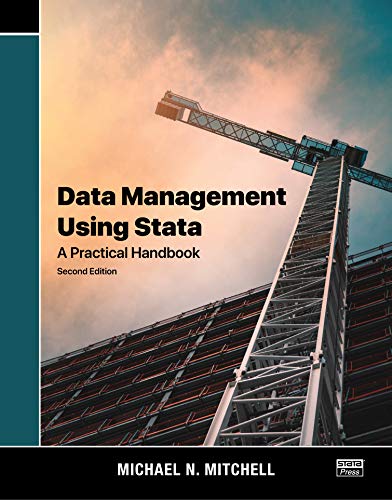
Data Management Using Stata (Paperback)
Sprache: Englisch
Verlag: Stata Press, College Station, 2020
ISBN 10: 1597183180 ISBN 13: 9781597183185
Anbieter: Grand Eagle Retail, Bensenville, IL, USA
Verkäuferbewertung 5 von 5 Sternen
Paperback. Zustand: new. Paperback. This second edition of Data Management Using Stata focuses on tasks that bridge the gap between raw data and statistical analysis. It has been updated throughout to reflect new data management features that have been added over the last 10 years. Such features include the ability to read and write a wide variety of file formats, the ability to write highly customized Excel files, the ability to have multiple Stata datasets open at once, and the ability to store and manipulate string variables stored as Unicode. Further, this new edition includes a new chapter illustrating how to write Stata programs for solving data management tasks. As in the original edition, the chapters are organized by data management areas: reading and writing datasets, cleaning data, labeling datasets, creating variables, combining datasets, processing observations across subgroups, changing the shape of datasets, and programming for data management. Within each chapter, each section is a self-contained lesson illustrating a particular data management task (for instance, creating date variables or automating error checking) via examples. This modular design allows you to quickly identify and implement the most common data management tasks without having to read background information first. In addition to the nuts and bolts examples, author Michael Mitchell alerts users to common pitfalls (and how to avoid them) and provides strategic data management advice. This book can be used as a quick reference for solving problems as they arise or can be read as a means for learning comprehensive data management skills. New users will appreciate this book as a valuable way to learn data management, while experienced users will find this information to be handy and time savingthere is a good chance that even the experienced user will learn some new tricks. This second edition focuses on tasks that bridge the gap between raw data and statistical analysis. It has been updated throughout. It is useful both as a quick reference for solving problems as they arise or can be read as a means for learning comprehensive data management skills. Shipping may be from multiple locations in the US or from the UK, depending on stock availability.
-

Maximum Likelihood Estimation with Stata, Fifth Edition (Paperback)
Sprache: Englisch
Verlag: Stata Press, College Station, 2023
ISBN 10: 159718411X ISBN 13: 9781597184113
Anbieter: Grand Eagle Retail, Bensenville, IL, USA
Verkäuferbewertung 5 von 5 Sternen
Paperback. Zustand: new. Paperback. Maximum Likelihood Estimation with Stata, Fifth Edition is the essential reference and guide for researchers in all disciplines who wish to write maximum likelihood (ML) estimators in Stata. Beyond providing comprehensive coverage of Statas commands for writing ML estimators, the book presents an overview of the underpinnings of maximum likelihood and how to think about ML estimation.The fifth edition includes a new second chapter that demonstrates the easy-to-use mlexp command. This command allows you to directly specify a likelihood function and perform estimation without any programming.The core of the book focuses on Stata's ml command. It shows you how to take full advantage of mls noteworthy features:Linear constraintsFour optimization algorithms (NewtonRaphson, DFP, BFGS, and BHHH)Observed information matrix (OIM) variance estimatorOuter product of gradients (OPG) variance estimatorHuber/White/sandwich robust variance estimatorClusterrobust variance estimatorComplete and automatic support for survey data analysisDirect support of evaluator functions written in MataWhen appropriate options are used, many of these features are provided automatically by ml and require no special programming or intervention by the researcher writing the estimator.In later chapters, you will learn how to take advantage of Mata, Stata's matrix programming language. For ease of programming and potential speed improvements, you can write your likelihood-evaluator program in Mata and continue to use ml to control the maximization process. A new chapter in the fifth edition shows how you can use the moptimize() suite of Mata functions if you want to implement your maximum likelihood estimator entirely within Mata.In the final chapter, the authors illustrate the major steps required to get from log-likelihood function to fully operational estimation command. This is done using several different models: logit and probit, linear regression, Weibull regression, the Cox proportional hazards model, random-effects regression, and seemingly unrelated regression. This edition adds a new example of a bivariate Poisson model, a model that is not available otherwise in Stata.The authors provide extensive advice for developing your own estimation commands. With a little care and the help of this book, users will be able to write their own estimation commands---commands that look and behave just like the official estimation commands in Stata.Whether you want to fit a special ML estimator for your own research or wish to write a general-purpose ML estimator for others to use, you need this book. Maximum Likelihood Estimation with Stata, Fifth Edition is the essential reference and guide for researchers in all disciplines who wish to write maximum likelihood (ML) estimators in Stata. Learn about ML estimation and how to write Stata code for a special ML estimator for your own research or for a general-purpose ML estimator. Shipping may be from multiple locations in the US or from the UK, depending on stock availability.
-

Survey Weights (Paperback)
Sprache: Englisch
Verlag: Stata Press, College Station, 2018
ISBN 10: 1597182605 ISBN 13: 9781597182607
Anbieter: Grand Eagle Retail, Bensenville, IL, USA
Verkäuferbewertung 5 von 5 Sternen
Paperback. Zustand: new. Paperback. Survey Weights: A Step-by-Step Guide to Calculation is the first guide geared toward Stata users that systematically covers the major steps taken in creating survey weights. These weights are used to project a sample to some larger population and can be computed for either probability or nonprobability samples. Sample designs can range from simple, single-stage samples to more complex, multistage samples, each of which may use specialized steps in weighting to account for selection probabilities, nonresponse, inaccurate coverage of a population by a sample, and auxiliary data to improve precision and compensate for coverage errors. The authors provide many examples with Stata code. Survey Weights: A Step-by-Step Guide to Calculation is the first guide geared towards Stata users that systematically covers the major steps taken in creating survey weights. These weights are used to project a sample to some larger population and can be computed for either probability or nonprobability samples. Shipping may be from multiple locations in the US or from the UK, depending on stock availability.
-

Create and Export Tables Using Stata (Paperback)
Sprache: Englisch
Verlag: Stata Press, College Station, 2024
ISBN 10: 1597183695 ISBN 13: 9781597183697
Anbieter: Grand Eagle Retail, Bensenville, IL, USA
Verkäuferbewertung 5 von 5 Sternen
Paperback. Zustand: new. Paperback. In Create and Export Tables Using Stata, Michael Mitchell teaches you how to expertly craft custom, publication-quality tables of summary statistics, regression results, and more. Mitchell examined hundreds of published journal articles from many disciplines, searching for commonly used table layouts. This book breaks down how to create the most popularly used tables by guiding you through examples using Statas table, dtable, and etable commands, as well as the collect suite of commands.This book begins with 24 sample tables, including 6 examples of a Table 1, 8 examples of regression models, 4 examples with Student's t tests, and an example of reporting results from a pretestposttest design. Each sample table is illustrated step by step, showing you how to create it, customize it, and export it as a Word document. You'll also learn how you can export your table as a PDF or an Excel spreadsheet.After the quick examples, the book takes a more thorough look at the process of creating a Table 1a table of descriptive statistics that optionally includes a comparison across groups. This discussion also includes extensive instruction on how to create different types of composite results to include in your table; composite results combine multiple statistics into one cell, such as the mean (SE) or median (IQR).Next Mitchell focuses on creating tables from regression models, such as multiple regression, multivariate regression, logistic, and multinomial logistic models, and illustrates how to make tables that combine results from several models.The book ends with a look under the hood, describing what a collection looks like and the steps used by the collect suite of commands for creating a table and filling it in based on the contents of the collection. This information can help you more deeply understand the process of creating tables and help you make more complex tables using Stata.Create and Export Tables Using Stata is integral to anyone reporting data characteristics or analysis. You will learn how to create tables with the layout, formatting, and style you need. Optimize your workflow by using your styles to automate the creation of any future tables. You will take this book off your shelf over and over again as it quickly becomes your go-to reference for creating tables in Stata. In Create and Export Tables Using Stata, Michael Mitchell teaches you how to expertly craft custom, publication-quality tables of summary statistics, regression results, and more. Mitchell examined hundreds of published journal articles from many disciplines, searching for commonly used table layouts. Shipping may be from multiple locations in the US or from the UK, depending on stock availability.
-

Stata Tips, Fourth Edition, Volumes I and II
Sprache: Englisch
Verlag: Stata Press, College Station, 2024
ISBN 10: 1597184055 ISBN 13: 9781597184052
Anbieter: Grand Eagle Retail, Bensenville, IL, USA
Verkäuferbewertung 5 von 5 Sternen
Zustand: new. Stata Tips provides concise and insightful notes about commands, features, and tricks that will help you obtain a deeper understanding of Stata.The book comprises the contributions of the Stata community that have appeared in the Stata Journal since 2003. Each tip is a brief article that provides practical advice on using Stata. With tips covering a breadth of topics in statistics, graphics, data management, and programming, both new and experienced Stata users are sure to find tips that will be useful in their research. Stata Tips provides concise and insightful notes about commands, features, and tricks that will help you obtain a deeper understanding of Stata. The book comprises the contributions of the Stata community that have appeared in the Stata Journal since 2003. Shipping may be from multiple locations in the US or from the UK, depending on stock availability.
-

Multilevel and Longitudinal Modeling Using Stata, Volume II (Paperback)
Sprache: Englisch
Verlag: Stata Press, College Station, 2021
ISBN 10: 1597181382 ISBN 13: 9781597181389
Anbieter: Grand Eagle Retail, Bensenville, IL, USA
Verkäuferbewertung 5 von 5 Sternen
Paperback. Zustand: new. Paperback. Multilevel and Longitudinal Modeling Using Stata, Fourth Edition, is a complete resource for learning to model data in which observations are grouped. With comprehensive coverage, researchers who need to apply multilevel models will find this book to be the perfect companion. It is also the ideal text for courses in multilevel modeling because it provides examples from a variety of disciplines as well as end-of-chapter exercises that allow students to practice newly learned material. The book comprises two volumes. Volume II focuses on generalized linear models for binary, ordinal, count, and other types of outcomes. Multilevel and Longitudinal Modeling Using Stata, Fourth Edition, is a complete resource for learning to model data in which observations are grouped. Volume II focuses on generalized linear models for binary, ordinal, count, and other types of outcomes. Shipping may be from multiple locations in the US or from the UK, depending on stock availability.
-

Multilevel and Longitudinal Modeling Using Stata, Volume I (Paperback)
Sprache: Englisch
Verlag: Stata Press, College Station, 2021
ISBN 10: 1597181374 ISBN 13: 9781597181372
Anbieter: Grand Eagle Retail, Bensenville, IL, USA
Verkäuferbewertung 5 von 5 Sternen
Paperback. Zustand: new. Paperback. Multilevel and Longitudinal Modeling Using Stata, Fourth Edition, is a complete resource for learning to model data in which observations are grouped. With comprehensive coverage, researchers who need to apply multilevel models will find this book to be the perfect companion. It is also the ideal text for courses in multilevel modeling because it provides examples from a variety of disciplines as well as end-of-chapter exercises that allow students to practice newly learned material. The book comprises two volumes. Volume I focuses on linear models for continuous outcomes. Multilevel and Longitudinal Modeling Using Stata, Fourth Edition, is a complete resource for learning to model data in which observations are grouped. Volume I focuses on linear models for continuous outcomes. Shipping may be from multiple locations in the US or from the UK, depending on stock availability.
-

Graphs Everyone Should Know and How to Create Them in Stata (Paperback)
Sprache: Englisch
Verlag: Stata Press, College Station, 2025
ISBN 10: 1597184136 ISBN 13: 9781597184137
Anbieter: Grand Eagle Retail, Bensenville, IL, USA
Verkäuferbewertung 5 von 5 Sternen
Paperback. Zustand: new. Paperback. Franz Buscha's book, Graphs Everyone Should Know and How to Create Them in Stata, is written for anyone who uses Stata to make graphs. Beginners will find a complete collection of tools for effectively visualizing their data and results. Experienced Stata users are certain to learn some new tricks as well.The chapters of the book are organized into four main sections: graphs for univariate data, graphs for bivariate data, graphs for multivariate data, and special graphs. Each chapter introduces a type of graph, explains when and why it is useful for visualizing a particular kind of data, demonstrates how to create that graph using Stata, and shows a few variations. The special graph section covers topics such as how to create maps, plot equations, create animated graphs, and create other specialty graphs.Readers will find it easy to learn to make graphs by example. Buscha demonstrates most graphs using datasets that are installed with your copy of Stata, so it is straightforward to follow along. He also clearly pairs each graph with the command used to create it in a box just above the graph. If you find a graph that you wish to create with your own data, you can take the command from the box and replace the variable names in the example with your own variable names.Buscha's book has two unique features that distinguish it from other books about Stata graphs. First, the book's goal is to clearly demonstrate how to effectively visualize different kinds of data and results from models using only necessary features. It focuses on important options but does not discuss all the options available for customizing each graph. Second, the book introduces many community-contributed graph commands that are freely available and can be downloaded from the internet. Readers may be unaware of these commands before finding them in this book, and they can learn how to use them quickly rather than spend time trying to write custom code for themselves.Graphs Everyone Should Know and How to Create Them in Stata is a reference you will use again and again as you visualize different types of data. You will quickly find the graphs that are applicable to your data and the Stata commands necessary to create them. Franz Buscha's book, Graphs Everyone Should Know and How to Create Them in Stata, is for anyone who uses Stata to make graphs. Beginners will find a complete collection of tools for effectively visualizing their data and results. Experienced Stata users are certain to learn some new tricks as well. Shipping may be from multiple locations in the US or from the UK, depending on stock availability.
-

The Mata Book (Paperback)
Sprache: Englisch
Verlag: Stata Press, College Station, 2018
ISBN 10: 159718263X ISBN 13: 9781597182638
Anbieter: Grand Eagle Retail, Bensenville, IL, USA
Verkäuferbewertung 5 von 5 Sternen
Paperback. Zustand: new. Paperback. The Mata Book: A Book for Serious Programmers and Those Who Want to Be is the book that Stata programmers have been waiting for. Mata is a serious programming language for developing small- and large-scale projects and for adding features to Stata. What makes Mata serious is that it provides structures, classes, and pointers along with matrix capabilities. The book is serious in that it covers those advanced features, and teaches them. The reader is assumed to have programming experience, but only some programming experience. That experience could be with Stata's ado language, or with Python, Java, C++, Fortran, or other languages like them. As the book says, "being serious is a matter of attitude, not current skill level or knowledge".The author of the book is William Gould, who is also the designer and original programmer of Mata, of Stata, and who also happens to be the president of StataCorp. The Mata Book: A Book for Serious Programmers and Those Who Want to Be is the book that Stata programmers have been waiting for. Mata is a serious programming language for developing small- and large-scale projects and for adding features to Stata. Shipping may be from multiple locations in the US or from the UK, depending on stock availability.
-

Environmental Econometrics Using Stata (Paperback)
Sprache: Englisch
Verlag: Stata Press, College Station, 2021
ISBN 10: 1597183555 ISBN 13: 9781597183550
Anbieter: Grand Eagle Retail, Bensenville, IL, USA
Verkäuferbewertung 5 von 5 Sternen
Paperback. Zustand: new. Paperback. Aspects of environmental change are some of the greatest challenges faced by policymakers today. The key issues addressed by environmental science are often empirical, and in many instances very detailed, sizable datasets are available. Researchers in this field should have a solid understanding of the econometric tools best suited for analysis of these data. While complex and expensive physical models of the environment exist, it is becoming increasingly clear that reduced-form econometric models have an important role to play in modeling environmental phenomena. In short, successful environmental modeling does not necessarily require a structural model, but the econometric methods underlying a reduced-form approach must be competently executed. Environmental Econometrics Using Stata provides an important starting point for this journey by presenting a broad range of applied econometric techniques for environmental econometrics and illustrating how they can be applied in Stata. The emphasis is not only on how to formulate and fit models in Stata but also on the need to use a wide range of diagnostic tests in order to validate the results of estimation and subsequent policy conclusions. This focus on careful, reproducible research should be appreciated by academic and non-academic researchers who are seeking to produce credible, defensible conclusions about key issues in environmental science. This book presents a broad range of applied econometric techniques for environmental econometrics and illustrating how they can be applied in Stata. Shipping may be from multiple locations in the US or from the UK, depending on stock availability.
-
An Introduction to Modern Econometrics Using Stata (Paperback)
Sprache: Englisch
Verlag: Stata Press, College Station, 2006
ISBN 10: 1597180130 ISBN 13: 9781597180139
Anbieter: Grand Eagle Retail, Bensenville, IL, USA
Verkäuferbewertung 5 von 5 Sternen
Erstausgabe
Paperback. Zustand: new. Paperback. Integrating a contemporary approach to econometrics with the powerful computational tools offered by Stata, An Introduction to Modern Econometrics Using Stata focuses on the role of method-of-moments estimators, hypothesis testing, and specification analysis and provides practical examples that show how the theories are applied to real data sets using Stata. As an expert in Stata, the author successfully guides readers from the basic elements of Stata to the core econometric topics. He first describes the fundamental components needed to effectively use Stata. The book then covers the multiple linear regression model, linear and nonlinear Wald tests, constrained least-squares estimation, Lagrange multiplier tests, and hypothesis testing of nonnested models. Subsequent chapters center on the consequences of failures of the linear regression model's assumptions. The book also examines indicator variables, interaction effects, weak instruments, underidentification, and generalized method-of-moments estimation. The final chapters introduce panel-data analysis and discrete- and limited-dependent variables and the two appendices discuss how to import data into Stata and Stata programming. Presenting many of the econometric theories used in modern empirical research, this introduction illustrates how to apply these concepts using Stata. The book serves both as a supplementary text for undergraduate and graduate students and as a clear guide for economists and financial analysts. Integrating a contemporary approach to econometrics with the powerful computational tools offered by Stata, An Introduction to Modern Econometrics Using Stata focuses on the role of method-of-moments estimators, hypothesis testing, and specification analysis and provides practical examples that show how the theories are applied to real data sets using Stata. As an expert in Stata, the author successfully guides readers from the basic elements of Stata to the core econometric topics. He first describes the fundamental components needed to effectively use Stata. The book then covers the multiple linear regression model, linear and nonlinear Wald tests, constrained least-squares estimation, Lagrange multiplier tests, and hypothesis testing of nonnested models. Subsequent chapters center on the consequences of failures of the linear regression model's assumptions. The book also examines indicator variables, interaction effects, weak instruments, underidentification, and generalized method-of-moments estimation. The final chapters introduce panel-data analysis and discrete- and limited-dependent variables and the two appendices discuss how to import data into Stata and Stata programming. Presenting many of the econometric theories used in modern empirical research, this introduction illustrates how to apply these concepts using Stata. The book serves both as a supplementary text for undergraduate and graduate students and as a clear guide for economists and financial analysts. Shipping may be from multiple locations in the US or from the UK, depending on stock availability.
-
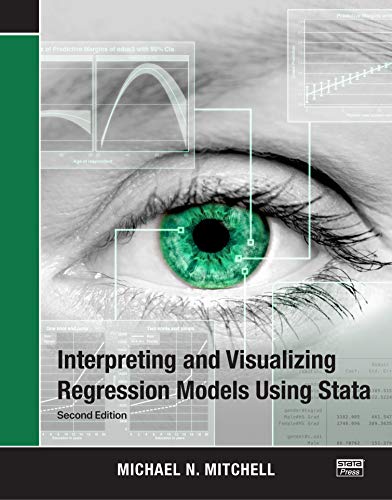
Interpreting and Visualizing Regression Models Using Stata (Paperback)
Sprache: Englisch
Verlag: Stata Press, College Station, 2020
ISBN 10: 1597183210 ISBN 13: 9781597183215
Anbieter: Grand Eagle Retail, Bensenville, IL, USA
Verkäuferbewertung 5 von 5 Sternen
Paperback. Zustand: new. Paperback. Interpreting and Visualizing Regression Models Using Stata, Second Edition provides clear and simple examples illustrating how to interpret and visualize a wide variety of regression models. Including over 200 figures, the book illustrates linear models with continuous predictors (modeled linearly, using polynomials, and piecewise), interactions of continuous predictors, categorical predictors, interactions of categorical predictors, and interactions of continuous and categorical predictors. The book also illustrates how to interpret and visualize results from multilevel models, models where time is a continuous predictor, models with time as a categorical predictor, nonlinear models (such as logistic or ordinal logistic regression), and models involving complex survey data. The examples illustrate the use of the margins, marginsplot, contrast, and pwcompare commands. This new edition reflects new and enhanced features added to Stata, most importantly the ability to label statistical output using value labels associated with factor variables. As a result, output regarding marital status is labeled using intuitive labels like Married and Unmarried instead of using numeric values such as 1 and 2. All the statistical output in this new edition capitalizes on this new feature, emphasizing the interpretation of results based on variables labeled using intuitive value labels. Additionally, this second edition illustrates other new features, such as using transparency in graphics to more clearly visualize overlapping confidence intervals and using small sample-size estimation with mixed models. If you ever find yourself wishing for simple and straightforward advice about how to interpret and visualize regression models using Stata, this book is for you. This book provides clear and simple examples illustrating how to interpret and visualize a wide variety of regression models. If you ever find yourself wishing for simple and straightforward advice about how to interpret and visualize regression models using Stata, this book is for you. Shipping may be from multiple locations in the US or from the UK, depending on stock availability.
-

Flexible Parametric Survival Analysis Using Stata (Paperback)
Sprache: Englisch
Verlag: Stata Press, College Station, 2011
ISBN 10: 1597180793 ISBN 13: 9781597180795
Anbieter: Grand Eagle Retail, Bensenville, IL, USA
Verkäuferbewertung 5 von 5 Sternen
Paperback. Zustand: new. Paperback. Through real-world case studies, this book shows how to use Stata to estimate a class of flexible parametric survival models. It discusses the modeling of time-dependent and continuous covariates and looks at how relative survival can be used to measure mortality associated with a particular disease when the cause of death has not been recorded. The book describes simple quantification of differences between any two covariate patterns through calculation of time-dependent hazard ratios, hazard differences, and survival differences. Shipping may be from multiple locations in the US or from the UK, depending on stock availability.
-

Microeconometrics Using Stata, Second Edition, Volume II: Nonlinear Models and Casual Inference Methods (Paperback)
Sprache: Englisch
Verlag: Stata Press, College Station, 2022
ISBN 10: 1597183628 ISBN 13: 9781597183628
Anbieter: Grand Eagle Retail, Bensenville, IL, USA
Verkäuferbewertung 5 von 5 Sternen
Paperback. Zustand: new. Paperback. Microeconometrics Using Stata, Second Edition is an invaluable reference for researchers and students interested in applied microeconometric methods.Like previous editions, this text covers all the classic microeconometric techniques ranging from linear models to instrumental-variables regression to panel-data estimation to nonlinear models such as probit, tobit, Poisson, and choice models. Each of these discussions has been updated to show the most modern implementation in Stata, and many include additional explanation of the underlying methods. In addition, the authors introduce readers to performing simulations in Stata and then use simulations to illustrate methods in other parts of the book. They even teach you how to code your own estimators in Stata.The second edition is greatly expandedthe new material is so extensive that the text now comprises two volumes. In addition to the classics, the book now teaches recently developed econometric methods and the methods newly added to Stata. Specifically, the book includes entirely new chapters onduration modelsrandomized control trials and exogenous treatment effectsendogenous treatment effectsmodels for endogeneity and heterogeneity, including finite mixture models, structural equation models, and nonlinear mixed-effects modelsspatial autoregressive modelssemiparametric regressionlasso for prediction and inferenceBayesian analysisAnyone interested in learning classic and modern econometric methods will find this the perfect companion. And those who apply these methods to their own data will return to this reference over and over as they need to implement the various techniques described in this book. Microeconometrics Using Stata, Second Edition is an invaluable reference for researchers and students interested in applied microeconometric methods. Shipping may be from multiple locations in the US or from the UK, depending on stock availability.


