
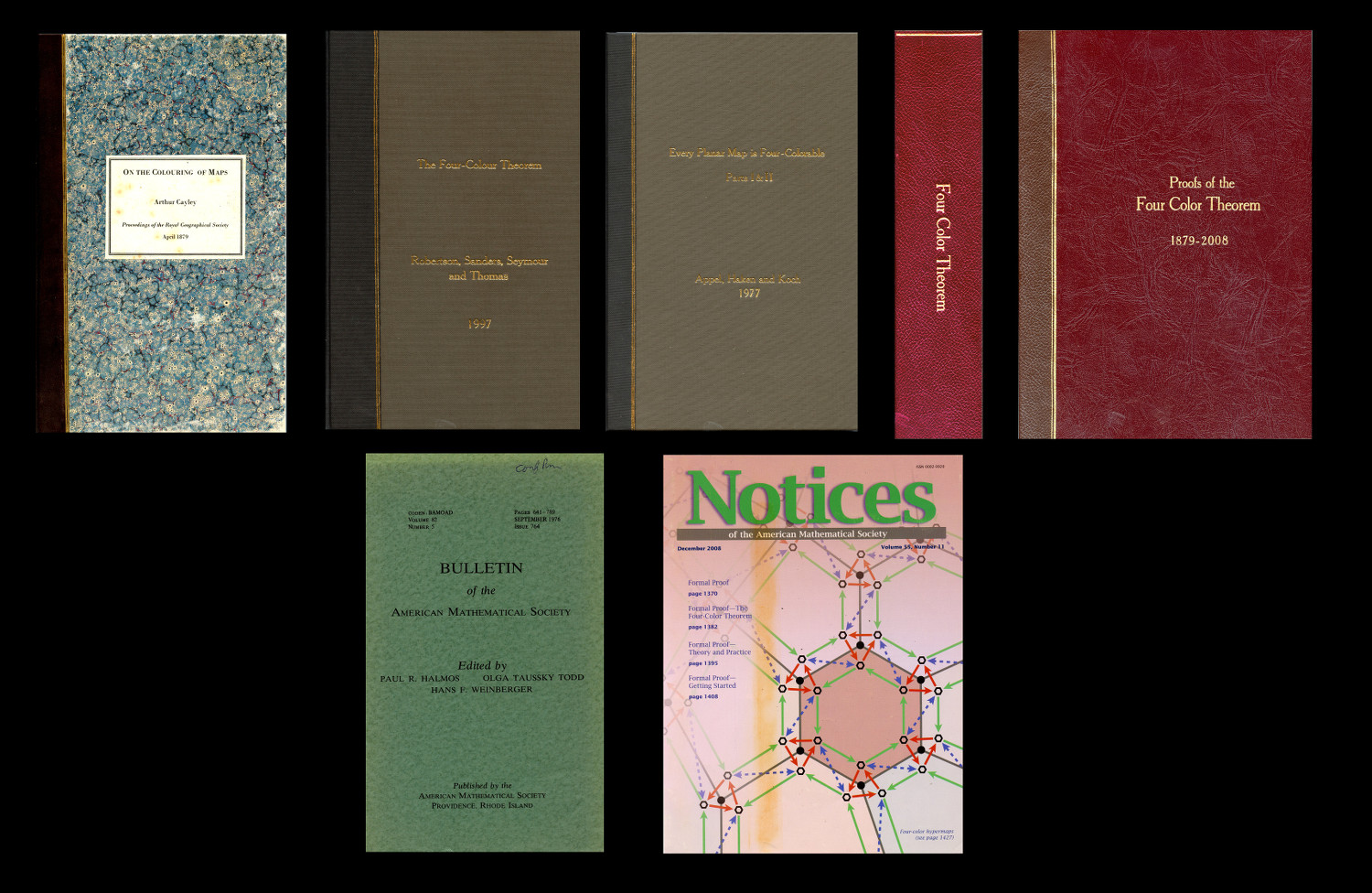
The Four-Color Theorem: On the Colouring of Maps by Arthur Cayley (in Proceedings of the Royal Geographical Society 1 No. 4 pp. 259-261, April 1879) WITH Every Planar Map is Four Colorable (in Bulletin of the American Mathematical Society 82 No. 5 pp. 711-712, September 1976) WITH Every Planar Map is Four Colorable Part I. Discharging and Every Planar Map is Four Colorable Part II. Reducibility by Kenneth Appel and Wolfgang Haken (in Illinois Journal of Mathematics 21 Issue 3 pp. 429 - 567, 1977) WITH The Four Colour Theorem by Neil Robertson et al. (in Journal of Combinatorial Theory B 70 No. 1 pp. 2-44, 1997); WITH Formal Proof - The Four Colour Theorem by Georges Gonthier (Notices of the American Mathematical Society 55 No. 11 pp. 382-39
Cayley, Arthur WITH Appel, Kenneth and Haken, Wolfgang WITH Robertson, Neil et al. WITH Gonthier, Georges
Gebraucht
Verkäufer
Atticus Rare Books, West Branch, IA, USA
Verkäuferbewertung 5 von 5 Sternen

AbeBooks-Verkäufer seit 23. August 2001
Dieses Buch ist nicht mehr verfügbar. AbeBooks führt Millionen von Büchern. Bitte geben Sie unten Suchbegriffe ein, um ähnliche Exemplare zu finden.
Beschreibung
Beschreibung:
THE FOUR-COLOUR (Color) PROBLEM (OR THEOREM) IS "THE FIRST MAJOR THEOREM TO BE PROVED USING A COMPUTER" (Lamb, Having Fun with the 4-Color Theorem, Scientific American, March 1, 2013). Because the problem had "resisted the attempts of able mathematicians for over a century.when it was successfully proved in 1976 the â??computer proof' was controversial [because] it did not allow scrutiny in the conventional way" (Crilly, Notes and Records of the Royal Society, 22 Sept. 2005). "The Four-Color Theorem states that any map in a plane can be colored using four-colors in such a way that regions sharing a common boundary (other than a single point) do not share the same color. The problem, or question, is well-known in mathematics and is certainly the most famous problem in the field of "discrete" mathematics. Included in a custom case are first editions of the first printed paper of the problem, this by Arthur Cayley in 1879, and three papers by Appel and Haken (an announcement of the proof (which took over 100 years) and two papers presenting the proof in detail, and the papers describing the two following proofs. "Six colors can be proven to suffice. and this number can easily be reduced to five, but reducing the number of colors all the way to four proved very difficult. [In a paper also included in this boxed set], the result was finally obtained by Appel and Haken (1977), who constructed a computer-assisted proof that four colors were sufficient" (ibid). This was the first major theorem proven using a computer. Appel and Haken's "proof reduced the infinitude of possible maps to 1,936 reducible configurations (later reduced to 1,476)" and then wrote a computer program to check each case, something that took over 1000 hours (Xiang, A formal Proof of the Four-Color Theorem, 2009). However, because part of the proof consisted of an exhaustive analysis of many discrete cases by means of a computer, some mathematicians doubted the proof's veracity because it could not be checked by normal means. In other words, did a computer proof count? By the 1990's, computer aided solutions were more widely accepted and Appel and Haken's proof was confirmed via general theorem proving software, in both 1997 and again in 2008. In 1997, Robertson et al [in a paper included in this box] created a quadratic-time algorithm, greatly simplifying and improving upon that of Appel and Haken. In 2005, Gonthiers formalized a proof of the theorem by using the proof assistant called Coq, a widely-used general purpose utility, which can be `verified experimentally. He didn't publish it until 2008 [in a paper included in this boxed set]. The theorem is now generally agreed to be proven. ALSO INCLUDED THOUGH NOT IN THE CLAMSHELL CASE: Solution of the Four Color Map Problem" by Kenneth Appel and Wolfgang Haken (Scientific American 237 Issue 4 pp. 108-121, October 1977) and "The Philosophical lImplications of the Four-Color Problem" by E. R. Swart (The American Mathematical Monthly 87 No. 9 pp. 697-707, November 1990). NOTE: The Four-Color Problem is sometimes referred to as Guthrie's Problem. CONDITION & DETAILS: Cayley in Proceedings of the Royal Geographical Society: handsomely re-bound (with title page) April issue in marbled paper over calf, near fine condition. Appel and Haken in Illinois Journal of Mathematics: handsomely rebound in grey and black, gilt lettered on the front board and inclusive of both Appel and Haken papers, fine condition. Georges Gonthier in Notices of the American Mathematical Society; original paper wrappers; near fine condition. "The Four Colour Theorem" by Neil Robertson et al. in Journal of Combinatorial Theory; handsomely rebound, small cancelation stamp on the rear of the title page; fine condition. Bestandsnummer des Verkäufers 1635
Bibliografische Details
Titel: The Four-Color Theorem: On the Colouring of ...
Auflage: 1st Edition.
AbeBooks ist ein Internet-Marktplatz für neue, gebrauchte, antiquarische und vergriffene Bücher. Bei uns finden Sie Tausende professioneller Buchhändler weltweit und Millionen Bücher. Einkaufen bei AbeBooks ist einfach und zu 100% sicher — Suchen Sie nach Ihrem Buch, erwerben Sie es über unsere sichere Kaufabwicklung und erhalten Sie Ihr Buch direkt vom Händler.
Millionen neuer und gebrauchter Bücher bei tausenden Anbietern
Neue und gebrauchte Bücher

Neue und gebrauchte Exemplare von Neuerscheinungen, Bestsellern und preisgekrönten Büchern. Eine riesige Auswahl an günstigen Büchern.
Antiquarische Bücher
Von seltenen Erstausgaben bis hin zu begehrten signierten Ausgaben ? bei AbeBooks finden Sie eine große Anzahl seltener, wertvoller Bücher und Sammlerstücke.
Versandkostenfreie Bücher

Hier finden Sie viele hunderttausend neue, gebrauchte und antiquarische Bücher, die Ihnen unsere deutschen und internationalen Händler versandkostenfrei liefern.