
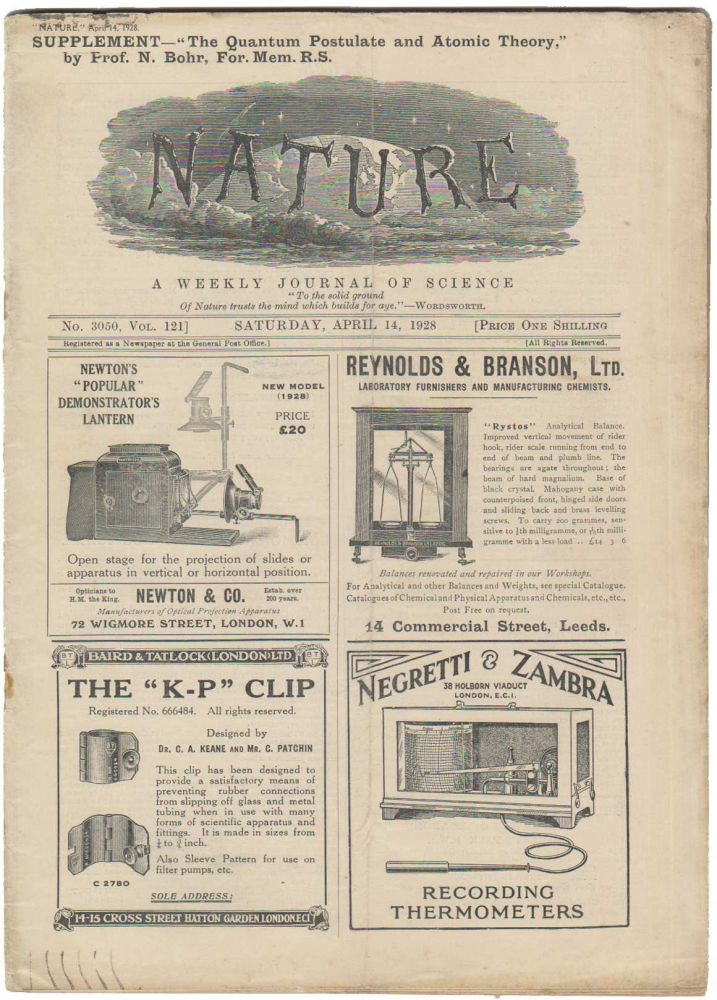
The Quantum Postulate and the Recent Development of Atomic Theory, pp. 580-590 in: Nature, vol. 121, no. 3050, April 14, 1928. COMPLEMENTARITY AND THE COPENHAGEN INTERPRETATION OF QUANTUM MECHANICS
BOHR, Niels
Verlag: London: Macmillan, 1928
Gebraucht
Soft cover
Verkäufer
Landmarks of Science Books, Richmond, Vereinigtes Königreich
Verkäuferbewertung 5 von 5 Sternen

AbeBooks-Verkäufer seit 17. März 2016
Dieses Buch ist nicht mehr verfügbar. AbeBooks führt Millionen von Büchern. Bitte geben Sie unten Suchbegriffe ein, um ähnliche Exemplare zu finden.
Beschreibung
Beschreibung:
First edition, journal issue in original wrappers, of this fundamental paper introducing Bohr's statement of his complementarity principle, the basis of what became known as the Copenhagen interpretation of quantum mechanics. "From the epistemological point of view, the discovery of the new type of logical relationship that complementarity represents is a major advance that radically changes our whole view of the role and meaning of science. In contrast with the nineteenth-century ideal of a description of the phenomena from which every reference to their observation would be eliminated, we have the much wider and truer prospect of an account of the phenomena in which due regard is paid to the conditions under which they can actually be observed - thereby securing the full objectivity of the description" (DSB). The concept of complementarity started to develop in Bohr's mind during discussions with Heisenberg in Copenhagen early in 1927, when Heisenberg was preparing for publication his famous paper on the uncertainty principle. In fact, the published version of Heisenberg's paper contains a note added in proof which mentions 'recent investigations by Bohr [that] have led to points of view that permit an essential deepening and refinement of the analysis of the quantum mechanical relationship attempted in this work'. "Bohr presented his ideas on complementarity for the first time at an international congress of physics in Como in the fall of 1927, commemorating the centenary of Volta's death. On this occasion, he stressed that in the quantum world, contrary to the classical world, an observation of a system can never be made without disturbing the system. But how can we then know the state of the system? The quantum postulate would seem to imply that the classical distinction between the observer and the observed was no longer tenable. How then would it be possible to obtain objective knowledge? Bohr's reflections on these and related questions led him to introduce the notion of complementarity as denoting the use of complementary but mutually exclusive viewpoints in the description of nature. Two years later, he defined the complementarity principle as 'a new mode of description . . . in the sense that any given application of classical concepts precludes the simultaneous use of other classical concepts which in a different connection are equally necessary for the elucidation of phenomena' . . . The wave description and the particle description are complementary and thus in conflict. But Bohr argued that the physicist is still able to account unambiguously for his experiments, for it is he who chooses what to measure and thereby destroys the possibility of the realization of the conflicting aspect . . . The complementarity principle became the cornerstone of what was later referred to as the Copenhagen interpretation of quantum mechanics. Pauli even stated that quantum mechanics might be called 'complementarity theory', in an analogy with 'relativity theory'. And Peierls later claimed that when you refer to the Copenhagen interpretation of the mechanics what you really mean is quantum mechanics . . . by the mid-1930s Bohr had been remarkably successful in establishing the Copenhagen view as the dominant philosophy of quantum mechanics" (Kragh, Quantum Generation (1999), pp. 209-210). This paper was published essentially simultaneously in English and German, and somewhat later in Danish and French. Large 8vo, pp. cxiii-cxvi, 561-578, iv, 579-590, v-viii, 591-608, cxvii-cxx. Original printed wrappers (light vertical crease, one advertisement leaf (vii/viii) with an advertisement cut out). Bestandsnummer des Verkäufers ABE-1601660414376
Bibliografische Details
Titel: The Quantum Postulate and the Recent ...
Verlag: London: Macmillan
Erscheinungsdatum: 1928
Einband: Soft cover
Zustand: Good
Auflage: 1st Edition
AbeBooks ist ein Internet-Marktplatz für neue, gebrauchte, antiquarische und vergriffene Bücher. Bei uns finden Sie Tausende professioneller Buchhändler weltweit und Millionen Bücher. Einkaufen bei AbeBooks ist einfach und zu 100% sicher — Suchen Sie nach Ihrem Buch, erwerben Sie es über unsere sichere Kaufabwicklung und erhalten Sie Ihr Buch direkt vom Händler.
Millionen neuer und gebrauchter Bücher bei tausenden Anbietern
Neue und gebrauchte Bücher

Neue und gebrauchte Exemplare von Neuerscheinungen, Bestsellern und preisgekrönten Büchern. Eine riesige Auswahl an günstigen Büchern.
Antiquarische Bücher

Von seltenen Erstausgaben bis hin zu begehrten signierten Ausgaben - bei AbeBooks finden Sie eine große Anzahl seltener, wertvoller Bücher und Sammlerstücke.
Versandkostenfreie Bücher


Hier finden Sie viele hunderttausend neue, gebrauchte und antiquarische Bücher, die Ihnen unsere deutschen und internationalen Händler versandkostenfrei liefern.