
Verwandte Artikel zu The Third Plate: Field Notes on the Future of Food
Inhaltsangabe
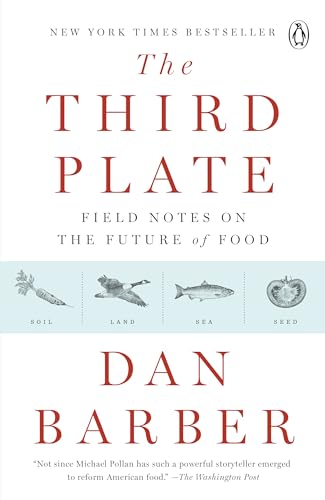
“Not since Michael Pollan has such a powerful storyteller emerged to reform American food.” —The Washington Post
Today’s optimistic farm-to-table food culture has a dark secret: the local food movement has failed to change how we eat. It has also offered a false promise for the future of food. In his visionary New York Times–bestselling book, chef Dan Barber, recently showcased on Netflix’s Chef’s Table, offers a radical new way of thinking about food that will heal the land and taste good, too. Looking to the detrimental cooking of our past, and the misguided dining of our present, Barber points to a future “third plate”: a new form of American eating where good farming and good food intersect. Barber’s The Third Plate charts a bright path forward for eaters and chefs alike, daring everyone to imagine a future for our national cuisine that is as sustainable as it is delicious.
Die Inhaltsangabe kann sich auf eine andere Ausgabe dieses Titels beziehen.
Über die Autorin bzw. den Autor
Dan Barber, who was recently showcased on Netflix's Chef's Table, is the executive chef of Blue Hill, a restaurant in Manhattan’s West Village, and Blue Hill at Stone Barns, located within the nonprofit farm Stone Barns Center for Food & Agriculture. He lives in New York City.
Auszug. © Genehmigter Nachdruck. Alle Rechte vorbehalten.
INTRODUCTION
A corncob, dried and slightly shriveled, arrived in the mail not long after we opened Blue Hill at Stone Barns. Along with the cob was a check for $1,000. The explanation arrived the same day, in an e-mail I received from Glenn Roberts, a rare-seeds collector and supplier of specialty grains. Since Blue Hill is part of the Stone Barns Center for Food and Agriculture, a multipurpose farm and education center, Glenn wanted my help persuading the vegetable farmer to plant the corn in the spring. He said the corn was a variety called New England Eight Row Flint.
There is evidence, Glenn told me, that Eight Row Flint corn dates back to the 1600s, when, for a time, it was considered a technical marvel. Not only did it consistently produce eight fat rows of kernels (four or five was the norm back then; modern cobs have eighteen to twenty rows), but it also had been carefully selected by generations of Native Americans for its distinctive flavor. By the late 1700s the corn was widely planted in western New England and the lower Hudson Valley, and later it was found as far as southern Italy. But a brutally cold winter in 1816 wiped out the New England crop. Seed reserves were exhausted to near extinction as most of the stockpiled corn went to feed people and livestock.
The cob Glenn had sent was from a line that had survived for two hundred years in Italy under the name Otto File (“eight rows”), which he hoped to restore to its place of origin. By planting the seed, he wrote, we would be growing “an important and threatened historic flavor of Italy while simultaneously repatriating one of New England’s extinct foodways. Congratulations on your quest, Dan, and thank you for caring.” Glenn added, in case I didn’t care, that the Eight Row was “quite possibly the most flavorful polenta corn on the planet, and absolutely unavailable in the U.S.” At harvest he promised another $1,000. He wanted nothing in return, other than a few cobs to save for seed.
If his offer sounds like a home run for Stone Barns, it was. Here was a chance to recapture a regional variety and to honor a Native American crop with historical significance. For me, it was a chance to cook with an ingredient no other restaurant could offer on its menu (catnip for any chef) and to try the superlative polenta for myself.
Yet I carried the corncob over to Jack Algiere, the vegetable farmer, with little enthusiasm. Jack is not a fan of growing corn, and, with only eight acres of field production on the farm, you can’t blame him for dismissing a plant that demands so much real estate. Corn is needy in other ways, too. It’s gluttonous, requiring, for example, large amounts of nitrogen to grow. From the perspective of a vegetable gardener, it’s the biological equivalent of a McMansion.
In the early stages of planning Stone Barns Center, I told Jack about a farmer who was harvesting immature corn for our menu. It was a baby cob, just a few inches long, the kernels not yet visible. You ate the whole cob, which brought to mind the canned baby corn one finds in a mediocre vegetable stir-fry. Except these tiny cobs were actually tasty. I wanted to impress Jack with the novelty of the idea. He was not impressed.
“You mean your farmer grows the whole stalk and then picks the cobs when they’re still little?” he said, his face suddenly scrunched up, as if he were absorbing a blow to the gut. “That’s nuts.” He bent over and nearly touched the ground with his right hand, then stood up on his toes and, with his left hand, reached up, high above my head, hiking his eyebrows to indicate just how tall a corn’s stalk grows. “Only after all that growth will corn even begin to think about producing the cob. That big, thirsty, jolly green giant of a stalk—which even when it produces full-size corn has to be among the plant kingdom’s most ridiculous uses of Mother Nature’s energy—and what are you getting for all that growth? You’re getting this.” He flashed his pinky finger. “That’s all you’re getting.” He rotated his hand so I could see his finger from all angles. “One tiny, pretty flavorless bite of corn.”
One summer when I was fourteen years old, Blue Hill Farm, my family’s farm in Massachusetts, grew only corn. No one can remember why. But it was the strangest summer. I think back to it now with the same sense of bewilderment I felt as a child encountering the sea of gold tassels where the grass had always been.
Before Blue Hill Farm became a corn farm for a summer, I helped make hay for winter storage from one of the eight pasture fields. We began in early August, loading bales onto a conveyor belt and methodically packing them, Lego-like, into the barn’s stadium-size second floor. By Labor Day the room was filled nearly to bursting, its own kind of landscape.
Making hay meant first cutting the grass, which—for me, anyway—meant riding shotgun in a very large tractor for hours each day, crouching silently next to one of the farmers and studying the contours of the fields. And so, by way of no special talent, just repetition, I learned to anticipate the dips and curves in the fields, the muddy, washed-out places, the areas of thick shrubbery and thinned grasses—when to brace for a few minutes of a bumpy ride and when to duck under a protruding branch.
I internalized those bumps and curves the way my grandmother Ann Strauss internalized the bumps and curves of Blue Hill Road by driving it for thirty years. She always seemed to be going to town (to get her hair done) or coming back (from running errands). Sometimes my brother, David, and I were with her, and we used to laugh in the backseat, because Ann (never “Grandma,” never “Grandmother”) rounded the corners in her Chevy Impala at incredible speeds, maneuvering with the ease and fluency of a practiced finger moving over braille. Her head was often cranked to the left or to the right, antennae engaged, inspecting a neighbor’s garden or a renovated screened-in porch. (She sometimes narrated the intrigue happening inside.) During these moments her body took over, autopiloting around corners without having to slow down, swerving slightly to avoid the ditch just beyond Bill Riegleman’s home.
Often, on the last leg of the drive, Ann would tell us the story of how she came to buy the farm in the 1960s, a story she had told a thousand times before. Back then, the property was a dairy operation owned by the Hall brothers, whose family had farmed the land since the late 1800s.
“You know, I used to walk up this road every week for years; sometimes every day,” she would say, as if telling the story for the first time. “I loved Blue Hill Farm more than any place in the world.” At the top of Blue Hill Road was four hundred acres of open pasture. “But what a mess! I couldn’t believe it, really. They had cows pasturing in the front yard. The house was run-down, and so dirty. They didn’t have a front door—climbed in and out through the kitchen window, for heaven’s sake. And you know what? I loved it. I loved the fields, I loved the backdrop of blue hills, I loved that I felt like a queen every time I came up here.”
Whenever Ann saw the Hall brothers, she would let them know she wanted to buy the farm. “But they just laughed. ‘Ms. Strauss,’ they’d say, ‘this farm’s been in our family for three generations. We’re never selling.’ So I’d return the next week, and they’d say...
„Über diesen Titel“ kann sich auf eine andere Ausgabe dieses Titels beziehen.
Suchergebnisse für The Third Plate: Field Notes on the Future of Food

Beispielbild für diese ISBN
The Third Plate Field Notes on
Anbieter: World of Books (was SecondSale), Montgomery, IL, USA
Verkäuferbewertung 5 von 5 Sternen

Zustand: Good. Item in good condition. Textbooks may not include supplemental items i.e. CDs, access codes etc. Bestandsnummer des Verkäufers 00101381596
Gebraucht kaufen
EUR 3,59
Versand gratis
Versand innerhalb von USA
Versand innerhalb von USA
Anzahl: Mehr als 20 verfügbar
Beispielbild für diese ISBN
The Third Plate: Field Notes on the Future of Food
Anbieter: Your Online Bookstore, Houston, TX, USA
Verkäuferbewertung 5 von 5 Sternen
Paperback. Zustand: Fair. Bestandsnummer des Verkäufers 0143127152-4-25658336
Gebraucht kaufen
EUR 3,60
Versand gratis
Versand innerhalb von USA
Versand innerhalb von USA
Anzahl: 1 verfügbar
Foto des Verkäufers
The Third Plate: Field Notes on the Future of Food
Anbieter: Zoom Books East, Glendale Heights, IL, USA
Verkäuferbewertung 5 von 5 Sternen
Zustand: good. Book is in good condition and may include underlining highlighting and minimal wear. The book can also include "From the library of" labels. May not contain miscellaneous items toys, dvds, etc. . We offer 100% money back guarantee and 24 7 customer service. Bestandsnummer des Verkäufers ZEV.0143127152.G
Gebraucht kaufen
EUR 3,96
Versand gratis
Versand innerhalb von USA
Versand innerhalb von USA
Anzahl: 1 verfügbar
Foto des Verkäufers
The Third Plate: Field Notes on the Future of Food
Anbieter: Zoom Books Company, Lynden, WA, USA
Verkäuferbewertung 5 von 5 Sternen
Zustand: very_good. Book is in very good condition and may include minimal underlining highlighting. The book can also include "From the library of" labels. May not contain miscellaneous items toys, dvds, etc. . We offer 100% money back guarantee and 24 7 customer service. Bestandsnummer des Verkäufers ZBV.0143127152.VG
Gebraucht kaufen
EUR 4,43
Versand gratis
Versand innerhalb von USA
Versand innerhalb von USA
Anzahl: 1 verfügbar
Beispielbild für diese ISBN
The Third Plate: Field Notes on the Future of Food
Verlag:
Penguin Books (edition Reprint), 2015
ISBN 10: 0143127152
ISBN 13: 9780143127154
Gebraucht
Paperback
Anbieter: BooksRun, Philadelphia, PA, USA
Verkäuferbewertung 5 von 5 Sternen
Paperback. Zustand: Very Good. Reprint. It's a well-cared-for item that has seen limited use. The item may show minor signs of wear. All the text is legible, with all pages included. It may have slight markings and/or highlighting. Bestandsnummer des Verkäufers 0143127152-11-1
Gebraucht kaufen
EUR 4,62
Versand gratis
Versand innerhalb von USA
Versand innerhalb von USA
Anzahl: 1 verfügbar
Beispielbild für diese ISBN
The Third Plate: Field Notes on the Future of Food
Anbieter: Evergreen Goodwill, Seattle, WA, USA
Verkäuferbewertung 5 von 5 Sternen
paperback. Zustand: Acceptable. Bestandsnummer des Verkäufers mon0000682463
Gebraucht kaufen
EUR 1,79
EUR 3,44 Versand
Versand innerhalb von USA
Versand innerhalb von USA
Anzahl: 1 verfügbar
Foto des Verkäufers
The Third Plate: Field Notes on the Future of Food
Anbieter: 2nd Life Books, Burlington, NJ, USA
Verkäuferbewertung 5 von 5 Sternen
Zustand: very_good. Used book in very good condition. May have some minor wear. May NOT include discs, or access code or other supplemental material. Ships directly from Amazon and is eligible for Prime or super saver FREE shipping. We ship Monday-Saturday and respond to inquiries within 24 hours. Bestandsnummer des Verkäufers BXM.E64H
Gebraucht kaufen
EUR 1,79
EUR 3,45 Versand
Versand innerhalb von USA
Versand innerhalb von USA
Anzahl: 1 verfügbar
Foto des Verkäufers
The Third Plate: Field Notes on the Future of Food
Anbieter: ZBK Books, Carlstadt, NJ, USA
Verkäuferbewertung 5 von 5 Sternen
Zustand: good. Fast & Free Shipping â" Good condition. It may show normal signs of use, such as light writing, highlighting, or library markings, but all pages are intact and the book is fully readable. A solid, complete copy that's ready to enjoy. Bestandsnummer des Verkäufers ZWV.0143127152.G
Gebraucht kaufen
EUR 5,24
Versand gratis
Versand innerhalb von USA
Versand innerhalb von USA
Anzahl: 1 verfügbar
Beispielbild für diese ISBN
The Third Plate: Field Notes on the Future of Food
Verlag:
Penguin Books (edition Reprint), 2015
ISBN 10: 0143127152
ISBN 13: 9780143127154
Gebraucht
Paperback
Anbieter: BooksRun, Philadelphia, PA, USA
Verkäuferbewertung 5 von 5 Sternen
Paperback. Zustand: Fair. Reprint. The item might be beaten up but readable. May contain markings or highlighting, as well as stains, bent corners, or any other major defect, but the text is not obscured in any way. Bestandsnummer des Verkäufers 0143127152-7-1-13
Gebraucht kaufen
EUR 5,54
Versand gratis
Versand innerhalb von USA
Versand innerhalb von USA
Anzahl: 1 verfügbar
Beispielbild für diese ISBN
The Third Plate: Field Notes on the Future of Food
Anbieter: ThriftBooks-Dallas, Dallas, TX, USA
Verkäuferbewertung 5 von 5 Sternen
Paperback. Zustand: Fair. No Jacket. Readable copy. Pages may have considerable notes/highlighting. ~ ThriftBooks: Read More, Spend Less. Bestandsnummer des Verkäufers G0143127152I5N00
Gebraucht kaufen
EUR 5,76
Versand gratis
Versand innerhalb von USA
Versand innerhalb von USA
Anzahl: 1 verfügbar