
Verwandte Artikel zu Renewable Fuel Standard: Potential Economic and Environmenta...
Renewable Fuel Standard: Potential Economic and Environmental Effects of U.S. Biofuel Policy - Softcover
Inhaltsangabe
In the United States, we have come to depend on plentiful and inexpensive energy to support our economy and lifestyles. In recent years, many questions have been raised regarding the sustainability of our current pattern of high consumption of nonrenewable energy and its environmental consequences. Further, because the United States imports about 55 percent of the nation's consumption of crude oil, there are additional concerns about the security of supply. Hence, efforts are being made to find alternatives to our current pathway, including greater energy efficiency and use of energy sources that could lower greenhouse gas (GHG) emissions such as nuclear and renewable sources, including solar, wind, geothermal, and biofuels. The United States has a long history with biofuels and the nation is on a course charted to achieve a substantial increase in biofuels.
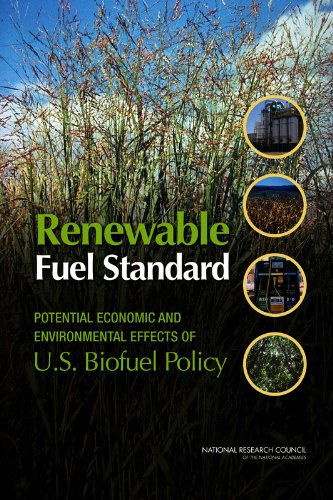
Renewable Fuel Standard evaluates the economic and environmental consequences of increasing biofuels production as a result of Renewable Fuels Standard, as amended by EISA (RFS2). The report describes biofuels produced in 2010 and those projected to be produced and consumed by 2022, reviews model projections and other estimates of the relative impact on the prices of land, and discusses the potential environmental harm and benefits of biofuels production and the barriers to achieving the RFS2 consumption mandate.
Policy makers, investors, leaders in the transportation sector, and others with concerns for the environment, economy, and energy security can rely on the recommendations provided in this report.
Die Inhaltsangabe kann sich auf eine andere Ausgabe dieses Titels beziehen.
Suchergebnisse für Renewable Fuel Standard: Potential Economic and Environmenta...

Beispielbild für diese ISBN
Renewable Fuel Standard: Potential Economic and Environmental Effects of U.S. Biofuel Policy
Verlag:
National Academies Press, 2012
ISBN 10: 0309187516
ISBN 13: 9780309187510
Gebraucht
paperback
Anbieter: Bookmonger.Ltd, HILLSIDE, NJ, USA
Verkäuferbewertung 5 von 5 Sternen

paperback. Zustand: Very Good. Crease on cover and a few pages*. Bestandsnummer des Verkäufers mon0000645753
Gebraucht kaufen
EUR 28,88
EUR 3,48 Versand
Versand innerhalb von USA
Versand innerhalb von USA
Anzahl: 1 verfügbar
Beispielbild für diese ISBN
Renewable Fuel Standard: Potential Economic and Environmental Effects of U.S. Biofuel Policy National Research Council; Division on Engineering and Physical Sciences; Board on Energy and Environmental Systems; Division on Earth and Life Studies; Board on Agriculture and Natural Resources and Committee on Economic and Environmental Impacts of Increasing Biofuels Production
Verlag:
National Academies Press, Washington, D.C, 2011
ISBN 10: 0309187516
ISBN 13: 9780309187510
Neu
Paperback
Anbieter: Fox and Tome Booksellers, Frederick, MD, USA
Verkäuferbewertung 4 von 5 Sternen

Paperback. Zustand: New. This 2011 report from the National Research Council examines the Renewable Fuel Standard (RFS2) established under the Energy Independence and Security Act of 2007, which mandated the production of 36 billion gallons of biofuels annually by 2022. The committee analyzes the economic feasibility of meeting these targets, the likely environmental consequences of expanded biofuel production on land use, water resources, air quality, and greenhouse gas emissions, and the potential effects on agricultural commodity markets. Drawing on contributions from multiple boards across engineering, earth sciences, and agriculture, the volume offers a technical assessment of whether cellulosic and conventional biofuels can realistically achieve the policy's stated goals. Bestandsnummer des Verkäufers NN-260429-shelf-7-006
Beispielbild für diese ISBN
Renewable Fuel Standard: Potential Economic and Environmental Effects of U.S. Biofuel Policy [Paperback] [Feb 28, 2012] Committee on Economic and Environmental Impacts of Increasing Biofuels Production and National Research Council
Verlag:
National Academies Press, 2011
ISBN 10: 0309187516
ISBN 13: 9780309187510
Gebraucht
Softcover
Anbieter: Hay-on-Wye Booksellers, Hay-on-Wye, HEREF, Vereinigtes Königreich
Verkäuferbewertung 4 von 5 Sternen
Zustand: Fine. Unused, minimal shelfwear, like new. Bestandsnummer des Verkäufers 084797-7a
Gebraucht kaufen
EUR 10,45
EUR 29,16 Versand
Versand von Vereinigtes Königreich nach USA
Versand von Vereinigtes Königreich nach USA
Anzahl: 1 verfügbar