
Verwandte Artikel zu Continuum Solvation Models in Chemical Physics: From...
Inhaltsangabe
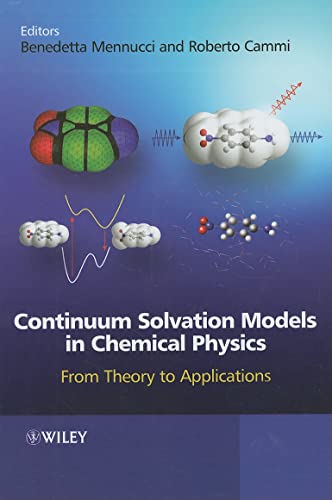
The modeling of liquids and solutions with computational tools is a very complex problem and many alternative theoretical models and computational algorithms have been proposed to-date. This text picks up on one specific of methods, namely continuum solvation models, which are widely used c computational techniques applied to the study of solvent effects on energy/geometry/reactivity and properties of very different molecular systems, i.e. from small molecules to very large biochemical systems such as proteins and enzymes. For the first time, salvation continuum models are treated in an up-to-date and coherent way using very different points of view coming from experts belonging to very different research fields including mathematicians, theoretical chemists, computational chemists, spectroscopists, etc.
To this end, the presentation of the various contributions follows a step-by-step scheme in which the physical bases of the models come first followed by an analysis of both mathematical and computational aspects and finally by a review on their applications to different physical-chemical problems.
The book is divided into four parts.
* The first focuses on a specific formulation of continuum solvation models using as a descriptor for the solvent polarization an apparent surface charge (ASC) spreading on the molecular cavity which contains the solute. The class of methods is central in the whole book as in recent years it has become the preferential approach to account of solvent effects in quantum mechanical calculations.
* The second presents extensions and generalizations of continuum solvation models to the calculation of molecular properties (both dynamic and static) an spectroscopic features of molecular solutes in different environments of increasing complexity.
* The third focuses on the modelization of static and dynamic solvent effects on ground state chemical reactivity and excited state reactive and non-reactive processes (electron and proton transfers as well energy transfers).
* The fourth presents extensions and generalizations of continuum models to classical molecular dynamics simulations, to layered and to hybrid methods as well as alternative methods starting from completely different theoretical bases but still having some elements in common with continuum solvation models.
Each part of the book presents two levels of reading - One, more introductory, on the given theoretical issue or on the given application, and the second more detailed, and hence more technical, on specific physical numerical aspects involved in each issue and/or application. Thus this book presents the main aspects and applications of conti8nuum solvation models in a clear and concise format, which will be useful to the expert researcher as well as to Ph.D. students and postdoctoral workers in theoretical chemistry, computational chemistry, physical chemistry and chemical engineering.
Die Inhaltsangabe kann sich auf eine andere Ausgabe dieses Titels beziehen.
Über die Autorin bzw. den Autor
Benedetta Mennucci and Roberto Cammi are the authors of Continuum Solvation Models in Chemical Physics: From Theory to Applications, published by Wiley.
Von der hinteren Coverseite
The modeling of liquids and solutions with computational tools is a very complex problem and many alternative theoretical models and computational algorithms have been proposed to-date. This text picks up on one specific of methods, namely continuum solvation models, which are widely used c computational techniques applied to the study of solvent effects on energy/geometry/reactivity and properties of very different molecular systems, i.e. from small molecules to very large biochemical systems such as proteins and enzymes. For the first time, salvation continuum models are treated in an up-to-date and coherent way using very different points of view coming from experts belonging to very different research fields including mathematicians, theoretical chemists, computational chemists, spectroscopists, etc.
To this end, the presentation of the various contributions follows a step-by-step scheme in which the physical bases of the models come first followed by an analysis of both mathematical and computational aspects and finally by a review on their applications to different physical-chemical problems.
The book is divided into four parts.
- The first focuses on a specific formulation of continuum solvation models using as a descriptor for the solvent polarization an apparent surface charge (ASC) spreading on the molecular cavity which contains the solute. The class of methods is central in the whole book as in recent years it has become the preferential approach to account of solvent effects in quantum mechanical calculations.
- strong>The second presents extensions and generalizations of continuum solvation models to the calculation of molecular properties (both dynamic and static) an spectroscopic features of molecular solutes in different environments of increasing complexity.
- strong>The third focuses on the modelization of static and dynamic solvent effects on ground state chemical reactivity and excited state reactive and non-reactive processes (electron and proton transfers as well energy transfers).
- The fourth presents extensions and generalizations of continuum models to classical molecular dynamics simulations, to layered and to hybrid methods as well as alternative methods starting from completely different theoretical bases but still having some elements in common with continuum solvation models.
Each part of the book presents two levels of reading - One, more introductory, on the given theoretical issue or on the given application, and the second more detailed, and hence more technical, on specific physical numerical aspects involved in each issue and/or application. Thus this book presents the main aspects and applications of conti8nuum solvation models in a clear and concise format, which will be useful to the expert researcher as well as to Ph.D. students and postdoctoral workers in theoretical chemistry, computational chemistry, physical chemistry and chemical engineering.
Aus dem Klappentext
The modeling of liquids and solutions with computational tools is a very complex problem and many alternative theoretical models and computational algorithms have been proposed to-date. This text picks up on one specific of methods, namely continuum solvation models, which are widely used c computational techniques applied to the study of solvent effects on energy/geometry/reactivity and properties of very different molecular systems, i.e. from small molecules to very large biochemical systems such as proteins and enzymes. For the first time, salvation continuum models are treated in an up-to-date and coherent way using very different points of view coming from experts belonging to very different research fields including mathematicians, theoretical chemists, computational chemists, spectroscopists, etc.
To this end, the presentation of the various contributions follows a step-by-step scheme in which the physical bases of the models come first followed by an analysis of both mathematical and computational aspects and finally by a review on their applications to different physical-chemical problems.
The book is divided into four parts.
* The first focuses on a specific formulation of continuum solvation models using as a descriptor for the solvent polarization an apparent surface charge (ASC) spreading on the molecular cavity which contains the solute. The class of methods is central in the whole book as in recent years it has become the preferential approach to account of solvent effects in quantum mechanical calculations.
* The second presents extensions and generalizations of continuum solvation models to the calculation of molecular properties (both dynamic and static) an spectroscopic features of molecular solutes in different environments of increasing complexity.
* The third focuses on the modelization of static and dynamic solvent effects on ground state chemical reactivity and excited state reactive and non-reactive processes (electron and proton transfers as well energy transfers).
* The fourth presents extensions and generalizations of continuum models to classical molecular dynamics simulations, to layered and to hybrid methods as well as alternative methods starting from completely different theoretical bases but still having some elements in common with continuum solvation models.
Each part of the book presents two levels of reading - One, more introductory, on the given theoretical issue or on the given application, and the second more detailed, and hence more technical, on specific physical numerical aspects involved in each issue and/or application. Thus this book presents the main aspects and applications of conti8nuum solvation models in a clear and concise format, which will be useful to the expert researcher as well as to Ph.D. students and postdoctoral workers in theoretical chemistry, computational chemistry, physical chemistry and chemical engineering.
„Über diesen Titel“ kann sich auf eine andere Ausgabe dieses Titels beziehen.
Suchergebnisse für Continuum Solvation Models in Chemical Physics: From...

Foto des Verkäufers
Continuum Solvation Models in Chemical Physics : From Theory to Applications
Anbieter: GreatBookPrices, Columbia, MD, USA
Verkäuferbewertung 5 von 5 Sternen

Zustand: As New. Unread book in perfect condition. Bestandsnummer des Verkäufers 4084813
Gebraucht kaufen
EUR 277,61
EUR 2,32 Versand
Versand innerhalb von USA
Versand innerhalb von USA
Anzahl: 7 verfügbar
Foto des Verkäufers
Continuum Solvation Models in Chemical Physics : From Theory to Applications
Anbieter: GreatBookPricesUK, Woodford Green, Vereinigtes Königreich
Verkäuferbewertung 5 von 5 Sternen
Zustand: As New. Unread book in perfect condition. Bestandsnummer des Verkäufers 4084813
Gebraucht kaufen
EUR 284,47
EUR 17,44 Versand
Versand von Vereinigtes Königreich nach USA
Versand von Vereinigtes Königreich nach USA
Anzahl: Mehr als 20 verfügbar
Beispielbild für diese ISBN
Continuum Solvation Models in Chemical Physics
Anbieter: Kennys Bookshop and Art Galleries Ltd., Galway, GY, Irland
Verkäuferbewertung 5 von 5 Sternen
Zustand: New. Continuum Solvation Models in Chemical Physics: From Theory to Applications presents and discusses the theory and applications of continuum solvation models. The main focus is on the quantum-mechanical version of these models, but classical approaches and combined or hybrid techniques are also discussed. Editor(s): Mennucci, Benedetta; Cammi, Roberto. Num Pages: 636 pages, Illustrations. BIC Classification: PNR. Category: (P) Professional & Vocational. Dimension: 249 x 177 x 40. Weight in Grams: 1276. . 2007. . . . . Bestandsnummer des Verkäufers V9780470029381
Neu kaufen
EUR 319,96
EUR 9,50 Versand
Versand von Irland nach USA
Versand von Irland nach USA
Anzahl: 15 verfügbar
Beispielbild für diese ISBN
Continuum Solvation Models in Chemical Physics: From Theory to Applications
Anbieter: Ubiquity Trade, Miami, FL, USA
Verkäuferbewertung 5 von 5 Sternen
Zustand: New. Brand new! Please provide a physical shipping address. Bestandsnummer des Verkäufers 9780470029381
Neu kaufen
EUR 344,25
EUR 2,63 Versand
Versand innerhalb von USA
Versand innerhalb von USA
Anzahl: Mehr als 20 verfügbar
Foto des Verkäufers
Continuum Solvation Models in Chemical Physics : From Theory to Applications
Anbieter: GreatBookPrices, Columbia, MD, USA
Verkäuferbewertung 5 von 5 Sternen
Zustand: New. Bestandsnummer des Verkäufers 4084813-n
Neu kaufen
EUR 344,57
EUR 2,32 Versand
Versand innerhalb von USA
Versand innerhalb von USA
Anzahl: 7 verfügbar
Foto des Verkäufers
Continuum Solvation Models in Chemical Physics : From Theory to Applications
Anbieter: GreatBookPricesUK, Woodford Green, Vereinigtes Königreich
Verkäuferbewertung 5 von 5 Sternen
Zustand: New. Bestandsnummer des Verkäufers 4084813-n
Neu kaufen
EUR 340,66
EUR 17,44 Versand
Versand von Vereinigtes Königreich nach USA
Versand von Vereinigtes Königreich nach USA
Anzahl: Mehr als 20 verfügbar
Beispielbild für diese ISBN
Continuum Solvation Models in Chemical Physics
Anbieter: Kennys Bookstore, Olney, MD, USA
Verkäuferbewertung 5 von 5 Sternen
Zustand: New. Continuum Solvation Models in Chemical Physics: From Theory to Applications presents and discusses the theory and applications of continuum solvation models. The main focus is on the quantum-mechanical version of these models, but classical approaches and combined or hybrid techniques are also discussed. Editor(s): Mennucci, Benedetta; Cammi, Roberto. Num Pages: 636 pages, Illustrations. BIC Classification: PNR. Category: (P) Professional & Vocational. Dimension: 249 x 177 x 40. Weight in Grams: 1276. . 2007. . . . . Books ship from the US and Ireland. Bestandsnummer des Verkäufers V9780470029381
Neu kaufen
EUR 404,40
EUR 9,22 Versand
Versand innerhalb von USA
Versand innerhalb von USA
Anzahl: 15 verfügbar