
Verwandte Artikel zu Up Your Business!: 7 Steps to Fix, Build, or Stretch...
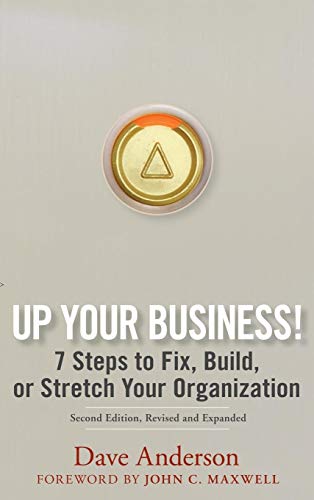
Inhaltsangabe
Praise for the first edition of Up Your Business!
"Dave Anderson has hit another home run! Up Your Business! is an invaluable, highly readable guide that should be on the desk--and in the mind--of anyone demanding top-level performance from themselves and others."
--James Strock, author, Reagan on Leadership and Theodore Roosevelt on Leadership
"Up Your Business! is a powerful blueprint for companies looking to take their business to the next level. It is one of the most powerful books on business and leadership I have ever read and will be a major component of Saga Communications' leadership training."
--Warren Lada, Senior Vice President, Saga Communications, Inc.
"Once again, Dave Anderson puts it all together in a way that almost makes you think he's been looking over your shoulder all these years. Chapter two alone, 'Abolish Corporate Welfare: Create a Culture of Merit,' is worth the time it takes to read the entire book."
--Mike Roscoe, founder and President, Horizon Communications
"Finally . . . a business book that gets to the heart of what matters and creates usable templates that could help any business thrive."
--Roxanne Emmerich, author, Thank God It's Monday!
Die Inhaltsangabe kann sich auf eine andere Ausgabe dieses Titels beziehen.
Über die Autorin bzw. den Autor
DAVE ANDERSON is an entrepreneur, columnist, trainer, speaker, and author of two other Wiley books, If You Don’t Make Waves, You’ll Drown and How to Deal with Difficult Customers. He is also President of Dave Anderson’s Learn To Lead and LearnToLead.com, a cutting-edge Web site that provides free training resources for business leaders.
Von der hinteren Coverseite
Up Your Business!, Second Edition is a no-holds-barred manifesto on making your organization perform at the highest possible level. Straightforward, honest, and in your face, it doesn’t offer empty buzzwords or mysterious acronyms or questionable cure-alls. It outlines seven no-nonsense steps you can take to fix, build, or stretch your business. This revised edition is better than ever, featuring updated strategies at the end of each chapter. In addition, a new final chapter called “Closing the Gap Between Knowing and Doing” equips you with the tools and inspiration to successfully implement the book’s strategies.
Up Your Business!, Second Edition proves it takes quality leaders to build quality companies. If your business is struggling, look in the mirror first, then get to work with these seven vital steps:
Step one: Hire the right people. With tips and tools for recruiting and interviewing, you’ll learn to bring in the people who can take your business to a higher level―and get rid of the ones who can’t.
Step two: Replace your culture of entitlement with a culture of merit. Learn to produce positive pressure to perform and reward the people who can get you to the top.
Step three: Develop the talent you bring in. Use easy step-by-step methods and proven tools to train, coach, and mentor your people.
Step four: Think BIG and set unreasonable goals. Now that you’ve got the right people in place and built a culture of merit and success, it’s time to go for it!
Step five: Be the leader your business deserves. Ensure your company’s growth and vitality by executing the vital daily disciplines that only a leader can accomplish.
Step six: Survive success. Overcome the six temptations that undermine successful organizations.
Step seven: Get down to business! Follow through on the principles you’ve learned and institutionalize them for sustainable, long-term benefit.
Whether you lead a Fortune 500 company or a mom-and-pop small business, quality leadership is the key to unlimited success. Up Your Business!, Second Edition offers tried-and-true leadership principles and real examples that will help you take responsibility, take control, and take your business to the top.
Aus dem Klappentext
Up Your Business!, Second Edition is a no-holds-barred manifesto on making your organization perform at the highest possible level. Straightforward, honest, and in your face, it doesn't offer empty buzzwords or mysterious acronyms or questionable cure-alls. It outlines seven no-nonsense steps you can take to fix, build, or stretch your business. This revised edition is better than ever, featuring updated strategies at the end of each chapter. In addition, a new final chapter called "Closing the Gap Between Knowing and Doing" equips you with the tools and inspiration to successfully implement the book's strategies.
Up Your Business!, Second Edition proves it takes quality leaders to build quality companies. If your business is struggling, look in the mirror first, then get to work with these seven vital steps:
Step one: Hire the right people. With tips and tools for recruiting and interviewing, you'll learn to bring in the people who can take your business to a higher leveland get rid of the ones who can't.
Step two: Replace your culture of entitlement with a culture of merit. Learn to produce positive pressure to perform and reward the people who can get you to the top.
Step three: Develop the talent you bring in. Use easy step-by-step methods and proven tools to train, coach, and mentor your people.
Step four: Think BIG and set unreasonable goals. Now that you've got the right people in place and built a culture of merit and success, it's time to go for it!
Step five: Be the leader your business deserves. Ensure your company's growth and vitality by executing the vital daily disciplines that only a leader can accomplish.
Step six: Survive success. Overcome the six temptations that undermine successful organizations.
Step seven: Get down to business! Follow through on the principles you've learned and institutionalize them for sustainable, long-term benefit.
Whether you lead a Fortune 500 company or a mom-and-pop small business, quality leadership is the key to unlimited success. Up Your Business!, Second Edition offers tried-and-true leadership principles and real examples that will help you take responsibility, take control, and take your business to the top.
Auszug. © Genehmigter Nachdruck. Alle Rechte vorbehalten.
Up Your Business!
7 Steps to Fix, Build, or Stretch Your OrganizationBy Dave Anderson John C. MaxwellJohn Wiley & Sons
Copyright © 2007 John Wiley & Sons, LtdAll right reserved.
ISBN: 978-0-470-06856-4
Chapter One
Always Remember, "It's the People, Stupid!"
During the 1992 presidential election campaign, Bill Clinton's inner circle decided that the troubled economy was the theme their candidate would hammer to win the White House. Whenever a Clinton staffer invested time, energy, or resources strategizing or articulating foreign policy, world trade, or environmental issues, a cohort would bluntly chastise him with the words, "It's the economy, stupid." This not-so-gentle reminder became a mantra that created laserlike focus and steered the campaign to victory.
First Things First
Leaders wanting to fix, build, or stretch their organizations must employ the same tenacious resolve and embrace the business version of this mantra-"It's the people, stupid"-as the catalyst of measurable and sustainable growth. All organizations have goals, and most have strategies. Both, however, are irrelevant if the right people aren't in place to execute them. In fact, a great dream with the wrong team is a nightmare because bold goals pursued by mediocre people still result in mediocre results. Grand plans designed at off-site meetings and facilitated by costly experts are rendered impotent when employed by the marginal, mediocre, or moronic. Most organizations suffer from a reality gap. The chasm between the leader's forecast and the realities of his people's abilities renders their goals unrealistic from day one.
Business leaders have no control over weather, the economy, interest rates, or competitors' actions; yet pondering or worrying about these issues often consumes much of their day. What a leader can control is who joins or leaves the team and how to develop those on board. Unfortunately, most leaders make poor use of this liberty. To fix, build, or stretch an organization, a leader must exercise one of leadership's greatest privileges proactively and aggressively: deciding whom to keep and whom to lose.
Dave Maxwell, after being hired to turn around Fannie Mae in 1981, related how the mortgage giant was losing $1 million per day and had nearly $60 billion in mortgage loans underwater. Naturally, the board was anxious and, when they met with Maxwell, they asked him about his vision and strategy for the company. Maxwell replied that asking where the company was going and how it would get there was the wrong first question; that before he made the journey his first order of business was to get the wrong people off the bus and the right people on the bus and to make sure the right people were sitting in the right seats. Then, he replied, they could focus all their energy on taking the bus somewhere great.
Soon after the board meeting, Maxwell met with his twenty-six key executives and laid it on the line. He told them the trip ahead was going to be difficult, that there would be major changes and tough decisions to make, and that people would be stretched and held accountable-but that for those who endeavored, the rewards would be great. He also told them that if they didn't think they could stomach the ride nobody would hate them if they left. Confronted with this challenge, fourteen of the twenty-six executives voluntarily exited the bus. The good news was that those who remained were totally committed, and Maxwell filled the vacant slots with some of the brightest minds in the finance business. Now he and his team were ready to take the bus on a ride to unprecedented heights. And what a ride it was. During Maxwell's reign, the same company that had lost $1 million per day was making $4 million per day and beating the general stock market returns 3.8 to 1 between 1984 and 1999. Maxwell retired while still at the top of his game, and the dream team he had attracted and developed drove the bus to equally impressive peaks. With focused discipline, Maxwell corrected the board's errant focus on vision and strategy, fixed his organization, and showed the world, "It's the people, stupid."
Get Proactive: Go from Hunted to Hunter
I sometimes wish I could find the man who gave me my first shot at management and apologize. I'd beg forgiveness for all the wrong people I hired who abused our resources, lowered team morale, and consistently broke our momentum. Don't get me wrong; I did have a recruiting, interviewing, and hiring strategy. In fact, I can describe it in one word: reactive. My strategy was to wait until we were shorthanded, run a worthless ad, and hire someone I liked with little regard to whether the person could do the job required.
Fortunately, I've learned a thing or two about building a team since then. In fact, I can sum up my current team-building strategy in four words: hire slow, fire fast. Leaders must be more proactive and deliberate in selecting employees. If you want great people you'd better be prepared to go find them yourself. You must go from waiting to be hunted to being a hunter. At the same time, you must remove poor performers more quickly. Both these concepts will be presented in detail throughout this chapter.
Unfortunately, much as I used to do, most managers don't recruit, interview, or hire until they're desperate. Soon, pressured by time and the need for coverage, they begin settling too early, too cheaply. Before long, however, they realize that a bird in the hand is not better than two in the bush if it's the wrong bird. (If you haven't read the book Hire with Your Head, by Lou Adler [Wiley, 1998], get it. In addition, go to Lou's web site, www.powerhiring.com, where you'll find one of the most valuable resources available to reinforce and coach you in the strategies for building a team.) Then, when managers realize they do have the wrong person, they cross their fingers, give a half-dozen second chances, and fail while trying to fix the unfixable for far too long.
Personally, I can't think of a better way for a leader to invest his or her time than in finding great people for the team. In fact, you have a choice of either investing time doing this or spending your time pushing the wrong people to do the right thing. Or, even worse, doing more of the work yourself because you have the wrong people. Since it's going to take plenty of work regardless of which path you choose, it's advisable to work in a manner that makes your future less frustrating and more productive. To build a team of eagles, you'll have to get past one of the most pervasive cop-outs in business: "There's a shortage of talented people where I live." I deliver approximately 150 speeches or training presentations annually, and it doesn't matter whether I'm in Manhattan, in Brunswick, Georgia, or in Devils Lake, North Dakota; every time I speak to managers I hear this whimper. Everyone likes to think their situation is unique, that finding good people is an impossible task reserved especially for them. I hate to be the one to kick the crutch out from under you but here is the fact: There is no shortage of talented people in any market area. The Creator didn't suddenly stop churning out talented people. It's just that the most talented people already have jobs! They're not perusing the want ads or knocking on your door with hat in hand. I don't say these next couple of sentences to be condescending or sarcastic, but your best job candidates are not the unemployed. I understand there are exceptions-focus on the rule. Some of these people have waited for...
„Über diesen Titel“ kann sich auf eine andere Ausgabe dieses Titels beziehen.
Suchergebnisse für Up Your Business!: 7 Steps to Fix, Build, or Stretch...

Beispielbild für diese ISBN
Up Your Business!: 7 Steps to Fix, Build, or Stretch Your Organization
Anbieter: Your Online Bookstore, Houston, TX, USA
Verkäuferbewertung 5 von 5 Sternen

hardcover. Zustand: Good. Bestandsnummer des Verkäufers 0470068566-3-35957767
Gebraucht kaufen
EUR 4,43
Versand gratis
Versand innerhalb von USA
Versand innerhalb von USA
Anzahl: 1 verfügbar
Beispielbild für diese ISBN
Up Your Business!: 7 Steps to Fix, Build, or Stretch Your Organization
Anbieter: Gulf Coast Books, Cypress, TX, USA
Verkäuferbewertung 5 von 5 Sternen
hardcover. Zustand: Good. Bestandsnummer des Verkäufers 0470068566-3-34789249
Gebraucht kaufen
EUR 4,43
Versand gratis
Versand innerhalb von USA
Versand innerhalb von USA
Anzahl: 1 verfügbar
Beispielbild für diese ISBN
Aktionskammarn
Anbieter: World of Books (was SecondSale), Montgomery, IL, USA
Verkäuferbewertung 5 von 5 Sternen
Zustand: Acceptable. Item in acceptable condition! Textbooks may not include supplemental items i.e. CDs, access codes etc. Bestandsnummer des Verkäufers 00101980418
Gebraucht kaufen
EUR 4,44
Versand gratis
Versand innerhalb von USA
Versand innerhalb von USA
Anzahl: 1 verfügbar
Beispielbild für diese ISBN
Aktionskammarn
Anbieter: World of Books (was SecondSale), Montgomery, IL, USA
Verkäuferbewertung 5 von 5 Sternen
Zustand: Good. Item in good condition. Textbooks may not include supplemental items i.e. CDs, access codes etc. Bestandsnummer des Verkäufers 00103905305
Gebraucht kaufen
EUR 4,44
Versand gratis
Versand innerhalb von USA
Versand innerhalb von USA
Anzahl: 2 verfügbar
Foto des Verkäufers
Up Your Business!: 7 Steps to Fix, Build, or Stretch Your Organization
Anbieter: Greenworld Books, Arlington, TX, USA
Verkäuferbewertung 5 von 5 Sternen
Zustand: good. Fast Free Shipping â" Good condition. It may show normal signs of use, such as light writing, highlighting, or library markings, but all pages are intact and the book is fully readable. A solid, complete copy that's ready to enjoy. Bestandsnummer des Verkäufers GWV.0470068566.G
Gebraucht kaufen
EUR 4,81
Versand gratis
Versand innerhalb von USA
Versand innerhalb von USA
Anzahl: 1 verfügbar
Beispielbild für diese ISBN
Up Your Business!: 7 Steps to Fix, Build, or Stretch Your Organization
Anbieter: HPB-Red, Dallas, TX, USA
Verkäuferbewertung 5 von 5 Sternen
hardcover. Zustand: Very Good. Connecting readers with great books since 1972! Used textbooks may not include companion materials such as access codes, etc. May have some wear or limited writing/highlighting. We ship orders daily and Customer Service is our top priority! Bestandsnummer des Verkäufers S_458045863
Gebraucht kaufen
EUR 2,68
EUR 3,25 Versand
Versand innerhalb von USA
Versand innerhalb von USA
Anzahl: 1 verfügbar
Beispielbild für diese ISBN
Up Your Business! : 7 Steps to Fix, Build, or Stretch Your Organization
Verlag:
Wiley & Sons, Incorporated, John, 2007
ISBN 10: 0470068566
ISBN 13: 9780470068564
Gebraucht
Hardcover
Anbieter: Better World Books, Mishawaka, IN, USA
Verkäuferbewertung 5 von 5 Sternen
Zustand: Good. 2nd Edition, Revised and Expanded. Former library copy. Pages intact with minimal writing/highlighting. The binding may be loose and creased. Dust jackets/supplements are not included. Includes library markings. Stock photo provided. Product includes identifying sticker. Better World Books: Buy Books. Do Good. Bestandsnummer des Verkäufers 4985032-6
Gebraucht kaufen
EUR 6,17
Versand gratis
Versand innerhalb von USA
Versand innerhalb von USA
Anzahl: 1 verfügbar
Beispielbild für diese ISBN
Up Your Business! : 7 Steps to Fix, Build, or Stretch Your Organization
Verlag:
Wiley & Sons, Incorporated, John, 2007
ISBN 10: 0470068566
ISBN 13: 9780470068564
Gebraucht
Hardcover
Anbieter: Better World Books: West, Reno, NV, USA
Verkäuferbewertung 5 von 5 Sternen
Zustand: Good. 2nd Edition, Revised and Expanded. Pages intact with minimal writing/highlighting. The binding may be loose and creased. Dust jackets/supplements are not included. Stock photo provided. Product includes identifying sticker. Better World Books: Buy Books. Do Good. Bestandsnummer des Verkäufers 4952227-6
Gebraucht kaufen
EUR 6,17
Versand gratis
Versand innerhalb von USA
Versand innerhalb von USA
Anzahl: 1 verfügbar
Beispielbild für diese ISBN
Up Your Business! : 7 Steps to Fix, Build, or Stretch Your Organization
Verlag:
Wiley & Sons, Incorporated, John, 2007
ISBN 10: 0470068566
ISBN 13: 9780470068564
Gebraucht
Hardcover
Anbieter: Better World Books, Mishawaka, IN, USA
Verkäuferbewertung 5 von 5 Sternen
Zustand: Very Good. 2nd Edition, Revised and Expanded. Pages intact with possible writing/highlighting. Binding strong with minor wear. Dust jackets/supplements may not be included. Stock photo provided. Product includes identifying sticker. Better World Books: Buy Books. Do Good. Bestandsnummer des Verkäufers 11064978-6
Gebraucht kaufen
EUR 6,17
Versand gratis
Versand innerhalb von USA
Versand innerhalb von USA
Anzahl: 1 verfügbar
Beispielbild für diese ISBN
Up Your Business! : 7 Steps to Fix, Build, or Stretch Your Organization
Verlag:
Wiley & Sons, Incorporated, John, 2007
ISBN 10: 0470068566
ISBN 13: 9780470068564
Gebraucht
Hardcover
Anbieter: Better World Books, Mishawaka, IN, USA
Verkäuferbewertung 5 von 5 Sternen
Zustand: Good. 2nd Edition, Revised and Expanded. Pages intact with minimal writing/highlighting. The binding may be loose and creased. Dust jackets/supplements are not included. Stock photo provided. Product includes identifying sticker. Better World Books: Buy Books. Do Good. Bestandsnummer des Verkäufers 4952227-6
Gebraucht kaufen
EUR 6,17
Versand gratis
Versand innerhalb von USA
Versand innerhalb von USA
Anzahl: 1 verfügbar