
Verwandte Artikel zu Active Credit Portfolio Management in Practice (Wiley...
Inhaltsangabe
State-of-the-art techniques and tools needed to facilitate effective credit portfolio management and robust quantitative credit analysis
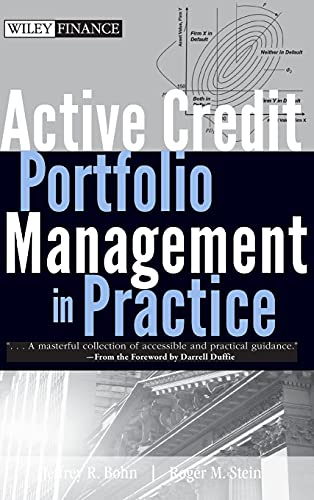
Filled with in-depth insights and expert advice, Active Credit Portfolio Management in Practice serves as a comprehensive introduction to both the theory and real-world practice of credit portfolio management. The authors have written a text that is technical enough both in terms of background and implementation to cover what practitioners and researchers need for actually applying these types of risk management tools in large organizations but which at the same time, avoids technical proofs in favor of real applications. Throughout this book, readers will be introduced to the theoretical foundations of this discipline, and learn about structural, reduced-form, and econometric models successfully used in the market today. The book is full of hands-on examples and anecdotes. Theory is illustrated with practical application. The authors' Website provides additional software tools in the form of Excel spreadsheets, Matlab code and S-Plus code. Each section of the book concludes with review questions designed to spark further discussion and reflection on the concepts presented.
Die Inhaltsangabe kann sich auf eine andere Ausgabe dieses Titels beziehen.
Über die Autorin bzw. den Autor
JEFFREY R. BOHN, PHD, leads the Financial Strategies group at Shinsei Bank in Tokyo. Previously, he led Moody's KMV's (MKMV's) Global Research group and MKMV's Credit Strategies group. After Moody's acquired KMV, he and Roger Stein coheaded MKMV's research and product development.
ROGER M. STEIN, PHD, is Group Managing Director of the newly formed Quantitative Research and Analytics group at Moody's Investors Service in New York. Previously, he was head of research for Moody's Risk Management Services. After Moody's acquired KMV, he and Jeffrey Bohn co-headed MKMV's research and product development.
Von der hinteren Coverseite
Despite numerous advances in the world of credit ranging from new methods for analyzing, managing, and trading credit risk to innovations in the structure of and markets for bank loans, bonds, and credit derivatives there is still much room for improvement.
With almost twenty years of experience in the credit arena, authors Jeffrey Bohn and Roger Stein are well versed in both the theory and practice of active credit portfolio management (ACPM). The models and systems their teams have developed are in use in hundreds of large and small financial institutions worldwide. In this detailed field guide, they lay out the steps for actually implementing approaches to ACPM in today's dynamic business environment and discuss how financial institutions of all sizes can benefit from more prudent use of quantitative credit and portfolio management.
Filled with in-depth insights and expert advice, Active Credit Portfolio Management in Practice opens with an informative introduction to credit analysis, credit portfolio management, and a number of organizational issues associated with ACPM in practice. The authors then move on to discuss a variety of probability of default (PD) and valuation models used in credit portfolio management systems including structural, econometric, and reduced-form as well as exploring some practical approaches to modeling loss given default (LGD). And since differentiating the usefulness of models is key to effective system implementation, Bohn and Stein have dedicated an entire chapter to model validation.
They then demonstrate how all of these pieces come together as they address practical strategies for credit portfolio modeling by focusing on estimating correlation and credit loss distributions. The final chapter puts all of these topics in perspective, by presenting a case study of a bank implementing the tools to build an ACPM and economic capital allocation function. This case study is drawn from a number of the actual implementations Bohn and Stein have participated in, and highlights the range of issues that often go beyond just choosing models when rolling out these systems in practice.
The book also contains supplemental material to complement it and facilitate its use for either classroom instruction or self-study. In particular, each chapter ends with review questions and exercises. Additional information including source code is located on the authors' companion Web site: www.creditrisklib.com.
Financial institutions without the infrastructure to measure, monitor, and manage their credit exposure run the risk of sudden and large credit losses. Active Credit Portfolio Management in Practice presents a framework for understanding and selectively implementing effective credit risk management and credit portfolio management systems one which can help organizations better position themselves in this evolving environment.
Aus dem Klappentext
Despite numerous advances in the world of credit—ranging from new methods for analyzing, managing, and trading credit risk to innovations in the structure of and markets for bank loans, bonds, and credit derivatives—there is still much room for improvement.
With almost twenty years of experience in the credit arena, authors Jeffrey Bohn and Roger Stein are well versed in both the theory and practice of active credit portfolio management (ACPM). The models and systems their teams have developed are in use in hundreds of large and small financial institutions worldwide. In this detailed field guide, they lay out the steps for actually implementing approaches to ACPM in today's dynamic business environment and discuss how financial institutions of all sizes can benefit from more prudent use of quantitative credit and portfolio management.
Filled with in-depth insights and expert advice, Active Credit Portfolio Management in Practice opens with an informative introduction to credit analysis, credit portfolio management, and a number of organizational issues associated with ACPM in practice. The authors then move on to discuss a variety of probability of default (PD) and valuation models used in credit portfolio management systems—including structural, econometric, and reduced-form—as well as exploring some practical approaches to modeling loss given default (LGD). And since differentiating the usefulness of models is key to effective system implementation, Bohn and Stein have dedicated an entire chapter to model validation.
They then demonstrate how all of these pieces come together as they address practical strategies for credit portfolio modeling by focusing on estimating correlation and credit loss distributions. The final chapter puts all of these topics in perspective, by presenting a case study of a bank implementing the tools to build an ACPM and economic capital allocation function. This case study is drawn from a number of the actual implementations Bohn and Stein have participated in, and highlights the range of issues that often go beyond just choosing models when rolling out these systems in practice.
The book also contains supplemental material to complement it and facilitate its use for either classroom instruction or self-study. In particular, each chapter ends with review questions and exercises. Additional information—including source code—is located on the authors' companion Web site: www.creditrisklib.com.
Financial institutions without the infrastructure to measure, monitor, and manage their credit exposure run the risk of sudden and large credit losses. Active Credit Portfolio Management in Practice presents a framework for understanding and selectively implementing effective credit risk management and credit portfolio management systems—one which can help organizations better position themselves in this evolving environment.
Auszug. © Genehmigter Nachdruck. Alle Rechte vorbehalten.
Active Credit Portfolio Management in Practice
By Jeffrey R. Bohn Roger M. SteinJohn Wiley & Sons
Copyright © 2009 Jeffrey R. Bohn and Roger M. SteinAll right reserved.
ISBN: 978-0-470-08018-4
Chapter One
The Framework: Definitions and Concepts
Commercial credit is the creation of modern times and belongs in its highest perfection only to the most enlightened and best governed nations. Credit is the vital air of the system of modern commerce. It has done more, a thousand times more, to enrich nations than all of the mines of the world. -Daniel Webster, 1934 (excerpt from speech in the U.S. Senate)
Theories of the known, which are described by different physical ideas, may be equivalent in all their predictions and are hence scientifically indistinguishable. However, they are not psychologically identical when trying to move from that base into the unknown. For different views suggest different kinds of modifications which might be made and hence are not equivalent in the hypotheses one generates from them in one's attempt to understand what is not yet understood. -Richard Feynman, 1965
Objectives
After reading this chapter, you should understand the following:
* Definition of credit.
* Evolution of credit markets.
* The importance of a portfolio perspective of credit.
* Conceptual building blocks of credit portfolio models.
* Conceptually how credit models are used in practice.
* The impact of bank regulation on portfolio management.
* Why we advocate active credit portfolio management (ACPM).
WHAT IS CREDIT?
Credit is one of the oldest innovations in commercial practice. Historically, credit has been defined in terms of the borrowing and lending of money. Credit transactions differ from other investments in the nature of the contract they represent. Contracts where fixed payments are determined up front over a finite time horizon differentiate a credit instrument from an equity instrument. Unlike credit instruments, equity instruments tend to have no specific time horizon in their structure and reflect a claim to a share of an entity's future profits, no matter how large these profits become. While some equity instruments pay dividends, these payments are not guaranteed, and most equity is defined by not having any predetermined fixed payments.
In contrast, traditional credit instruments facilitate transactions in which one party borrows from another with specified repayment terms over a specific horizon. These instruments include fixed-coupon bonds and floating-rate loans (the coupon payments are determined by adding a spread to an underlying benchmark rate such as the U.S. Treasury rate or LIBOR). Corporations are well-known issuers of these types of debt instruments; however, they are not the only borrowers. The past several decades have seen an explosion of consumer credit (particularly in the United States) in the form of home mortgages, credit card balances, and consumer loans. Other borrowers (also called obligors) include governments (usually termed sovereigns) and supranational organizations such as the World Bank. The credit risk of these instruments depends on the ability of the sovereign, corporation, or consumer to generate sufficient future cash flow (through operations or asset sales) to meet the interest and principal payments of the outstanding debt.
As financial engineering technology has advanced, the definition of credit has expanded to cover a wider variety of exposures through various derivative contracts whose risk and payoffs are dependent on the credit risk of some other instrument or entity. The key characteristic of these instruments is that, here again, the risk tends to lie in a predetermined payment stream over the life of the security or contract. Credit default swaps (CDS) exemplify this trend which aims to isolate the credit risk of a particular firm, the reference obligor, by linking a derivative's value to the solvency of the reference obligor, only. These contracts require the protection buyer to pay a regular fee (or spread) to the protection seller. In the event the reference obligor defaults (per the specification of the CDS contract), the protection seller is required to make the protection buyer whole per the terms of the contract. Conceptually, the contract represents an insurance policy between the buyer (the insured) and the seller (the insurance provider). Extending the metaphor, the regular fee represents an insurance premium and the payout in the event of default represents an insurance claim under the policy. While a myriad of contract types now trade in the market, fundamentally they all represent a view on the credit risk of the underlying reference obligor.
While a CDS refers to a single name, derivative contracts on indexes of many named obligors can also be purchased as contracts on a specific basket of assets. These instruments expand the ability of credit portfolio managers to manage a large number of exposures without always resorting to hedging on a name-by-name basis or selling assets outright.
A related set of securities requiring financial engineering are broadly defined as structured credit. Popular forms of structured credit (also known as securitization) include collateralized debt obligations (CDOs) and asset-backed securities (ABS). In recent times, the credit crisis has made discussion of CDOs and ABSs more common in the media. Many commentators have called for drastic measures to curtail the use of structured credit. While abuse of these instruments can increase risk in institutions and markets, structured financial products can also be used responsibly to reduce risk in the financial system. Some regional banks, for example, have successfully hedged the concentration risk in their portfolios that results from most of their loans being originated in a single geography. They do this by selling some of their portfolio risk via structured credit. Other investors have purchased this risk and integrated it into their own portfolios as diversifying investments, creating lower volatility portfolios with improved return per unit of risk profiles. All market participants benefit from this kind of trading. Of course, these instruments can be abused when combined with excessive leverage or when market participants attempt to speculate using structures they do not fully understand.
But even the simplest of financial instruments such as equity can be inappropriate for particular investors in certain situations. The same is true of structured credit. We try to be careful to distinguish the purpose from the characteristics of particular instruments.
Conceptually, the basic structure of these instruments is straightforward: A number of securities or derivative contracts called collateral are placed in a structure called a special purpose vehicle (SPV) or special purpose company (SPC), creating a corporate vehicle to direct the cash flows from the collateral. In its simplest form, the purpose of the SPV is to borrow cash, typically through debt issuance, and to use this cash to purchase the collateral: some type of credit-sensitive obligation. The collateral may be provided by a financial institution, such as a bank that issues mortgages, or purchased in the secondary market, such as the case of corporate bonds.
Why could not a...
„Über diesen Titel“ kann sich auf eine andere Ausgabe dieses Titels beziehen.
Suchergebnisse für Active Credit Portfolio Management in Practice (Wiley...

Beispielbild für diese ISBN
Active Credit Portfolio Management in Practice
Anbieter: World of Books (was SecondSale), Montgomery, IL, USA
Verkäuferbewertung 5 von 5 Sternen

Hardback. Zustand: Good. State-of-the-art techniques and tools needed to facilitate effective credit portfolio management and robust quantitative credit analysis Filled with in-depth insights and expert advice, Active Credit Portfolio Management in Practice serves as a comprehensive introduction to both the theory and real-world practice of credit portfolio management. Bestandsnummer des Verkäufers 00100917131
Gebraucht kaufen
EUR 17,79
Versand gratis
Versand innerhalb von USA
Versand innerhalb von USA
Anzahl: 2 verfügbar
Beispielbild für diese ISBN
Active Credit Portfolio Management in Practice
Anbieter: ThriftBooks-Atlanta, AUSTELL, GA, USA
Verkäuferbewertung 5 von 5 Sternen
Hardcover. Zustand: Very Good. No Jacket. May have limited writing in cover pages. Pages are unmarked. ~ ThriftBooks: Read More, Spend Less. Bestandsnummer des Verkäufers G0470080183I4N00
Gebraucht kaufen
EUR 17,80
Versand gratis
Versand innerhalb von USA
Versand innerhalb von USA
Anzahl: 1 verfügbar
Beispielbild für diese ISBN
Active Credit Portfolio Management in Practice
Anbieter: World of Books Inc, Montgomery, IL, USA
Verkäuferbewertung 4 von 5 Sternen

Hardback. Zustand: Good. State-of-the-art techniques and tools needed to facilitate effective credit portfolio management and robust quantitative credit analysis Filled with in-depth insights and expert advice, Active Credit Portfolio Management in Practice serves as a comprehensive introduction to both the theory and real-world practice of credit portfolio management. Bestandsnummer des Verkäufers CIN0470080183G
Gebraucht kaufen
EUR 19,63
Versand gratis
Versand innerhalb von USA
Versand innerhalb von USA
Anzahl: 2 verfügbar
Beispielbild für diese ISBN
Active Credit Portfolio Management in Practice
Verlag:
Wiley & Sons, Incorporated, John, 2009
ISBN 10: 0470080183
ISBN 13: 9780470080184
Gebraucht
Hardcover
Erstausgabe
Anbieter: Better World Books Ltd, Dunfermline, Vereinigtes Königreich
Verkäuferbewertung 5 von 5 Sternen
Zustand: Good. 1st Edition. Former library copy. Pages intact with minimal writing/highlighting. The binding may be loose and creased. Dust jackets/supplements are not included. Includes library markings. Stock photo provided. Product includes identifying sticker. Better World Books: Buy Books. Do Good. Bestandsnummer des Verkäufers 67979698-20
Gebraucht kaufen
EUR 17,83
EUR 5,92 Versand
Versand von Vereinigtes Königreich nach USA
Versand von Vereinigtes Königreich nach USA
Anzahl: 1 verfügbar
Foto des Verkäufers
Active Credit Portfolio Management in Practice. Wiley Finance
Anbieter: books4less (Versandantiquariat Petra Gros GmbH & Co. KG), Welling, Deutschland
Verkäuferbewertung 5 von 5 Sternen
gebundene Ausgabe. Zustand: Gut. 610 Seiten Der Erhaltungszustand des hier angebotenen Werks ist trotz seiner Bibliotheksnutzung sehr sauber und kann entsprechende Merkmale aufweisen (Rückenschild, Instituts-Stempel.). In ENGLISCHER Sprache. Sprache: Englisch Gewicht in Gramm: 895. Bestandsnummer des Verkäufers 2281527
Gebraucht kaufen
EUR 18,95
EUR 15,95 Versand
Versand von Deutschland nach USA
Versand von Deutschland nach USA
Anzahl: 1 verfügbar
Beispielbild für diese ISBN
Active Credit Portfolio Management in Practice: 384 (Wiley Finance)
Anbieter: Sell Books, Elland, YORKS, Vereinigtes Königreich
Verkäuferbewertung 5 von 5 Sternen
hardcover. Zustand: Very Good. Most of our very good books have only minor imperfections such as shelf wear consistent with a new book that's sat on a bookshop shelf for a year or two. Occasionally we may miss other minor imperfections as we have to grade books at speed. Our books are dispatched from a Yorkshire former cotton mill. We list via barcode/ISBN so please note that the images are stock images and may not be the exact copy you receive, furthermore the details about edition and year might not be accurate as many publishers reuse the same ISBN for multiple editions and as we simply scan a barcode or enter an ISBN we do not check the validity of the edition data when listing. If you're looking for an exact edition please don't order (at least not without checking with us first, although we don't always have time to check). We aim to dispatch prompty, the service used will depend on order value and book size. We can ship to most countries, see our shipping policies. Payment is via Abe only. Bestandsnummer des Verkäufers SBAB-mon0000076132
Gebraucht kaufen
EUR 31,40
EUR 13,50 Versand
Versand von Vereinigtes Königreich nach USA
Versand von Vereinigtes Königreich nach USA
Anzahl: 1 verfügbar
Beispielbild für diese ISBN
Active Credit Portfolio Management in Practice
Anbieter: Lakeside Books, Benton Harbor, MI, USA
Verkäuferbewertung 5 von 5 Sternen
Zustand: New. Brand New! Not Overstocks or Low Quality Book Club Editions! Direct From the Publisher! We're not a giant, faceless warehouse organization! We're a small town bookstore that loves books and loves it's customers! Buy from Lakeside Books! Bestandsnummer des Verkäufers OTF-S-9780470080184
Neu kaufen
EUR 62,28
EUR 3,56 Versand
Versand innerhalb von USA
Versand innerhalb von USA
Anzahl: Mehr als 20 verfügbar
Foto des Verkäufers
Active Credit Portfolio Management in Practice
Anbieter: GreatBookPrices, Columbia, MD, USA
Verkäuferbewertung 5 von 5 Sternen
Zustand: New. Bestandsnummer des Verkäufers 4224471-n
Neu kaufen
EUR 63,51
EUR 2,36 Versand
Versand innerhalb von USA
Versand innerhalb von USA
Anzahl: Mehr als 20 verfügbar
Foto des Verkäufers
Active Credit Portfolio Management in Practice
Anbieter: GreatBookPrices, Columbia, MD, USA
Verkäuferbewertung 5 von 5 Sternen
Zustand: As New. Unread book in perfect condition. Bestandsnummer des Verkäufers 4224471
Gebraucht kaufen
EUR 67,36
EUR 2,36 Versand
Versand innerhalb von USA
Versand innerhalb von USA
Anzahl: Mehr als 20 verfügbar
Beispielbild für diese ISBN
Active Credit Portfolio Management in Practice
Anbieter: PBShop.store UK, Fairford, GLOS, Vereinigtes Königreich
Verkäuferbewertung 5 von 5 Sternen
HRD. Zustand: New. New Book. Shipped from UK. Established seller since 2000. Bestandsnummer des Verkäufers FW-9780470080184
Neu kaufen
EUR 63,92
EUR 8,00 Versand
Versand von Vereinigtes Königreich nach USA
Versand von Vereinigtes Königreich nach USA
Anzahl: 15 verfügbar