
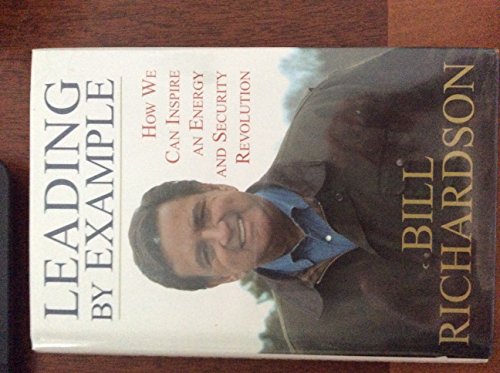
Verwandte Artikel zu Leading by Example: How We Can Inspire an Energy and...
Inhaltsangabe
Global climate change?
We can stop it.
Addiction to oil?We can replace it.
Technological innovation?
We can create it.
But we can't wait twenty, thirty, or fifty years.
Bill Richardson launched his campaign for the presidency to remind the American people--and their representatives in Washington--that we know how to get things done. We need to end our dependence on oil, and we need to do it yesterday.
This isn't something that's going to happen only in Washington, or Detroit, or even Hollywood or Tokyo. It's going to take all of us, a united United States. We have the opportunity, perhaps for only a few years, to make dramatic but beneficial changes in the way we run America.
As Leading by Example makes clear, if we succeed, with strong presidential leadership and the support of the American people, we will restore America's role in the world--a source of moral leadership, a source of astonishing technology, and a source of optimism to be admired.
We can stop it.
Addiction to oil?We can replace it.
Technological innovation?
We can create it.
But we can't wait twenty, thirty, or fifty years.
Bill Richardson launched his campaign for the presidency to remind the American people--and their representatives in Washington--that we know how to get things done. We need to end our dependence on oil, and we need to do it yesterday.
This isn't something that's going to happen only in Washington, or Detroit, or even Hollywood or Tokyo. It's going to take all of us, a united United States. We have the opportunity, perhaps for only a few years, to make dramatic but beneficial changes in the way we run America.
As Leading by Example makes clear, if we succeed, with strong presidential leadership and the support of the American people, we will restore America's role in the world--a source of moral leadership, a source of astonishing technology, and a source of optimism to be admired.
Die Inhaltsangabe kann sich auf eine andere Ausgabe dieses Titels beziehen.
Über die Autorin bzw. den Autor
Governor Bill Richardson (D-NM) has served as Secretary of Energy and Ambassador to the United Nations. Now, as the only candidate with executive and foreign policy experience, he presents an action program to sharply reduce America's oil dependence, build foreign policy on our principles instead of our addictions, and lead the world with energy and climate solutions that might just save millions of American jobs--and the planet.
Von der hinteren Coverseite
Global climate change?
We can stop it.
Addiction to oil?We can replace it.
Technological innovation?
We can create it.
But we can't wait twenty, thirty, or fifty years.
Bill Richardson launched his campaign for the presidency to remind the American people?and their representatives in Washington?that we know how to get things done. We need to end our dependence on oil, and we need to do it yesterday.
This isn't something that's going to happen only in Washington, or Detroit, or even Hollywood or Tokyo. It's going to take all of us, a united United States. We have the opportunity, perhaps for only a few years, to make dramatic but beneficial changes in the way we run America.
As Leading by Example makes clear, if we succeed, with strong presidential leadership and the support of the American people, we will restore America's role in the world?a source of moral leadership, a source of astonishing technology, and a source of optimism to be admired.
Aus dem Klappentext
America is just one crisis away from an energy emergency that will completely disrupt daily life, sharply increase energy prices, and perhaps even lead to a military intervention in world energy markets. Yet, as households and businesses suffer the impacts of our nation's worsening oil addiction, and as the world's atmosphere clogs with carbon pollution, there is just one bold, integrated, comprehensive energy program on the table. This is it.
In Leading by Example, Governor Richardson offers a positive, practical vision of the future that will eliminate our nation's crippling dependence on foreign oil, while rapidly cutting our climate-changing emissions. The program relies on new technologies and domestic energy sources, from renewables to efficiency and plug-in cars, that will grow the American economy while protecting our national security and restoring an oil-free foreign policy. Bill Richardson sees a thriving nation, invigorated by new opportunities, free from the constant threat of interrupted oil supplies, and finding innovative solutions for slowing and reversing global climate change. America will once again lead the world toward peace and prosperity. But to achieve these changes, America must move quickly.
Calling on every man, woman, and child in the United States to take part in an ambitious nationwide campaign to achieve energy independence in the very near future, Richardson lays out the details of a plan designed to:
Cut oil dependence 50 percent by 2020, including an 80 percent reduction in oil imports
Reduce carbon emissions 20 to 30 percent by 2020 and 90 percent by 2050
Quickly bring new automotive technologies to market
Develop, manufacture, and export energy-saving technologies
Decrease the need for American forces to defend world oil supplies
Meet energy demand much more efficiently across the economy
Develop, manufacture, and export energy-saving technologies
Restore America's leadership role in the world, from energy to climate to world peace and security
Governor Richardson knows that the American people are ready for change, eager to play their part, and impatient for leadership that addresses the energy-environment-security nexus as a whole. In Leading by Example, he sets the standard for a fully developed, well-considered energy plan?one that demands committed presidential leadership and deserves the support of the American people.
Auszug. © Genehmigter Nachdruck. Alle Rechte vorbehalten.
Leading by Example
How We Can Inspire an Energy and Security RevolutionBy Bill RichardsonJohn Wiley & Sons
Copyright © 2008 Bill RichardsonAll right reserved.
ISBN: 978-0-470-18637-4
Chapter One
No Challenge Is Greater or More Important
Several years ago, I had a visit from some oil executives in my Santa Fe office that signaled sharp, surprising, sudden changes in world energy markets.
The executives told me a story, a rather frightening story, about a liquefied natural gas (LNG) tanker that had been en route to the United States only the week before, carrying a load of natural gas under contract to a buyer in the United States.
The tanker had turned around, literally done a 180, when buyers in Asia decided to intercept that natural gas on its way to markets in the United States by paying the contract penalties and a price premium. I don't know whether it was day or night, stormy or quiet, but picture it: the diversion of a huge tanker carrying liquefied natural gas, out on the high seas. The order comes in. The tanker turns around. In a relatively stable, long-term market like that for natural gas, this was a big event. For a buyer to turn a huge LNG tanker around, and for U.S. buyers to face such unpredictable competition, marks a significantly new world.
Oil and gas markets are tightening. Global pressures from the explosion of economic growth in China and India are changing world oil and gas supply and demand, perhaps structurally. As a result, prices are higher than we expected they could ever reach. The price of oil broke through $70 per barrel in July 2007, even as the U.S. Senate passed a relatively toothless energy bill that does too little too late. (And that bill - with nothing to address climate change, renewable electricity mandates, or new incentives for alternative energy - still needs to clear several hurdles to become law.)
Gasoline costs are around three dollars a gallon. People can't afford these prices and the other everyday costs of living. Some are forced to make choices - bad choices between putting food on the table and getting to work, paying medical bills and staying warm, building their equity through education and filling the tank.
Meanwhile, the world's climate is starting to change around us. We humans have burned so much fossil energy that the atmosphere of the world we live in is warming. The results could be Earth-changing and hugely disruptive if we don't quickly change our energy technologies and fuels.
The executives who told me the LNG tanker story wanted my support for more oil and gas production in the United States, especially in New Mexico, where I have instituted new environmental controls and supported the protection of ecologically sensitive areas treasured by hunters, ranchers, and conservationists.
But my reaction was different. I know we're hooked on oil and gas, and I know that producing more and more won't cure that addiction. We should leave some resources in place for future generations, and we need a quick, decisive shift away from the energy policies that have put us where we are today.
Hearing that story further convinced me that we aren't doing nearly enough to create energy efficiency, to use renewable energy, to get new technologies into the marketplace so that our energy markets feature competition and choice. Seeing the energy legislation working through a divided Congress convinces me that the people making policy in Washington aren't acting boldly enough, by a long measure. Meeting people around the country on my presidential campaign travels convinces me that Americans want large changes that will bring down energy costs over time, create jobs in the United States, strengthen our national security, and protect the climate. The world is waiting.
I am confident about our nation's ability to address the energy challenge, but there is no question that the next president of the United States must provide the leadership to change our energy, security, and climate policies - or else. The country, even the world, can't afford to stay on the energy path we have taken. It directly threatens our national interests and undermines our national security, and it is a path we have returned to again and again over the past thirty years despite embargoes, trade deficits, wars, and price shocks.
I am not only confident in our nation's ability to address this energy challenge, I am also fully optimistic about it. This is a great opportunity for America. It is a time for optimism and positive ideas, not for pessimism and bowed heads.
Energy issues are big issues. They are all-encompassing. Every time a middle- or lower-income American pulls up to the gas pump, energy issues hit hard - right in the wallet. And these issues stretch all the way from the wallet to the atmosphere, where our global overdependence on fossil fuels clogs the climate with carbon dioxide, leading to global warming.
Our nation's dependence on oil threatens everything we care about, everything from our economy and environment to our national security to our atmosphere. Our dependence on oil creates targets for terrorists and other threats to our national security, from nuclear weapons to economic uncertainty. The states - including New Mexico, the "clean-energy state" - have done a lot to address the oil dependency challenge, but the federal government must be engaged at a far more intense level. We have become so dependent on oil because of our nation's failure to implement needed energy alternatives, from efficiency to clean cars to renewable energy.
Over recent years the price of oil has averaged about five times as high as it was when it bottomed out in the late 1990s. Now, in 2007, the price is about seven times what it was back then. As U.S. energy secretary from 1998 to 2001, I found that there was little appetite for alternatives when the price of oil went down to nine or ten dollars a barrel. Today, we see the error of our ways. The continuing petroleum price pendulum swings appear to catch us by surprise, even though for the past thirty years that same pendulum has been swinging in both directions, and hurting us badly when it swings the wrong way. Because the energy issue is so critical, we need to approach it with a much more focused and higher-priority campaign.
We need stability, diversity, competition, and sustainability in our energy supplies and energy technologies and practices. When oil is cheap, we seem to forget about the need to change. We can't afford a long-range campaign to get off oil, and we can't afford feel-good policies, because long-range and feel-good are how we got where we are today. And "today" includes 65 percent dependence on foreign oil, high energy prices, almost total reliance on fossil fuels (especially for transportation), and increasing climate pollution.
The reason I am optimistic and confident that we can change is that the technologies are available for us to do so. Further, we are already spending so much on energy that we will actually save money by converting our energy markets. Above all, however, the American people want change and they are enthusiastic about it. Everywhere I go, I encounter students, senior citizens, business people, scientists, entrepreneurs, inventors, factory workers, teachers - real people who want real change.
We're ready! We have seen enough to know that gradual, partial solutions don't work. We know that the sensible solutions are renewable and sustainable. We want to preserve Earth for future generations, not pollute it,...
„Über diesen Titel“ kann sich auf eine andere Ausgabe dieses Titels beziehen.
Suchergebnisse für Leading by Example: How We Can Inspire an Energy and...

Foto des Verkäufers
Leading by Example: How We Can Inspire an Energy and Security Revolution
Anbieter: -OnTimeBooks-, Phoenix, AZ, USA
Verkäuferbewertung 5 von 5 Sternen

Zustand: very_good. Gently read. May have name of previous ownership, or ex-library edition. Binding tight; spine straight and smooth, with no creasing; covers clean and crisp. Minimal signs of handling or shelving. 100% GUARANTEE! Shipped with delivery confirmation, if you're not satisfied with purchase please return item! Ships USPS Media Mail. Bestandsnummer des Verkäufers OTV.0470186372.VG
Gebraucht kaufen
EUR 6,22
Versand gratis
Versand innerhalb von USA
Versand innerhalb von USA
Anzahl: 1 verfügbar
Beispielbild für diese ISBN
Leading by Example: How We Can Inspire an Energy and Security Revolution
Anbieter: Wonder Book, Frederick, MD, USA
Verkäuferbewertung 5 von 5 Sternen
Zustand: Good. Good condition. Very Good dust jacket. A copy that has been read but remains intact. May contain markings such as bookplates, stamps, limited notes and highlighting, or a few light stains. Bestandsnummer des Verkäufers B11A-04890
Gebraucht kaufen
EUR 6,35
Versand gratis
Versand innerhalb von USA
Versand innerhalb von USA
Anzahl: 1 verfügbar
Foto des Verkäufers
Leading by Example: How We Can Inspire an Energy and Security Revolution
Anbieter: Greenworld Books, Arlington, TX, USA
Verkäuferbewertung 5 von 5 Sternen
Zustand: very_good. Fast Free Shipping â" Very Good condition book with a firm cover and clean pages. Shows normal use and some light wear or limited notes markings. A solid, nice copy to enjoy. Bestandsnummer des Verkäufers GWV.0470186372.VG
Gebraucht kaufen
EUR 6,48
Versand gratis
Versand innerhalb von USA
Versand innerhalb von USA
Anzahl: 1 verfügbar
Beispielbild für diese ISBN
Leading by Example : How We Can Inspire an Energy and Security Revolution
Verlag:
Wiley & Sons Canada, Limited, John, 2007
ISBN 10: 0470186372
ISBN 13: 9780470186374
Gebraucht
Hardcover
Anbieter: Better World Books, Mishawaka, IN, USA
Verkäuferbewertung 5 von 5 Sternen
Zustand: Very Good. Former library copy. Pages intact with possible writing/highlighting. Binding strong with minor wear. Dust jackets/supplements may not be included. Includes library markings. Stock photo provided. Product includes identifying sticker. Better World Books: Buy Books. Do Good. Bestandsnummer des Verkäufers 12441640-75
Gebraucht kaufen
EUR 8,24
Versand gratis
Versand innerhalb von USA
Versand innerhalb von USA
Anzahl: 1 verfügbar
Foto des Verkäufers
Leading by Example: How We Can Inspire an Energy and Security Revolution
Verlag:
John Wiley & Sons, Inc., New York, 2007
ISBN 10: 0470186372
ISBN 13: 9780470186374
Gebraucht
Trade Paperback
Anbieter: Bookmarc's, La Porte, TX, USA
Verkäuferbewertung 5 von 5 Sternen
Trade Paperback. Zustand: Very Good. BT6 - An advance uncorrected proof trade paperback in very good condition that has light discoloration and shelf wear. 8.5"x5.5", 239 pages. Satisfaction Guaranteed. Size: 8vo - over 7¾" - 9¾" tall. Advance Reading Copy (ARC). Bestandsnummer des Verkäufers EC28001BB
Gebraucht kaufen
EUR 4,54
EUR 5,07 Versand
Versand innerhalb von USA
Versand innerhalb von USA
Anzahl: 1 verfügbar
Foto des Verkäufers
Leading by Example: How We Can Inspire an Energy and Security Revolution
Verlag:
Wiley, Hoboken, NJ, 2007
ISBN 10: 0470186372
ISBN 13: 9780470186374
Gebraucht
Hardcover
Erstausgabe
Anbieter: Storbeck's, Georgetown, TX, USA
Verkäuferbewertung 5 von 5 Sternen
Hardcover. Zustand: Very Good. Zustand des Schutzumschlags: Near Fine. First Edition. Bump at top of front cover. 1.1 x 9.2 x 6.3 Inches. 256 pages. Bestandsnummer des Verkäufers 603126
Gebraucht kaufen
EUR 8,13
EUR 5,29 Versand
Versand innerhalb von USA
Versand innerhalb von USA
Anzahl: 1 verfügbar
Beispielbild für diese ISBN
Leading by Example: How We Can Inspire an Energy and Security Revolution
Verlag:
Trade Paper Press, 2007
ISBN 10: 0470186372
ISBN 13: 9780470186374
Gebraucht
Hardcover
Signiert
Anbieter: Wonder Book, Frederick, MD, USA
Verkäuferbewertung 5 von 5 Sternen
Zustand: Very Good. Signed Copy . Very Good dust jacket. Signed/Inscribed by author on half title page. Bestandsnummer des Verkäufers SB10M-00149
Gebraucht kaufen
EUR 15,49
Versand gratis
Versand innerhalb von USA
Versand innerhalb von USA
Anzahl: 1 verfügbar
Beispielbild für diese ISBN
Leading by Example: How We Can Inspire an Energy and Security Revolution
Anbieter: Lakeside Books, Benton Harbor, MI, USA
Verkäuferbewertung 5 von 5 Sternen
Zustand: New. Brand New! Not Overstocks or Low Quality Book Club Editions! Direct From the Publisher! We're not a giant, faceless warehouse organization! We're a small town bookstore that loves books and loves it's customers! Buy from Lakeside Books! Bestandsnummer des Verkäufers OTF-S-9780470186374
Neu kaufen
EUR 16,19
EUR 3,52 Versand
Versand innerhalb von USA
Versand innerhalb von USA
Anzahl: 15 verfügbar
Foto des Verkäufers
Leading by Example: How We Can Inspire an Energy and Security Revolution
Anbieter: Southampton Books, Sag Harbor, NY, USA
Verkäuferbewertung 5 von 5 Sternen
Hardcover. Zustand: Like New. First Edition. First Edition, First Printing. Not price-clipped. Published by Wiley, 2007. Octavo. Hardcover. Book is like new. Dust jacket is like new.100% positive feedback. 30 day money back guarantee. NEXT DAY SHIPPING! Excellent customer service. Please email with any questions. All books packed carefully and ship with free delivery confirmation/tracking. All books come with free bookmarks. Ships from Sag Harbor, New York. Bestandsnummer des Verkäufers 431349
Gebraucht kaufen
EUR 18,17
EUR 4,40 Versand
Versand innerhalb von USA
Versand innerhalb von USA
Anzahl: 1 verfügbar
Foto des Verkäufers
Leading By Example
Verlag:
John Wiley & Sons, Inc., Hoboken, NJ, U.S.A., 2008
ISBN 10: 0470186372
ISBN 13: 9780470186374
Gebraucht
Hardcover
Erstausgabe
Anbieter: Gene The Book Peddler, Winchester, NH, USA
Verkäuferbewertung 5 von 5 Sternen
Hardcover. Zustand: Very Good. Zustand des Schutzumschlags: Very Good. First Edition. first edition/first printing book is tight with no markings, light soiling to page edges, dj has minor rubbing with curling/creasing along the edges. Bestandsnummer des Verkäufers 017295
Gebraucht kaufen
EUR 15,44
EUR 7,50 Versand
Versand innerhalb von USA
Versand innerhalb von USA
Anzahl: 1 verfügbar